How Do Plants Turn Sunlight into Food?
Plants use sunlight to turn carbon dioxide and water into sugar, and release oxygen as they go. Here is how photosynthesis works inside a leaf.
A plant cannot walk to the shops, so it has to make its own food. It does this mostly in its leaves, using three ingredients from its surroundings and one kind of energy from the Sun.
Those ingredients are carbon dioxide from the air, water from the soil and light. When they come together in the right place, the plant makes sugar and releases oxygen. Scientists call this process photosynthesis.
The short answer: Plants use energy from sunlight to turn carbon dioxide and water into sugar. This process is called photosynthesis. It happens inside tiny green structures called chloroplasts, and it releases oxygen as a by-product.[1][2]
Plants make their own food
Scientists describe photosynthesis as the way plants convert carbon dioxide, water and energy from sunlight into organic compounds.[1] The sugars that the plant builds are its food. The Sun does not feed the plant directly. Instead, the leaf captures some of the light’s energy and uses it to build those molecules.
The carbon that ends up in the sugar comes from carbon dioxide taken from the air.[1]
The recipe: ingredients and products
The whole process can be summed up in one balanced equation. Read it as a recipe, with the ingredients on the left and the products on the right.[2]
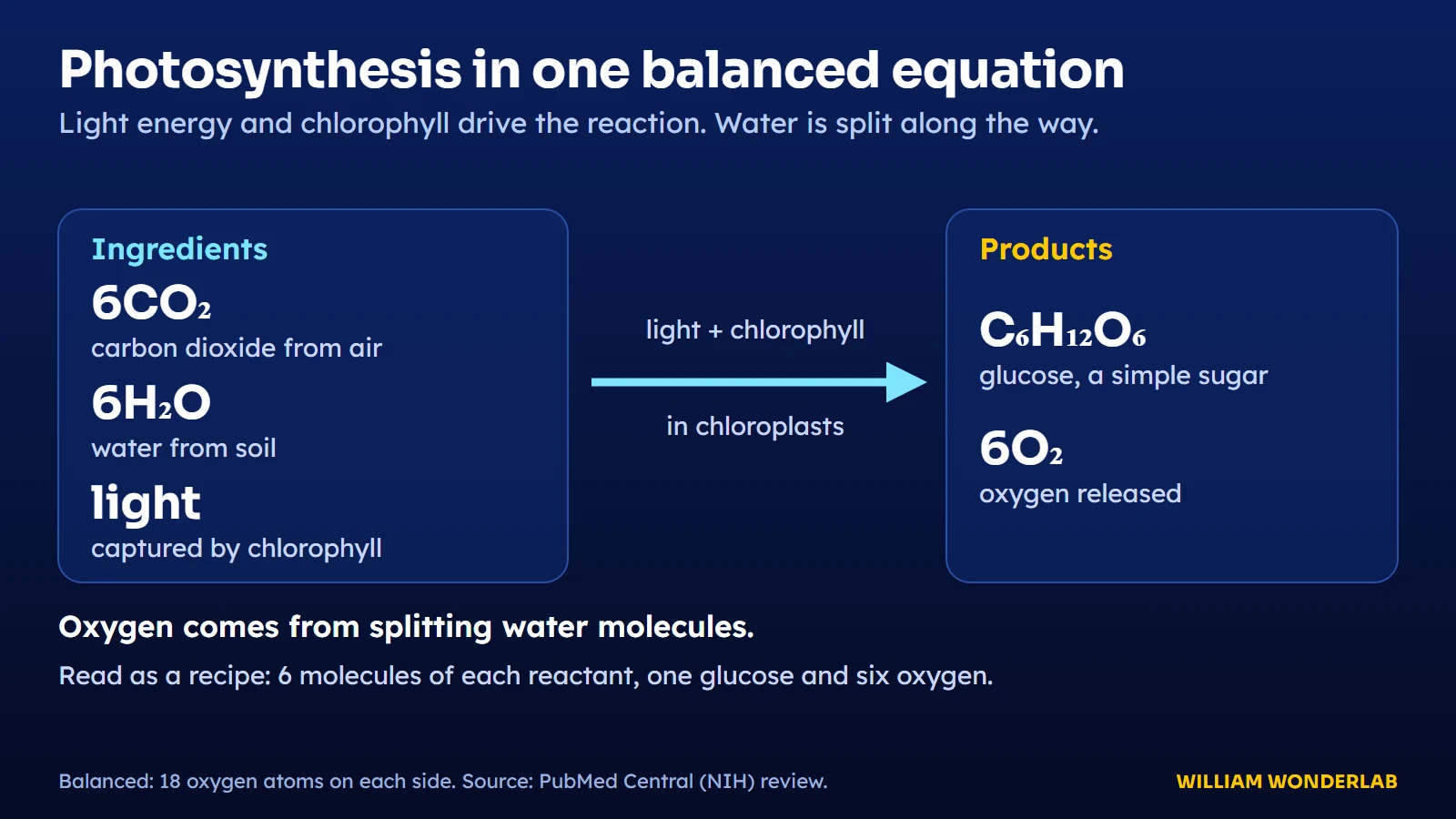
On the left are six molecules of carbon dioxide and six molecules of water. Light energy, captured by chlorophyll, drives the reaction. On the right are one molecule of glucose, a simple sugar, and six molecules of oxygen.
The plant takes up its water from the soil.[2] The water has a second job too. The oxygen released by the plant is produced when water molecules are split during the light-dependent part of the process.[2]
Chlorophyll catches the light
Chlorophyll is the green pigment that captures light energy. Both chlorophylls absorb light most strongly in the red and violet parts of the spectrum. When white light shines on a leaf, the green light is transmitted and reflected, so the leaf looks green.[3]
Chlorophyll is the pigment that gives leaves their green colour in spring and summer.[4] It works inside the chloroplast. The light-harvesting proteins in the thylakoid membranes bind chlorophylls, and they also bind three to four carotenoids.[2] Other pigments, called carotenoids, are usually masked by chlorophyll while the leaf is green.[3]
Two linked jobs inside the chloroplast
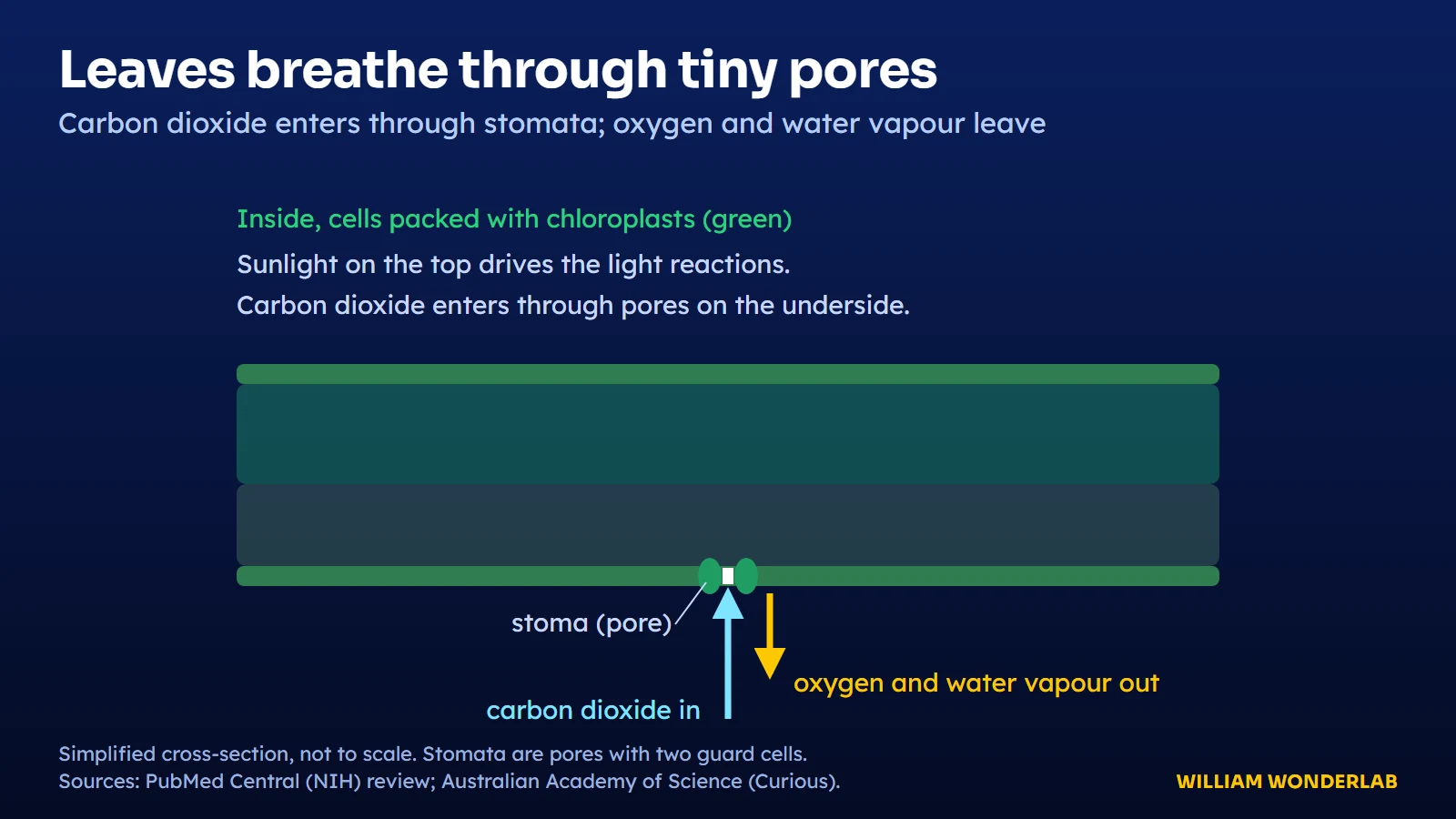
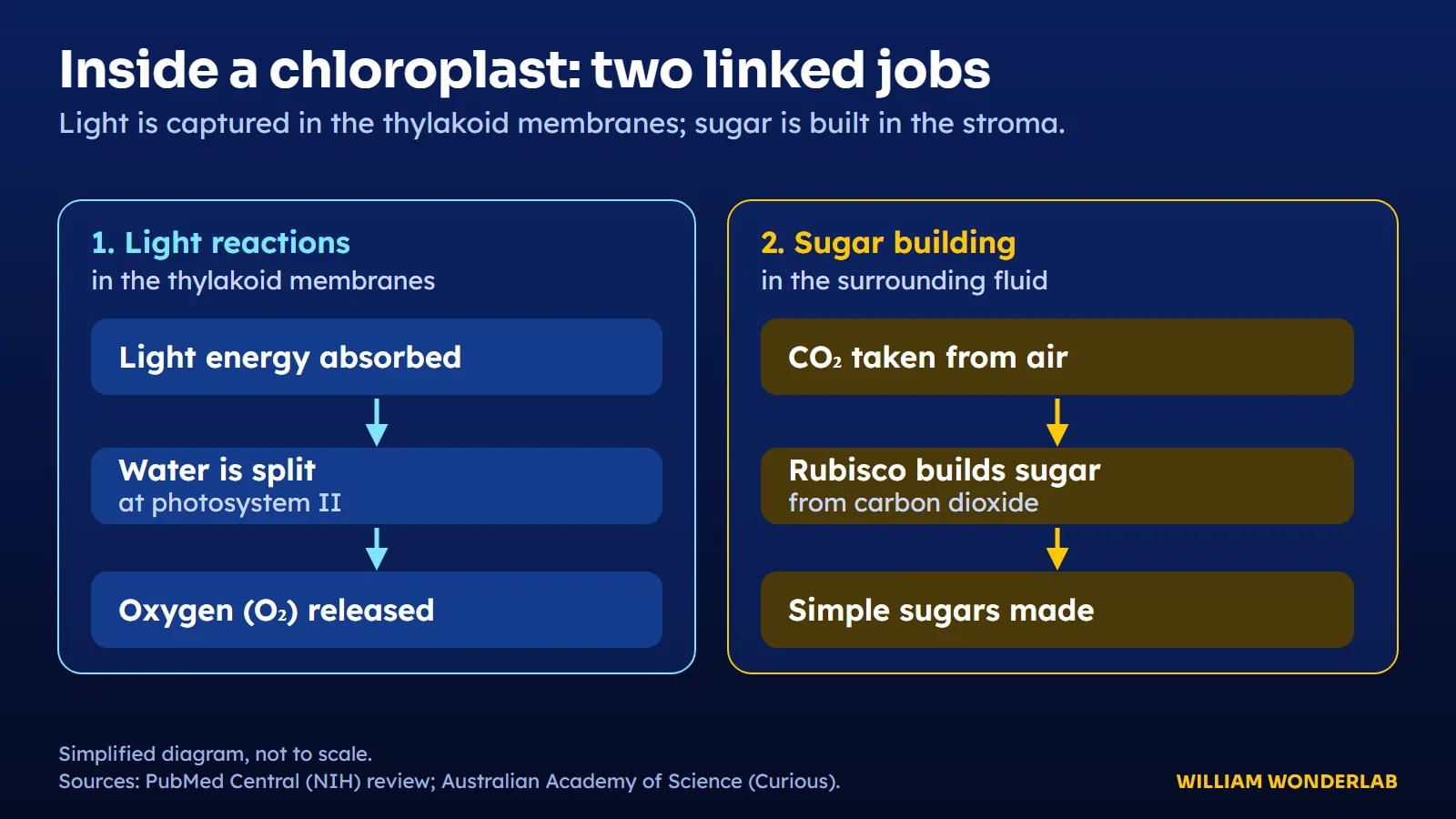
A chloroplast does two kinds of work, and they depend on each other. The first part happens in the thylakoid membranes, which are the light-capturing parts inside the chloroplast.[2]
In the light-dependent part, absorbed light energy splits water at a protein complex called the Oxygen-Evolving Complex in photosystem II. The water is split into protons and molecular oxygen.[2] This part also makes two energy carriers, ATP and NADPH. A research review describes them as “the NADPH and the ATP produced by photosynthetic electron transport”, which are “essential to drive the Calvin–Benson–Bassham cycle”.[2]
The second part uses carbon dioxide to build sugar, powered by the ATP and NADPH from the first part. An enzyme called rubisco pulls carbon dioxide from the atmosphere and converts it into simple sugars.[1]
Oxygen for the air
Plants release oxygen as a by-product, but they are not the only organisms doing this. Tiny ocean plants called phytoplankton also have chlorophyll to capture sunlight. They take in carbon dioxide and release oxygen.[5]
Did you know? Leaves and ocean phytoplankton use the same basic chemistry: chlorophyll captures light, carbon dioxide goes in, and oxygen comes out.[5]
Try it: compare sun and shade leaves
You need: a notebook, coloured pencils and a plant you have permission to observe, such as a houseplant or a plant in your own garden.
- Find two leaves on the same plant: one in direct sun and one in shade.
- Draw each leaf. Note its colour, its size, and whether it looks thick or thin.
- Look at the two leaves again after a few days. Did anything change?
- Write down one question you could test with a second plant.
What to expect: Leaves in sun and shade can look different. Record what you actually see. There is no fixed result to match.
Safety first: Wash your hands after touching plants and soil. Never put any part of a plant in your mouth, and do not touch plants you cannot identify. Ask permission before picking leaves in a park or someone else’s garden. Never look directly at the Sun. Keep your attention on the leaves, not the sky above them.
Go deeper: the chemistry in more detail
Counting the atoms
The balanced equation is 6CO₂ + 6H₂O → C₆H₁₂O₆ + 6O₂.[2] A balanced equation has the same number of each kind of atom on both sides. Count them to check.
On the left, six carbon dioxide molecules contain 6 carbon and 12 oxygen atoms, and six water molecules contain 12 hydrogen and 6 oxygen atoms. That is 6 carbon, 12 hydrogen and 18 oxygen atoms in total. On the right, one glucose molecule (C₆H₁₂O₆) contains 6 carbon, 12 hydrogen and 6 oxygen atoms, and six oxygen molecules add 12 more oxygen atoms. That is also 6 carbon, 12 hydrogen and 18 oxygen.
Light energy becomes stored energy
Photosynthesis changes energy from sunlight into organic compounds, which is how the plant stores that energy in chemical form.[1] The sugar that results is the product the plant keeps.
Frequently asked questions
Do plants need sunlight to make food?
Yes. The process uses light energy absorbed by the plant to split water and begin the chain of reactions that builds sugar.[2]
Where does a plant’s sugar come from?
Much of its carbon comes from carbon dioxide taken from the air. An enzyme called rubisco builds simple sugars from that carbon.[1]
Do plants release oxygen when they make food?
Yes. Oxygen is released when water is split during the light-dependent part of photosynthesis.[2] Ocean phytoplankton also take in carbon dioxide and release oxygen.[5]
Why are leaves green?
Chlorophyll absorbs red and violet light most strongly, so the green light is reflected and transmitted to your eyes.[3]
Do plants need water to make food?
Yes. Water is one of the three ingredients in the balanced equation, and the plant takes it up from the soil.[2]
The big idea
Sunlight in, sugar and oxygen out. Chlorophyll in chloroplasts captures light energy. The plant uses that energy to turn carbon dioxide and water into sugar, and it releases oxygen as a by-product.
Related reading
More from William Wonderlab:
Explore more from scientists:
- Growing food in a warming climate (Australian Academy of Science, Curious)
- What are Phytoplankton? (NASA Science)
- Here comes the sun: how optimization of photosynthetic light reactions can boost crop yields (PubMed Central)
References
[1] Australian Academy of Science, “Growing food in a warming climate” (Curious) (accessed 25 October 2026)
[2] PubMed Central (NIH), “Here comes the sun: How optimization of photosynthetic light reactions can boost crop yields” (accessed 25 October 2026)
[3] LibreTexts Biology (Kimball), “3.18: Chlorophylls and Carotenoids” (accessed 25 October 2026)
[4] NASA Earthdata, “Why Do Leaves Change Color?” (accessed 25 October 2026)
[5] NASA Science, “What are Phytoplankton?” (accessed 25 October 2026)
Keep exploring
Now try the science yourself
Reading is a great start. Experimenting is even better: these interactive models use the same science as this article.