Why Is Pluto Not a Planet?
Pluto was once counted as the ninth planet. In 2006 astronomers agreed on three tests for a planet, and Pluto fails the one about its orbit.

Pluto was once counted as the ninth planet of our solar system.[1] Then, in 2006, the rules changed and Pluto received a new label. So is Pluto still a planet, or did something happen to Pluto itself? The answer is mostly about how astronomers define a word, not about the ice and rock that make up Pluto.
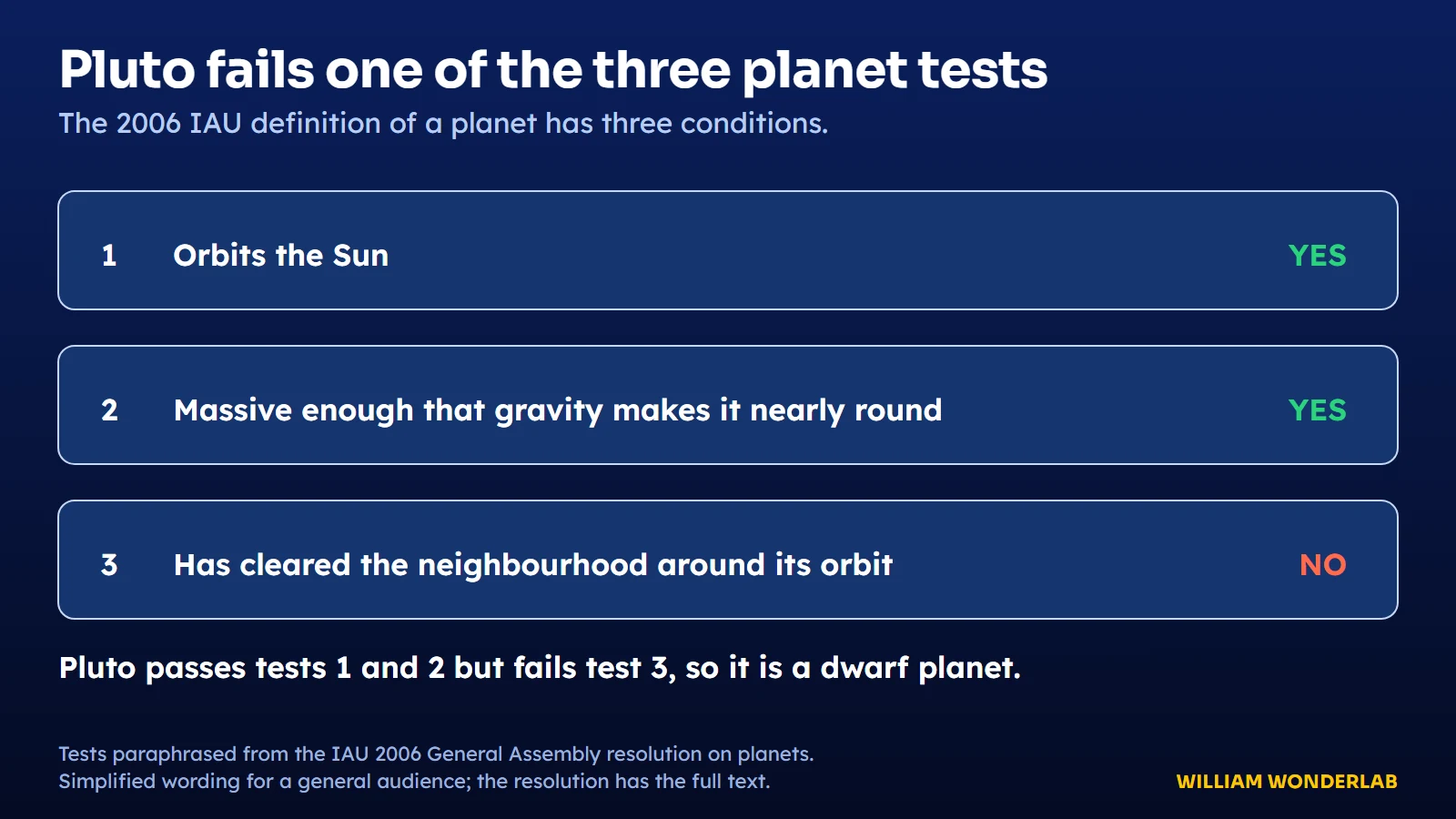
The short answer: Pluto is not classed as a planet because of the definition the International Astronomical Union (IAU) adopted in 2006. That definition has three tests. Pluto orbits the Sun and is nearly round, but it has not cleared the area around its orbit of other objects. So it is classed as a dwarf planet.[2]
What makes a planet?
In 2006 the IAU voted on a formal definition of a planet, with three conditions.[2] Each condition is a yes-or-no test:
- It orbits the Sun. Like a car circling a roundabout, a planet travels around the Sun.
- It is massive enough to be nearly round. Gravity pulls a large body into a nearly round shape. A small lump of rock can stay lumpy, like a chunk of potato.
- It has cleared the neighbourhood around its orbit. The IAU’s wording is that the body “has cleared the neighbourhood around its orbit.”[2] A simplified picture: the planet’s gravity has done most of the tidying up along its own path, so few other objects of similar size share that route.
The first two tests are about the object itself. The third is about what else is near it. That third test is where Pluto runs into trouble.
Pluto passes two tests and fails one
The same IAU resolution defines a second class, the dwarf planet. A dwarf planet orbits the Sun and is nearly round, but it has not cleared the neighbourhood around its orbit.[2] Pluto is classed as a dwarf planet because it fails the third test.
Science Australia’s Curious site calls this third test “the criterion that knocked Pluto from its planetary perch.”[3] Size is not one of the three tests. The question is about the path around the Sun, not about how big the object is.
The Kuiper Belt: Pluto’s crowded neighbourhood
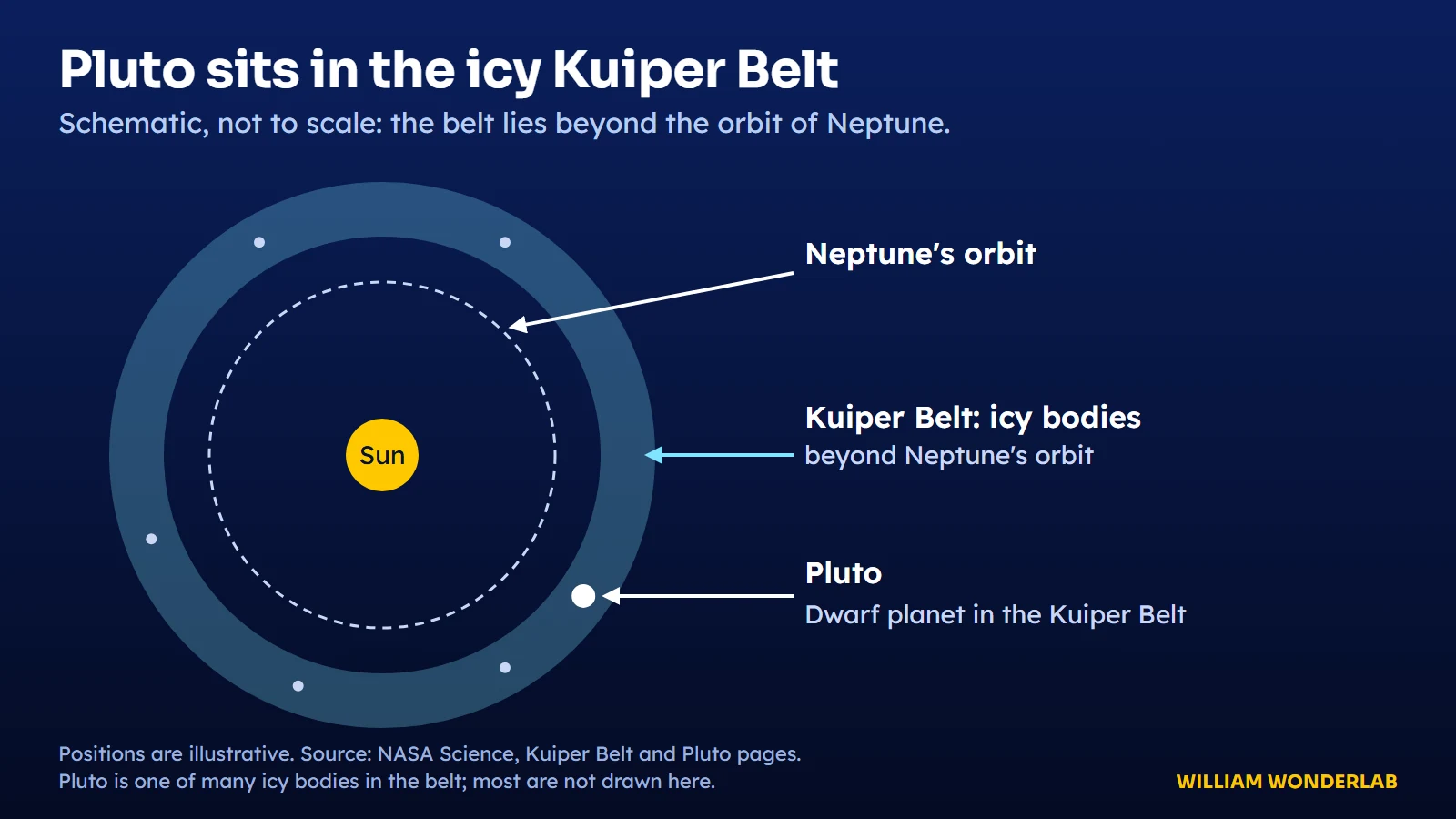
NASA describes Pluto as “a dwarf planet located in a distant region of our solar system beyond Neptune known as the Kuiper Belt.”[1] NASA also describes the Kuiper Belt as “a doughnut-shaped region of icy objects beyond the orbit of Neptune.”[4]

Curious adds that Pluto “shares its orbit with a lot of other small, icy bodies in the Kuiper Belt.”[3] Because many similar objects share that region, Pluto has not cleared its neighbourhood, so the third test is not met.
How big is Pluto?
NASA gives Pluto an equatorial diameter of about 2,377 kilometres, or about 1,477 miles.[5] It is also “about 1/5th the width of Earth.”[5] That makes Pluto small, but size is not the test that decided its label.
Did you know? NASA says Pluto is “about two-thirds the diameter of Earth’s Moon.”[5]
Did the decision change Pluto?
The 2006 decision changed the rules for the word “planet”. It did not change the object. Curious puts it this way: “Even though the debate around Pluto’s classification continues, Pluto is still Pluto.”[3]
This is a useful habit in science. A category is a human agreement that helps us organise what we know. When new discoveries arrive, the agreement can be revised.
Try it: sort objects with a simple test
This is a proposed at-home activity with everyday objects. It is a model of the idea of “clearing” a path, not a real measurement of a planet.
You need: a ball, a potato, a book, a tray, and about 20 small scraps of paper.
- Predict which object will roll most smoothly, and which one will push the most paper aside.
- Roll the ball, the potato and the book across a table. Note which ones roll straight and which wobble.
- Scatter the paper scraps across the tray. Push each object slowly across the tray and count how many scraps it pushes aside.
- Compare your predictions with what happened. Write one sentence about what this activity shows, and one sentence about what it does not show.
What to expect: The ball should roll most smoothly, and the potato should wobble. The scrap count is a simple picture of “clearing” a path. Astronomers use very different measurements for real planets.
Safety first: Use only large, safe household objects, and do not roll anything heavy off the edge of a table. Keep the paper scraps away from young children, because small pieces can be swallowed. Never use anything sharp or hot. Clean up the scraps when you finish so nobody slips on them.
Go deeper: definitions, cut-offs and arithmetic
Why a definition needs a cut-off
Any yes-or-no rule needs a boundary somewhere. The IAU asks whether a body has “cleared the neighbourhood around its orbit.”[2] How many other objects may share an orbit before the path no longer counts as cleared is a judgement, not a measurement. This is why Curious describes “the debate around Pluto’s classification” as continuing.[3]
Checking NASA’s size figures
NASA gives Pluto’s diameter as 1,477 miles and as 2,377 kilometres.[5] One mile is about 1.609 kilometres. So 1,477 × 1.609 ≈ 2,377 km, and the two figures agree. The same page’s comparison, “about two-thirds the diameter of Earth’s Moon,” is a comparison rather than a calculation, so the article quotes it without converting it.[5]
Frequently asked questions
Is Pluto a planet today?
Under the IAU’s 2006 definition, no. It is classed as a dwarf planet.[2]
Was Pluto demoted because it is small?
Size is not one of the three tests. The test that removed Pluto from the planets was the cleared-orbit test.[3]
Are there other dwarf planets?
Yes. NASA says the Kuiper Belt “is home to Pluto and most of the known dwarf planets and some comets.”[4]
Could the definition change again?
Yes. Definitions are agreed by people, and Curious notes that the debate around Pluto’s classification continues.[3]
The big idea
A label changed, not the object. The IAU’s tests ask whether a body orbits the Sun, is nearly round under its own gravity and has cleared its orbit. Pluto passes the first two and fails the third, because it shares its region with many icy bodies. Pluto is still Pluto.
Related reading
More from William Wonderlab:
Explore more from scientists:
- Pluto (NASA Science)
- Kuiper Belt (NASA Science)
- IAU 2006 General Assembly: Result of the IAU Resolution votes
References
[1] NASA Science, “Pluto” (accessed 26 October 2026)
[2] International Astronomical Union (IAU), “IAU 2006 General Assembly: Result of the IAU Resolution votes” (accessed 26 October 2026)
[3] Science Australia, Curious, “Pluto’s planetary predicament” (accessed 26 October 2026)
[4] NASA Science, “Kuiper Belt” (accessed 26 October 2026)
[5] NASA Science, “Pluto: Facts” (accessed 26 October 2026)