Why Does Salt Melt Ice?
Salt does not heat ice. It lowers the temperature at which salty water freezes, so ice can melt even when it is still below zero. Here is how that works.

Sprinkle salt on an icy footpath and, after a while, the ice turns to slush. It can look as though the salt is warming the ice up. It is not. The ice is still cold, and the salt is not burning. So what is really going on?
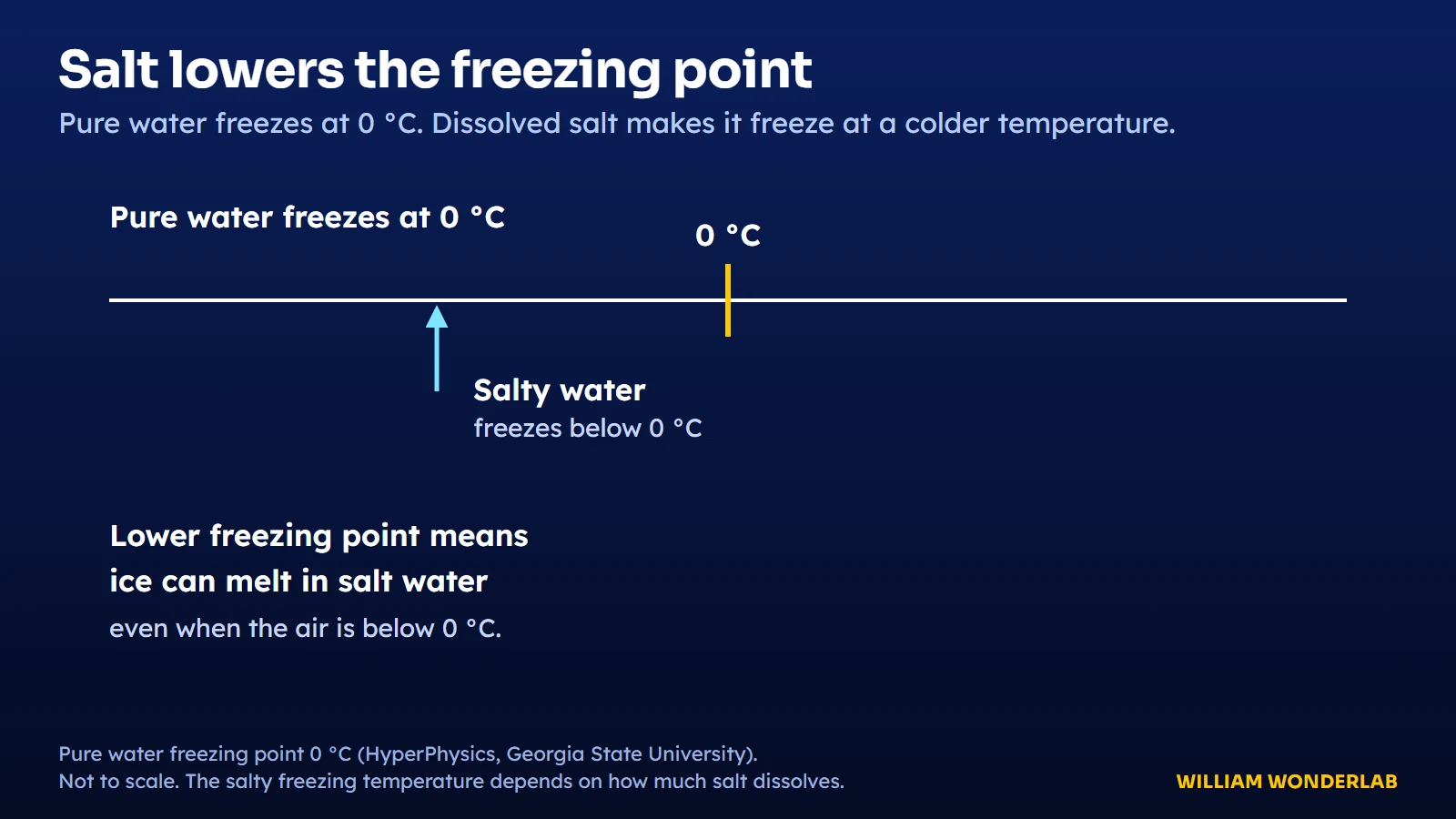
The short answer: Salt lowers the temperature at which water freezes. Pure water freezes at 0 °C, but salt dissolved in water needs a lower temperature before it freezes. So ice can melt into salty water even when the air is below 0 °C.[1][2]
Start with what freezing means
Freezing is what happens when a liquid cools until its molecules slow down and lock into a fixed pattern. In ice, water molecules sit in an ordered crystal. Melting is the reverse: the molecules gain enough energy to break out of that pattern and move freely as a liquid.
Pure water freezes at 0 °C. HyperPhysics, a physics resource from Georgia State University, states that “The freezing point of pure water is 0°C.”[1] Below that temperature, pure water freezes. Above it, ice melts.
Salt changes that rule.
Dissolved salt lowers the freezing point
When salt dissolves, it breaks apart. Table salt, sodium chloride, separates into sodium ions and chloride ions that spread out through the water. These particles get in the way of the water molecules that would otherwise join the ice pattern. A Lumen Learning chemistry chapter describes it this way: “By dissolving a solute into the liquid solvent, this ordering process is disrupted.” As a result, “more energy must be removed from the solution in order to freeze it.”[2]
Chemists call this freezing point depression. The word “depression” means the freezing point goes down. A chemistry lab guide describes freezing point depression as a colligative property, which “depends only on the amount of particles dissolved, no matter which substance you use.”[4]
Think of a crowded doorway. If many people are pushing through, a single person takes longer to get out. The dissolved particles are the crowd, and the water molecules are the people trying to reach the ice pattern.
Why ice can melt into salt water
Salt needs a liquid to dissolve in. Lumen Learning says the solute dissolves “into the liquid solvent,” so there has to be some liquid water for the salt to work in.[2] Salt sprinkled on ice dissolves in the water that is already on the ice, or in the meltwater that forms as the salt starts to work.
That salty solution needs a lower temperature before it freezes. So the ice in contact with it can melt, even though the surrounding air is still below 0 °C. The University of Washington chemistry demonstration page notes this practical result: “Ice on frozen sidewalks and roads will melt if salt is sprinkled on top.”[3]
The melted ice mixes into the salty water, which makes the solution more dilute. The process keeps going while there is salt and ice to react.
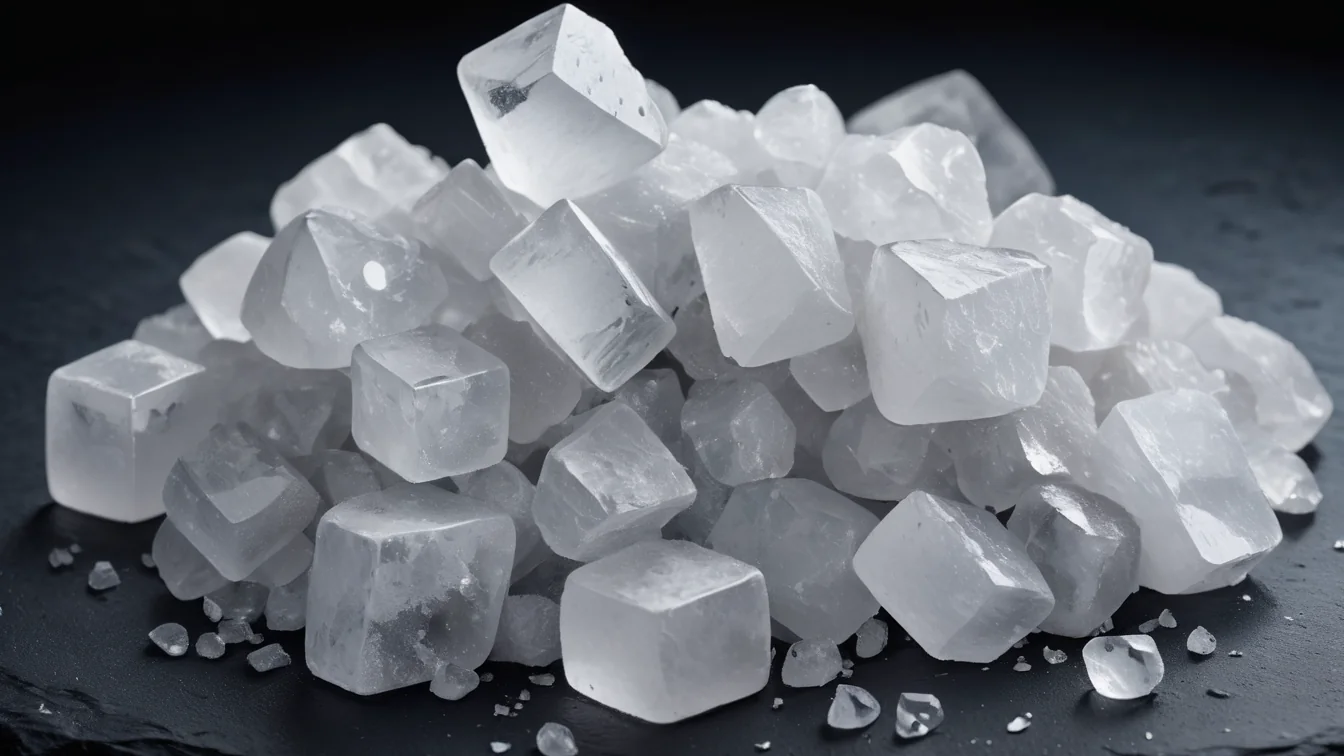
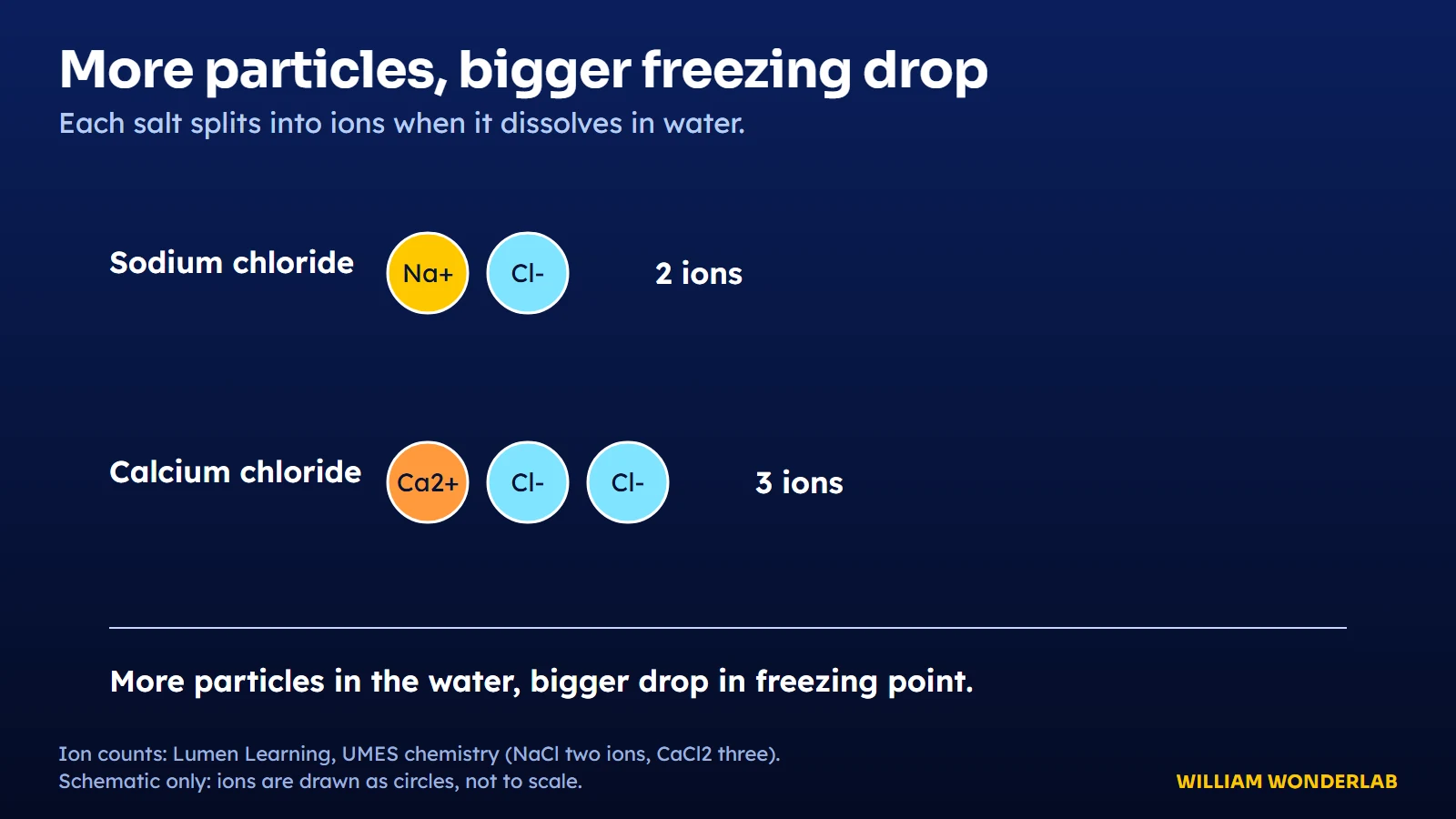
Did you know? Sodium chloride gives two ions when it dissolves. Calcium chloride gives three. For the same number of moles (the same amount of substance), calcium chloride gives three particles per formula unit and sodium chloride gives two, so calcium chloride lowers the freezing point more strongly.[2]
Why some salts work better
The number of particles matters. Lumen Learning explains that sodium chloride is the least expensive option for icy roads, but it is less effective than calcium chloride or magnesium chloride. The reason is that sodium chloride “only dissociates into two ions instead of three.”[2]
The diagram below shows the counting. More particles dissolved in the same amount of water means a bigger drop in the freezing point.
A kitchen test: salt, ice and a thermometer
You can see the effect with a simple test. The University of Wisconsin chemistry demonstration describes the same idea in a classroom setting: “Salt is added to an ice-water mixture and the temperature of the mix decreases.”[5]
The diagram below shows the freezing points on a simple scale. It is drawn to show the idea, not to a measured scale.
Try it: the salt and ice thermometer test
This is a proposed at-home activity. Nothing in it needs heat, but an adult should be nearby.
You need: a zip-lock bag, a handful of ice cubes, about two tablespoons of table salt, a cup of cold water, a bowl, a kitchen thermometer that reads below 0 °C (many kitchen probes do not, so check the range first), and a tea towel.
- Put the ice cubes and the cold water in the bowl. Place the thermometer in the middle and wait one minute. Record the temperature.
- Predict what will happen to the temperature when salt is added.
- Sprinkle the salt over the ice, stir gently and wait two minutes. Record the temperature again.
- Compare your two readings. Did the temperature drop? Did the ice start to melt faster?
What to expect: the mixture with salt should read lower than the mixture without it, because the salt lowers the freezing point of the water. Salt that does not dissolve stays in the bottom of the bowl.
Safety first: This is a cold activity. Never heat the salt, the ice or the water. Use table salt only, and do not taste, drink or eat the mixture. Keep it away from eyes, and wash your hands after handling the salt. If salt gets in an eye, rinse it with clean water for several minutes and ask an adult for help. Wrap the ice in the tea towel so you do not hold bare ice for long, because very cold ice can hurt the skin. An adult should handle the freezer and the thermometer. Younger scientists should do this with a grown-up.
Go deeper: particles, not identity
What the drop is measured against
Freezing point depression is the difference between the freezing point of the pure solvent and the freezing point of the solution. A chemistry lab guide describes this as “the difference in temperature between the freezing point of the pure solvent and that of the solution.”[4] For water, the pure solvent starts at 0 °C, so any salty solution sits below that line.
Why salt stops working in very cold weather
A solution has its own freezing point, which is lower than 0 °C. If the air is colder than that point, the salty water freezes too, and it can no longer melt the ice. The same logic that makes salt useful also sets its limit.
Why the chemistry matters for the ice
Adding a solute disrupts the pattern that water molecules need to form ice. The more particles there are, the harder it is for the ice pattern to form, so the freezing point falls. The effect is about the count of particles, which is why different salts can have different strengths.[2][4]
Frequently asked questions
Does salt make ice hotter?
No. Salt does not add heat to ice. It lowers the temperature at which salty water freezes, so ice can melt below 0 °C.[1][2]
Why does salt work on icy roads?
Salt dissolves in the liquid water on the road, and the salty solution needs a lower temperature to freeze. The ice can melt into that solution.[2][3]
Why does calcium chloride work better than table salt?
Lumen Learning gives the ion count as one reason. Calcium chloride breaks into three ions, while sodium chloride breaks into two, and more dissolved particles give a bigger drop in the freezing point.[2]
Does salt stop working in very cold weather?
Yes. A salty solution has its own freezing point, so once the air is colder than that, the solution freezes and the salt cannot melt the ice.[1]
Is this the same as why ice floats?
No. Ice floats because it is less dense than liquid water. Salt melts ice because it changes the freezing point. You can read more in Why Does Ice Float?.
The big idea
Salt changes the freezing point. Dissolved salt gets between water molecules and makes freezing harder. The ice melts into the salty water at a temperature below 0 °C, without any heat being added.
Related reading
More from William Wonderlab:
Explore more from scientists:
- Freezing Point Depression in Solutions (HyperPhysics, Georgia State University)
- Freezing Point Depression (Lumen Learning, UMES Chemistry)
- Freezing Point Depression demonstration (University of Washington Chemistry)
References
[1] HyperPhysics, Georgia State University, “Freezing Point Depression in Solutions” (accessed 25 October 2026)
[2] Lumen Learning (University of Maryland Eastern Shore chemistry course), “Freezing Point Depression” (accessed 25 October 2026)
[3] University of Washington Chemistry, “Freezing Point Depression” lecture demonstration (accessed 25 October 2026)
[4] Westfield State University, “2.2: Freezing Point Depression”, LibreTexts General Chemistry Lab (accessed 25 October 2026)
[5] University of Wisconsin-Madison Chemistry, “Getting Colder: Freezing-Point Depression” demonstration (accessed 25 October 2026)