How Do Fish Breathe Underwater?
Fish take oxygen from water through their gills. Water holds much less oxygen than air, so the gill design has to work very hard.
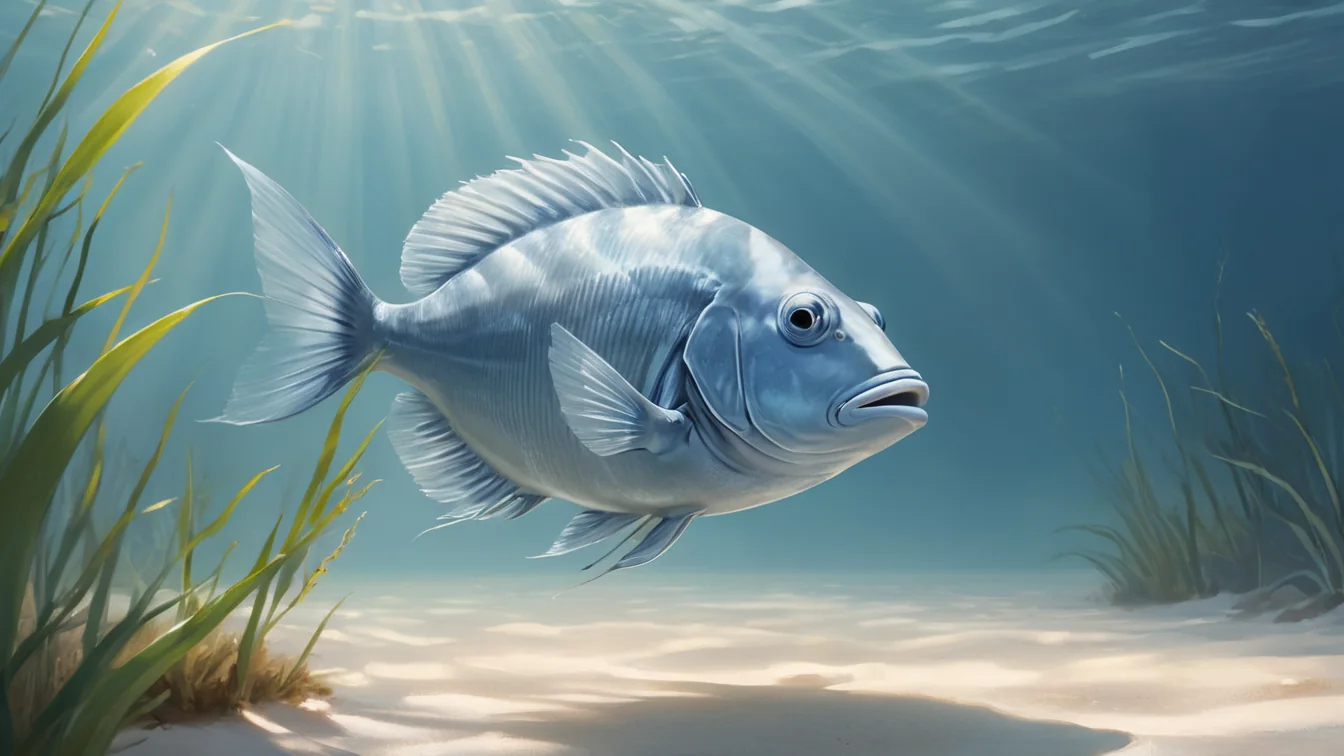
Watch a fish in a tank and you will see its mouth open and close, and the flaps on the side of its head move in and out. It looks as if the fish is drinking the water. In a sense it is, but the water is not being swallowed for its oxygen. The oxygen is taken out of the water as the water passes over special organs called gills. So how does a fish take a breath when it is always surrounded by water?
The short answer: Fish take oxygen that is dissolved in water through their gills. Water holds far less oxygen than air, so fish need a steady flow of fresh water across their gills. Inside the gills, blood flows in the opposite direction to the water, which keeps oxygen moving into the blood along the whole gill.[1][2]
What “dissolved” oxygen means
Oxygen gas can mix into water, the way sugar mixes into a cup of tea and disappears from view. This is called dissolved oxygen. The US Geological Survey (USGS) describes it this way: “A small amount of oxygen, up to about ten molecules of oxygen per million of water, is actually dissolved in water.”[1]
That tiny amount is enough for aquatic life. The USGS says that “this dissolved oxygen is breathed by fish and zooplankton and is needed by them to survive.”[1] Zooplankton are tiny animals that drift through the water, and they need oxygen too.
Why water is a tough place to get oxygen
Water is a difficult place to get oxygen for three reasons. Oxygen spreads through water slowly, it dissolves in water less readily, and water is harder to move than air. A lecture from Millersville University lists these problems: “slow rate of diffusion of O2 in water,” “lower O2 solubility in water,” and “more work required to move water.”[2] The lecture adds that “water is much harder to move than air, so this requires an output of energy.”[2]
Diffusion is the slow spreading of molecules from where there are more of them to where there are fewer. Solubility is how much of a gas can dissolve in a liquid. So a fish has less oxygen to work with, and has to move a lot of water to get it.
Inside a gill
Gills are the organs that let fish take oxygen from the water around them. The Hawai’i Department of Land and Natural Resources puts it simply: “Gills allow fish to take in oxygen from the surrounding water and eliminate carbon dioxide from the blood.”[3] Carbon dioxide is the waste gas that leaves the blood on the way out.
Each gill is made of many thin filaments. Water flows across them, and the thin surfaces of the filaments are where oxygen passes from the water into the blood. The same source describes the design this way: “The filaments are designed so that water flows in one direction alongside them, while inside the filaments blood flows in the opposite direction.”[3]
Why the blood flows the opposite way
Fish gills use a trick called countercurrent exchange, which means two flows moving in opposite directions. The University of Hawai’i at Mānoa explains that “the blood vessels in the gills used for gas exchange also run on a countercurrent system,” creating “a gradient that maximizes oxygen uptake.”[4] A gradient is a difference in concentration, and here it means the water always holds more oxygen than the blood it is passing.
Millersville University’s lecture puts the logic clearly: “By moving the blood in the opposite direction, the blood always has a lower concentration of O2 than the water.”[2] As blood picks up oxygen, it moves towards water that is still fresher, so oxygen keeps flowing in along the whole length of the gill.
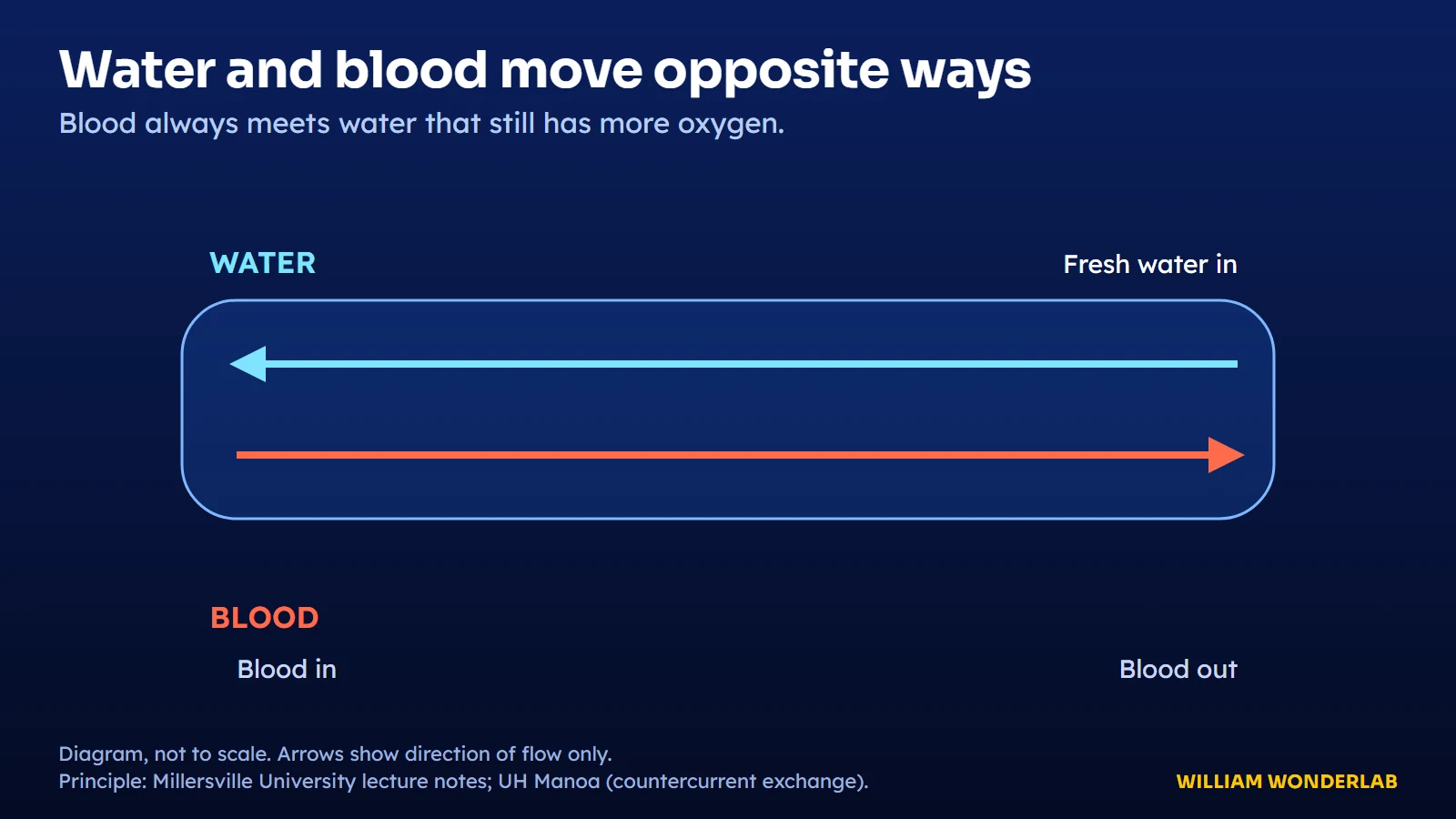
Think of two lanes of traffic passing each other. If the water and blood were moving in the same direction, they would tend to reach the same level early and then stop exchanging oxygen. Moving in opposite directions keeps the difference going.
How good is the system?
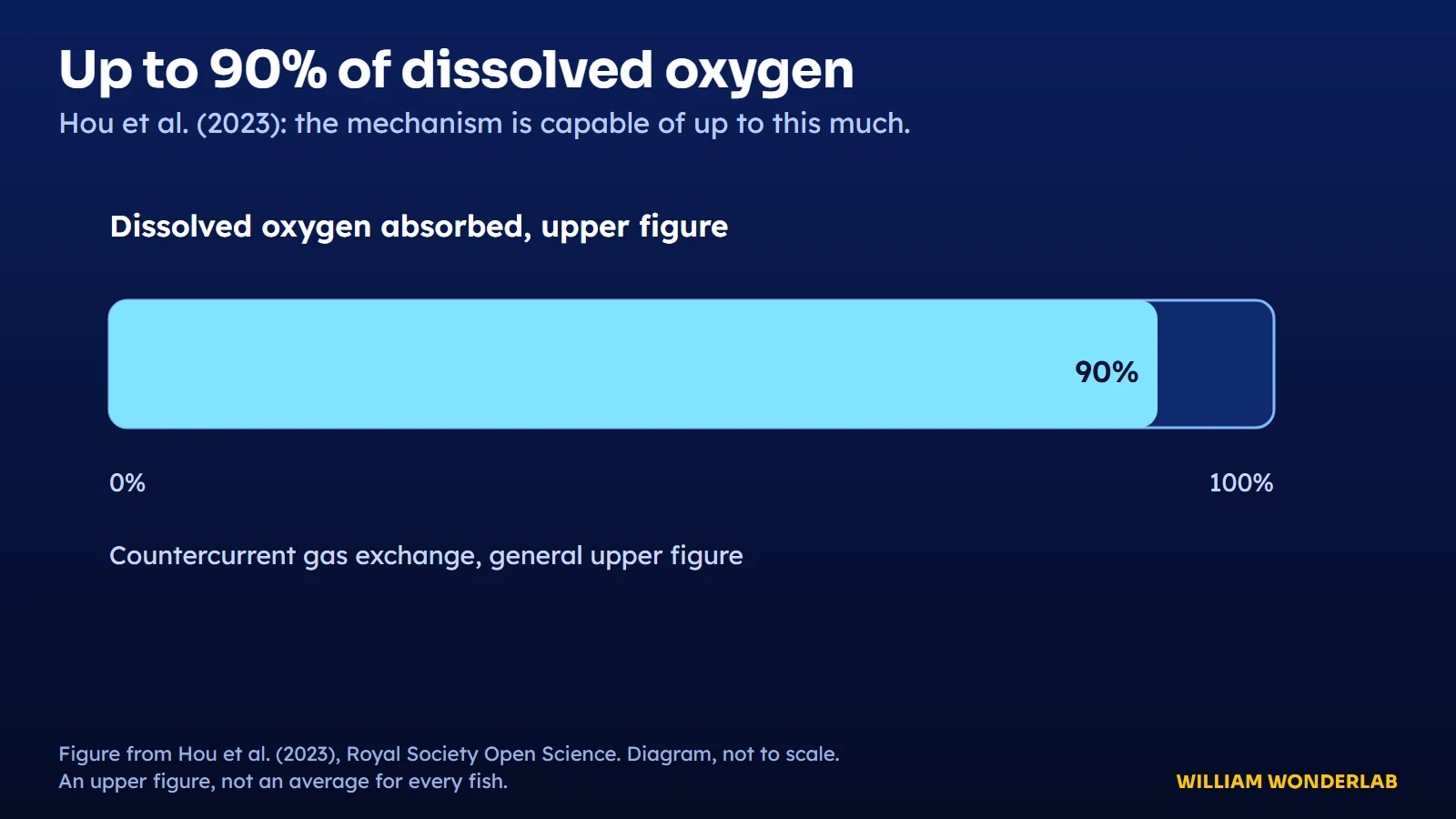
A 2023 study of an ancient sea creature called a trilobite (Triarthrus eatoni), published in Royal Society Open Science, describes how good this kind of system can be. Hou and colleagues write that the countercurrent gaseous exchange mechanism is “capable of absorbing up to 90% of dissolved oxygen.”[5]
The paper’s main subject is a trilobite, an ancient sea creature that was an early arthropod, so this is the authors’ general statement about the mechanism, and “up to” marks an upper figure. It is not an average for every fish.
Did you know? Cold water can hold more dissolved oxygen than warm water. The USGS also notes that in summer and fall, when water is warm, “the dissolved-oxygen concentration is often lower.”[1]
Try it: count the gill movements
You need: a fish tank at home or a public aquarium, a watch or timer, and a notebook.
- Stand back from the glass, or stand at a quiet part of a pond edge. Do not tap the glass.
- Pick one fish that is calm and resting in the water.
- Count how many times its gill cover on one side opens and closes in one minute. Write the number down.
- Repeat with a different fish, or with the same fish after it has been swimming. Compare your counts.
- Write down what you noticed. Did the gill covers move faster or slower when the fish was active?
What to expect: The gill covers open and close in a steady rhythm. The count will vary from fish to fish, so compare several counts rather than trusting one.
Safety first: This is an observation, so keep your hands out of the tank or pond, and wash your hands with soap afterwards. Do not tap or press on the glass, and do not feed the fish during the count. Keep a grown-up with you if you are at a pond or a river edge, and stay well back from the water’s edge. Never swallow pond or tank water.
Go deeper: why the design works
Gradients and efficiency
A gas moves along a gradient, from a place where it is more concentrated to a place where it is less concentrated. In the gill, the water starts with plenty of oxygen, and the blood starts with less. The countercurrent arrangement keeps that difference across the whole gill, which is why the University of Hawai’i describes it as maximising uptake.[4]
Why efficiency varies
Hou and colleagues also compare modern fish with modern crabs. They report a “lower efficiency of countercurrent gaseous exchange in modern crabs compared with that of modern fish,” and they link efficiency to the diffusion barrier, the layer oxygen must cross, which has properties such as cuticle thickness and density.[5] This is a good reminder that the design is only part of the story; the materials matter too.
Frequently asked questions
Do fish drink water to get oxygen?
Fish take in water through their mouths, but the oxygen is taken from it at the gills. The gills take in oxygen from the water flowing past, and they also release carbon dioxide from the blood.[3]
Can fish run out of oxygen?
Yes, if the dissolved oxygen falls too low. The USGS notes that dissolved oxygen is needed by fish and other aquatic life to survive, and that it is measured to assess the health of lakes and streams.[1]
Is the oxygen level the same in every water?
No. Cold water can hold more dissolved oxygen than warm water, so the amount varies with temperature.[1]
Are all fish gills equally efficient?
No. Efficiency differs between animals. Hou and colleagues report that modern crabs are less efficient than modern fish at countercurrent gas exchange.[5]
Why does the blood flow the opposite way from the water?
Because the difference in oxygen concentration is then kept along the whole gill. If the flows matched, the blood would reach a balance with the water sooner, and less oxygen would move in.[2][4]
The big idea
Water is a tough place to find oxygen, so fish make the most of it. Gills take dissolved oxygen out of water as it flows past. Blood moves in the opposite direction, so it always meets water that still has more oxygen, and oxygen keeps moving in.
Related reading
More from William Wonderlab:
Explore more from scientists:
- Dissolved Oxygen and Water (US Geological Survey, Water Science School)
- Gill function in an early arthropod and the widespread adoption of the countercurrent exchange mechanism (Royal Society Open Science, 2023)
- Compare-Contrast-Connect: Warm-bodied and Hot-headed Fish (University of Hawai’i at Mānoa)
References
[1] US Geological Survey (USGS), Water Science School, “Dissolved Oxygen and Water” (accessed 25 October 2026)
[2] Millersville University, “Lecture 20: Gas exchange I” (Bio 220 course notes) (accessed 25 October 2026)
[3] State of Hawai’i, Department of Land and Natural Resources, Division of Aquatic Resources, “Gills & Respiration” (Hawai’i Sharks) (accessed 25 October 2026)
[4] University of Hawai’i at Mānoa, Exploring Our Fluid Earth, “Compare-Contrast-Connect: Warm-bodied and Hot-headed Fish” (accessed 25 October 2026)
[5] Hou, J.-B., Hughes, N. C., Hopkins, M. J. and Shu, D., “Gill function in an early arthropod and the widespread adoption of the countercurrent exchange mechanism”, Royal Society Open Science 10(8) (2023) (accessed 25 October 2026)