Why Is the Ocean Salty?
Rivers are fresh, yet the sea is salty. Rain, rivers and rocks on land deliver the salt, and seawater keeps it because the water evaporates and returns as rain.
Dip a finger into the sea and you will taste it straight away. Now think about a river. Rivers are fresh, so the water that runs into the sea has very little salt in it. So where does all the salt in the ocean come from?
The short answer: The ocean is salty because rain has been wearing down rocks on land for a very long time. The rain carries dissolved salts and minerals through streams and rivers to the sea, and seafloor vents add more. Seawater is about 3.5 per cent dissolved salt by weight.[1][2][3]
Rain wears down the land
Salt in the ocean comes from rocks on land.[2] Rain does not just fall on the ground. It slowly breaks the rock apart. The USGS describes it this way: “The rain physically erodes the rock and the acids chemically break down the rocks.”[2]
Rainwater is slightly acidic because it picks up carbon dioxide from the air. WHOI explains that this slightly acidic water also dissolves rock: “When rain falls onto rock, the acid dissolves tiny bits of salts and minerals.”[3]
When a salt dissolves, its ions separate and spread through the water.[4] An ion is a single atom, or a small group of atoms, that carries an electric charge. You cannot see ions, just as you cannot see the grains of sugar after you stir it into tea. They are still there, spread through the water.
The USGS says the ions are then carried away: “The ions in the runoff are carried to the streams and rivers and then to the ocean.”[2]
Rivers deliver the salt
Every river and stream carries a small load of dissolved salts. NOAA explains that the ocean ends up with all of it: “the water in the ocean collects all of the salt and minerals from all of the rivers that flow into it.”[1]
NOAA also estimates how much arrives each year. Rivers worldwide carry an estimated “four billion tons of dissolved salts to the ocean annually.”[1] The number is large, but the sea is so vast that the amount in each drop is tiny.
Rivers themselves stay fresh because of the rain. NOAA says: “Rain replenishes freshwater in rivers and streams, so they don’t taste salty.”[1] Fresh water keeps flowing through the river and out to sea, so the salt never builds up in the river itself. The ocean is the place where it collects.
Did you know? NOAA says the early seas were “probably only slightly salty”. The ocean has become saltier over a very long time, as rain wore down the land and carried minerals to the sea.[1]
Seafloor vents add more
Rain and rivers are not the only source. WHOI reports that “More salts and minerals are added from seafloor vents.”[3]
Cracks in the seafloor let seawater seep down into hot rock. The water is heated underground, and WHOI explains that “Hot water dissolves salts and minerals from the rock.” The heat comes from magma, which is molten rock beneath the Earth’s crust.[3] When the hot water rises back out through the vents, it carries those minerals into the sea.
Why the salt stays in the sea
Water in the sea keeps evaporating. The sun turns the surface water into vapour, but the salt does not evaporate with it. NASA’s salinity pages say that evaporation of ocean water increases the ocean’s salinity.[5] Only the water leaves, so the dissolved salts are left in less water. The vapour rises into the sky, falls as rain and returns to the land and the sea again.
NOAA’s Climate.gov explains the other side of the cycle: where more rain or snow falls over the ocean, it dilutes the salts in the seawater there.[6]
WHOI makes the same point with a lake: “As water evaporates from these land-locked bodies of water, salts are left behind.”[3] An inland lake with no outlet becomes saltier over time for this reason. The open ocean is not land-locked, but evaporation still matters there. NASA notes that ocean regions dominated by evaporation have higher salinities, while areas with high precipitation have lower salinities.[5]
How salty is seawater?
The USGS gives the figures plainly. “About 3.5% of the weight of seawater comes from the dissolved salts.”[2] In its Water Science School, the USGS also says that ocean water “contains about 35,000 ppm of salt.”[7] Parts per million (ppm) is another way to write the same amount, since 35,000 ppm is 35 parts of salt per 1,000 parts of seawater.
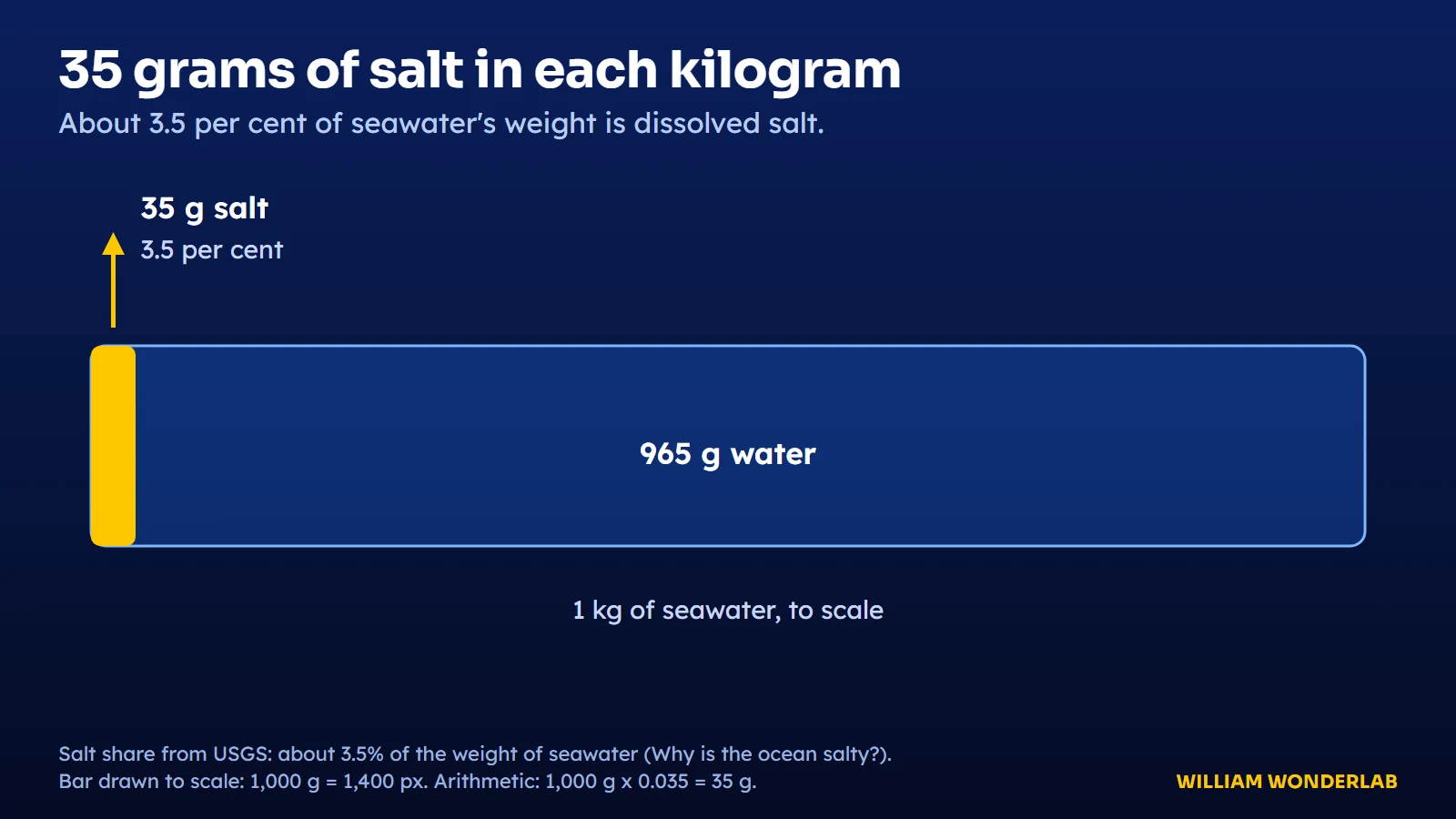
The arithmetic is simple. Take 1,000 grams of seawater, which is one kilogram. At 3.5 per cent, the salt is 1,000 g × 0.035 = 35 g. The rest, 965 g, is water. The diagram above shows that proportion to scale.
How the salt gets to the sea
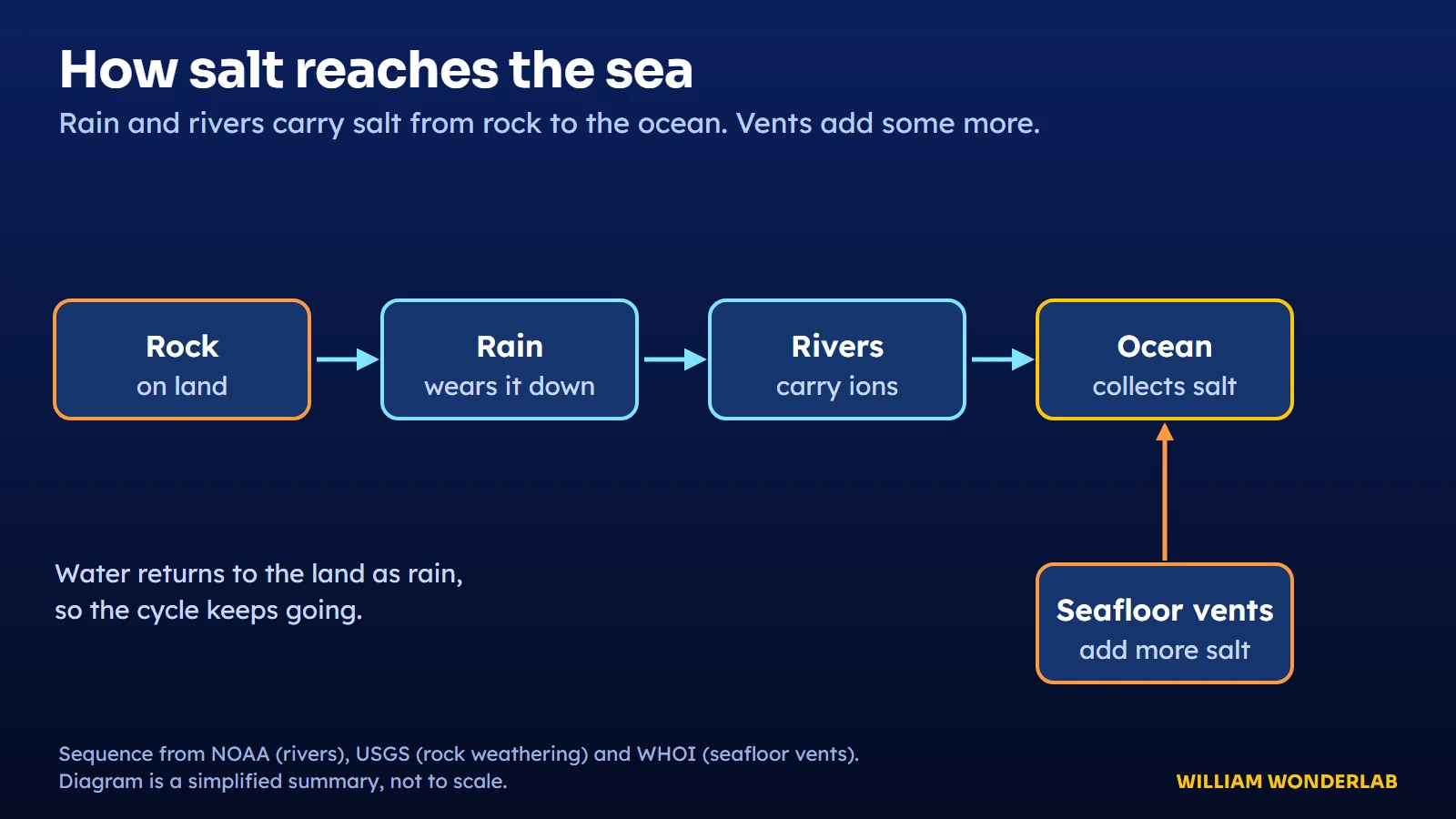
Put the pieces together and the story runs in a loop. Rain breaks down rock on land. Ions move into streams and rivers. Rivers carry them to the sea. Seafloor vents add more. Water leaves the ocean as vapour and falls back as rain.
Try it: where does the salt go?
This is a proposed at-home activity. It shows what happens to salt when water evaporates. It takes several days.
You need: a shallow dish, a cup of tap water, one teaspoon of table salt, a spoon, and a sunny windowsill.
- Predict what will happen to the salt when the water disappears.
- Stir the salt into the water until it dissolves. You should not see the salt grains any more.
- Pour the water into the dish and leave it in a sunny spot where nobody will touch it.
- Check it each day. Write down what you see. Once the water has gone, look closely at the dish.
What to expect: The water evaporates and white crystals of salt are left behind on the dish. This is the same process that leaves salt behind in shallow, land-locked water.[3]
Safety first: Do not taste the salty water, and do not use the dish for food afterwards. Keep the dish out of reach of pets and small children, and wipe up any spills. An adult should choose the spot and help you check the dish, especially if it is near a window or a heater.
Go deeper: ions, charge and the water cycle
Why dissolved salts stay in the water
When salt dissolves, water molecules gather around each ion. Positive ions and negative ions are each surrounded by water, which weakens the pull between them. Each ion can then move independently, and the salt is spread through the water.[4] That is why the dissolved salt stays spread through the ocean instead of settling back into a solid.
Checking the salt figure yourself
Use the USGS number to work out how much salt is in a known amount of seawater. A 500-gram bottle of seawater at 3.5 per cent holds 500 g × 0.035 = 17.5 g of dissolved salt, and the rest is water. Each step uses only the percentage, so you can test the idea with any amount you like.[2]
Frequently asked questions
Is river water salty too?
No. Rain keeps rivers and streams supplied with fresh water, so they do not taste salty.[1] The dissolved salts they carry keep flowing on to the sea.
Where does the salt in the ocean come from?
Most of it comes from rocks on land, which rain slowly breaks down. Rivers carry the dissolved salts to the sea. Seafloor vents also add salts and minerals.[2][3]
Did the ocean always have this much salt?
No. NOAA says the early seas were “probably only slightly salty”, and the ocean became saltier as rain carried minerals from the land.[1]
How much salt is in seawater?
About 3.5 per cent of seawater’s weight is dissolved salt. That is about 35 grams in each kilogram.[2][7]
Does seawater evaporate and leave its salt behind?
Yes. Evaporation takes away fresh water and leaves the dissolved salts in the sea. NASA notes that evaporation increases ocean salinity, and the water returns as rain, so the cycle continues.[5][6]
The big idea
Rain and rivers deliver it; the sea keeps it. The ocean is salty because rain wears down rocks, rivers carry the dissolved salts to the sea, and seafloor vents add more. The water leaves as vapour, but the salt stays behind.
Related reading
More from William Wonderlab:
Explore more from scientists:
- Why aren’t rivers salty? (NOAA Ocean Service)
- Why is the ocean salty? (USGS)
- What makes the ocean salty? (Woods Hole Oceanographic Institution)
Related on this site: Why Does Ice Float? explains another everyday property of water.
References
[1] NOAA Ocean Service, “Why is the ocean salty, but rivers flowing into it are not?” (accessed 25 October 2026)
[2] US Geological Survey (USGS), “Why is the ocean salty?” (accessed 25 October 2026)
[3] Woods Hole Oceanographic Institution (WHOI), “What makes the ocean salty?” (accessed 25 October 2026)
[4] Segar, D. A., “5.3: The Dissolving Power of Water”, Introduction to Ocean Sciences (LibreTexts, Geosciences) (accessed 25 October 2026)
[5] NASA Salinity, “Science Overview” (accessed 25 October 2026)
[6] NOAA Climate.gov, “Ocean Saltiness Provides Clues to Precipitation Patterns” (accessed 25 October 2026)
[7] US Geological Survey (USGS), Water Science School, “Saline Water and Salinity” (accessed 25 October 2026)