What Is a Black Hole?
A black hole is a region of space where matter is packed so tightly that nothing, not even light, can escape. Here is how they form and what telescopes have revealed.
Black holes sound like something from a science-fiction film, but they are real. They are among the strangest objects in the universe, and scientists have studied them for decades. Here is what they are, how they form, and what the first image of one really shows.
The short answer: A black hole is a region of space where matter is packed into a tiny space and gravity is so strong that nothing, not even light, can escape. NASA describes black holes as “huge concentrations of matter packed into very tiny spaces.”[1]
Matter packed into a tiny space
Gravity is the pull that every object with mass exerts on every other object. You feel it every day, because Earth pulls you towards the ground. A black hole is what happens when so much matter is squeezed into a small space that its gravity becomes extremely strong.
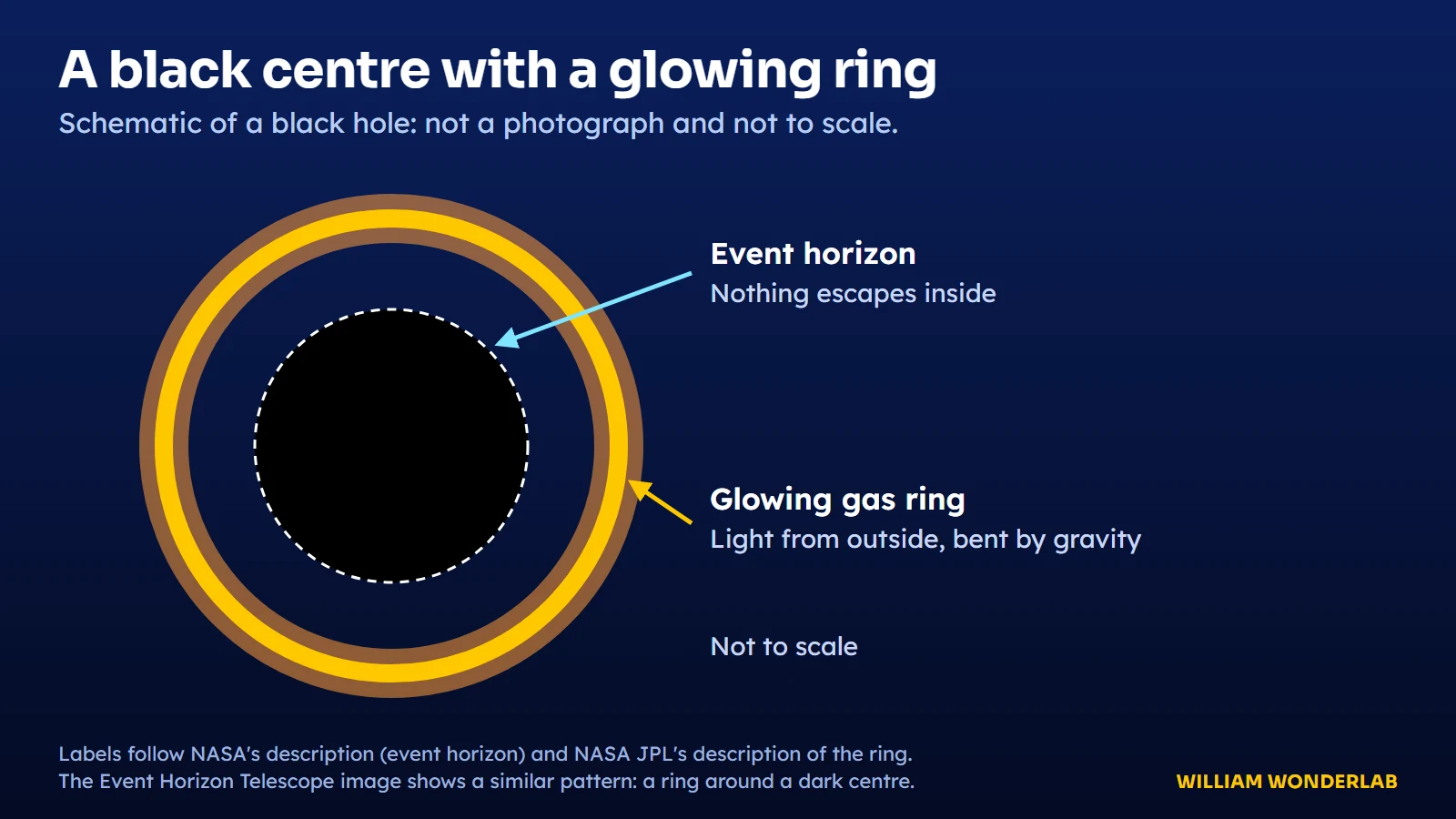
NASA explains the key feature: near a black hole, “gravity is so strong that nothing – not even light – can escape.”[1] The boundary around it is called the event horizon. NASA describes it as “a boundary that contains all the matter that makes up the black hole.”[1]
How black holes form
Some black holes are born when very large stars reach the end of their lives. NASA says that “one type of black hole is born when massive stars run out of fuel and explode in supernovae.”[1] This is one type of black hole. NASA’s examples below show that others are far larger.
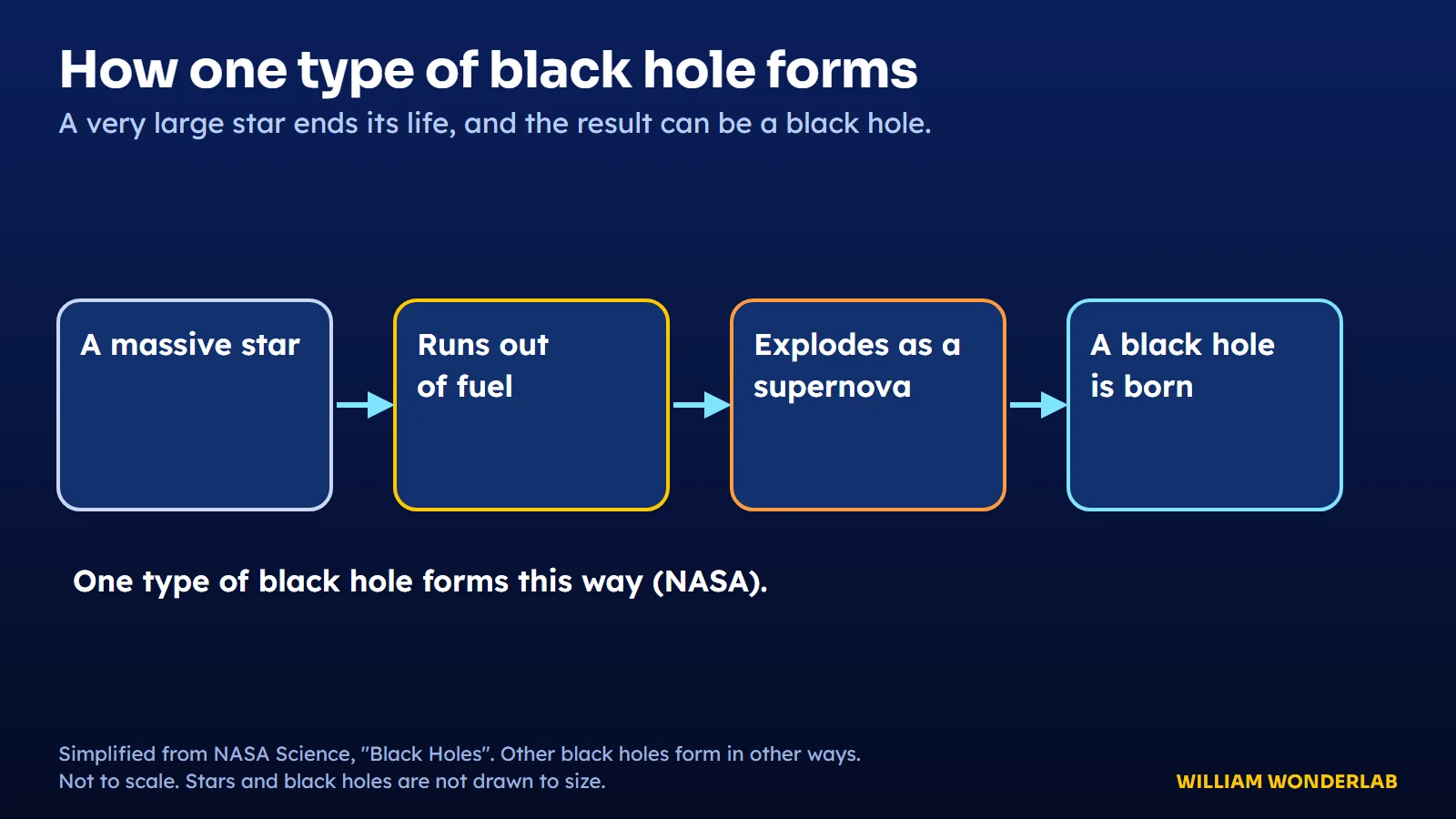
How big can they be?
The size range is enormous. NASA’s black hole page gives two examples. The most massive black hole it names, TON 618, is “66 billion times the Sun’s mass.” At the centre of our own galaxy is Sagittarius A*, which NASA says is “4 million times the Sun’s mass.”[1]
These numbers show how much mass black holes can hold, from stellar-sized ones to giant ones.
The first picture of a black hole
Because nothing, not even light, can escape from inside the event horizon, the hole itself cannot be seen directly.[1] The Event Horizon Telescope team released the first image of a black hole in April 2019. It showed M87*, the giant black hole at the centre of the galaxy M87. ESO describes the dark centre as “a completely dark object from which light cannot escape.”[2]
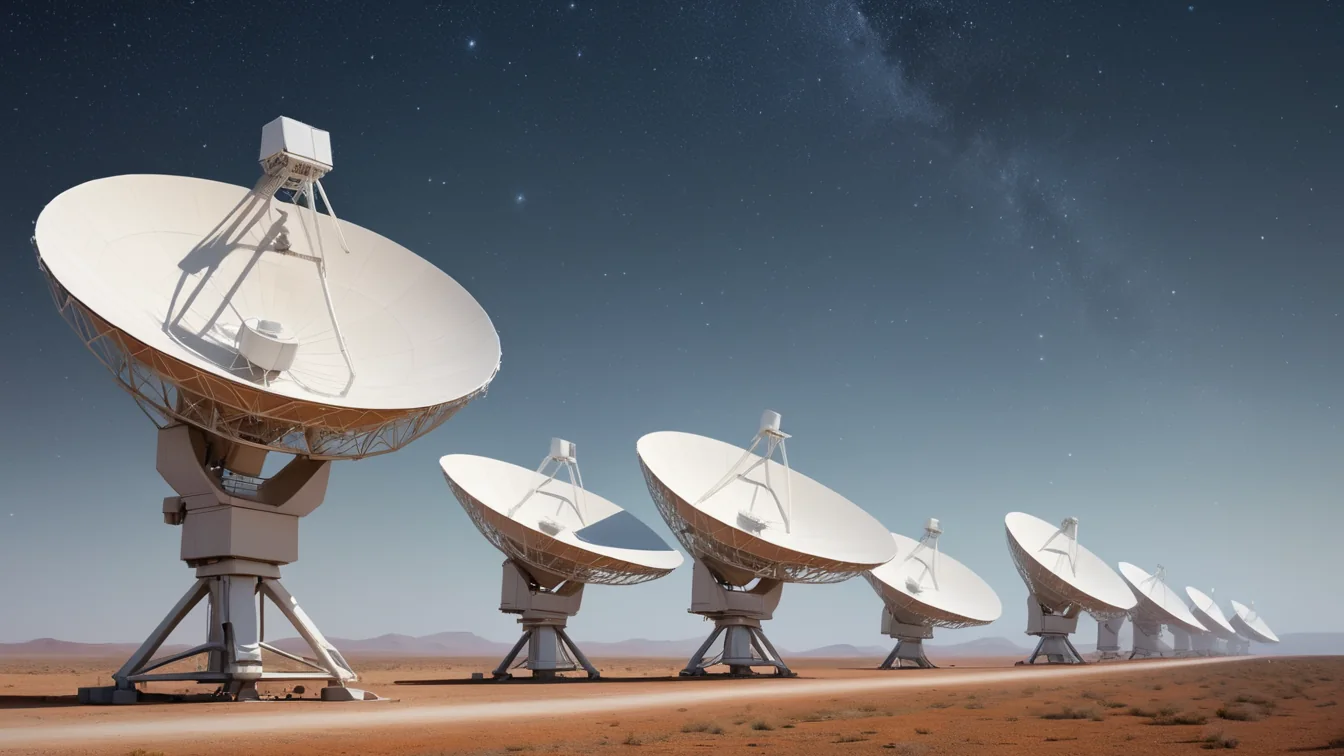
Here is what the image really shows. NASA’s Jet Propulsion Laboratory explains that the team built a network of telescopes, “creating an aperture that’s nearly the same as the diameter of Earth.”[3] The National Science Foundation says the network is “an array that links together eight existing radio observatories across the planet,” which works “to form a single Earth-sized virtual telescope.”[4] The data from the sites were “synchronized using the time stamps and combined to create a composite set of images.”[3]
The result is a bright ring. The JPL page describes it as “a bright ring formed as light bends in the intense gravity around a black hole.”[3] The dark centre is the shadow of the black hole, which is “outlined by the glowing gas that surrounds its event horizon.”[3]
So the picture is not a camera photo of the black hole itself. It is a reconstruction from radio-telescope data, and the dark area is where light cannot escape.
Did you know? The black hole in the first image is roughly 6.5 billion times the mass of the Sun. JPL’s image caption and the National Science Foundation both give the figure.[3][4]
Myths and misconceptions
A common idea is that black holes are giant vacuum cleaners that suck up everything nearby. They do not. Outside the event horizon, a black hole pulls on objects only through its gravity, in the same way that any object with mass does. The problem comes when something crosses the event horizon, because then nothing can escape.[1]
Try it: the stretched-sheet model
This is a proposed at-home activity and an analogy. It shows how a heavy object bends a surface. It is not a black hole, and it does not show how gravity works in detail.
You need: a tablecloth or thin cloth stretched tightly over a large bowl, a small heavy object such as a metal nut or a few coins, and a marble.
- Predict what the marble will do if you roll it across the stretched cloth away from the centre.
- Place the heavy object in the middle of the cloth and watch how the surface dips.
- Roll the marble past the dip at different distances and compare the paths.
- Write down what you saw and whether the marble’s path bent.
What to expect: The cloth dips where the heavy object sits, and the marble’s path curves towards the dip.
Safety first: Use a cloth stretched over a bowl, not a glass or ceramic bowl that could break. Keep the marble and small metal objects away from young children, because they are a choking hazard. Do not drop anything heavy, and never put a hand or face over the stretched cloth. An adult should supervise.
Go deeper: why light cannot escape
Escape
NASA says that near a black hole, “nothing – not even light – can escape.”[1] Inside the event horizon, no light reaches us, so the region looks black. The bright ring in the image is light from outside it, bent by strong gravity.
What the image can and cannot tell us
The Event Horizon Telescope image shows a dark centre surrounded by a bright ring. JPL describes the ring as formed “as light bends in the intense gravity around a black hole.”[3] It is a picture of that light, not of a solid surface.
Frequently asked questions
What is a black hole?
A region of space where matter is packed so tightly that gravity is so strong nothing can escape, not even light.[1]
How does a black hole form?
One type forms when massive stars run out of fuel and explode in supernovae.[1]
Can you see a black hole?
Not directly. The first image shows a bright ring of glowing gas around a dark shadow, built from radio-telescope data.[3]
Is a black hole a hole in space?
No. It is a region where matter is packed into a tiny space and gravity is very strong.[1]
Would a black hole pull everything into it?
Not everything. Objects around it feel its gravity, but nothing is trapped unless it passes the event horizon.[1]
The big idea
So much mass, so little space. A black hole forms where matter is packed tightly enough for gravity to trap even light. Telescopes now show its glowing ring, not the hole itself.
Related reading
More from William Wonderlab:
Explore more from scientists:
References
[1] NASA Science, “Black Holes” (accessed 25 October 2026)
[2] European Southern Observatory (ESO), “First Image of a Black Hole” (press release eso1907a, 10 April 2019) (accessed 25 October 2026)
[3] NASA Jet Propulsion Laboratory, “How Scientists Captured the First Image of a Black Hole” (accessed 25 October 2026)
[4] National Science Foundation, “Event Horizon Telescope” (media toolkit) (accessed 25 October 2026)