What Are Shooting Stars?
Shooting stars are not stars at all. They are meteors, small space rocks that glow as they hit Earth's atmosphere, and many come from comet debris.
On a clear, dark night, a bright streak sometimes flashes across the sky and is gone in a second. People make wishes on them and call them shooting stars. But a shooting star is not a star falling out of the sky. Stars are huge, distant balls of hot gas, and they do not fall.
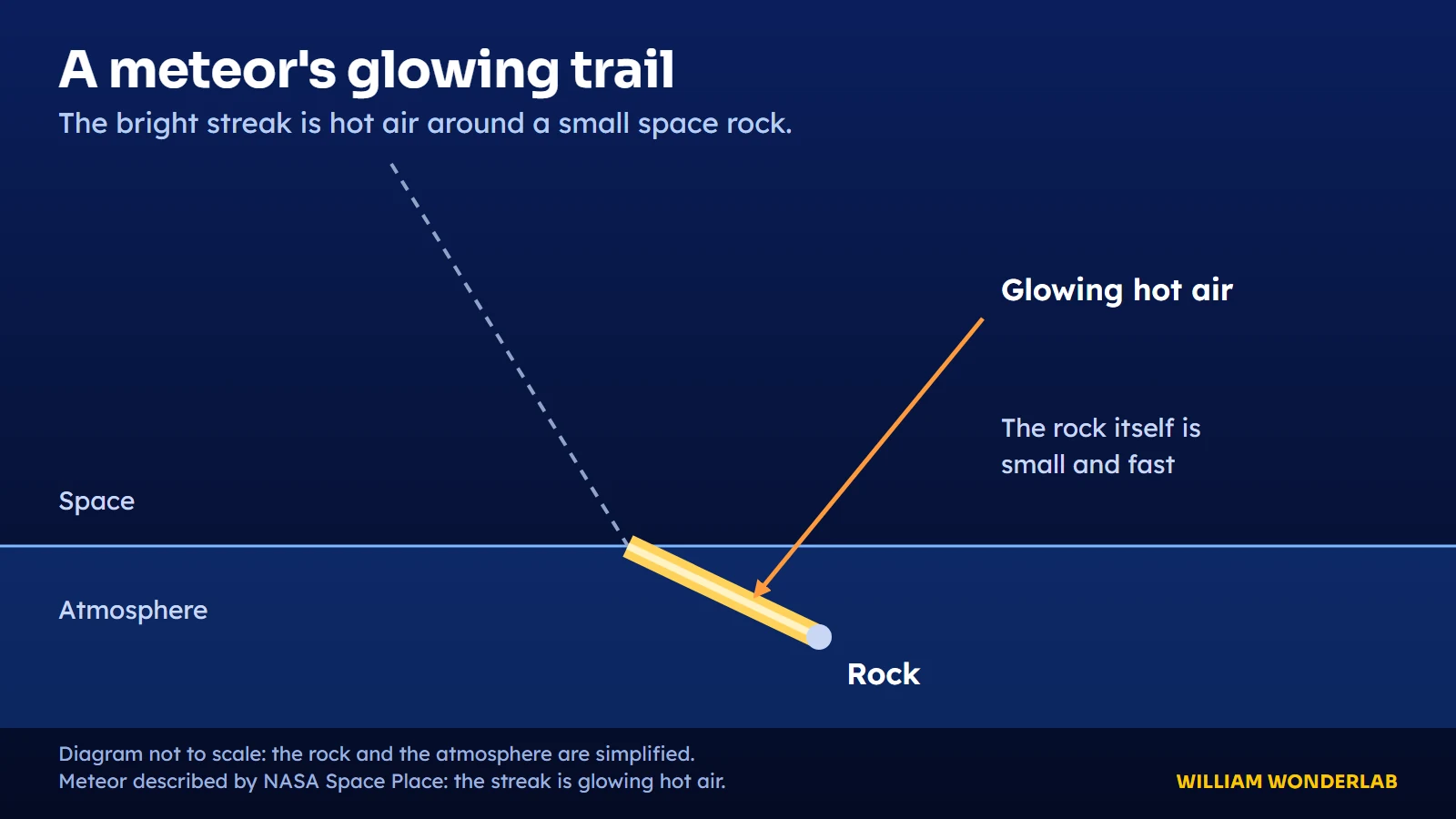
The short answer: A shooting star is a meteor. A meteor is a small space rock, called a meteoroid, that enters Earth’s atmosphere and glows. The bright streak we see is the hot air around the rock, not the rock itself. Many meteors come from dust and rock left behind by comets.[1][2]
A space rock meets the air
NASA defines the term plainly: “A meteor is a space rock—or meteoroid—that enters Earth’s atmosphere.”[1] The rock is moving very fast when it arrives, and the air in its path heats up and begins to glow.
NASA’s Space Place explains what you actually see: “That bright streak is not actually the rock, but rather the glowing hot air.”[1] The rock is usually too small and too quick to see. The glow is the trail of hot air it leaves behind for a moment.
Everyday comparison: a sparkler looks like it has a bright trail, but the bright part is the hot material around the tip, not the whole stick. A meteor’s streak works in a similar way.
Where the space rocks come from
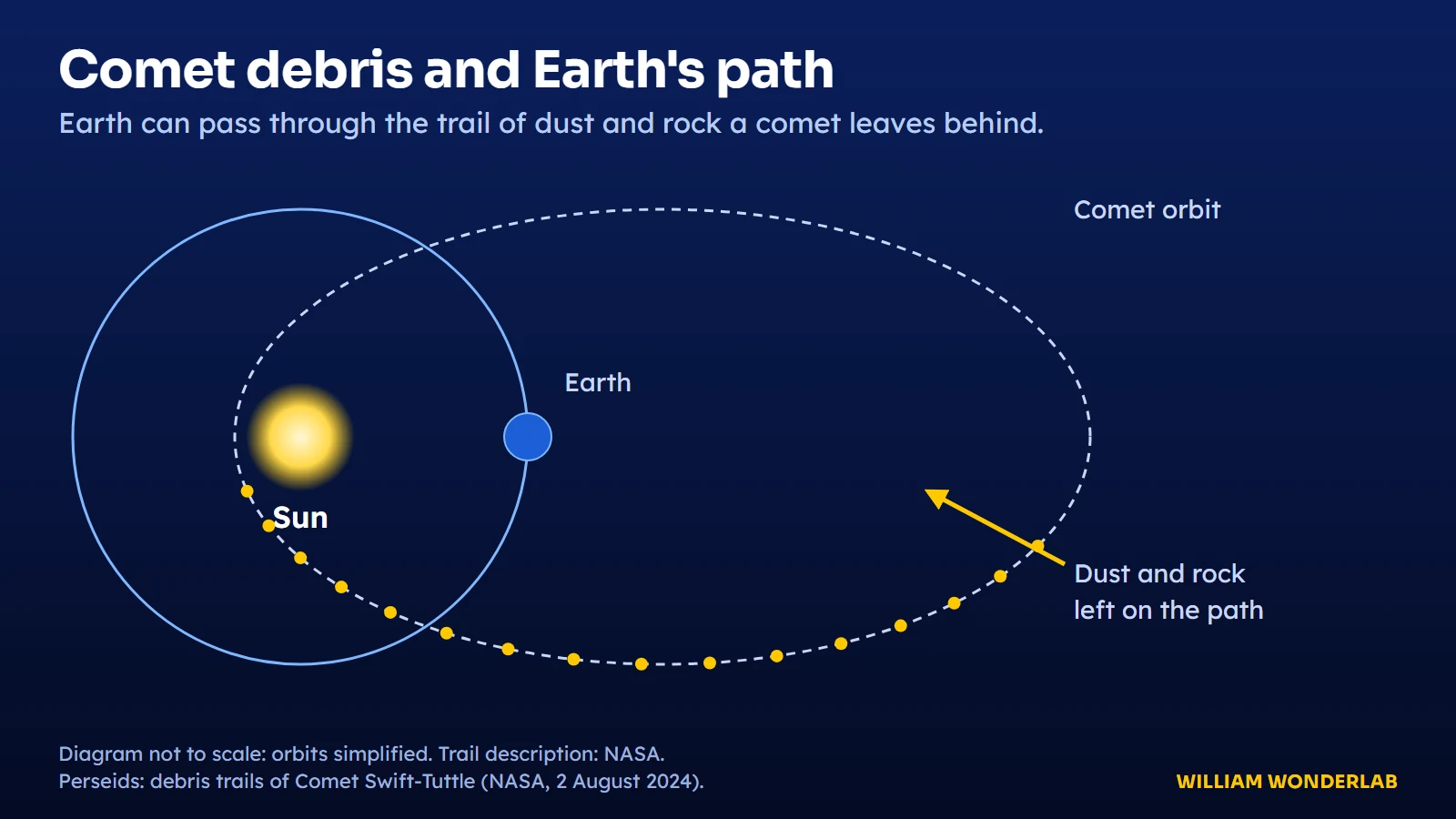
Many meteors come from comets. NASA explains that “As a comet gets closer to the sun, some of its icy surface boils off, releasing lots of particles of dust and rock.”[1] These particles are left along the comet’s path through space.
When Earth travels through one of these paths, the particles enter the atmosphere together. NASA’s 2024 Perseids article describes the Perseids this way: the shower is caused by “Earth passing through trails of debris left behind by Comet Swift-Tuttle.”[2]
Meteor showers have names
A meteor shower is a time when many meteors appear in the same part of the sky. NASA says that “Meteor showers are named for the constellation where the meteors appear to be coming from.”[1] The meteors do not really come from that constellation; it is simply the direction in which they seem to start.
The Perseids are one of the best-known showers. In 2024, NASA said that “the Perseid maximum will occur on the night of Aug. 11 and pre-dawn hours of Aug. 12.”[2] Dates change from year to year, so check a current source before going out to look.
If you have seen stars flicker instead of streak across the sky, that is a different effect. See Why Do Stars Twinkle?
Try it: count the shooting stars
Proposed at-home activity. This is a simple count, not an experiment.
You need: a clear night, a warm blanket, a notebook and pencil, and an adult to take you outside.
- Choose a dark spot away from bright lights, such as a porch or backyard with the lights turned down.
- Lie back on the blanket, so you can see a wide part of the sky without straining your neck.
- Count every shooting star you see for ten minutes. Write down the count and the time.
- Repeat on another clear night and compare the two counts.
What to expect: the numbers vary a lot from night to night. Some nights you may see none, and some nights many. There is no fixed number to expect.
Safety first: Go outside only with an adult, and tell someone where you are going. Keep to flat, familiar ground and watch for steps, kerbs, pets and traffic. Dress warmly and stay inside if it is cold, wet or windy. If you use a torch, keep it on a low, red-filtered or dim setting and do not shine it into anyone’s eyes. Do not look at bright lights, and do not try to find a meteor by staring at a streetlight.
Go deeper: why showers come back
Trails on a yearly path
A comet leaves its dust along its orbit, and Earth’s orbit crosses that path. NASA’s Perseids article supports the idea that the Perseids come from debris trails left by Swift-Tuttle.[2] NASA’s meteor showers page says that “Meteor showers occur annually or at regular intervals as Earth passes through the trail of dusty debris left by a comet.”[4] The Royal Museums Greenwich says that certain times of the year are “generally associated with comets that have passed by after spewing fragments in their wake.”[3] That is why the same showers can return each year, although the peak can move by a day or two from one year to the next.[1]
Why a meteor stops glowing
A meteor shows as a streak while the hot air around it glows. NASA’s Space Place says: “That bright streak is not actually the rock, but rather the glowing hot air.”[1]
Frequently asked questions
Are shooting stars really stars?
No. A shooting star is a meteor, a small space rock that glows as it enters Earth’s atmosphere.[1]
Why do meteor showers have names?
Showers are named for the constellation the meteors seem to come from.[1]
Which comet is linked to the Perseids?
The Perseids come from debris left behind by Comet Swift-Tuttle.[2]
What makes a shooting star glow?
The bright streak is the glowing hot air around the rock as it enters the atmosphere, not the rock itself.[1]
The big idea
A shooting star is a space rock burning in the air. The streak is glowing air around a meteor. Many meteors are dust and rock left behind by comets, and when Earth passes through their trails we see a shower.
Related reading
More from William Wonderlab:
Explore more from scientists:
References
[1] NASA Space Place, “What Is a Meteor Shower?” (accessed 25 October 2026)
[2] NASA, “Shooting Stars: Annual Perseid Meteor Shower to Peak Aug. 11-12” (Watch the Skies blog, 2 August 2024) (accessed 25 October 2026)
[3] Royal Museums Greenwich, “Comets, meteors and asteroids” (accessed 25 October 2026)
[4] NASA Science, “Meteor Showers” (accessed 25 October 2026)