Why Are Snowflakes Six-Sided?
Snowflakes have six sides because the water molecules inside them join into hexagon rings. Each flake takes its own path through the air, which is why no two match.

Look closely at a snowflake and you may see six arms, like the points of a star. Why do snowflakes so often have six sides, when many other things in nature are round or lumpy? And if they all share that shape, why does no snowflake ever look exactly like another?
The short answer: A snowflake is a tiny ice crystal. Its water molecules lock together in a hexagon, a shape with six sides, and the crystal keeps repeating that pattern as it grows. That is why the arms come in sixes. Each flake drifts through slightly different air on its way down, so its temperature and humidity change as it grows, and every flake ends up with its own design.[1][2]
Water is built from tiny blocks
Everything is made of very small pieces called atoms. A water molecule is a group of three atoms: one oxygen atom and two hydrogen atoms. A molecule is far too small to see, even with a magnifying glass. Think of it like a tiny Lego brick that can click onto other bricks.
The University at Buffalo’s chemistry explanation of snowflakes says that “the water molecules that form ice crystals (snowflakes) are made from two hydrogen atoms bonded to one oxygen atom.”[2]
Locking into a hexagon
When ice forms in a cloud, its molecules start to click together in a regular pattern. That pattern is made of hexagon rings. The University at Buffalo puts it this way: the molecules “arrange themselves in a lattice of hexagonal rings.”[2]
A lattice is a repeating pattern, like the squares of a fence that go on and on in every direction.
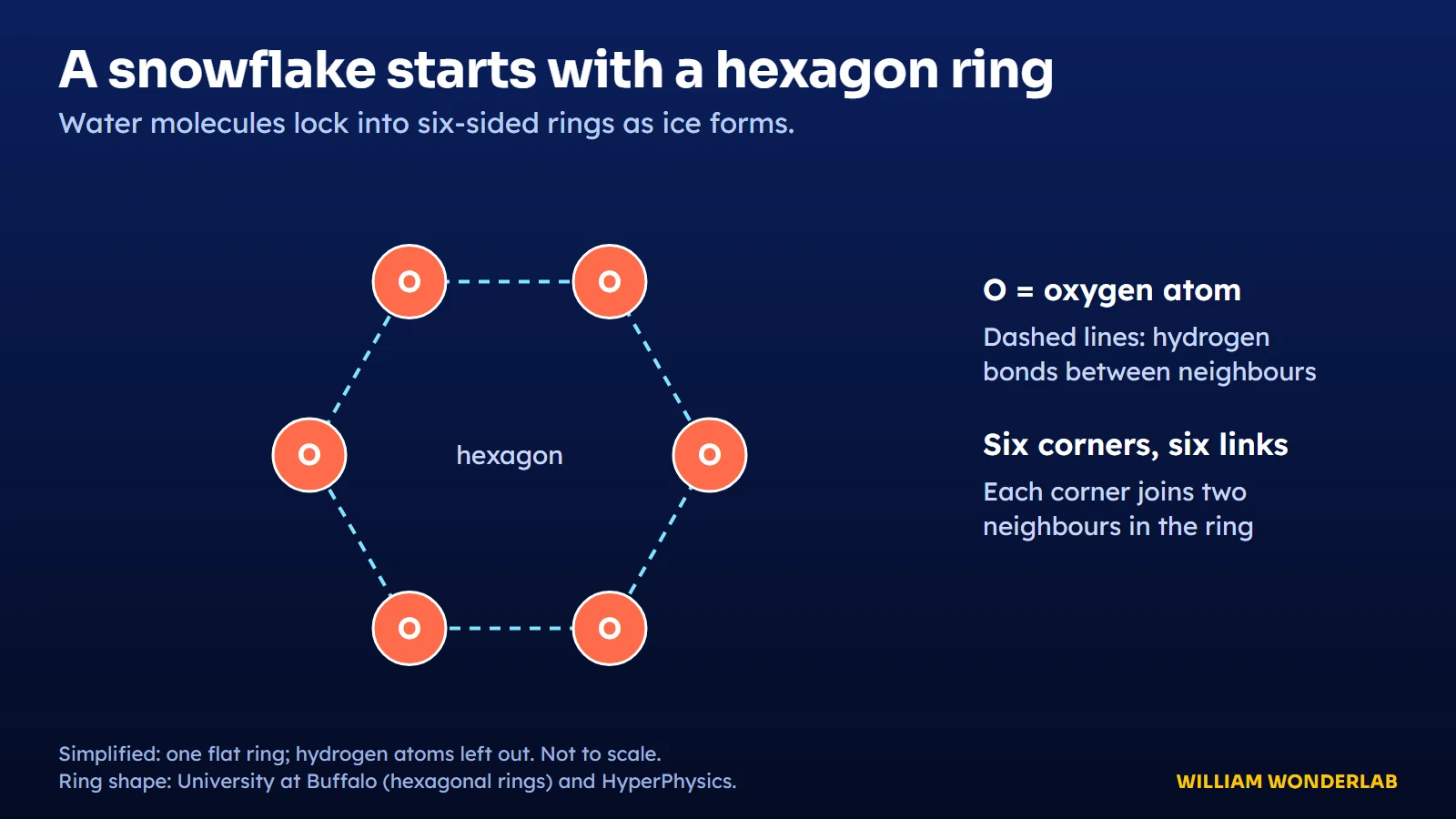
HyperPhysics, a physics resource from Georgia State University, explains that the pattern is loose and open. It says that the expansion of water on freezing comes from water crystallising “into an open hexagonal form.” It adds: “This hexagonal lattice contains more space than the liquid state.”[3] The gaps in the pattern are one reason ice is less dense than liquid water, which is why ice floats[3] (see Why Does Ice Float?).
Six arms from one centre
A snowflake starts as one small crystal. Caltech’s snowflake science article says that “such a snowflake starts out, as all do, as a hexagonal crystal of ice.”[4] The crystal grows outward, and its six corners stretch out into the arms you can see.
Scientists call this pattern six-fold symmetry. Symmetry means a shape looks the same after you turn it. A snowflake with six arms looks the same each time you turn it by one sixth of a full turn. A full turn is 360 degrees, and 360 ÷ 6 = 60, so the arms sit 60 degrees apart. The University at Buffalo explains: “This crystal structure means that snowflakes are going to exhibit six-fold symmetry.”[2]
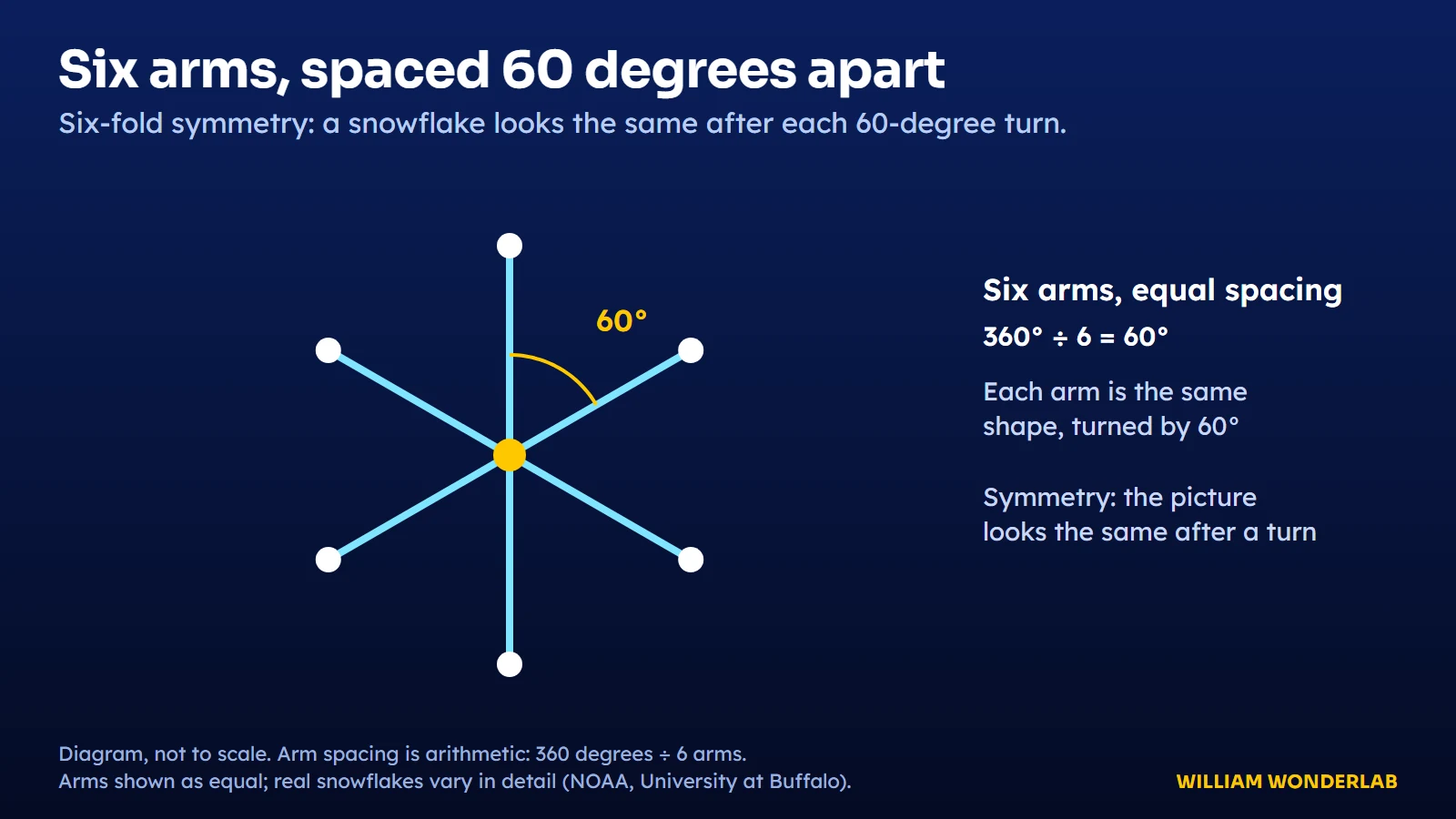
Here is a simple picture to hold on to. The hexagon sets the plan, and the arms are the plan repeated at six corners.
Why no two snowflakes match
Every snowflake starts with the same hexagonal plan, so why do they look so different? The NOAA Snowflake Simulator says that “Every snow crystal has a six-sided (hexagonal) shape, but they come in all different arrangements and sizes.”[1] The shape stays the same, but the details change.
The details come from the air. The same simulator notes that “Differences in temperature and humidity affect the snowflake’s shape.”[1] Humidity means how much water vapour is in the air. A snowflake is growing all the way down from the cloud, so each flake takes its own route through air that is never quite the same.
Caltech’s article describes this as “the ever-changing conditions in the clouds where snow crystals form.”[4] Picture two plants grown from the same seed, one in a sunny garden and one in the shade. They begin alike and grow into different shapes because of what surrounds them.
Humidity can make a big difference. Northern Illinois University’s snow crystal page says that “a crystal which encounters more humidity will grow faster than one that has less available humidity.”[5] If the air changes as the flake falls, its growth can change too. The same page says: “If the conditions vary as it falls, the result can be a crystal with longer fern-like offshoots, or dendrites.”[5] Dendrites are branching shapes, a bit like a fern leaf.
Snow is ice in the air
Snow is ice that forms in the sky and falls to the ground. Its shape is set by the crystal structure of ice. The University at Buffalo says: “The shape of snowflakes is driven by the crystal structure of ice.”[2] Think of a snowflake like a tiny sugar crystal grown in a glass of sugar water: the inside pattern decides the outside shape, and the surroundings decide the small differences.
Go deeper: the geometry of six
A quick check with angles
Inside a regular hexagon, each corner has an angle of 120 degrees. The sum of the inside angles of any hexagon is (6 − 2) × 180 = 720 degrees, and 720 ÷ 6 = 120 degrees each. Six equal arms placed around a centre point are spaced at 360 ÷ 6 = 60 degrees. The number 6 shows up twice: once in the hexagon’s six corners and once in the six arms.
Frequently asked questions
Why do snowflakes have six sides?
Their water molecules lock into hexagon rings as the ice forms. The University at Buffalo describes this lattice of hexagonal rings.[2] The crystal then grows with six-fold symmetry.[2][4]
Are all snowflakes ice?
Yes. Snowflakes are made of ice crystals, and the shape of a snowflake is driven by the crystal structure of ice.[2]
Do all snowflakes have six arms?
Every snow crystal has a six-sided (hexagonal) shape, but the arrangements and sizes vary.[1]
Why does no snowflake look exactly like another?
Temperature and humidity change while each flake falls, so each one grows in its own way.[1][5]
Does humidity change how a snowflake grows?
Yes. A crystal that meets more humidity grows faster than one with less available humidity.[5]
Why does a hexagon matter?
A hexagon has six corners. When molecules join into hexagon rings, the crystal grows with six arms, so the hexagon is the plan the snowflake follows.[2][3]
The big idea
Six sides from one shape. Water molecules lock into hexagon rings as ice forms, so snowflakes grow with six-fold symmetry. Changing air makes each flake’s design unique.
Related reading
More from William Wonderlab:
- Why Is Snow White?
- Why Does Ice Float?
- Why Does Water Freeze at Zero Degrees?
Explore more from scientists:
- The chemistry of snowflakes, explained (University at Buffalo)
- Snowflake Simulator (NOAA)
- Snowflake Science (Caltech)
References
[1] NOAA, “Snowflake Simulator” (accessed 26 October 2026)
[2] University at Buffalo, “The chemistry of snowflakes, explained” (accessed 26 October 2026)
[3] HyperPhysics, Georgia State University, “The Expansion of Water Upon Freezing” (accessed 26 October 2026)
[4] California Institute of Technology (Caltech), “Snowflake Science” (accessed 26 October 2026)
[5] Northern Illinois University STEAM, “Let it Snow: The Science of Snow Crystals” (accessed 26 October 2026)