Why Does Concrete Get Hard?
Concrete gets hard because cement reacts chemically with water, not just because it dries. New crystal products grow and link sand and gravel together.

A bucket of wet grey mix can turn into a footpath that holds a car. Most people guess that it hardens the way mud dries on a path. But concrete is not simply drying out. Something chemical is happening inside the mix. So why does concrete get hard?
The short answer: Concrete gets hard because cement reacts chemically with water. This reaction, called hydration, makes new products that grow and interlock around the sand and gravel. The reaction can continue for a long time when the concrete stays moist, and most of its strength is gained within the first 28 days.[1][2][5][6]
Cement meets water
Cement is the powder that reacts with water. The University of Illinois materials science page on concrete explains that “Hydration is a chemical reaction in which the major compounds in cement form chemical bonds with water molecules.”[1] Concrete is the cement paste plus sand and gravel, which act as the solid filler in the mix.
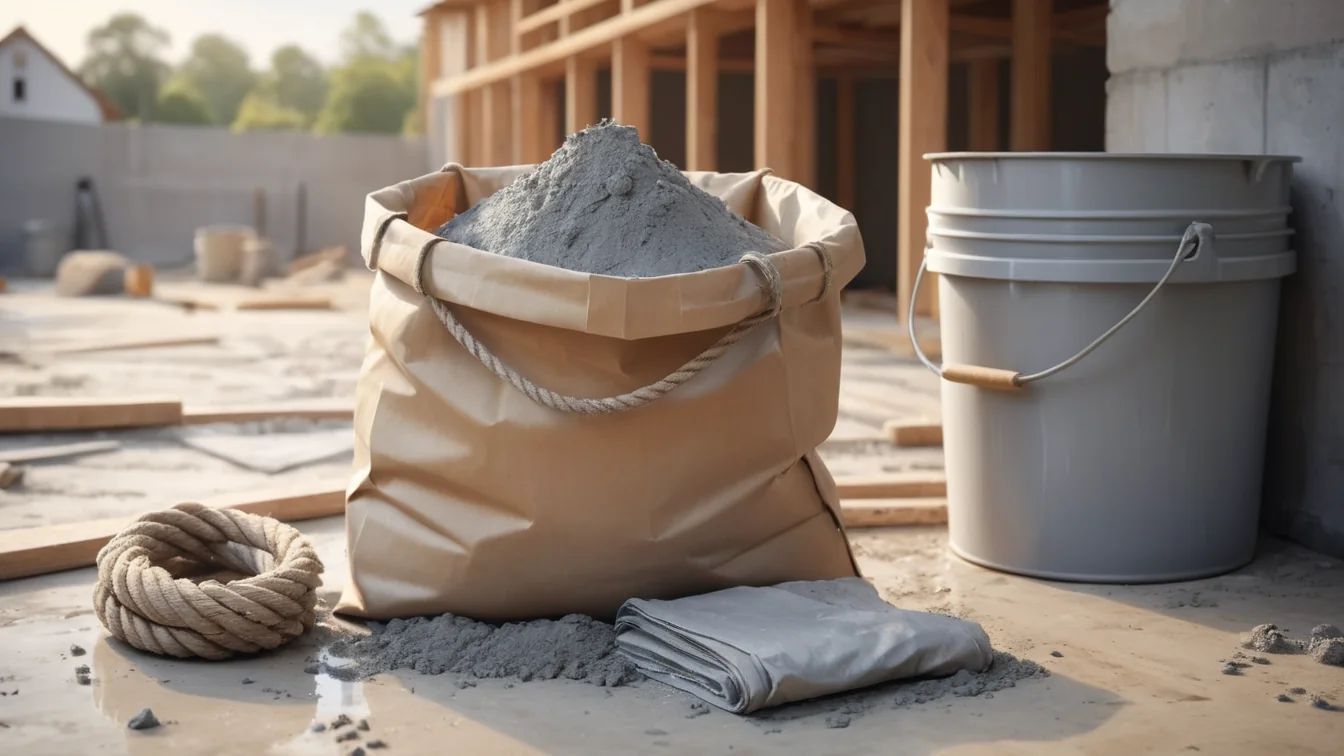
The picture above is a conceptual illustration of a bag of grey cement powder beside an empty bucket on a building site. It is not a record of a specific pour.
Crystals that lock together
Hydration makes new solids. The University of Memphis civil engineering notes describe two main products. One is calcium silicate hydrate, which the notes describe as a “poorly crystalline material of extremely small particle size.” The other is calcium hydroxide, which they describe as “a well understood hexagonal crystalline material.”[2]
A 2022 laboratory study in the journal Langmuir describes calcium silicate hydrate as “a nanocrystalline mineral glue, keeping the brittle calcium silicate grains together.”[3] In simple terms, the products grow between the grains and link them, so the whole mix becomes a solid rather than a pile of grit.
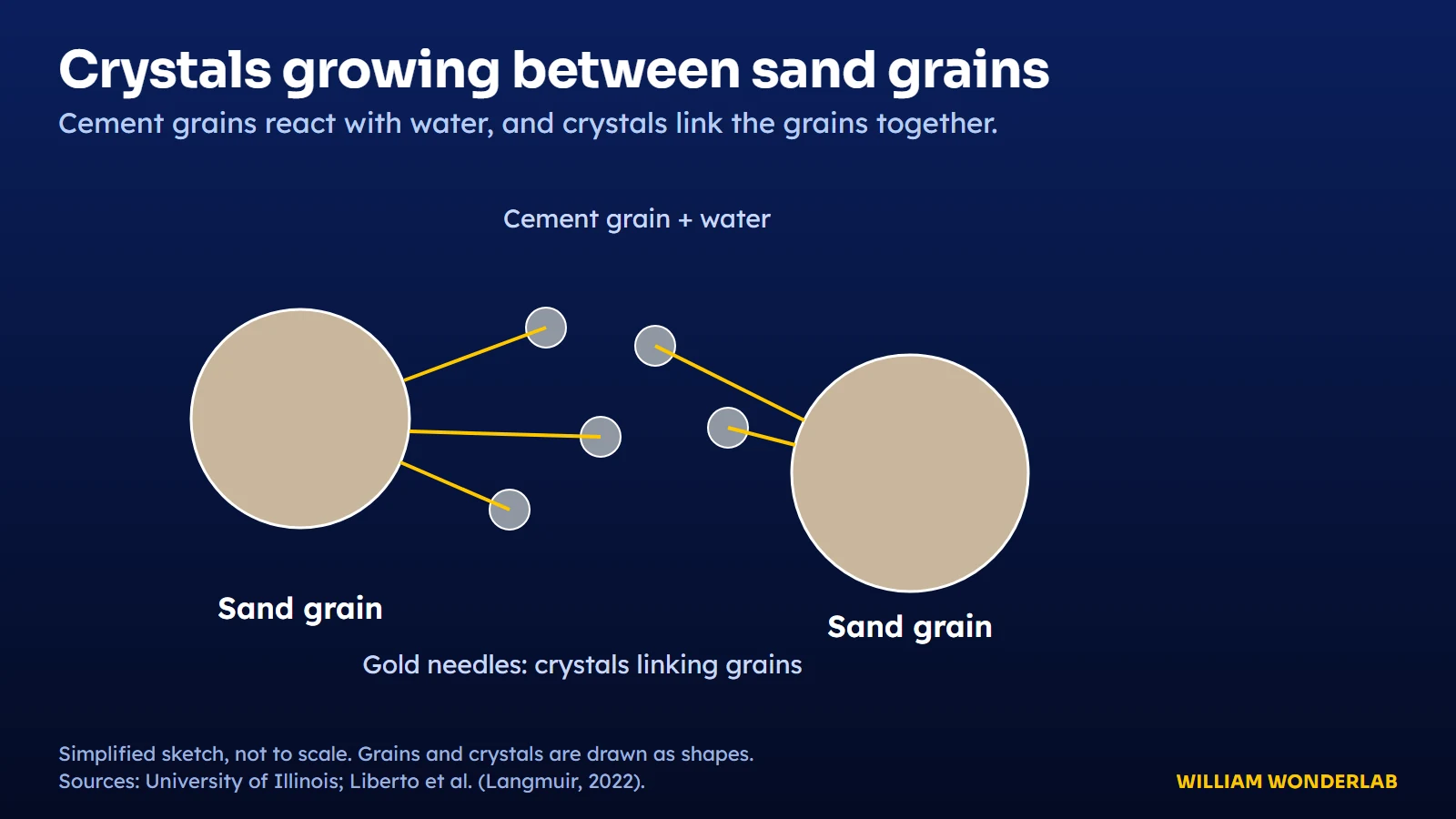
The diagram above is a simplified sketch. It is not drawn to scale, and real cement grains are far smaller than the sand grains shown.
Why it takes weeks
Not all cement compounds react at the same speed. The Illinois page explains that “Tricalcium silicate is responsible for most of the early strength (first 7 days).”[1] A second compound, dicalcium silicate, is slower: it “contributes only to the strength at later times.”[1] So the early hardness comes mainly from one reaction, and the later gain comes from another.
The Memphis hydration notes describe a timing pattern as well. There is a dormant period of about two to four hours, during which the paste stays soft and workable. Bae and colleagues (2016), a lab study of pure tricalcium silicate in water, describe calcium silicate hydrate as starting to grow rapidly at the end of the induction period, which in that pure system was about an hour. The 2 to 4 hour figure above is for cement.[7]
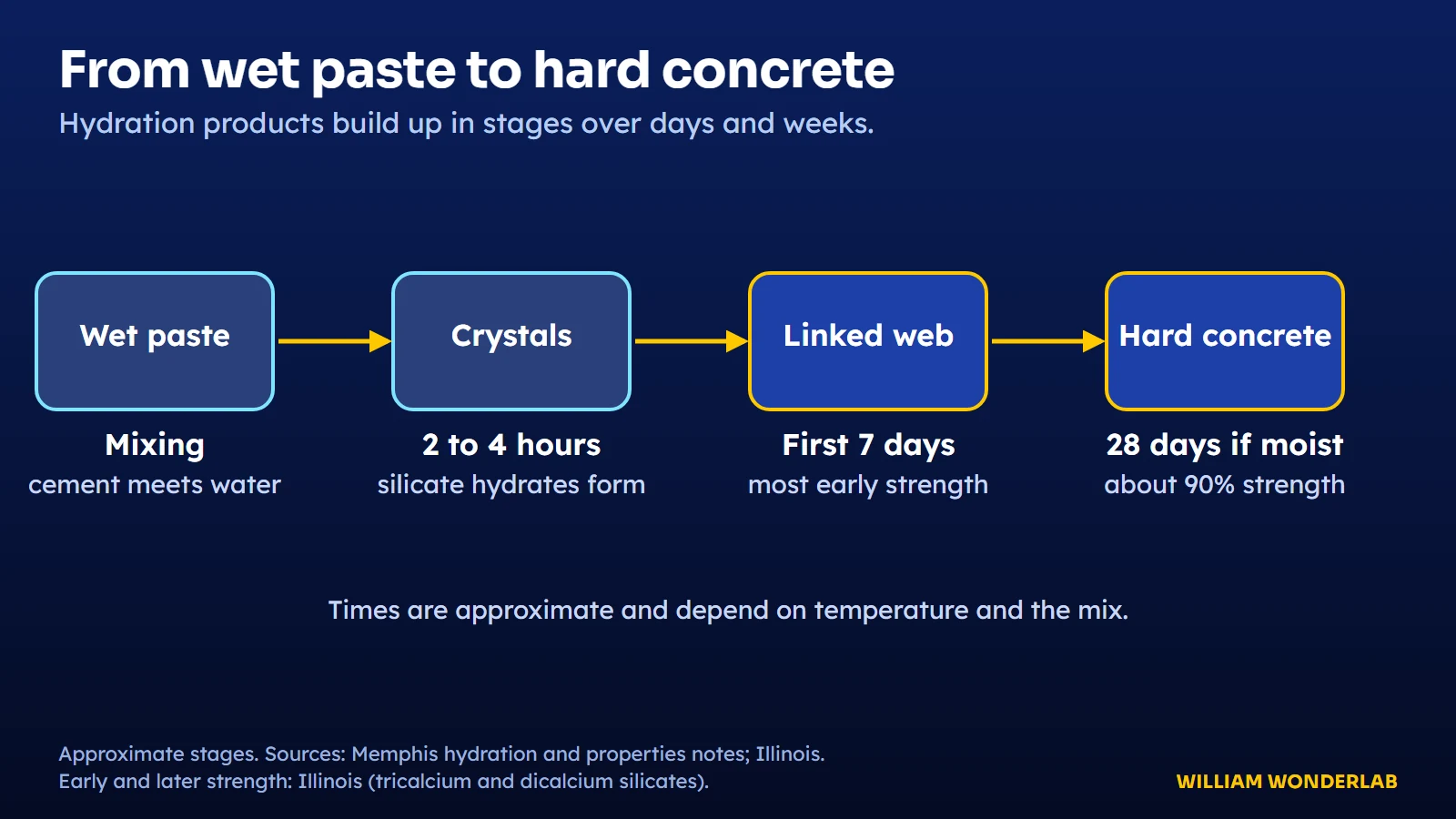
The timeline above is a simplified picture. The exact times depend on temperature, the cement and the mix, so the numbers are approximate.
Moisture keeps the reaction going
Water is needed for the reaction to continue. The Memphis curing notes say that “If the internal relative humidity drops below 80%, hydration and strength gain will stop.”[4] In other words, if the concrete dries out too early, the chemical reaction slows down or stops, and the concrete stays weaker than it could have been.
The Penn State civil engineering curing notes make a similar point: “As long as water is present, the hydration will continue for many years.”[5] They also warn that “Concrete that is allowed to dry in air will gain only 50% of the strength of continuously moist-cured concrete.”[5]
Why drying is not the main step
The myth is easy to understand. A puddle dries, and so does a footpath. But concrete’s strength comes from the new products that form when cement reacts with water, not from water leaving the mix.[1][2] Hydration needs water to be present, so keeping it wet helps the reaction. If concrete dries out in air too early, hydration can stop, which is why curing matters.[4][5]
This is why curing, which means keeping concrete moist after it is poured, matters so much.[4]
Keep it moist for weeks
The University of Memphis properties notes give a practical figure for strength over time. They say: “Theoretically, if kept in a moist environment, concrete will gain strength forever,” but “in practical terms, about 90% of its strength is gained in the first 28 days.”[6]
So the first month does most of the work, and the gain slows down after that. This is a simplified picture of a process that depends on the mix and the conditions.
Try it: the sponge test
This is a proposed at-home activity, using a sponge as a model. It does not make concrete and does not show the chemistry. Predict first: if you soak one sponge and let another sponge dry in the air, which will feel firmer after a day?
You need: two identical kitchen sponges, a cup of water, a plate, and a notebook.
- Predict which sponge will feel firmer after a day if one is left wet and one is left dry.
- Soak one sponge in water and squeeze out the extra water. Leave the other sponge dry on the plate.
- Leave both on the plate for a day, away from direct sun.
- Squeeze each sponge gently and compare how firm it feels.
- Write down what you noticed. Remember that a sponge does not harden through a chemical reaction, so this is only a rough model of how water matters.
Safety first: Use plain water only, and do not add any chemicals or soaps. Keep the sponges on a plate away from the edge of the table. Do not put the sponges in your mouth, and wash your hands after the activity.
Go deeper: the chemistry in more detail
Two cement compounds, two timescales
The Illinois page names the two silicates that make up most of the cement and links them to two timescales: a faster compound for early strength and a slower compound for later strength.[1][2]
Why the glue matters
The 2022 Langmuir lab study describes the hydration products as a connected network that keeps the brittle grains together.[3] This is why the mix becomes solid even though its starting ingredients are powders and grit.
Frequently asked questions
Is concrete hard because it dries?
Not mainly. Concrete hardens because cement reacts with water, which forms new crystal-like products that link the grains together.[1][2]
Why does concrete keep getting stronger?
Hydration continues as long as water is present. The Penn State notes say it can continue for many years, but most strength is gained early.[5][6]
What happens if concrete dries out too early?
If the internal humidity falls below 80 per cent, the Memphis curing notes say hydration and strength gain will stop.[4]
What are the new products in concrete?
The main products include calcium silicate hydrate and calcium hydroxide, which the Memphis notes describe as a poorly crystalline material and a well understood crystalline material.[2]
Does concrete need air to harden?
Concrete needs water for hydration. Its strength depends on the reaction continuing, and drying in air can stop that reaction early.[4][5]
The big idea
A chemical reaction, not just drying. Cement reacts with water to form products that grow and interlock around the sand and gravel. Keeping concrete moist lets that reaction carry on, so the concrete keeps gaining strength for weeks.
Related reading
More from William Wonderlab:
Explore more from scientists:
- Concrete: Scientific Principles (University of Illinois, Materials Science and Engineering)
- Curing Concrete (Penn State, civil engineering course notes)
- Detecting Early-Stage Cohesion Due to Calcium Silicate Hydration with Rheology and Surface Force Apparatus (Langmuir, 2022)
References
[1] University of Illinois, Materials Science and Engineering, “Concrete: Scientific Principles” (accessed 26 October 2026)
[2] University of Memphis, CIVL 1101, “Hydration of Portland Cement” (accessed 26 October 2026)
[3] Liberto, T., Nenning, A., Bellotto, M., Dalconi, M. C., Dworschak, D., Kalchgruber, L., Robisson, A., Valtiner, M. and Dziadkowiec, J., “Detecting Early-Stage Cohesion Due to Calcium Silicate Hydration with Rheology and Surface Force Apparatus”, Langmuir (2022) (accessed 26 October 2026)
[4] University of Memphis, CIVL 1101, “Curing” (accessed 26 October 2026)
[5] Pennsylvania State University, Civil Engineering, “Curing Concrete” (accessed 26 October 2026)
[6] University of Memphis, CIVL 1101, “Properties of Concrete” (accessed 26 October 2026)
[7] Bae, S., Kanematsu, M., Hernández-Cruz, D., Moon, J., Kilcoyne, D. and Monteiro, P. J. M., “In Situ Soft X-ray Spectromicroscopy of Early Tricalcium Silicate Hydration”, Materials (Basel), 2016 (accessed 26 October 2026)