Why Do Some Stars Look Red and Others Blue?
Look up on a clear night and stars show different colours. The colour is a clue to how hot each star's surface is, not a sign of paint.
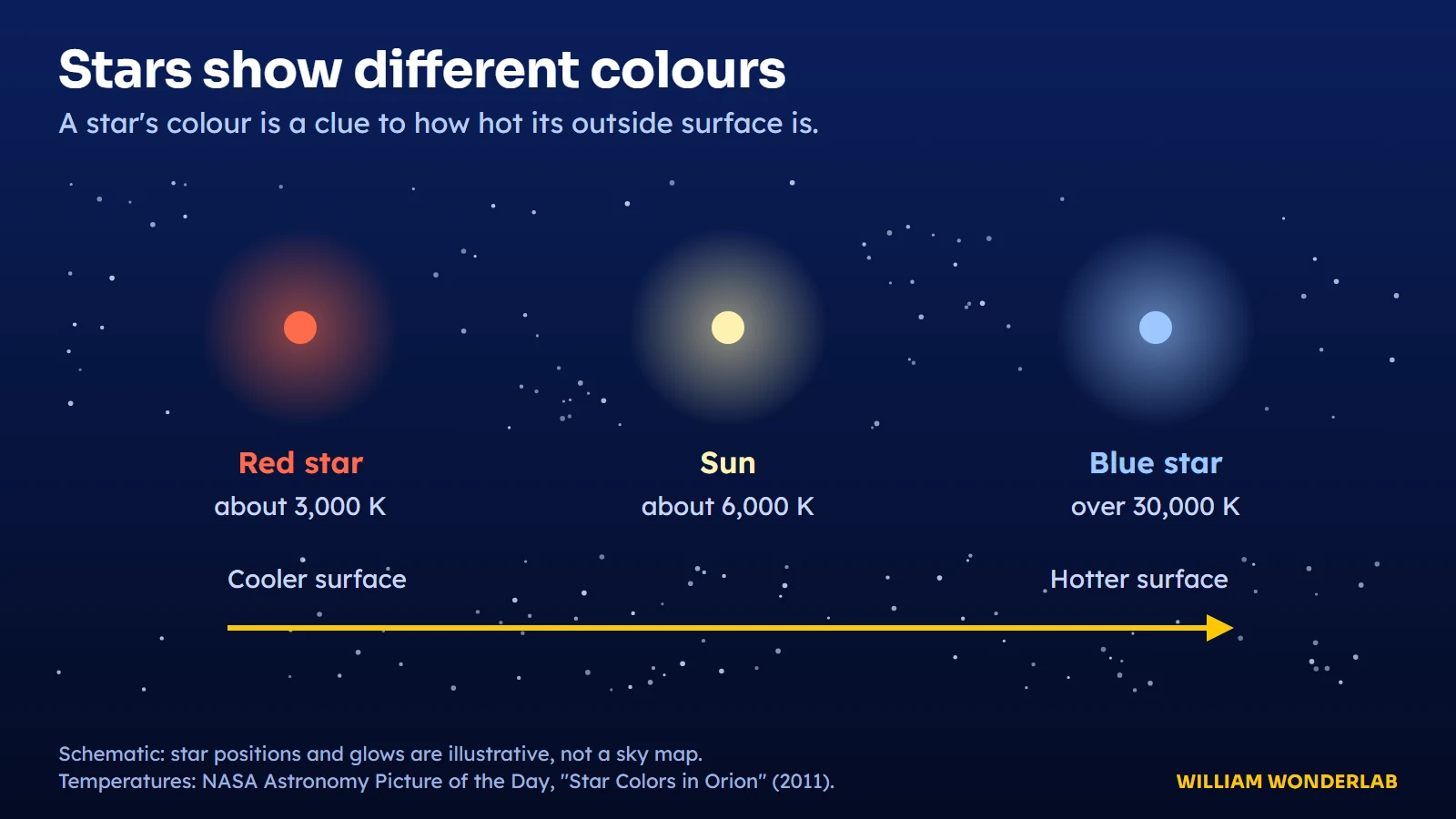
On a clear night, look closely at the stars and you will notice they are not all the same colour. Some look orange-red, others look yellow-white, and a few look bluish. The colour is not paint on the sky. It is a clue about how hot each star’s outside surface is.
The short answer: A star’s colour depends on its surface temperature. Cooler stars glow red, stars like the Sun look yellow-white, and very hot stars look blue-white. NASA’s Astronomy Picture of the Day explains that a star’s colour is set by its temperature.[1]
Heat changes colour
You already know a hot object can change colour. A blacksmith heats a piece of iron until it glows. At first the glow is a dull red. Hotter iron looks yellow, and when it is very hot it looks white.
A university chemistry text describes this pattern. It says that “A relatively low-temperature object, such as a horseshoe forged by a blacksmith, appears red, whereas a higher-temperature object, such as the surface of the sun, appears yellow or white.”[2] As the temperature climbs further, it “becomes yellow, white, and ultimately blue-white.”[2]
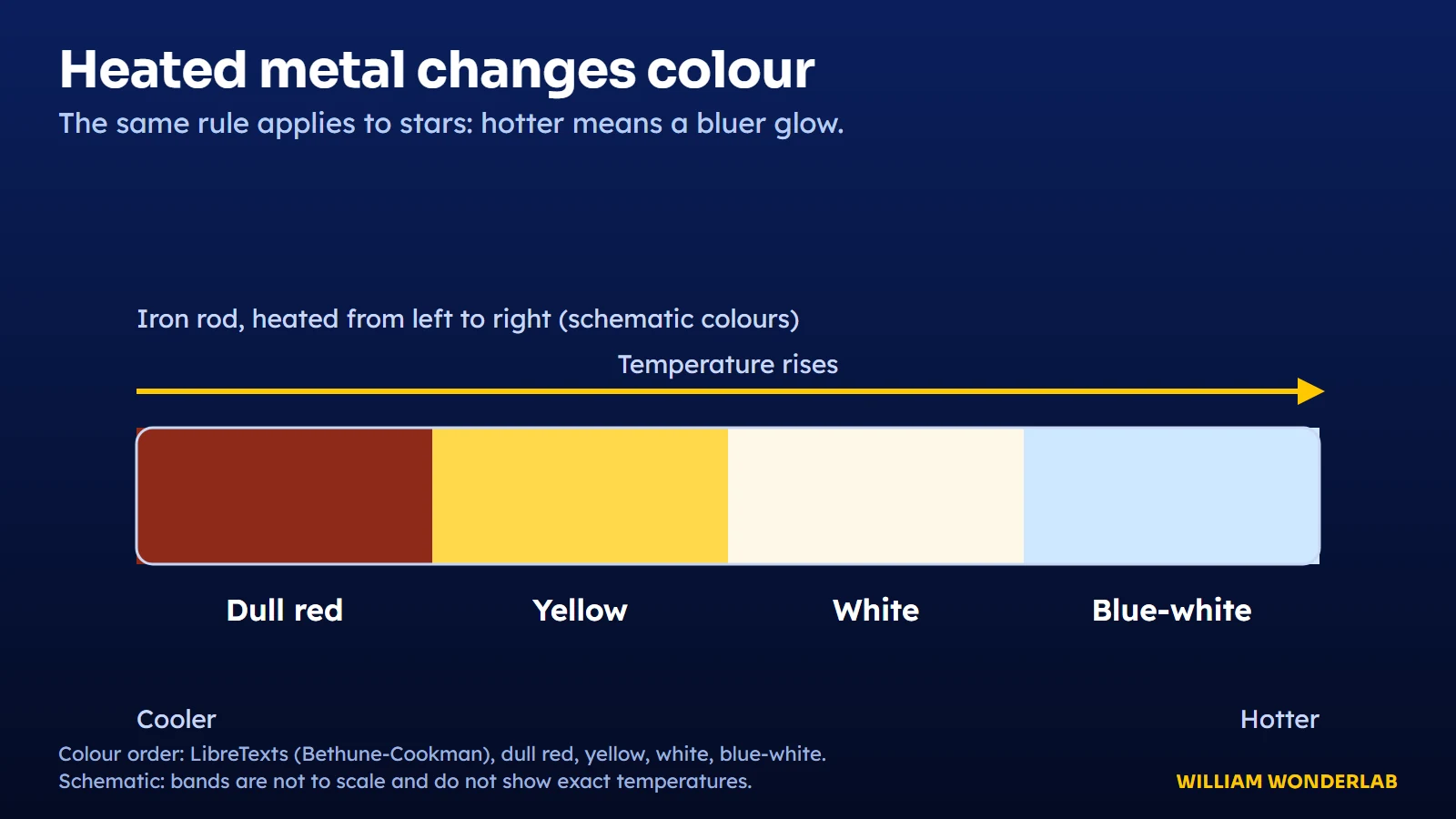
The iron does not change colour because of paint. It changes because its temperature changes the light it gives out.[2]
What a star’s colour tells us
A star is a huge ball of hot gas, and its surface glows in the same way. The main idea is the same as the iron: the hotter the surface, the more the light shifts from red towards blue.
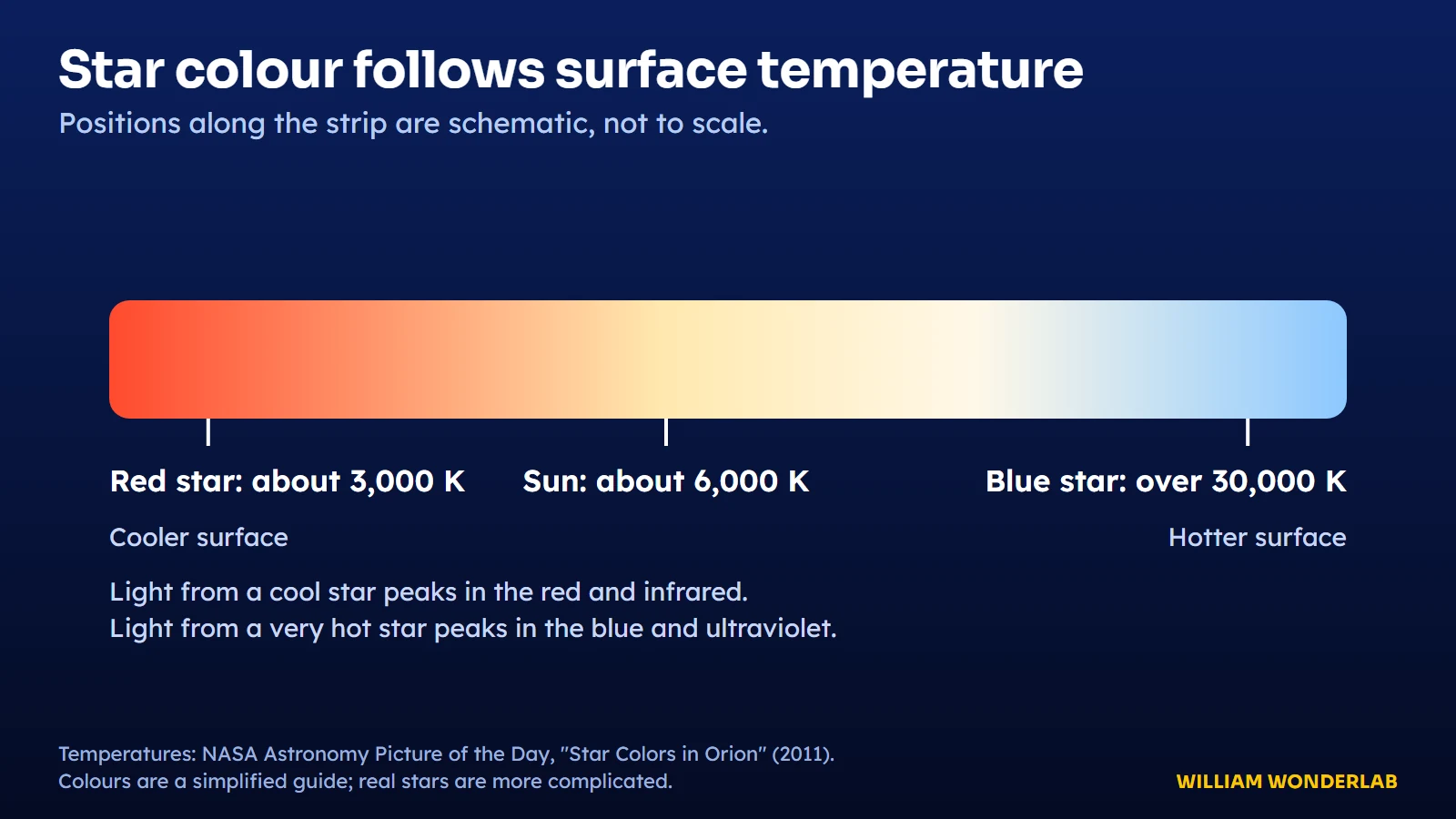
NASA’s Astronomy Picture of the Day gives typical numbers. It says that “Red stars are cool, with surface temperatures of around 3,000 kelvins (K),” while “blue stars are hotter and can have temperatures over 30,000 K.”[1] The Sun looks yellow to us, and its surface is about 6,000 K.[1]
Kelvin is a temperature scale that starts at absolute zero, the coldest possible temperature. The numbers here are all kelvins, so 6,000 K is a much higher temperature than 3,000 K.
Why very hot stars look blue
Scientists use a simplified picture called a black body, an idealised object that glows according to its temperature alone.[3] Treating a star as roughly a black body is a simplification that helps explain the main trend. Real stars are more complicated than this.
A university geoscience text puts the key rule plainly: “As the black body becomes hotter, it emits at shorter wavelengths and greater intensities.”[3] Shorter wavelengths of light are bluer. So a hotter surface sends more of its light towards the blue end of the range.
The same page gives a rule of thumb, Wien’s law. Wien’s law uses a constant, 2,897, when the wavelength is measured in micrometres.[3] You can use that number to work out roughly where the peak of the light lies. The details are in the Go deeper section below.
There is a subtlety worth knowing. A university astronomy text notes that “Blue colors dominate the visible light output of very hot stars (with much additional radiation in the ultraviolet).”[4] It also says that “cool stars emit most of their visible light energy at red wavelengths (with more radiation coming off in the infrared).”[4] So a red star gives out a lot of light we cannot see, and what we see as its colour is only part of its output.
Did you know? Betelgeuse, in Orion, is a “cool red supergiant” that stands out from the other, hotter, bluish stars there.[1]
Go deeper: the maths of Wien’s law
Wien’s law and the peak
Wien’s law says the peak wavelength of a blackbody, in micrometres, is about 2,897 divided by its temperature in kelvin.[3] The peak is the wavelength at which the most energy comes out.
Using the temperatures from NASA’s Astronomy Picture of the Day:[1]
- Red star at 3,000 K: 2,897 ÷ 3,000 = 0.97 micrometres, in the infrared.
- Sun-like star at 6,000 K: 2,897 ÷ 6,000 = 0.48 micrometres, in the blue-green part of the visible range.
- Very hot blue star at 30,000 K: 2,897 ÷ 30,000 = 0.097 micrometres, in the ultraviolet.
The numbers show the trend: a hotter surface gives a shorter peak wavelength. Human eyes detect wavelengths from about 380 to 700 nanometres, and 0.97 micrometres is 970 nanometres, so the red star’s peak lies beyond the red end of what we can see.[5] This matches the note that cool stars give out most of their visible light at red wavelengths and much more in the infrared.[4]
Why this is a simplified picture
These numbers assume a simple blackbody. Real stars are more complicated, so treat the numbers as a guide to the trend, not as exact measurements of any one star.
Are all red stars the same temperature?
No. Red stars are cooler than the Sun, but the exact temperature varies from star to star. The NASA source gives a typical value of about 3,000 K for red stars.[1]
Is the Sun a yellow star?
It looks yellow-white from Earth. Its surface is about 6,000 K, which sits between the cooler red stars and the hotter blue ones.[1]
Why does a hotter object look bluer?
Its light peaks at a shorter wavelength as the temperature rises, so more of its light falls in the blue part of the spectrum.[3]
Can I tell how hot a star is just by looking at it?
Colour gives a rough clue. Astronomers combine it with other measurements for a careful estimate.
The big idea
A star’s colour is a thermometer. The same rule that turns hot iron from red to white works on a star. The hotter the surface, the bluer the light.
Related reading
More from William Wonderlab:
- Why Is the Sun So Hot?
- Why Do Stars Twinkle?
- How Old Is the Universe?
Explore more from scientists:
References
[1] NASA, “Astronomy Picture of the Day: Star Colors in Orion” (accessed 26 October 2026)
[2] Bethune-Cookman University, “1.1: Blackbody Radiation Cannot Be Explained Classically”, LibreTexts Chemistry (accessed 26 October 2026)
[3] Geosciences LibreTexts, “2.4: Characterizing Emission” (accessed 26 October 2026)
[4] OpenStax Astronomy via Physics LibreTexts, “17.2: Colors of Stars” (accessed 26 October 2026)
[5] NASA Science, “Visible Light” (accessed 26 October 2026)