Why Do Leaves Change Colour?
Leaves look green because of chlorophyll. In autumn, chlorophyll breaks down and other pigments take over, so the leaves turn yellow, orange and red.
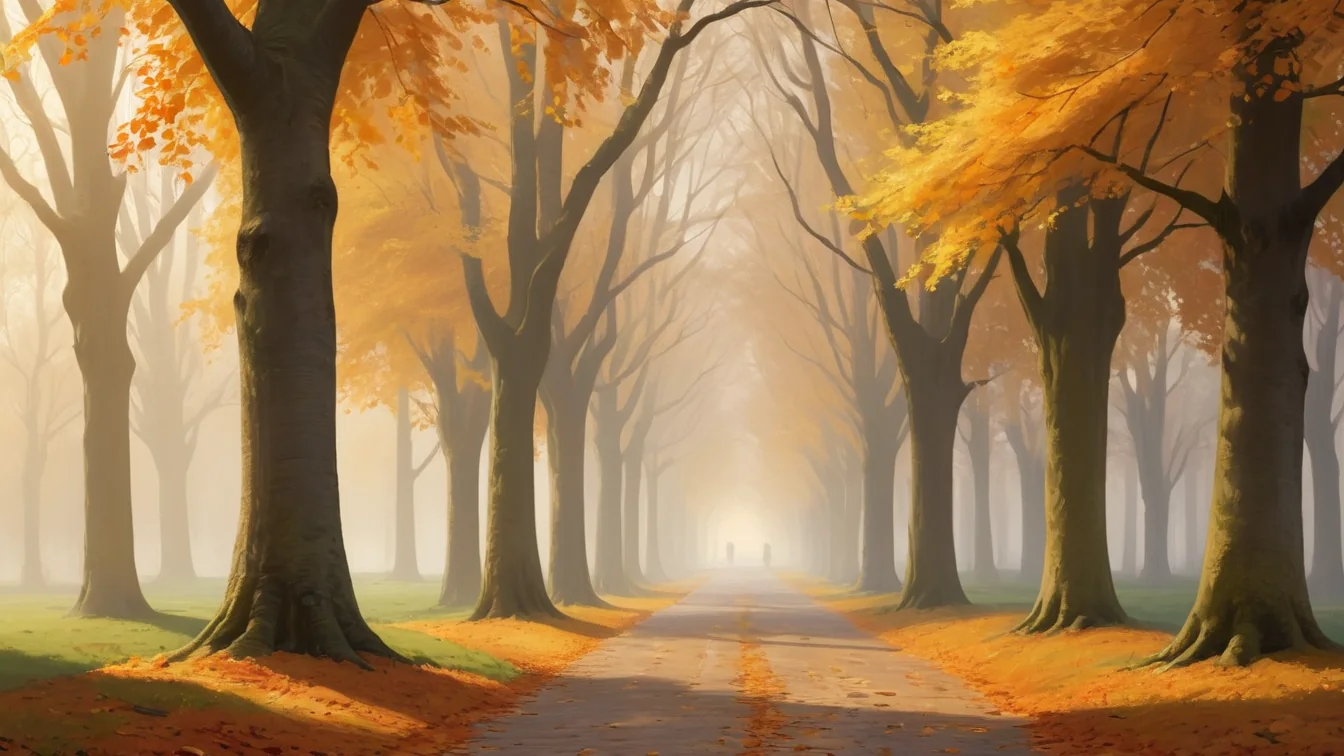
Every autumn, many trees put on a show of gold, orange and red. It can look as if the tree is painting its leaves for the season. The real story is more interesting. Many of the colours were in the leaf all along, hidden by green. Autumn changes what happens to the green.
The short answer: Leaves look green because of chlorophyll. In autumn, the tree breaks chlorophyll down, so yellow and orange pigments called carotenoids become visible. Many trees also make red pigments called anthocyanins, mostly in autumn.[1][2]
Green is a mask
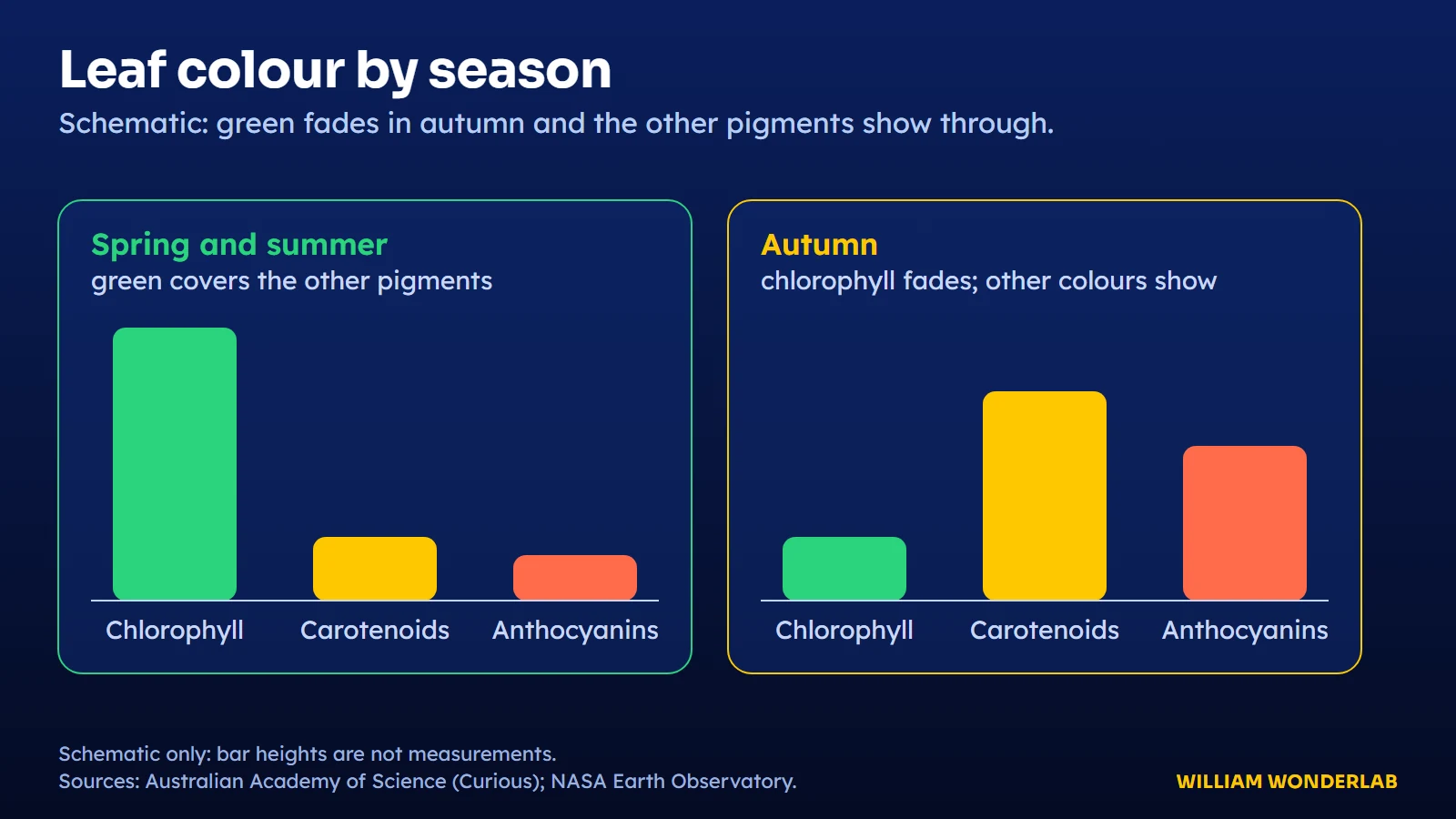
Chlorophyll is the pigment that gives leaves their green colour in spring and summer.[3] It absorbs light most strongly in the red and violet parts of the spectrum. The green light is transmitted and reflected, so the leaf looks green.[2]
Other pigments are present in the leaf too. In leaves, the carotenoids are usually masked by the chlorophylls.[2] While the leaf is green, the chlorophyll is strong enough to hide them.
Autumn: the chlorophyll breaks down
Chlorophyll is not a stable compound, so plants have to keep making it.[4] Making it needs ample sunlight and warm temperatures.[4] When temperatures drop and days shorten, levels of chlorophyll drop as well.[4]
Come autumn, the tree starts to break down the chlorophyll.[1] As the quantity of chlorophyll in the leaf declines, the carotenoids become visible.[2] The yellows and oranges are caused by varying amounts of carotenoids.[1] Carotenoids absorb blue-green and blue light, so they appear yellow.[4]
Red leaves come from anthocyanins
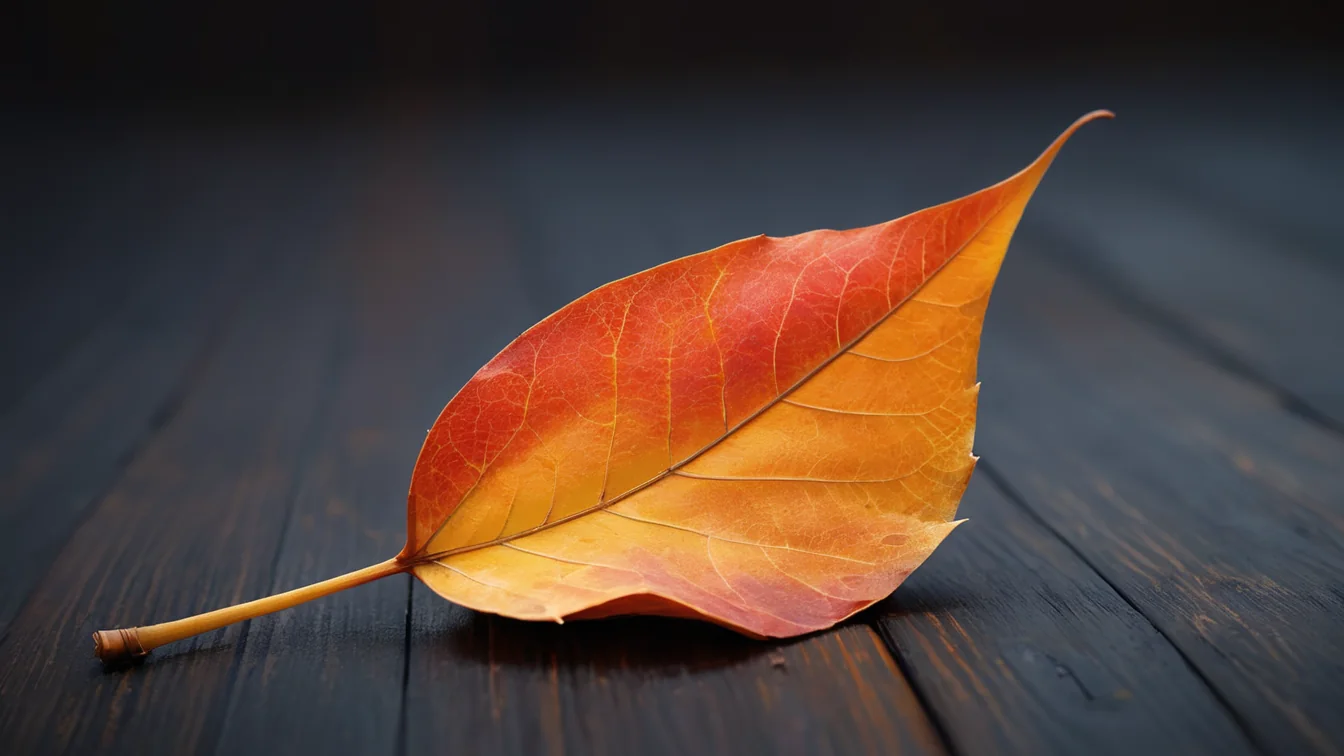
The red and purple colours are produced by a chemical called anthocyanin.[1] Some trees have anthocyanin in their leaves throughout the year, but many only produce this chemical in the autumn.[1] Anthocyanins absorb blue, blue-green and green light, so they appear red.[4]
As green chlorophyll fades, other leaf pigments, carotenoids and anthocyanins, show off their colours.[4] Weather matters too. If the weather stays above freezing, it is easier for anthocyanins to form, and the brightest autumn colours occur when dry, sunny days are followed by cool, dry nights.[5]
Why trees drop their leaves
Deciduous trees lose their leaves to conserve energy during the winter months.[1] It is hard for broadleaf trees to keep their leaves healthy in these conditions, so many species do not even try.[1]
Australian trees: evergreen and deciduous
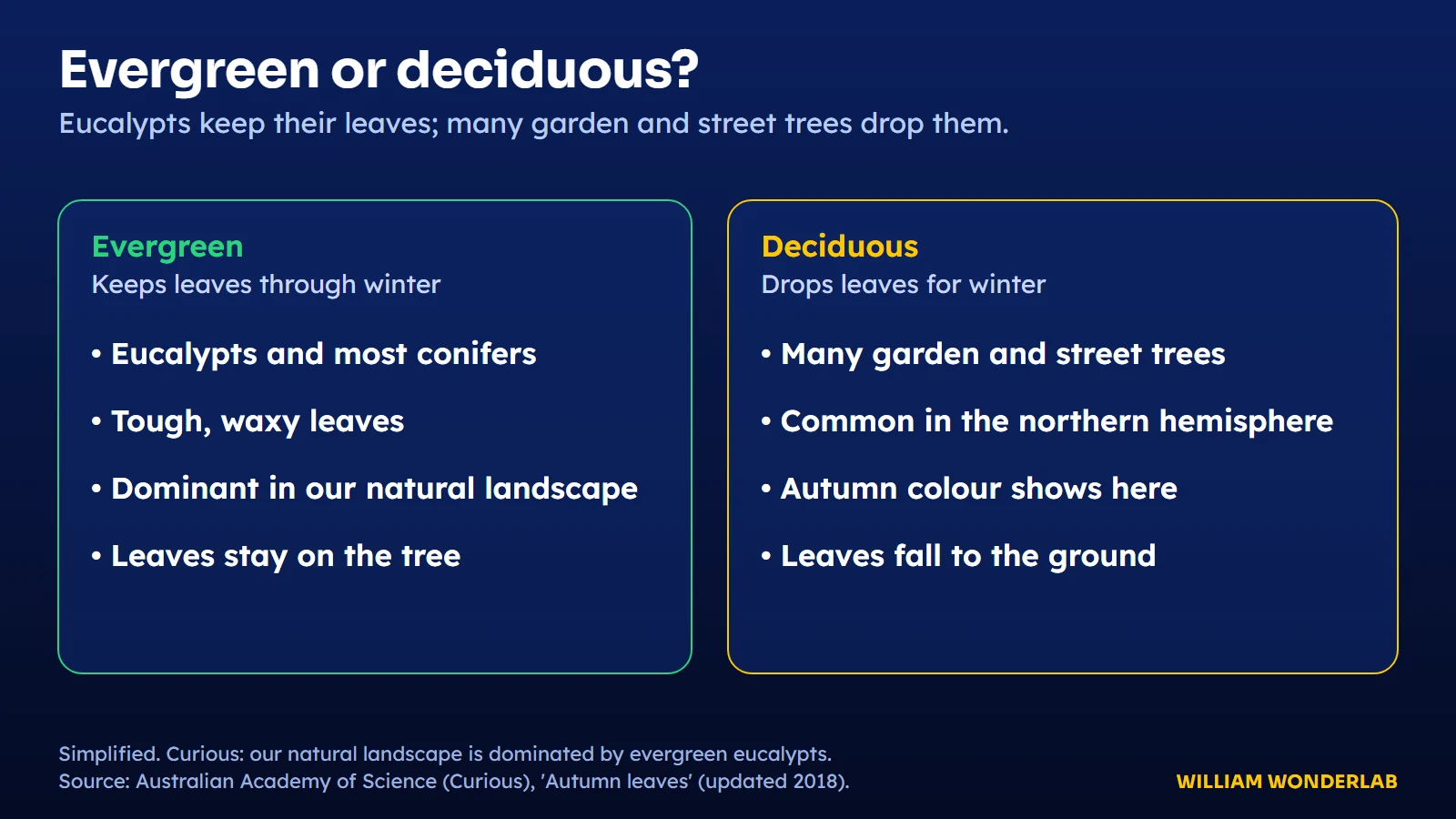
Our natural landscape is dominated by evergreen eucalypts. Eucalypts are evergreens, and unlike many northern hemisphere trees that drop their leaves in winter, they have leaves all year.[6] Evergreen trees, like eucalypts and most conifers, have tough waxy leaves that can withstand the harsh conditions of winter.[1] Many gardens and streets, though, are lined with deciduous trees native to the northern hemisphere.[1]
Did you know? Some oak trees hang on to their dead, brown leaves until new growth arrives in spring.[1]
Try it: a leaf colour log
You need: a notebook, a camera or phone, and one tree you can observe safely, such as a tree at school, at home or in a park where you have permission.
- Choose one tree and name it if you can.
- Each week for a month, look at a section of branch you can reach safely. Note whether most, some or few leaves are green, yellow, orange, red or brown.
- Take a photo from the same spot each week.
- Compare your tree with a different kind of tree nearby.
What to expect: Trees vary. Record what you see rather than expecting a set pattern.
Safety first: Observe from the ground, and never climb or reach into high branches. Wash your hands after touching leaves. Do not eat leaves, berries or seeds, and do not touch plants you cannot identify. Some people react to pollen or plant sap, so stop if your skin or eyes itch. Ask permission before you observe a tree in a park or someone else’s garden.
Go deeper: why each colour appears
Each pigment absorbs different colours
A pigment looks coloured because it absorbs some wavelengths of light and lets others through or reflects them. Chlorophyll absorbs red and violet light most strongly.[2] Carotenoids absorb blue-green and blue light and appear yellow.[4] Anthocyanins absorb blue, blue-green and green light and appear red.[4]
Why the change happens
Chlorophyll levels fall when the days shorten and temperatures drop.[4] Because the tree has to keep making chlorophyll, and that process needs ample sunlight and warm temperatures, the balance shifts as the season turns.[4] Once chlorophyll falls, the other pigments in the leaf can be seen.
Scientists still debate why trees make anthocyanins. One idea is photoprotection: the pigments may defend the leaf’s photosynthetic system from high light levels. A 2022 review by Simcha Lev-Yadun describes this as one hypothesis among several, and notes that in many studies “no photoprotective function was found.”[7]
Frequently asked questions
Why are leaves green in summer?
Chlorophyll gives leaves their green colour in spring and summer, and its green colour hides the carotenoids underneath.[3][2]
Why do leaves turn yellow?
As chlorophyll breaks down, the carotenoids that were masked become visible. They appear yellow because they absorb blue-green and blue light.[2][4]
Why are some autumn leaves red?
Many trees make anthocyanins, mostly in autumn, and these pigments absorb blue, blue-green and green light so they appear red.[1][4]
Do eucalypts change colour in autumn?
Eucalypts are evergreens, so they have leaves all year.[6] Many gardens and streets are lined with deciduous trees native to the northern hemisphere, and those are the trees that drop their leaves.[1]
The big idea
Less green, more colour. Chlorophyll levels fall as days shorten and temperatures drop. Yellow and orange carotenoids show through, and many trees also make red anthocyanins, mostly in autumn.
Related reading
More from William Wonderlab:
Explore more from scientists:
- Autumn leaves (Australian Academy of Science, Curious)
- Superior Fall Colors (NASA Earth Observatory)
- Why Do Leaves Change Color? (NASA Earthdata)
References
[1] Australian Academy of Science, “Autumn leaves” (Curious) (accessed 25 October 2026)
[2] LibreTexts Biology (Kimball), “3.18: Chlorophylls and Carotenoids” (accessed 25 October 2026)
[3] NASA Earthdata, “Why Do Leaves Change Color?” (accessed 25 October 2026)
[4] NASA Earth Observatory, “Superior Fall Colors” (accessed 25 October 2026)
[5] NASA Earth Observatory, “Fall Colors in the Mid-Atlantic” (accessed 25 October 2026)
[6] Australian Academy of Science, “The story of our eucalypts” (Curious) (accessed 25 October 2026)
[7] Simcha Lev-Yadun, “The phenomenon of red and yellow autumn leaves: Hypotheses, agreements and disagreements”, Journal of Evolutionary Biology (2022), PubMed Central (accessed 25 October 2026)