Why Do We Yawn?
Scientists are still working out why we yawn. The main ideas are brain cooling, a brief wake-up effect and social spreading, and none is settled.

You might be yawning as you read this. A yawn is a long, wide opening of the mouth, usually with a deep slow breath in and a stretch of the jaw, followed by a breath out. People yawn when they are tired and when they are bored. It is also common just after waking and just before sleep. Yet something this familiar is still a puzzle. Scientists have several ideas, and none has been fully proven.
The short answer: Scientists are still not certain why we yawn. The main ideas are that yawning may help cool the brain, may give the brain a brief boost in alertness, and spreads between people for social reasons that may be linked to empathy. The older idea that yawning brings in extra oxygen has mostly been disproven.[1]
The main ideas
Arizona State University’s Ask A Biologist puts it plainly: “scientists are still figuring out why, and they’ve come up with a few strong theories.” Even so, it adds, “scientists still haven’t settled on a single explanation for why we yawn.”[1]
The diagram below summarises four ideas and how well each is supported. The labels describe the state of the evidence, not a final verdict.
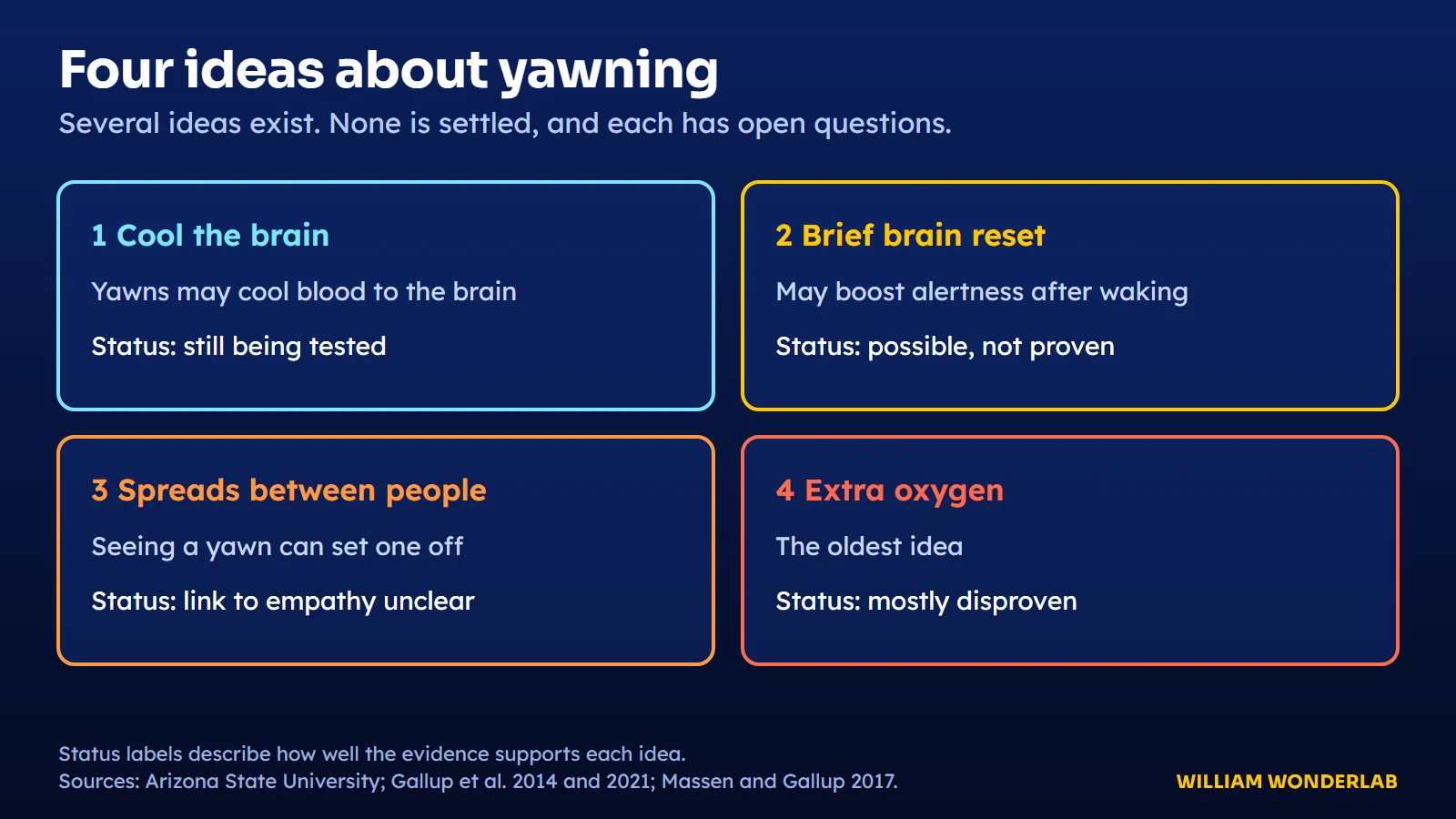
Idea one: yawning may cool the brain
The brain-cooling idea is the one researchers have tested most. The proposal is that a deep breath draws in air that is cooler than the body, and that this changes the blood reaching the brain. Think of a fan blowing across a warm room: it moves air so that the room feels cooler. A yawn is proposed to do something similar for the brain.
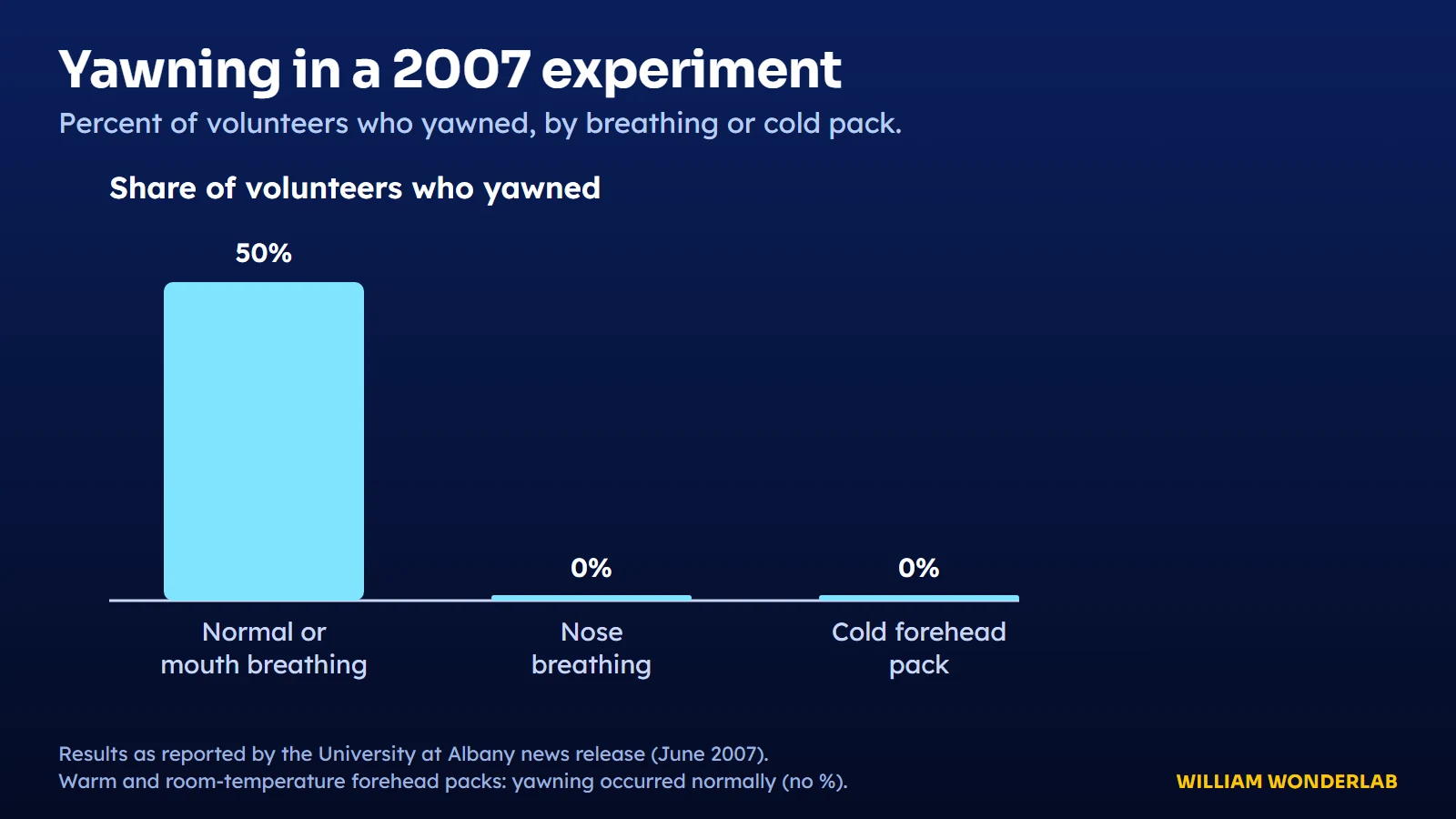
In 2007, researchers at the University at Albany tested this in a series of experiments. When volunteers were told to breathe normally or through their mouths, 50 per cent of them yawned while watching other people yawn. Those told to breathe through their nose did not yawn at all.[2] In a second test, a cold pack held to the forehead stopped yawning, while a warm pack or a room-temperature pack did not.[2]
The same idea has supporters. A 2014 review by Andrew Gallup in Frontiers in Neuroscience says that “research supporting the brain cooling hypothesis has accumulated over the past 5 years.”[3] The review also calls for future studies of people with unusually frequent yawning to measure brain temperature continuously. In other words, the idea is promising, but it has not yet been tested in the most direct way.[3]
An Arizona State University summary notes one study in which people holding warm packs yawned more than those holding cool packs.[1] That fits with the cooling idea, but it is still a small body of evidence.
Idea two: a brief wake-up effect
Another idea is that yawning gives the brain a short reset. Arizona State University describes yawning as possibly giving the brain a “quick reset” that increases alertness, and notes that yawns are common after waking and before sleep.[1] The brain-cooling and wake-up ideas are not necessarily rivals. Researchers have not yet shown how the two might connect, so they are best treated as separate possibilities.
Did you know? Yawns are common just after waking and just before sleep, according to Arizona State University.[1]
Idea three: yawns that spread between people
Yawns spread. Arizona State University says that yawning “is socially contagious, which means seeing, hearing, or even reading about someone yawning can make you do it too.”[1]
Some researchers have linked contagious yawning to empathy, which is the ability to understand and share what another person is feeling. A 2021 study by Gallup and colleagues found that the results “are consistent with an indirect link between contagious yawning and empathy,” but also “align with functional accounts of spontaneous and contagious yawning.”[4] In plain terms, the findings fit more than one explanation.
A 2017 review by Jorg Massen and Andrew Gallup in Neuroscience and Biobehavioral Reviews went further. It found “a pattern of inconsistent and inconclusive evidence regarding the connection between contagious yawning and empathy.”[5] The authors recommended more rigorous studies, using objective measures.[5]
Why the oxygen idea fell away
For a long time, many people thought yawning was a way to take in more oxygen. It is a sensible guess, because a yawn is a very deep breath. But Arizona State University notes that “older ideas, like yawning to get more oxygen, have mostly been disproven.”[1] The lesson is a useful one for science in general: an idea that sounds right still needs to be tested.
Go deeper: how researchers test an idea
Change one thing at a time
Scientists test explanations by changing one factor and watching what happens. The 2007 Albany experiments did this with breathing and with forehead temperature. If nose breathing stops yawns, and a cold pack stops yawns, that is evidence that cooling the airflow or the forehead matters for yawning.[2]
These results are interesting, but they do not prove the whole idea. A yawn in a laboratory is not the same as a yawn during a long day at school or work, and an experiment can only test the factors that its designers chose to change.
Why contagious yawning is hard to measure
Counting yawns sounds simple, but it is not. People may yawn because they are tired, bored or simply paying attention to someone else. Massen and Gallup’s review says that research on the empathy link needs “more rigorous investigation,” and recommends objective measurements to test it directly.[5] Measuring the body directly, such as its temperature, would help separate the cooling idea from the social ones.[3]
Frequently asked questions
Do scientists know why we yawn?
Not for certain. Arizona State University says scientists have several strong theories but have not settled on a single explanation.[1]
Does yawning bring more oxygen into the body?
That idea has mostly been disproven, according to Arizona State University.[1]
Can seeing or reading about a yawn make you yawn?
Yes, that is one of the best-known features of yawning. Arizona State University describes yawning as socially contagious, including when people only see, hear or read about it.[1]
Is contagious yawning linked to empathy?
Some researchers think so, but the evidence is inconsistent. Massen and Gallup’s 2017 review found “inconsistent and inconclusive evidence” on the link.[5]
Did the Albany experiment show that a cold pack stops yawning?
In that experiment, participants holding a cold pack to the forehead did not yawn, while those holding warm or room-temperature packs yawned normally.[2] It was a laboratory test with a particular group of volunteers, so it is a clue, not a final answer.
Is there a single answer I can take away?
No. The best honest answer is that yawning probably serves more than one purpose, and researchers are still working out which ideas are right.[1][4]
The big idea
A yawn is still a puzzle. Brain cooling, a brief wake-up effect and social spreading are the main ideas. Each has supporting studies, and each has open questions. The science is still moving, so the honest answer is that we do not yet know everything about why we yawn.
Related reading
More from William Wonderlab:
Explore more from scientists:
- Why do we yawn? (Arizona State University, Ask A Biologist)
- Abnormal yawning in stroke patients: the role of brain thermoregulation (Frontiers in Neuroscience, 2014)
- What’s in a Yawn? Ask UAlbany Researchers (University at Albany, 2007)
References
[1] Arizona State University, “Why do we yawn?” (Ask A Biologist) (accessed 25 October 2026)
[2] University at Albany, State University of New York, “What’s in a Yawn? Ask UAlbany Researchers” (news release, June 2007) (accessed 25 October 2026)
[3] Gallup, A. C., “Abnormal yawning in stroke patients: the role of brain thermoregulation”, Frontiers in Neuroscience (2014) (accessed 25 October 2026)
[4] Gallup, A. C., Kret, M. E., Eldakar, O. T., Folz, J. and Massen, J. J. M., “People that score high on psychopathic traits are less likely to yawn contagiously”, Scientific Reports (2021) (accessed 25 October 2026)
[5] Massen, J. J. M. and Gallup, A. C., “Why contagious yawning does not (yet) equate to empathy”, Neuroscience and Biobehavioral Reviews, vol. 80 (2017), pp. 573-585 (accessed 25 October 2026)