Why Do Onions Make You Cry?
Cutting an onion breaks open its cells and starts a chemical chain that makes a volatile irritant. It reaches your eyes and triggers tears.

Few kitchen jobs are as teary as slicing an onion. You can be fine for the first few cuts, and then your eyes are suddenly streaming. What is the onion doing to you?
The short answer: Cutting an onion breaks open its cells. An enzyme and other chemicals inside the onion mix together and form a compound called the lachrymatory factor. This compound is volatile, which means it easily turns into a vapour and drifts through the air. When the vapour reaches your eyes, your nerves detect it and your tear glands respond.[1][2]
Cutting breaks open the cells
Plants are made of tiny units called cells, and each cell is like a small room with its own contents. When you cut or peel an onion, you break open those cells. Poison control experts describe it this way: when onions are damaged, such as when they are peeled or cut, the chemistry inside them starts to change.[3]
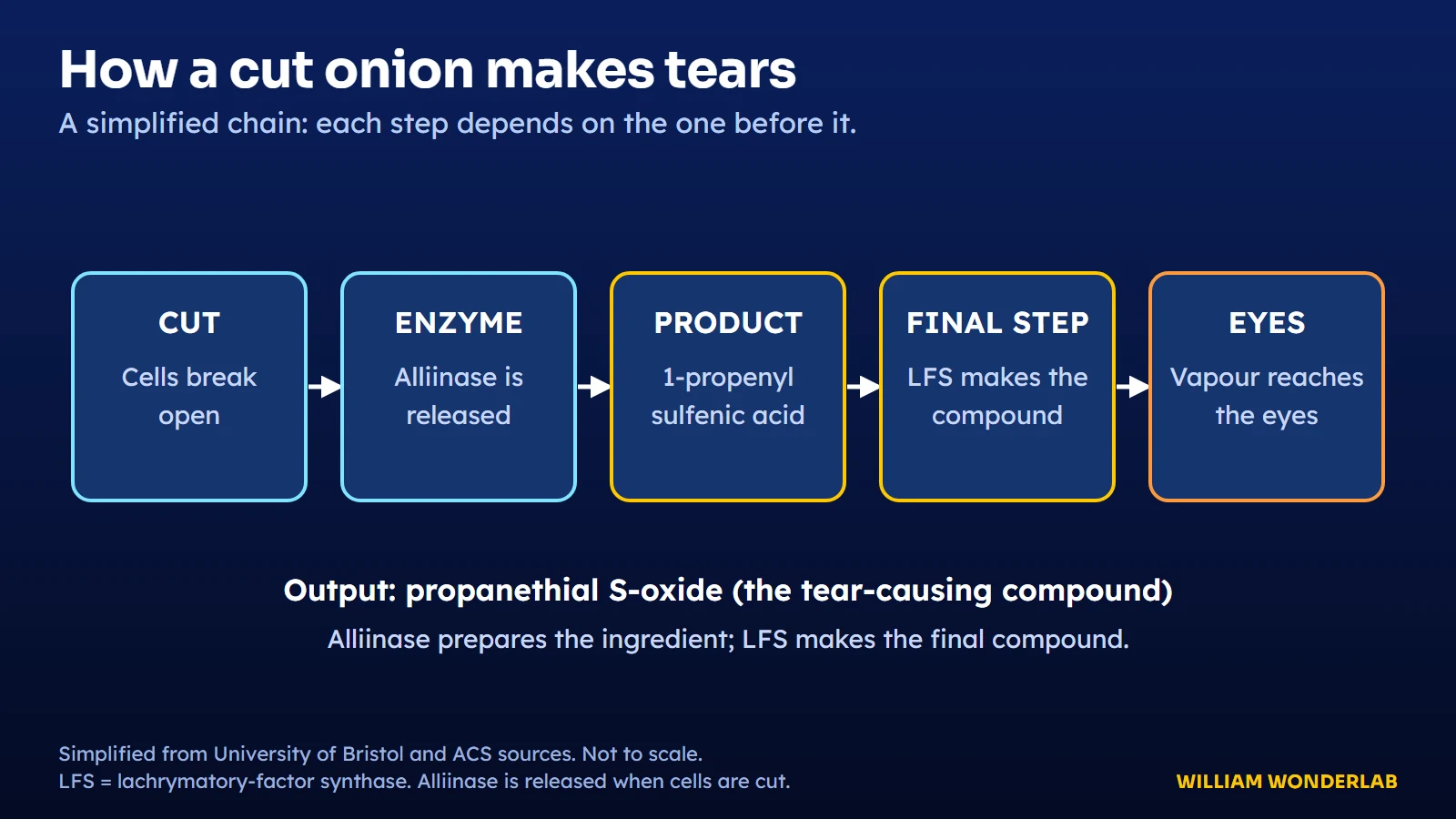
Cutting releases an enzyme called alliinase. An enzyme is a protein that speeds up a chemical reaction, a bit like a helper that makes a job happen faster. The enzyme is released from the injured cells and starts working on the chemicals around it.[3]
The chemical chain that makes the compound
Alliinase acts on a sulfur-containing precursor, which is a starting ingredient in the onion. The reaction makes a mixture of products. One of them is 1-propenyl sulfenic acid, an intermediate, which is a step on the way to the final product.[1]
A second enzyme then does the final step. Scientists in Japan identified it, named it lachrymatory-factor synthase (LFS), and found that it converts the intermediate into the compound called propanethial S-oxide.[1][2] This is the compound that makes you cry.
Think of it as a two-part recipe. Alliinase prepares the ingredients, and LFS makes the final dish. Older accounts credited alliinase with the whole job, but a separate enzyme does the last step.[1]
Why the vapour reaches your eyes
The name tells you the job. “Lachrymatory” comes from the Latin word for tear, lacrima. Propanethial S-oxide is described as a lachrymator, an irritant that causes the eyes to fill with tears without damaging them.[1]
Because the compound is volatile, its vapour drifts through the air to your face.[1] A 2012 study measured the gases from freshly cut onions in real time and identified propanethial S-oxide, the lachrymatory factor, as one of the compounds released.[4]
Once the vapour reaches the eye, it is detected by the nervous system. This triggers a response from the lachrymal (tear) glands.[1] That response is the stinging and watering you feel. Your body is trying to rinse the irritant away.
Did you know? The word “lachrymatory” comes from the Latin lacrima, meaning tear. The same root gives us the word “lachrymose”, which means tearful.
Go deeper: enzymes, tearless onions and the lab
How scientists studied the enzyme
Researchers have worked out the enzyme’s role in more detail over time. In 2017, an American Chemical Society press release reported that a research team determined the three-dimensional shape, or crystal structure, of LFS and analysed it.[2] Knowing the shape helps scientists explain how the enzyme does its job. The same release notes that the compound “evaporates or breaks down easily”.[2]
Tearless onions
Scientists have also bred onions that make much less of the irritant. A 2016 study in Scientific Reports described onions made by irradiating seeds with neon ions. The authors describe the method as non-transgenic, meaning no foreign genes were added. The researchers reported levels of the lachrymatory factor about 7.5 times lower than in a normal onion, and no tear-inducing property when 20 sensory panellists tested them.[5]
The chart below shows what that reduction means. A reduction of 7.5 times means the level is about one-seventh of normal, so the normal onion is 100 and the tearless line is about 13.
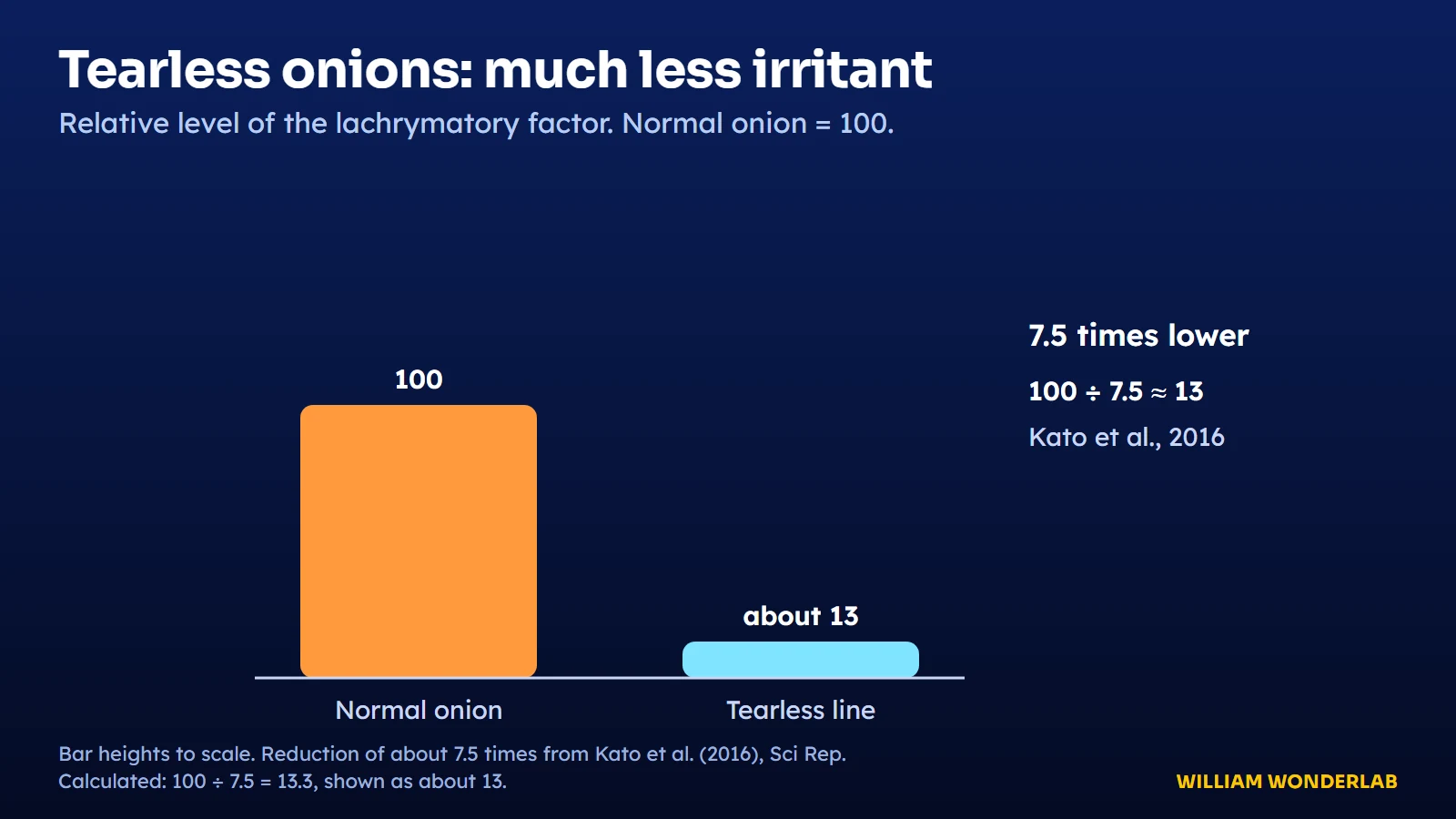
The tearless onions came from a research method using irradiated seeds. It is a laboratory technique, not a kitchen trick.
Myth check: does the compound turn into acid?
Some websites say the compound forms acid in your eyes. The University of Bristol source says a small amount of the vapour reacts in the eye to form sulfuric acid, and this causes the burning and itching that come with the tears.[1] The tears themselves are the body’s response: the irritant is detected by the nerves, and the tear glands respond.[1]
Try it: an adult cuts, you observe
This is a proposed at-home activity. It is observation only, and an adult does all of the cutting.
You need: one onion, a cutting board, a sharp knife (handled by an adult only), a timer or clock, and a notepad.
- Predict how far away a person could stand and still smell the onion, and how long it might take.
- An adult cuts the onion in a well-ventilated kitchen. Everyone else stays on the far side of the room.
- Each person writes down the time they first notice the smell, the time their eyes start to sting, and how far away they were standing.
- Compare the results with your prediction. Talk about why people may have noticed the smell or sting at different times.
Safety first: An adult should do all cutting and handle the knife, and no one should reach across the board. Keep the onion, board and knife away from the edge of the bench. Wash your hands afterwards and do not rub your eyes. If your eyes sting strongly, step into fresh air and wash your face with clean water. If you wear contact lenses, take them out before cutting, or skip this activity. Keep onion away from pets, because onions can harm dogs and cats. If eye irritation lasts or worries you, speak with a doctor, nurse or pharmacist.
Frequently asked questions
What is the lachrymatory factor?
It is the name for the compound that makes your eyes water when you cut an onion. Its chemical name is propanethial S-oxide.[1]
Is the stinging from acid?
Partly. The University of Bristol source says a small amount of the vapour reacts in the eye to form sulfuric acid, and this adds to the burning and itching. The tears are the body’s response to the irritant, which the nerves detect.[1]
Does only cutting release the chemical?
No. Any damage to the onion’s cells can start the reaction, including peeling.[3]
Can I buy an onion that does not make me cry?
Tearless onions have been produced in research using irradiated seeds, which is a laboratory method.[5]
What should I do if my eyes keep stinging?
Eye irritation that lasts or worries you should be checked by a doctor, nurse or pharmacist.
The big idea
Cut cells, make a compound, then tears. Cutting an onion releases enzymes that form a volatile irritant. The vapour reaches your eyes, your nerves detect it, and your tear glands respond.
Related reading
More from William Wonderlab:
Explore more from scientists:
- Propanethial S-oxide: The lachrymatory factor in onions (University of Bristol)
- The nitty-gritty behind how onions make you cry (American Chemical Society, via ScienceDaily)
- Production and characterization of tearless and non-pungent onion (Scientific Reports, PubMed Central)
References
[1] University of Bristol, School of Chemistry, “Propanethial S-oxide: The lachrymatory factor in onions (Molecule of the Month, September 2007)” (accessed 25 October 2026)
[2] American Chemical Society (via ScienceDaily), “The nitty-gritty behind how onions make you cry” (accessed 25 October 2026)
[3] American Association of Poison Control Centers, “Why do onions make you cry?” (accessed 25 October 2026)
[4] Løkke et al., Sensors (Basel) 2012, “Investigation of Volatiles Emitted from Freshly Cut Onions (Allium cepa L.) by Real Time Proton-Transfer Reaction-Mass Spectrometry (PTR-MS)” (accessed 25 October 2026)
[5] Kato et al., Scientific Reports 2016, “Production and characterization of tearless and non-pungent onion” (accessed 25 October 2026)