How Do Vaccines Train Your Immune System?
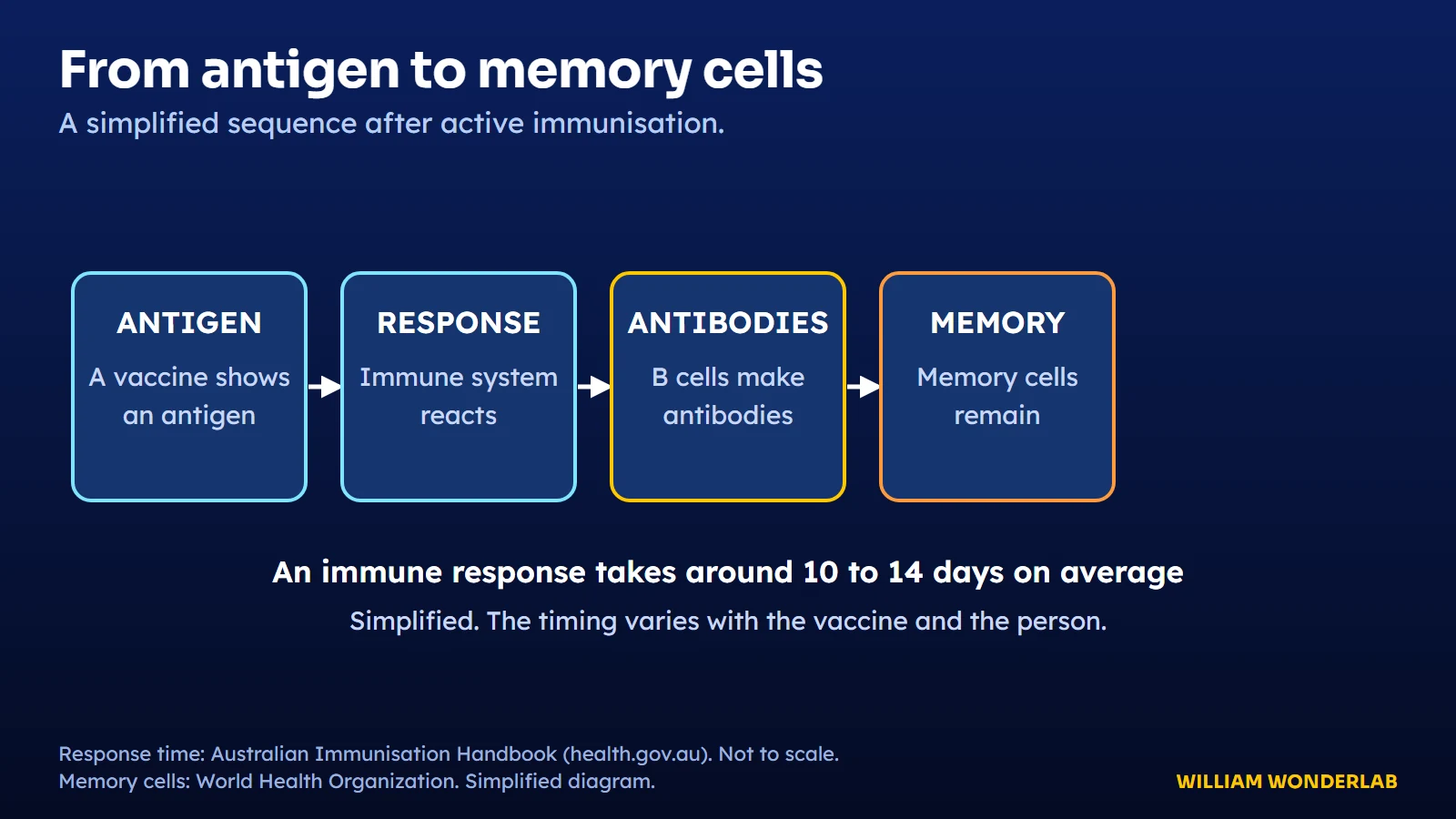
A vaccine shows the immune system a harmless part of a germ so the body can learn to respond. The learning leaves memory cells that can respond faster later.

Your body is surrounded by germs, and most of the time your immune system keeps them under control without you noticing. A vaccine works by giving that system practice. It is general education, not medical advice, so let’s look at how the training works.
The short answer: A vaccine introduces an antigen, which is a part of a germ that the immune system can recognise, and it does this without causing the illness. The immune system responds by making antibodies. It also keeps memory cells. If the real germ arrives later, those memory cells help the body respond more quickly.[1][2][3]
Germs carry antigens
Every germ has features the immune system can recognise. The WHO defines the part that prompts antibodies to form as an antigen: “The subpart of a pathogen that causes the formation of antibodies is called an antigen.”[3] Antigens are the signal the immune system uses to identify a specific germ.
Vaccines contain antigens. Better Health, a Victorian Government service, explains that vaccines usually introduce a dead or weakened version of a germ, and it calls the antigens “the most important ingredient of all vaccines.”[4]
Not every vaccine uses a whole germ. The Australian Immunisation Handbook says that vaccines contain “one or more antigens” that stimulate an active immune response.[2] Some vaccines teach your cells to make a single protein from the germ instead. NCIRS explains that “the immune system recognises this protein as foreign and responds.”[5]
The immune system responds
Once the immune system meets an antigen, it starts a response. Health.gov.au puts it simply: vaccines work by producing an immune response in the body without causing illness.[1]
The main output is antibodies. The Handbook notes that “most vaccines work by inducing B-cells to produce antibodies that bind to a specific pathogen or toxin.”[2] Think of an antibody as a tag that sticks to one particular target. It does not stick to every germ, only to the one it was made for.
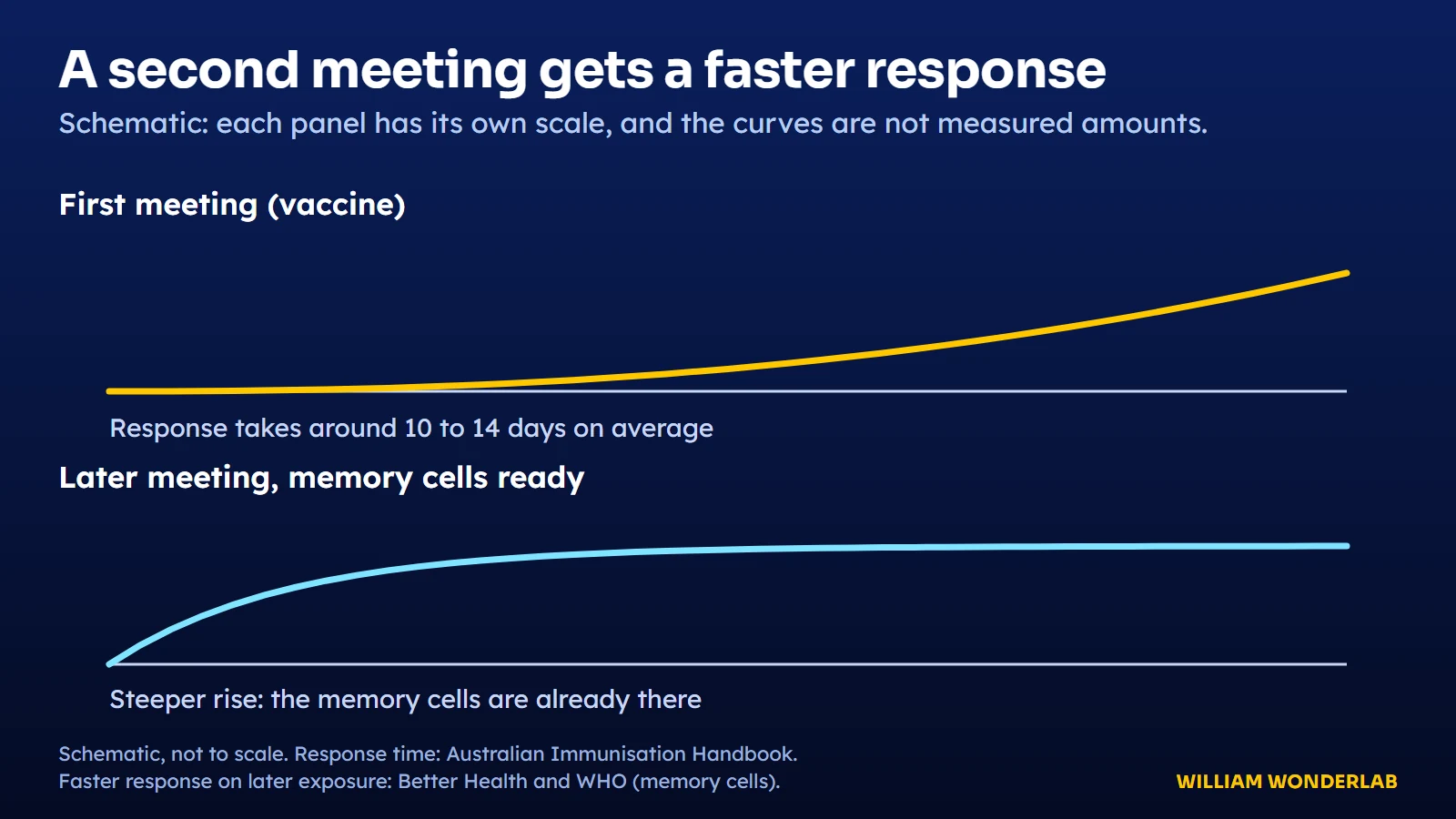
This response takes time. The Handbook gives an average of “around 10 to 14 days” for an immune response.[2]
Memory cells keep the record
The immune system does not forget everything once the threat is gone. The WHO explains that the body “also creates antibody-producing memory cells, which remain alive even after the pathogen is defeated by the antibodies.”[3] Health.gov.au describes them as special “memory” cells that remember and recognise specific germs or viruses.[1]
Better Health adds that some antibodies “remain ‘on patrol’ in our bloodstream,” which helps explain why the body can react quickly to a germ it has met before.[4]
Did you know? Natural infection can leave memory that lasts a very long time. The Australian Academy of Science notes that a small number of lymphocytes survive for months or years after an infection is cleared, and that in the case of measles, “that memory has been shown to last for more than 60 years.”[6]
Why a second meeting can be faster
When your immune system meets the same germ again, the memory cells can act quickly. Health.gov.au says that when you come across the virus in the future, “your immune system rapidly produces antibodies to destroy it.”[1] Better Health says the body “responds quickly and creates antibodies and memory cells to give the body protection.”[4]
This is the central idea of vaccination. The first meeting is a practice run, so that the body has a trained response ready before it matters.
Why some vaccines need more than one dose
Sometimes one dose is not enough to build a strong response. The Handbook says that “children and adults may need several doses of a vaccine to induce a protective immune response.”[2] Your immunisation schedule or a health professional can explain which doses apply to a specific vaccine.
Myth: a vaccine works by giving you the disease
A vaccine is designed to produce an immune response without causing the illness.[1] The training is the immune response itself. The point is to build protection, not to make the disease happen.
Go deeper: two arms, helpers and how long protection lasts
Two arms of the immune response
The antibodies described above are one part of the response. The Handbook explains that some vaccines also generate T-cell-mediated immunity, which is also called cellular immunity.[2] The two parts of the response work differently, and different vaccines produce different mixes of them.
Helpers that boost the response
Some vaccines contain adjuvants, which are ingredients added to strengthen the response. NCIRS describes them as “adjuvants that help strengthen the immune system’s response to the antigen so less vaccine or fewer doses are needed.”[7]
How long protection lasts
Protection depends on several things. The Handbook says that “immunity after active immunisation generally lasts for months to many years,” and that this “depends on the nature of the vaccine, the type of immune response (antibody or T-cell) and host factors.”[2] The WHO notes that, for some diseases, people who have received doses can remain protected for “years, decades or even a lifetime.”[8]
Frequently asked questions
Does every vaccine contain a whole germ?
No. Vaccines contain one or more antigens. Some use a dead or weakened version of a germ, and others use a single part of a germ or instructions for making one part of it.[2][5]
Is an antibody the same as a memory cell?
No. Antibodies are the molecules that bind to a particular germ or toxin. Memory cells are immune cells that stay in the body and help it respond quickly if the same germ returns.[1][3]
Why does a vaccine take time to work?
The immune system needs time to recognise the antigen and produce antibodies. The Handbook gives an average of around 10 to 14 days for an immune response.[2]
How long does protection last?
It depends on the vaccine, the disease and the person. The Handbook notes that the duration varies, and the WHO notes that protection can last for years, decades or a lifetime for some diseases.[2][8]
What should I ask about my own vaccines?
This article is general education only. For personal questions about your health or a vaccine, speak with a doctor, nurse or pharmacist.
The big idea
Practice builds protection. A vaccine shows the immune system an antigen so it can make antibodies and memory cells. If the germ arrives later, the memory cells help the body respond more quickly.
Related reading
More from William Wonderlab:
Explore more from scientists:
- About immunisation (Australian Government Department of Health and Aged Care)
- What is immunisation? (Australian Academy of Science)
- How do vaccines work? (World Health Organization)
References
[1] Australian Government Department of Health and Aged Care, “About immunisation” (accessed 25 October 2026)
[2] Australian Government Department of Health and Aged Care, “Australian Immunisation Handbook: Fundamentals of immunisation” (accessed 25 October 2026)
[3] World Health Organization, “How do vaccines work?” (accessed 25 October 2026)
[4] Better Health Channel (Victoria), “Vaccines” (accessed 25 October 2026)
[5] National Centre for Immunisation Research and Surveillance (NCIRS), “How vaccines are developed” (accessed 25 October 2026)
[6] Australian Academy of Science, “1. What is immunisation?” (accessed 25 October 2026)
[7] National Centre for Immunisation Research and Surveillance (NCIRS), “Vaccine ingredients” (accessed 25 October 2026)
[8] World Health Organization, “Vaccines and immunization: What is vaccination?” (accessed 25 October 2026)