Why Do We Need Sleep?
Sleep gives the brain time to store memories and clear waste. Here is what researchers have found, and what health authorities recommend for children.

Everyone sleeps, but very few people enjoy being asked why. Your body does not switch off while you sleep. Your brain stays busy, sorting the day’s experiences and tidying up. This article is general education only, not medical advice.
The short answer: Sleep gives the brain time to do jobs that are hard to do while we are awake. Researchers think sleep helps the brain store memories for the long term,[1] and the University of Rochester says the brain’s waste-clearing system is most active during deep sleep.[2] Studies in mice, including a 2013 study in the journal Science, describe this clearing during sleep.[8]
Sleep helps store what you learned
Think about learning a new song. You practise it in the afternoon, and by the next morning you can sing more of it. Something happened while you slept.
Yale Medicine explains that memory consolidation is “a process that researchers think occurs during sleep, particularly slow-wave sleep.” In that process, “encoded sequences are integrated by chemical connections into new and existing neuronal knowledge networks” and are “filed for long-term storage in the neocortex.”[1]
The Sleep Health Foundation lists some of the body’s work during sleep: sleep helps the body “repair and regenerate tissues, consolidate memories, and support cognitive functions like learning and problem-solving.”[3] Healthdirect adds that REM sleep, the stage with the most vivid dreaming, is “important for learning and creating new memories.”[4]
The word consolidation means making a memory stronger and more stable. The word neocortex means the outer layer of the brain, where many long-term memories are stored. Slow-wave sleep is a deep stage of sleep, when brain activity moves in slow, large waves.
This is still an active area of research, so scientists describe these ideas as their best current understanding rather than a finished story.

Sleep helps the brain clean itself
Scientists have found a waste-clearing system that flows through the brain, mostly by studying mice. The University of Rochester describes it this way: “This system uses cerebrospinal fluid to flush away proteins such as beta-amyloid and tau.”[2] Cerebrospinal fluid is the clear liquid that surrounds the brain and spinal cord.
Think of it like a city’s street-sweeping crew that works at night, when the roads are quiet. The Rochester article says the cleaning process is “most active during deep, non-REM (rapid eye movement) sleep.”[2] Research on this cleaning system has been done in mice. For example, a 2013 study published in the journal Science watched the brains of “live mice” and found that during sleep the space between brain cells grew by about 60%, which helped wash waste away faster.[8] Scientists are still studying how much of this happens in the same way in people. In those mouse studies, as Yale Medicine puts it, “The system also seems to be most efficient during sleep.”[1]
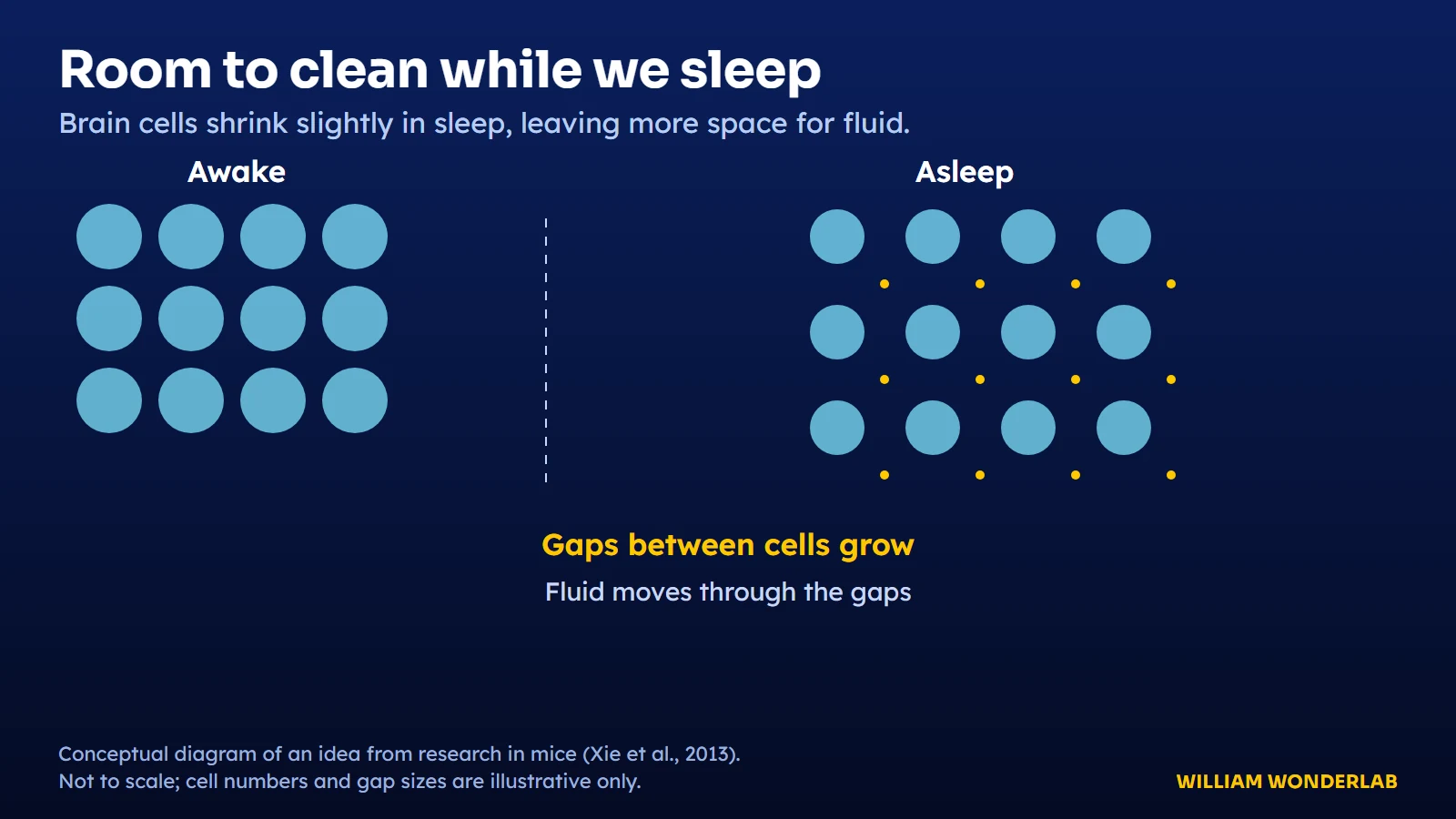
Why does the brain have room to clean at night? The Rochester article explains that “When we sleep, brain cells subtly shrink, creating space for fluid to flow more freely through brain tissue.”[2] In the 2013 mouse study, the space between brain cells grew by about 60% during sleep.[8] The diagram above is a simplified picture of that idea, and it is not to scale.
Did you know? The University of Rochester says the brain’s waste-clearing system is most active during deep, non-REM sleep.[2] The research behind this idea includes studies in mice.[8]
How much sleep do children need?
The NSW Government’s children’s health service gives sleep ranges by age. The table below uses those ranges, which include naps for the youngest children.[5]
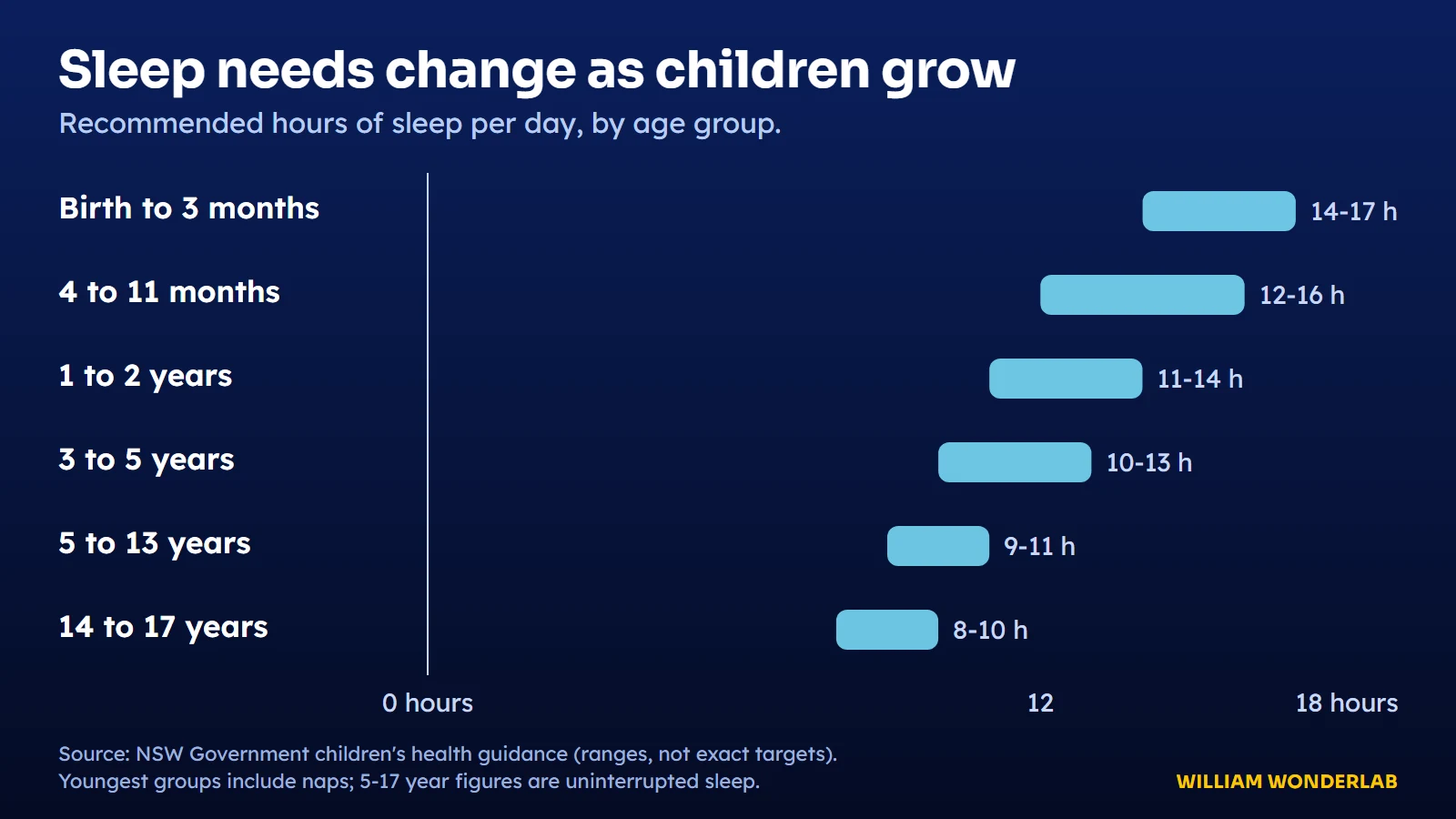
The guidance is clear about the difference between age groups. For children aged 5 to 13 the advice is “9-11 hours of uninterrupted sleep,” and for teenagers aged 14 to 17 it is “8-10 hours of uninterrupted sleep.”[5] “Uninterrupted” means sleep that is not broken up by waking.
The Australian Government’s national movement guidelines give the same hours for young people. They say “children aged 5 to 13 years get 9 to 11 hours of uninterrupted sleep” and “young people aged 14 to 17 years get 8 to 10 hours of uninterrupted sleep.”[6]
The NSW source adds a caution: “Every child is different, so use these sleep recommendations as a general guide.”[5] If you are worried about a child’s sleep, speak with a doctor or a child health professional.
Myth: “Sleep is just doing nothing”
Sleep is not the same as switching off. Memory work happens during sleep, and in mice the brain’s cleaning system is also most active during sleep,[8] so sleep is an active process, not an empty break.[1][2] The US National Heart, Lung, and Blood Institute notes that “A common myth is that people can learn to get by on little sleep with no negative effects.” Its reply is that “research shows that getting enough quality sleep at the right times is vital for mental health, physical health, quality of life, and safety.”[7]
Try it: keep a simple sleep diary
Proposed at-home activity. This is for noticing patterns only. It is not a test and it does not diagnose anything.
You need: a notebook or sheet of paper, and a pencil.
- For one week, write down the time you went to bed and the time you woke up each day.
- Next to each day, note whether you felt rested when you woke up, using a simple word such as “rested”, “tired” or “in between”.
- At the end of the week, look for patterns. Is there a day when you slept later or woke up earlier?
- Share the pattern with a grown-up, and talk about it together.
Safety first: Do not stay up late or skip sleep to finish this activity. If you or a child often have trouble sleeping, feel very tired during the day, or have other worries about sleep, talk to a doctor or a health professional rather than changing things on your own.
Go deeper: memory and the night shift
Why sleep stages matter
Sleep has different stages, and they seem to do different jobs. Slow-wave sleep is linked to memory consolidation,[1] and deep non-REM sleep is when the brain’s cleaning system is most active, according to research that includes studies in mice.[2][8] Healthdirect describes REM sleep as the stage linked to learning and new memories.[4] Researchers are still working out how these stages relate to each other.
Why this matters for adults
The Rochester article links the cleaning system to the proteins beta-amyloid and tau.[2] The 2013 mouse study found that beta-amyloid was cleared faster during sleep in mice.[8] The cleaning system is a research topic, and this article does not say what it means for any particular disease. This article does not give advice about dementia or any other condition. Anyone with concerns about memory or sleep should speak with a doctor.
Frequently asked questions
What happens to memories while we sleep?
Researchers think memories are consolidated during sleep, particularly slow-wave sleep. This means they are linked to existing knowledge and stored for the long term.[1]
Does the brain really clean itself?
The University of Rochester describes a waste-clearing system that flushes proteins such as beta-amyloid and tau. It is most active during deep, non-REM sleep.[2] Studies in mice, including a 2013 study in the journal Science, describe this clearing during sleep.[8]
How many hours do children need?
The NSW Government’s children’s health service gives ranges by age. For 5 to 13 year olds it is 9-11 hours of uninterrupted sleep.[5] The Australian Government’s national guidelines give the same figure.[6]
Why do the recommended hours change with age?
The guidance lists 8-10 hours of uninterrupted sleep for teenagers aged 14 to 17, and 9-11 hours for 5 to 13 year olds.[5][6] The reasons for the differences are not explained in these sources.
Who should I talk to about sleep worries?
A doctor or a child health professional. This article is general education only.
The big idea
Sleep is busy, useful time. While you rest, your brain helps store what you learned and clears away waste. That is why good sleep is part of learning and growing well.
Related reading
More from William Wonderlab:
Explore more from scientists:
- Sleep’s crucial role in preserving memory (Yale Medicine)
- Why is sleep important? Brain and glymphatic system (University of Rochester)
- 24-hour movement guidelines: recommendations for children and young people 5 to 17 years (Australian Government)
References
[1] Yale Medicine, “Sleep’s crucial role in preserving memory” (accessed 25 October 2026)
[2] University of Rochester, “Why is sleep important? The brain’s glymphatic system” (accessed 25 October 2026)
[3] Sleep Health Foundation, “Basics of Sleep” (accessed 25 October 2026)
[4] Healthdirect Australia, “Sleep” (accessed 25 October 2026)
[5] NSW Government, Sydney Children’s Hospitals Network, Kids Health Hub, “Sleep recommendations by age” (accessed 25 October 2026)
[6] Australian Government Department of Health, “Recommendations for children and young people 5 to 17 years” (accessed 25 October 2026)
[7] US National Heart, Lung, and Blood Institute, “Sleep Deprivation and Deficiency” (accessed 25 October 2026)
[8] Xie L. et al. (2013), “Sleep drives metabolite clearance from the adult brain”, Science, abstract via Europe PMC (accessed 26 October 2026)