How Does Your Heart Pump Blood?
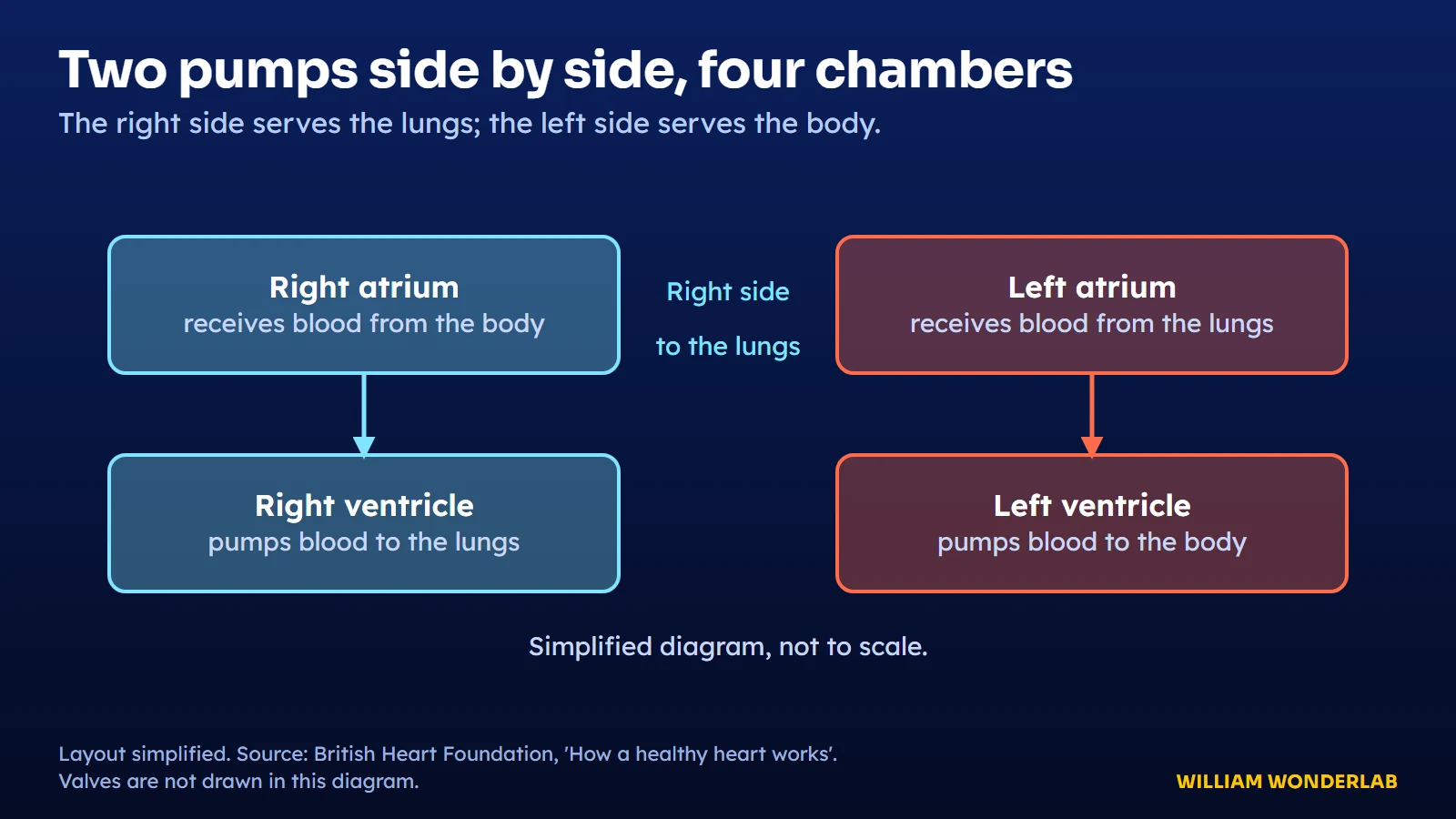
Your heart has four chambers and four valves. It works as two pumps side by side, sending blood to the lungs and then around the body.
Your heart keeps working while you read this sentence, and it does not stop for a break. It is a muscular pump that moves blood around your body without stopping. How does one organ do such a big job?
The short answer: The heart has four chambers and four valves. It works as two pumps side by side. The right side sends blood to the lungs to pick up oxygen, and the left side pushes that oxygen-rich blood around the body.[1][2]
Four chambers: two rooms on top, two pumps below
The heart has four chambers, which are hollow rooms. The British Heart Foundation describes them this way: “the 2 upper chambers are called the left atrium and the right atrium (or the atria)” and “they receive blood flowing into the heart.” The two lower chambers are the ventricles: “they pump blood out of the heart.”[1]
Think of the atria as the receiving rooms and the ventricles as the pumps. The Victorian Government’s Better Health Channel says the heart “consists of four chambers, each separated by valves which direct the flow of blood.”[3]
The heart works as two pumps that sit next to each other. The right side handles blood going to the lungs, and the left side handles blood going to the rest of the body.[1]
Valves: one-way doors
Blood must not flow backwards, so the heart has valves. A valve is a flap that opens to let blood through and closes to stop it leaking back. Healthdirect says there are “4 valves in your heart that act like doors between the different chambers inside.”[2] They are:
- The tricuspid valve sits between the right atrium and right ventricle.
- The pulmonary valve sits between the right ventricle and the pulmonary artery, which leads to the lungs.
- The mitral valve sits between the left atrium and left ventricle.
- The aortic valve sits between the left ventricle and the aorta, the main artery to the body.
The British Heart Foundation explains the job of the tricuspid valve like this: “It prevents blood from flowing back into the right atrium when the right ventricle contracts.”[1] “Contracts” means the muscle squeezes. The other valves do the same kind of job on their own sides.
The US National Heart, Lung, and Blood Institute puts the whole idea simply: “Inside your heart, valves keep blood flowing in the right direction.”[4] A university physiology course describes the same one-way system: “A system of valves in the heart and veins ensures that the blood flows in one direction.”[5]
The route: to the lungs, then around the body
Blood travels in a loop. The British Heart Foundation describes each step:
- The right atrium “receives blood low in oxygen from the rest of the body.”
- The right ventricle “pumps the blood low in oxygen to the lungs to pick up a fresh supply of oxygen.”
- The left atrium “receives blood high in oxygen from the lungs and pumps it to the left ventricle.”
- The left ventricle “pumps blood high in oxygen to the rest of the body.”[1]
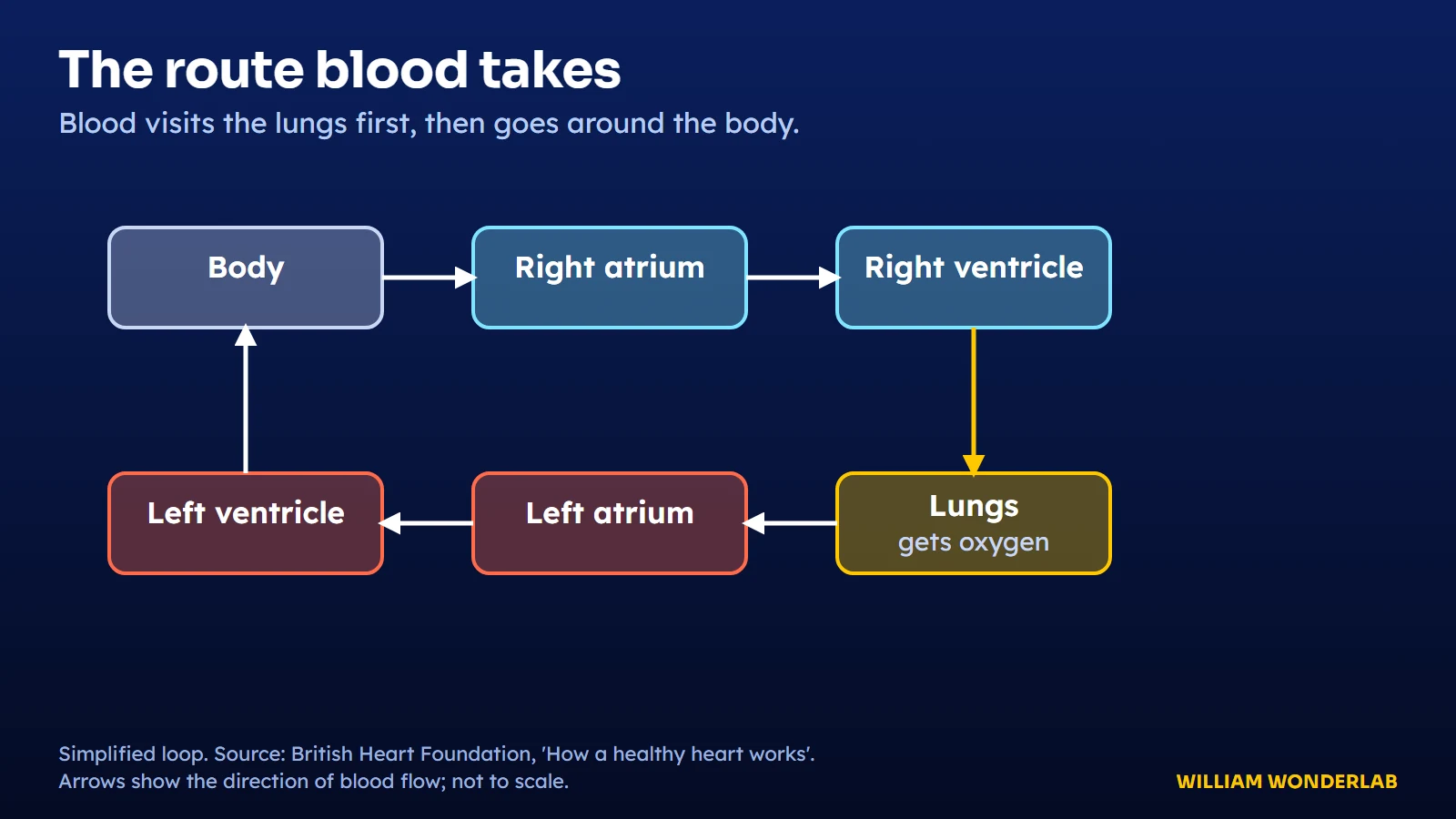
The NHLBI describes the lung part of the loop in the same order: blood “is pumped to your right ventricle, which in turn pumps the blood to your lungs.”[6]
Notice that the blood goes through the heart twice on each trip round. First it visits the lungs on the right side, then it goes around the body from the left side.
Everyday example: a one-way door
A swing door in a shop opens for people going in and shuts for people going out, so customers cannot all pile through the wrong way. Heart valves work in a similar way. They let blood move in one direction and close to block the reverse.
Did you know? The heart has four valves, and each one acts as a one-way gate between two parts of the heart.[2]
A common myth: “one pump does the whole job”
It is easy to imagine the heart as a single pump, but it is really two pumps working side by side. The heart is divided into two halves by a central wall, or septum, and each half has an atrium and a ventricle.[5] One side handles the lungs, and the other side handles the body.[1] Keeping them separate lets blood pick up oxygen before it is sent out again.
Try it: find your pulse and count
Proposed at-home activity. This is a simple way to notice your heartbeat. It does not measure your health.
You need: a clock or timer with seconds, and a pencil and paper.
- Sit quietly for one minute.
- Place two fingers (not your thumb) gently on the inside of your wrist, below the thumb, until you feel a steady beat.
- Count the beats for 15 seconds, then multiply by four. Write the number down.
- Walk gently on the spot for one minute, then repeat steps 2 and 3. Compare the two numbers.
Safety first: Do this with an adult. Keep the activity gentle, and stop straight away if you feel dizzy, unwell, or have pain in your chest. Never press on the neck to find a pulse. If you have a heart condition or any worry about your heart, talk to a doctor before doing any exercise.
Go deeper: the heart as a system
Why valves matter
Valves stop blood flowing backwards, which keeps the flow in the right order. The British Heart Foundation describes each valve as preventing blood from flowing back into the chamber it has just left.[1]
Why the lungs come first
Blood that has been around the body has used up much of its oxygen. It returns to the right atrium and must go to the lungs for a fresh supply. Only then does it return to the left side to go out to the body again.[1]
What this article does not cover
This article does not give heart-rate ranges or explain how the heart’s electrical signals control each beat. The sources checked for this article describe how blood moves, not the timing of the heartbeat.
Frequently asked questions
How many chambers does the heart have?
Four: two upper atria that receive blood, and two lower ventricles that pump it out.[1][2]
What is the job of a heart valve?
A valve opens to let blood through and closes to stop it flowing back.[1][2]
Where does the heart send blood first?
From the right side, the blood goes to the lungs to pick up oxygen.[1]
Is the heart one pump or two?
It works as two pumps side by side, one for the lungs and one for the body.[1][5]
The big idea
Two pumps, four valves, one loop. Your heart moves blood in a loop: to the lungs for oxygen, then around the body. Valves keep it moving in one direction.
Related reading
More from William Wonderlab:
Explore more from scientists:
- How a healthy heart works (British Heart Foundation)
- Heart anatomy (healthdirect Australia)
- How the Heart Works (NHLBI, US National Institutes of Health)
References
[1] British Heart Foundation, “How a healthy heart works” (accessed 25 October 2026)
[2] Healthdirect Australia, “Heart” (accessed 25 October 2026)
[3] Better Health Channel, Victorian Government, “Heart” (accessed 25 October 2026)
[4] US National Heart, Lung, and Blood Institute, “How the Heart Works” (accessed 25 October 2026)
[5] University of California, Berkeley, Molecular and Cell Biology, “Cardiovascular Physiology” (accessed 25 October 2026)
[6] US National Heart, Lung, and Blood Institute, “How Blood Flows through the Heart” (accessed 25 October 2026)