How Do Spiders Make Silk?
Spiders make silk from proteins stored as a liquid in glands inside their abdomen. The liquid hardens into a solid thread as it is pulled out through the spinnerets.
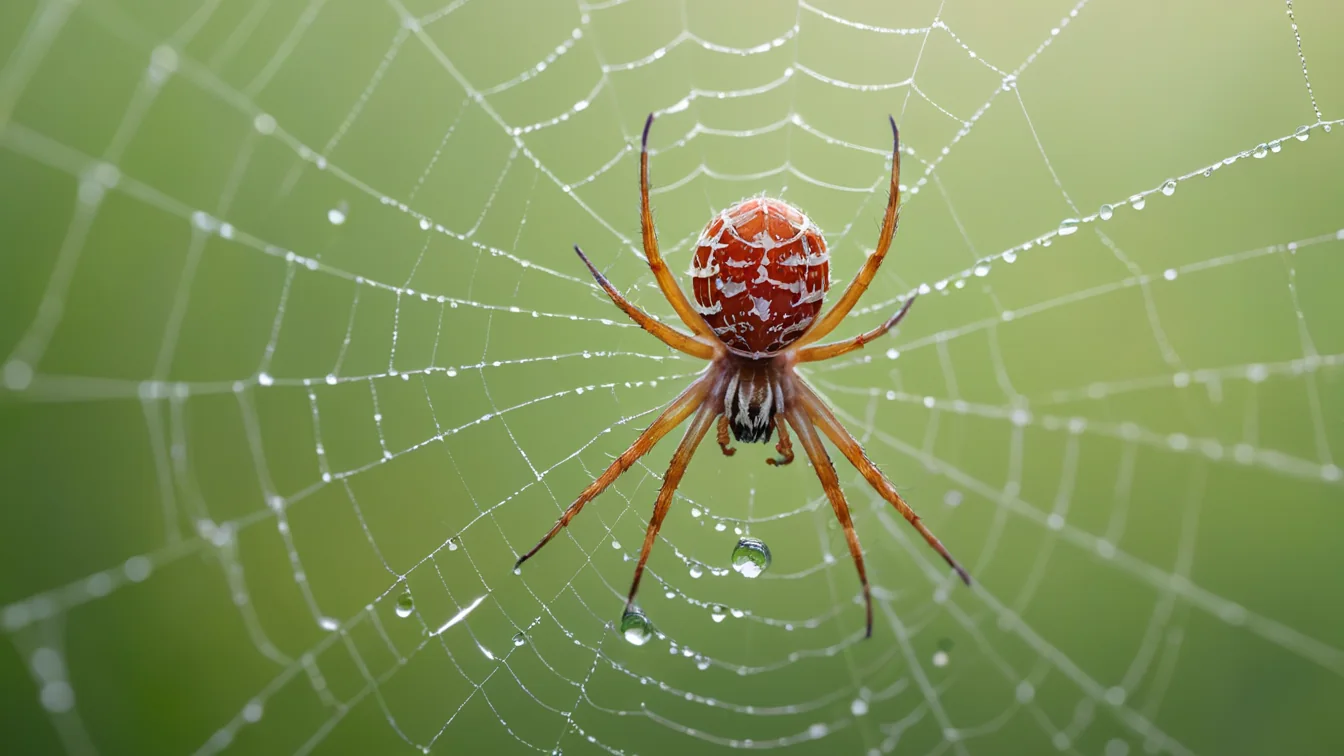
A spider’s web looks like it was made from magic thread. It is not magic, but it is clever chemistry. Spiders make silk inside their own bodies, from proteins that start out as a liquid. The liquid then turns into a solid thread as the spider pulls it out.
The short answer: Spiders make silk in silk glands inside the abdomen. The silk starts as a liquid protein, and it leaves the body through spinnerets at the rear.[1][2] The liquid hardens into a solid fibre as it is drawn out.[1]
Silk is made of protein
Silk is a protein, like the protein in your hair and muscles, but the spider’s version is built in a special way. A protein is a long chain of smaller building blocks, which folds into a shape. Proteins are the body’s building material.
The silk protein is often called a fibroin. A research paper on black widow spiders says that “spider silk consists largely of proteins, or fibroins, that have block repeats.”[3] Repeats mean the chain has the same pattern over and over, like a string of beads that keeps repeating the same shape.
Researchers also use the word spidroin for these large silk proteins. Science Nordic says: “The silk consists of so-called spidroins, large proteins which are created in the ampulate gland.”[4]
Where it is made: the silk glands
The silk is made in silk glands located inside the spider’s abdomen, the big rear part of the body. A gland is a little factory that makes and stores a substance. The Australian Museum says the glands sit “within the abdomen” and can “occupy a large amount of abdominal space”, especially in web-building spiders.[1]
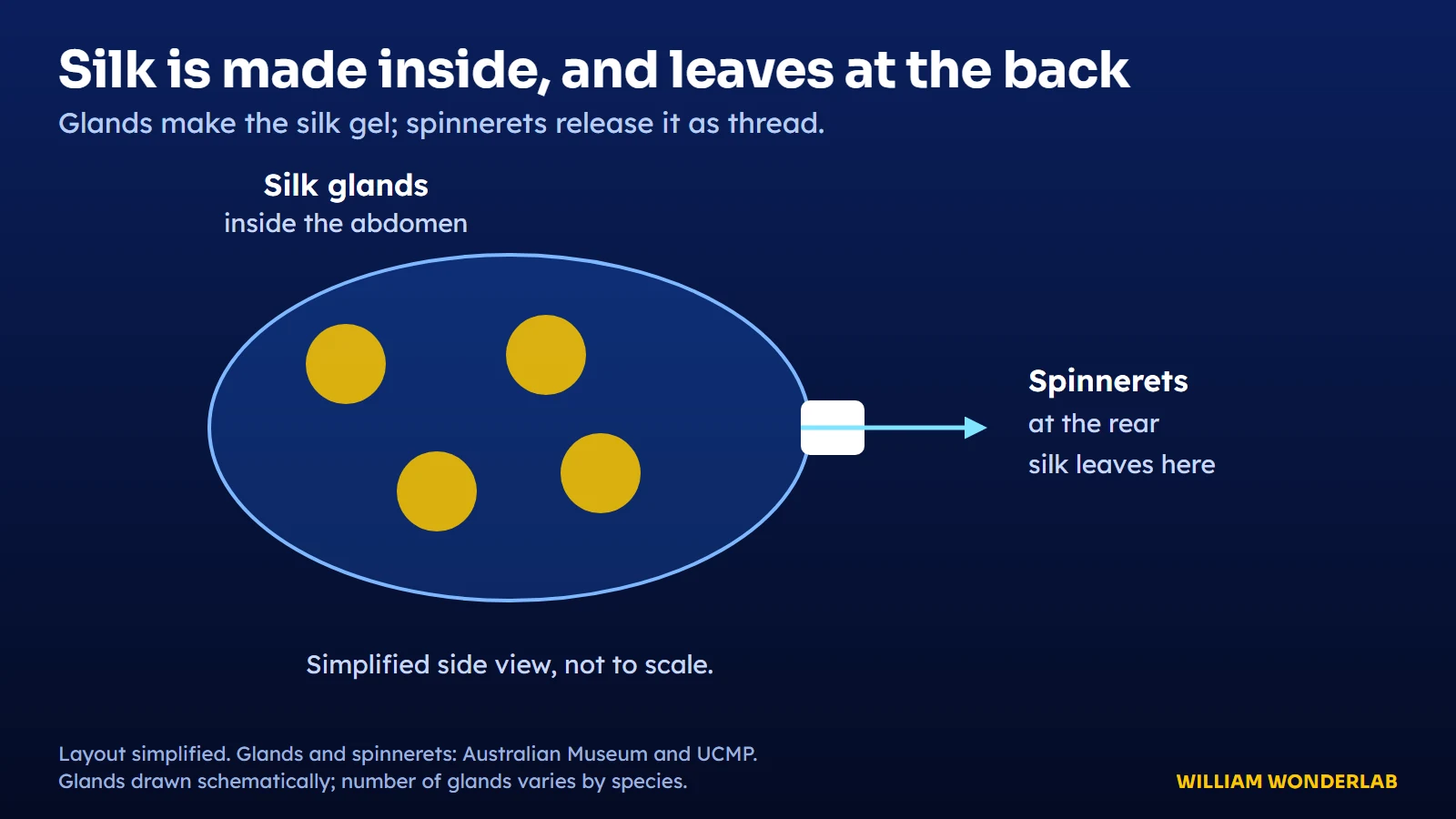
Silk glands are not all the same. The Australian Museum notes that ten different types of silk gland and their spigots are known in spiders.[1] Different glands open through different numbers of spigots, which is one reason a spider can produce more than one kind of thread.[1]
Out through the spinnerets
The silk leaves the body through spinnerets. These are the spider’s silk nozzles. The UC Museum of Paleontology explains that “The last two abdominal segments are specially modified into spinnerets which secrete the silk threads for which spiders have become well known.”[2]
Think of a spinneret like the head of a watering can, with many tiny holes. The Australian Museum calls these holes spigots: “hollow, hair-like silk outlets connected to particular paired silk glands.”[1] Science Nordic says that “Most spiders have many of these glands, each making a single fibre.”[4]
From liquid to solid thread: the stretch
Silk is not hard when it leaves the spider. The Australian Museum says that “Although silk is produced as a liquid within the silk glands, it usually emerges from the spigots,” and that acid and pulling stress help convert the liquid protein into a solid fibre.[1]
The black widow study describes the same change: “these silk proteins are converted from a liquid into a solid material upon extrusion.”[3] Extrusion means being pushed or drawn out through a small opening, like toothpaste squeezed from a tube.
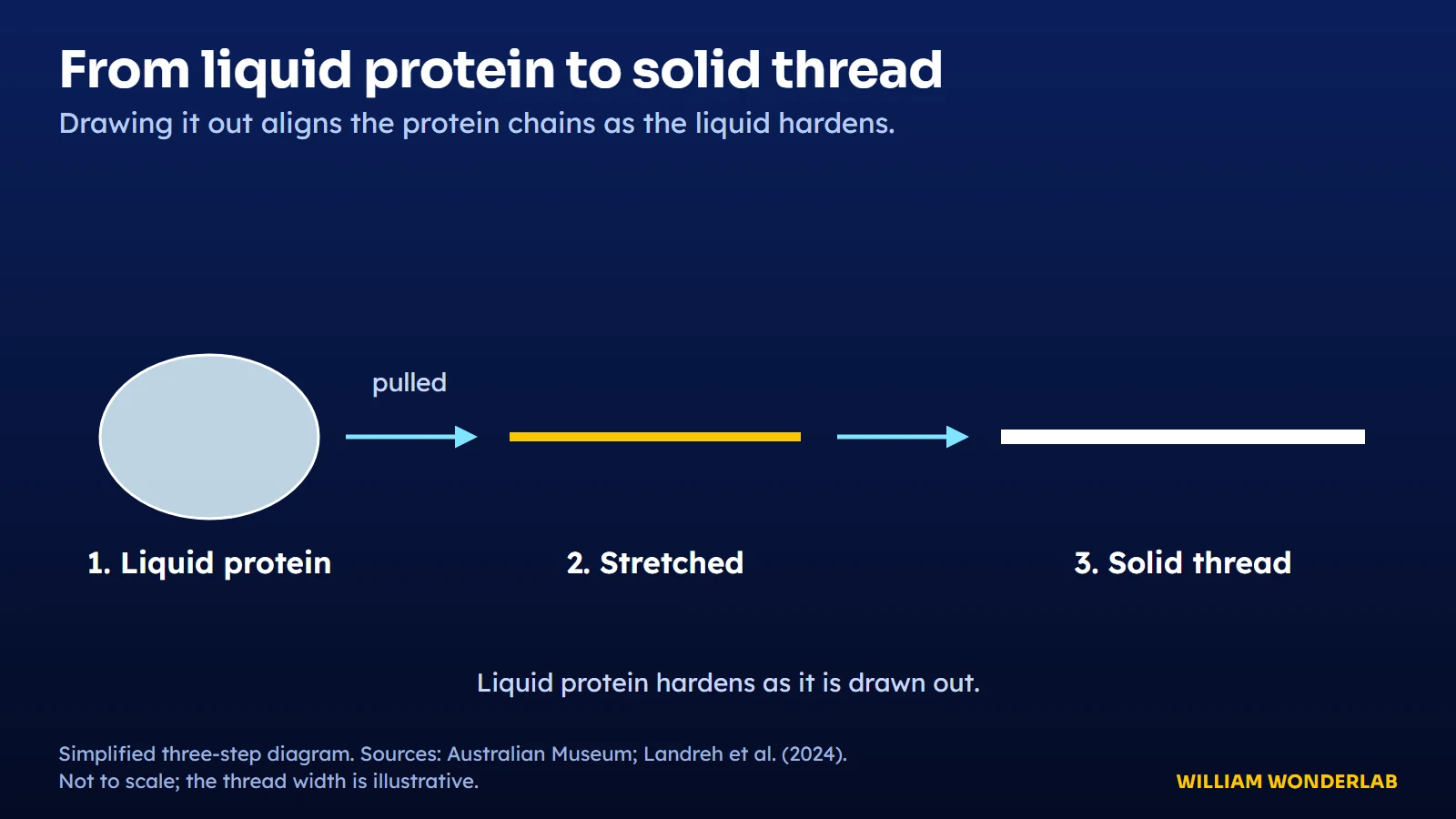
Researchers are still working out the details. One 2024 review proposes that, as the liquid moves down a narrow spinning duct, the pH falls and shear force increases, and that these changes line up the protein chains.[5] The authors present this as a model that has not yet been tested for spider silk, so treat the details as current thinking rather than settled fact.
Did you know? Spiders can make several different silks from the same body. Science Nordic notes that “a single spider spins several types of silk”.[4]
A myth: spiders make silk from their mouths
Some people think spiders spin silk out of their mouths, like a caterpillar. Spiders do not. The silk glands are inside the abdomen, and the silk comes out at the spinnerets at the back end of the body.[1][2]
Try it: look at a web from a safe distance
Proposed at-home activity. Do this with an adult, and only if you can see a web safely from the outside.
You need: a garden or park with a web you can see clearly, a notebook, and a grown-up to come with you.
- Look at the web from a safe distance. Notice where the thin lines are and how they are joined together.
- Draw the web in your notebook, showing the main threads and the spider’s position.
- Write down one question you have about how the spider made it.
- Head back inside, and look up the answer in this article.
Safety first: Look at webs only, and do not touch the web, the spider or anything nearby. Stay at a safe distance and never try to pick up or move a spider. Go with an adult, and wash your hands after you come inside.
Go deeper: why silk is so useful
Spidroins and the liquid
Spidroins are large protein chains. Science Nordic says they are “large proteins which are created in the ampulate gland.”[4] The 2024 review describes the spider’s silk as “stored as a concentrated liquid known as ‘silk dope'” before it is spun.[5]
Why stretching changes the material
As the dope moves through the spinning duct, the review describes a drop in pH and an increase in shear force, which align the protein chains.[5] Scientists think these aligned chains help make the thread strong. A news release from King’s College London and San Diego State University on a related study says that the interactions “persist as the silk fibre forms, helping to create the complex nanostructure responsible for its exceptional mechanical performance.”[6]
Keeping the details honest
Scientists are still learning exactly how each silk type is made, so this article does not give strength numbers or claim to explain every step. If you want more, the sources below are a good start.
Frequently asked questions
Is spider silk a protein?
Yes. Silk is made of long protein chains, which are called fibroins or spidroins.[3][4]
Where do spiders make their silk?
In silk glands inside the abdomen, the rear part of the body.[1][3]
What are spinnerets?
They are the silk nozzles at the back of the spider. They are made from the last two abdominal segments.[2]
Why does silk turn from a liquid into a thread?
The protein becomes solid as it is drawn out of the spider. Acid and pulling stress help make this change.[1][3]
Do all spiders make the same kind of silk?
No. Silk glands come in many types, and one spider can spin several kinds of silk.[1][4]
The big idea
A liquid that becomes a thread. Spiders make silk from proteins stored in glands. The protein is drawn out through spinnerets, and the stretch helps turn the liquid into a solid, useful fibre.
Related reading
More from William Wonderlab:
- Why Do Koalas Sleep So Much?
- How Does Your Heart Pump Blood?
- How Does a Caterpillar Turn into a Butterfly?
Explore more from scientists:
- Silk: the spider’s success story (Australian Museum)
- Liquid-liquid crystalline phase separation of spider silk proteins (Communications Chemistry, 2024, via PubMed Central)
- Microdissection of Black Widow Spider Silk-producing Glands (J Vis Exp, via PubMed Central)
References
[1] Australian Museum, “Silk: the spider’s success story” (accessed 25 October 2026)
[2] UC Museum of Paleontology (UCMP), “Araneae: spiders” (accessed 25 October 2026)
[3] “Microdissection of Black Widow Spider Silk-producing Glands,” Journal of Visualized Experiments (2011), via PubMed Central (accessed 25 October 2026)
[4] Science Nordic, “How spiders make their silk” (accessed 25 October 2026)
[5] Landreh, M., Osterholz, H., Chen, G., Knight, S. D., Rising, A. and Leppert, A., “Liquid-liquid crystalline phase separation of spider silk proteins”, Communications Chemistry 7 (2024), 260 (accessed 25 October 2026)
[6] King’s College London, news release, “Scientists uncover the molecular marvel behind spider silk’s super powers” (study with San Diego State University, published in PNAS) (accessed 25 October 2026)