How Does a Caterpillar Turn into a Butterfly?
Butterflies go through complete metamorphosis: egg, larva, pupa and adult. Inside the chrysalis, the caterpillar's body is rebuilt from groups of cells that were already waiting.
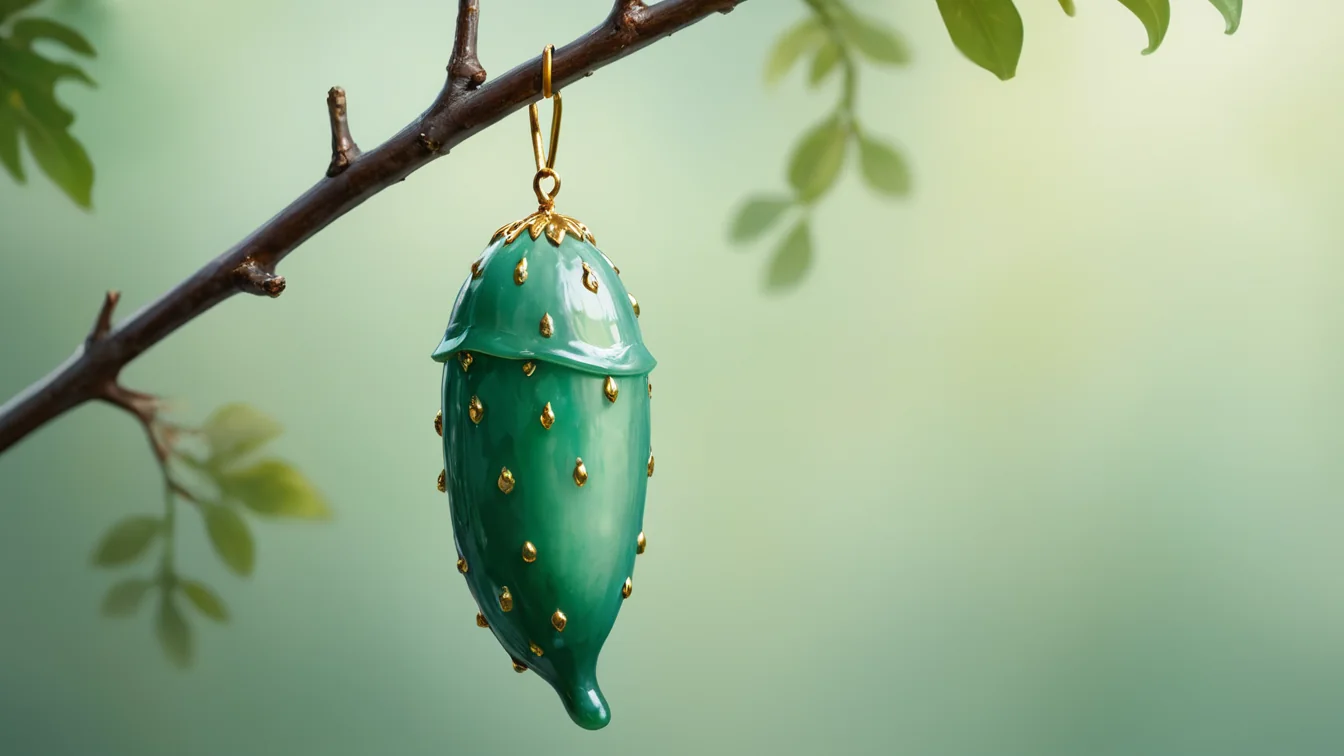
A caterpillar crawls, munches leaves and seems to have no wings at all. Then, after a short rest in a hard case, a butterfly comes out. It looks like a completely different animal, and in a way it is. How does that change happen?
The short answer: Butterflies go through complete metamorphosis, which has four stages: egg, larva, pupa and adult.[1][2] Inside the pupa, much of the larval tissue is broken down and reorganised, while groups of cells already in the larva build the adult’s wings, legs and antennae.[3][4]
Four stages, one insect
Insects with complete metamorphosis “develop through four life stages: egg, larva, pupa, and adult.”[2] UC IPM adds that “Each stage has a radically different appearance.”[2]
Most insects change form as they grow, and the Australian Museum describes this as metamorphosis.[5] A university entomology page explains why the middle stage matters: the difference between larva and adult is so great “that an instar known as the pupa has been developed to connect the gulf between them.”[6]
The larva is the stage that eats. In butterflies and moths, “the larva is also called a caterpillar.”[2] The pupa is the resting stage. The pupa of a butterfly is called a chrysalis.[2] The adult is the last stage of the cycle.[1][2]
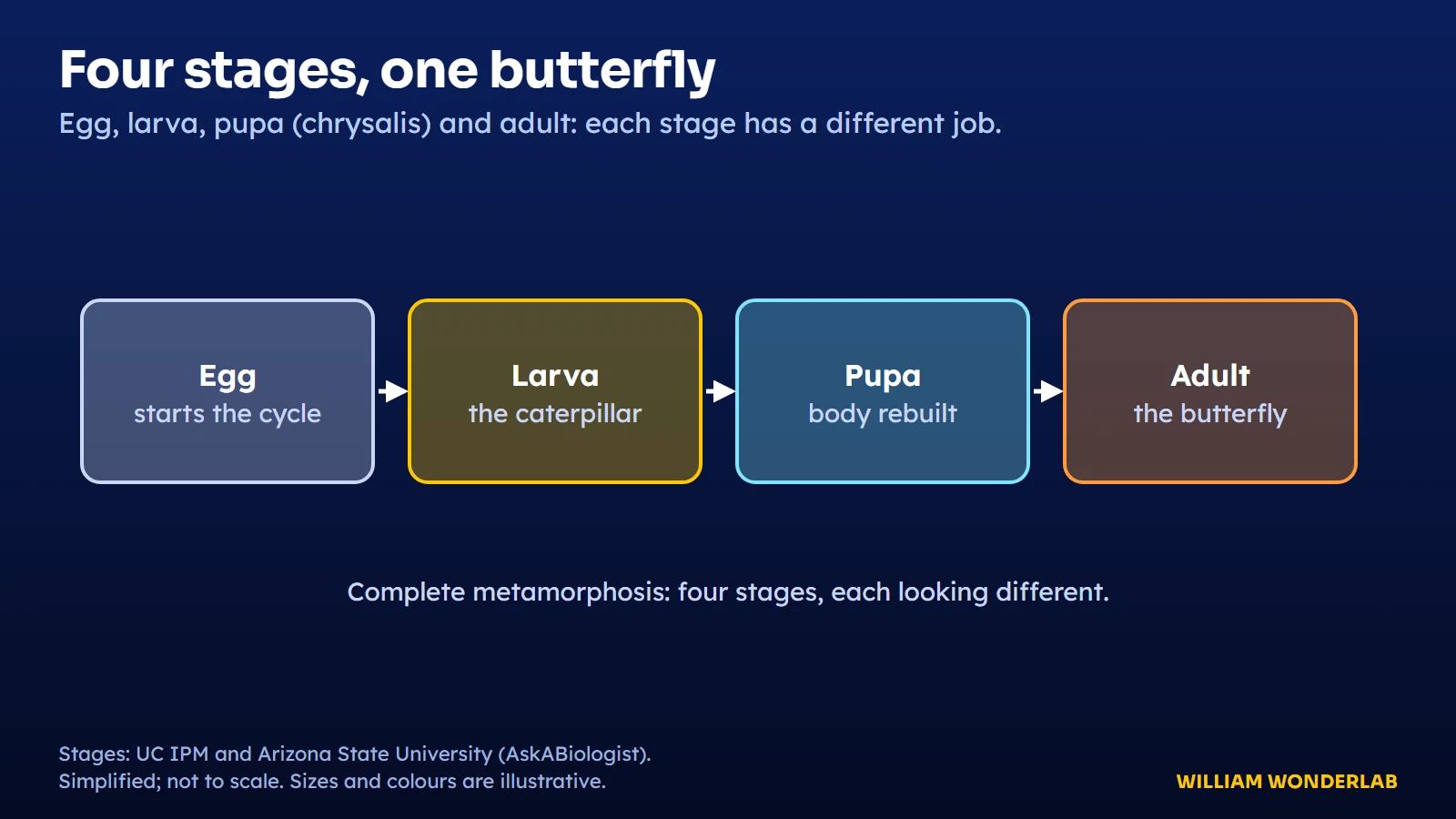
A useful way to remember it is that each stage looks different, almost like four different animals sharing one life. The pupa is the stage in between, where the body is rebuilt.
Blueprints hidden in the caterpillar
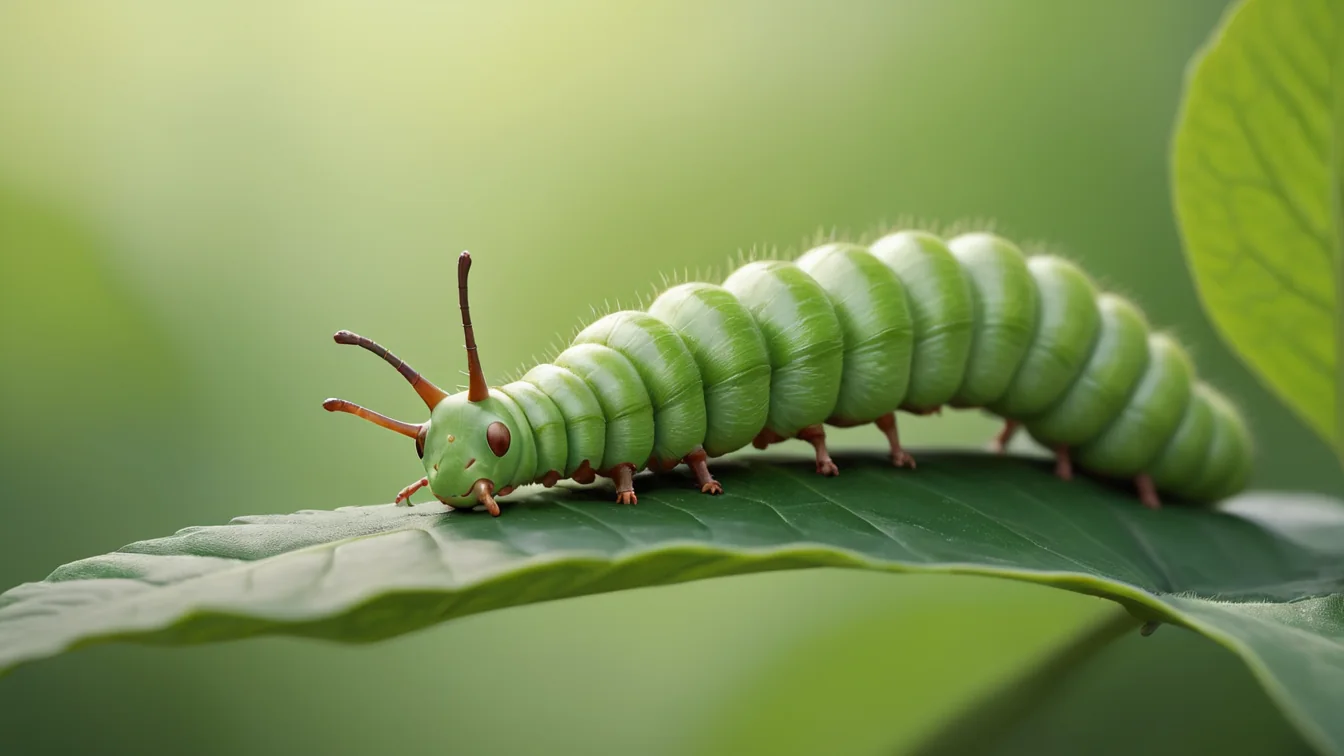
The adult parts are not made from nothing. Discover Wildlife explains that “bundles of cells are already primed, destined to become adult features such as antennae, wings, legs and genitalia.”[3] A review of insect development says that “Unpatterned portions of primordia persist in the larva, becoming imaginal discs that form pupal and adult structures.”[7] These groups of cells are called imaginal discs, and they are present during the larval stage.
Think of them like folded-up plans in a box. The plans are already there while the caterpillar is still crawling, but they are not yet used. Discover Wildlife says the discs “are prevented from growing and developing by a constant wash of a juvenile hormone.”[3]
Hormones decide when to change
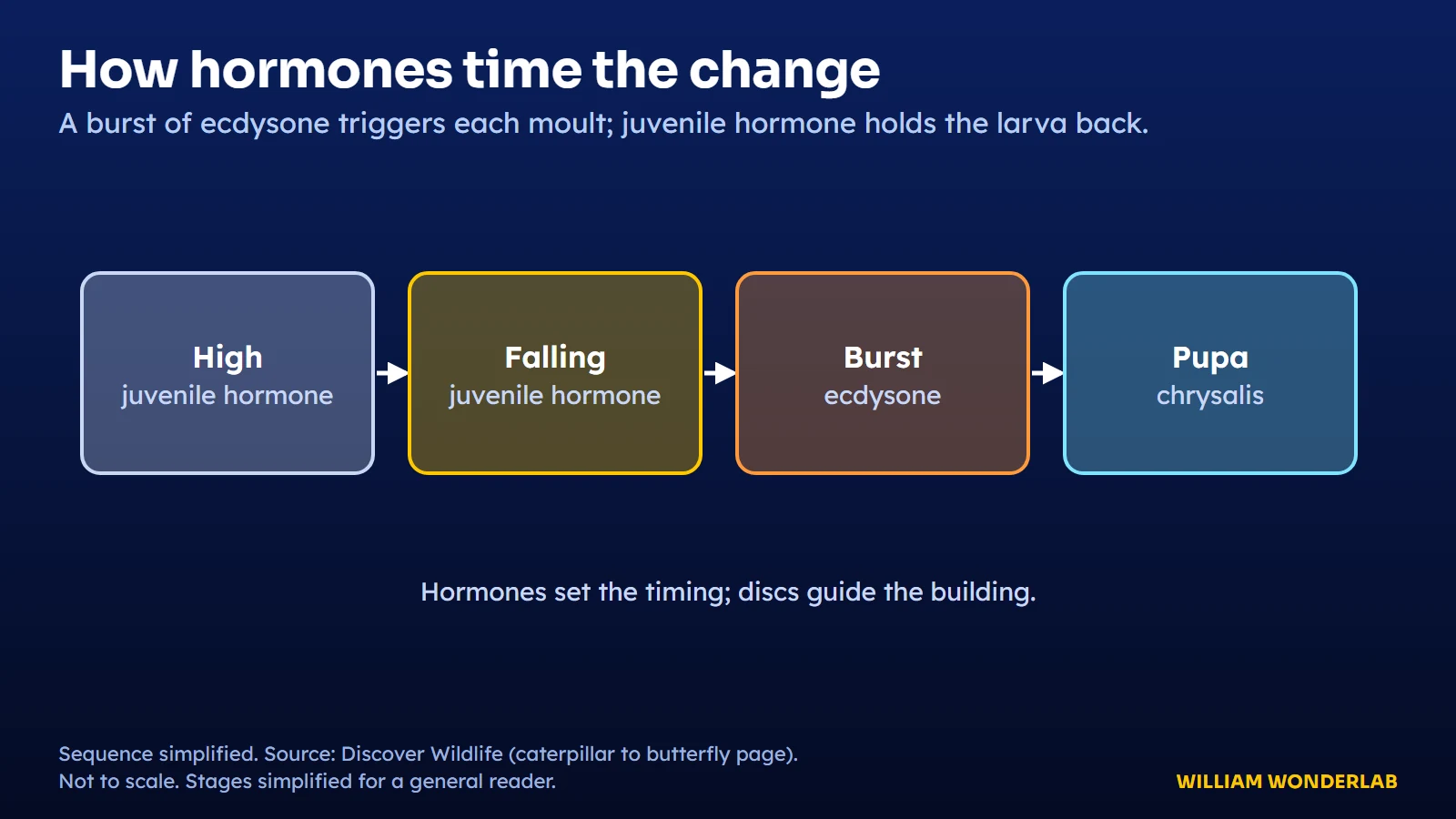
Hormones are chemical messengers in the body. Two of them control this change. Discover Wildlife explains that juvenile hormone “keeps it a caterpillar, preventing onward development” while levels are high.[3]
When the caterpillar is ready, the balance shifts. The article says that “When it reaches a critical size, a burst of moulting hormone, ecdysone, is released.”[3] That burst of moulting hormone is linked to shedding the old skin. When juvenile hormone levels fall, the caterpillar can change into a pupa, and the discs can start to grow into adult parts.[3]
Inside the chrysalis
Inside the chrysalis, the larval body is not simply patched up. A 2025 study of the Bicyclus anynana butterfly, which tracked protein levels from caterpillar to adult, says that “Complete metamorphosis requires the breakdown and reorganisation of larval tissues and the coordinated construction and development of adult structures.”[4] The study describes a “non-feeding and immobile transitional pupal stage, in which tissues are extensively remodelled and rebuilt.”[4]
The same study found that proteins linked to “cuticle formation, apoptosis and autophagy” changed during the pupal stages.[4] Apoptosis is a planned way for cells to shut down, and autophagy is the cell’s own recycling system. The study’s authors describe the molecular events as only partly understood, so this article keeps to the general picture.
Discover Wildlife gives a related picture: “The bulk of the caterpillar’s pudgy mass is recycled into the adult features.”[3] The word “bulk” means most, not all. So the body is not turned into liquid, but most of it is reused to build the adult. The discs, which were already there, guide where the new parts form.[3][7]
Did you know? Some butterflies form a chrysalis, while some other insects form a cocoon. UC IPM says that “in other species, the pupa occurs within a silk covering called a cocoon.”[2]
A myth: “the wings are glued on”
Some people imagine the wings being stuck onto the body after the caterpillar has changed. The evidence points the other way. The adult wings are built from cell groups that were already in the larva,[3][7] so the change is a rebuilding, not a simple attachment.
Try it: draw the life cycle
Proposed at-home activity. This is a drawing exercise, and it does not need any live animals.
You need: paper, coloured pencils, and this article or a book about butterflies.
- Draw four boxes in a row, labelled egg, larva, pupa and adult.
- In each box, draw what that stage looks like, using the descriptions in this article.
- Under the pupa box, write one sentence explaining what happens inside the chrysalis.
- Check your drawings against a trusted book or website, and talk about them with an adult.
Safety first: If you find caterpillars outside, look at them but do not pick them up or put them in your mouth, and do not touch plants you are not sure about. Wash your hands after any time outdoors. Ask an adult before bringing any insect inside.
Go deeper: a change in four steps
Why the stages look so different
UC IPM notes that each stage has a radically different appearance.[2] A caterpillar is built for eating and growing. An adult butterfly is built for flight and reproduction. The pupal stage, as the Bicyclus anynana study describes it, is non-feeding and immobile, while tissues are rebuilt.[4]
The pupa as a workshop
ASU’s AskABiologist describes the change this way: “Inside the pupa, the larva’s body will completely change into a fully grown adult.”[1] Discover Wildlife’s “bulk … recycled” wording describes most of the body being reused rather than the whole body, so the two descriptions are best read together.[1][3]
Staying honest about what is known
Scientists still study the exact steps by which the cell groups grow and how the larval tissues are broken down, so this article describes the main picture rather than every detail.[4]
Frequently asked questions
What is a caterpillar’s pupa called in a butterfly?
A chrysalis.[2]
Does the caterpillar turn into liquid?
Much of its tissue is broken down and reorganised, but Discover Wildlife describes most of its mass as being recycled into the adult, not simply melted.[3][4]
What are imaginal discs?
Groups of cells present in the larva that become adult features such as wings and legs.[3][7]
What controls the change?
Hormones. Juvenile hormone keeps the caterpillar from changing, and a burst of ecdysone is released when it reaches a critical size.[3]
The big idea
A rebuild, not a costume. A butterfly goes through four stages. Hormones decide when the change happens, and cell groups already in the caterpillar guide the building of the adult.
Related reading
More from William Wonderlab:
Explore more from scientists:
- Complete metamorphosis (Arizona State University, AskABiologist)
- Insect life cycle: complete metamorphosis (UC Statewide IPM Program)
- A Proteomic View of Butterfly Metamorphosis (Proteomes, 2025)
References
[1] Arizona State University, AskABiologist, “Complete metamorphosis” (accessed 25 October 2026)
[2] UC Statewide Integrated Pest Management Program (UC IPM), “Insect life cycle: complete metamorphosis” (accessed 25 October 2026)
[3] Discover Wildlife, “How does a caterpillar turn into a butterfly?” (accessed 25 October 2026)
[4] Hesketh, A. (2025), “A Proteomic View of Butterfly Metamorphosis”, Proteomes 13(4):68 (accessed 25 October 2026)
[5] Australian Museum, “Insects” (accessed 25 October 2026)
[6] University of California, Riverside, faculty entomology notes on insect metamorphosis (accessed 25 October 2026)
[7] “The evolution of insect metamorphosis: a developmental and endocrine view”, review article, PubMed Central (accessed 25 October 2026)