How Do Bridges Hold So Much Weight?
Bridges carry heavy loads by turning them into squeezing and stretching forces. Here is how beam, arch, suspension and truss designs do it, with a safe paper test to try.

Stand on a bridge and it feels solid. Yet most bridges are built from steel, concrete or stone, and the weight of cars, trains and people is pressing on them all the time. So how does a bridge carry all that weight without sagging into the water?
The short answer: A bridge does not simply resist weight. It sends the load along paths that its materials handle well: compression (squeezing) and tension (stretching). Different bridge shapes send these forces in different directions.[1][2]
Two forces: squeezing and stretching
Every bridge handles two kinds of push and pull. Compression is a force that squeezes or shortens the thing it acts on.[1] Squeeze a sponge, or press the two ends of a stack of books together, and you feel compression. Tension is a force that stretches or lengthens the thing it acts on.[1] Pulling the two ends of a rope in a game of tug of war is tension.
A bridge’s job is to move the load from the road down to the ground. Some parts get squeezed, some parts get stretched, and the shape of the bridge decides which part does which.
Beam bridges: the top squeezes, the bottom stretches
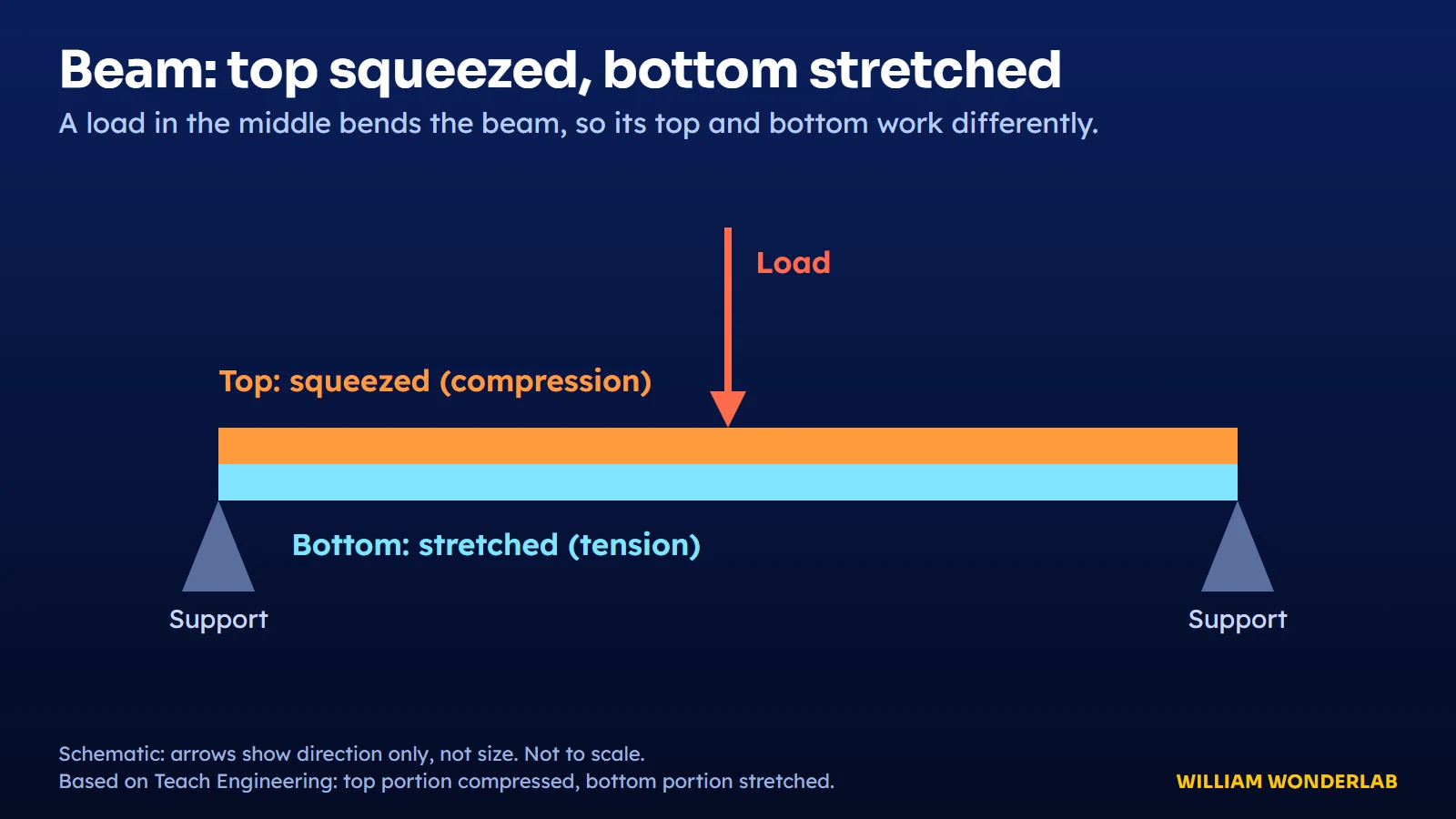
A beam bridge is typically a simple structure made of horizontal, rigid beams, and its ends rest on piers or columns.[1] Place a ruler across two books and press on the middle, and it bends. A beam bridge does the same thing on a much bigger scale.
When the load pushes down, the top of the beam is shortened and the bottom is lengthened. Teach Engineering describes it this way: a compression force acts on the top portion of the beam and the bridge deck, shortening them, while a tension force acts on the bottom portion, stretching it.[1]
Because the beam bends, it has to work hard to carry the load. The next designs avoid that bending by sending the load along a different path.
Arches: loads travel along a curve
An arch bridge is easily recognised by its defining characteristic, a semicircular structure.[1] The curve carries the load along the arch and down into its feet. Teach Engineering states the goal of an arch bridge plainly: “to carry all loads in compression, without any tensile loads present.”[2]
Think of a row of stacked bricks, each pressing on the next. The arch works in a similar way: each piece pushes on its neighbour rather than being stretched apart.
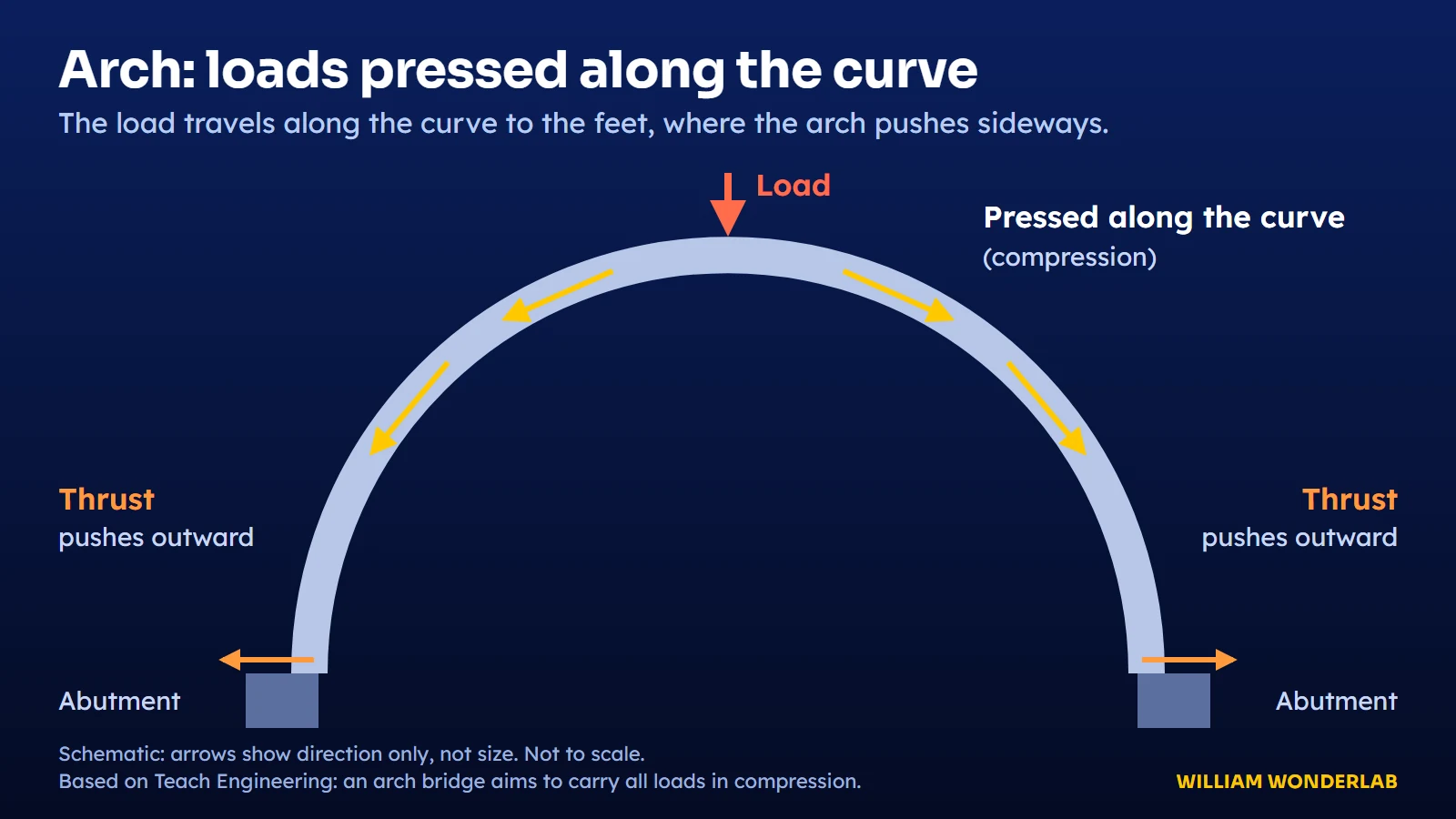
The weight does not just press straight down. Teach Engineering says that “the weight of the arch bridge and any additional load on the bridge is carried outward along the curve of the arch,” and that “Abutments distribute the load from the bridge and keep the ends of the bridge from spreading out.”[2] So the feet of an arch need firm supports, which the abutments provide.
Suspension bridges: cables do the pulling
A suspension bridge is easily recognised by its defining characteristic: a bridge deck suspended from cables.[1] The main cables are stretched tight, so they work in tension and carry the deck. A swing shows the same idea. Its ropes pull tight and hold up the seat and the person sitting on it.

Truss bridges: triangles that stay rigid
A truss is a structural form based on the geometric rigidity of the triangle, and it is composed of straight members.[1] Teach Engineering describes truss systems as “a combination of triangular units that use fewer materials and are simple to build.”[3] Look for triangles in a garden trellis, a ladder’s cross braces or the frame of a bicycle, and you will see the same idea.
An old example is the Howe truss, which “combined diagonal and vertical members to create impressive strength over long spans.”[3]
Sydney Harbour Bridge: a steel arch in Australia
The Sydney Harbour Bridge is one of Australia’s most famous landmarks. The NSW Government says it was “Built in 1932, this incredible feat of engineering used almost 53,000 tonnes of steel.”[4] It stands “134 metres above the waters of Sydney Harbour,” and the government says it “remains the tallest steel arch bridge in the world today.”[4]
The NSW Government describes the bridge as a steel arch, so the arch principle above applies to its design: an arch bridge is meant to carry its loads in compression.[2] The official page does not explain the detailed engineering, so this article does not go further than that.
Try it: a paper and book bridge test
This is a proposed at-home activity, not a documented experiment. It uses only paper, books and coins.
You need: one sheet of A4 paper, two stacks of books of the same height, and a pile of small coins.
- Set the two stacks of the same height about 15 cm apart, as a starting gap to try.
- Predict how many coins a flat sheet will hold across the gap before it folds.
- Lay the flat sheet across the stacks. Add coins one at a time to the middle, and stop when the paper folds or a coin slides off. Count the coins.
- Fold the same sheet into an accordion (zig-zag) shape, lay it across the same gap, and repeat step 3.
- Compare the two counts. Which version held more coins, and did it match your prediction?
What to notice: Think about why the folded paper might behave differently from the flat sheet. Your own counts are the evidence, so record them and compare them with your prediction.
Safety first: An adult should set up the stacks, handle the coins and count them. Small coins can be a choking hazard, so keep them away from young children, mouths, noses and little hands. Build on a stable table, make both stacks the same height so nothing slides off, and keep the books away from the edge. Do not cut or tear the paper with scissors, and do not stand on a chair to reach the setup. Wash your hands after handling coins.
Go deeper: reading a bridge like an engineer
Balancing the load
A bridge that is not moving is in balance. The forces pushing one way equal the forces pushing the other. This is why a bridge can carry a load without accelerating up, down or sideways. Every part of the bridge shares the load, and each part has to be squeezed, stretched or both without breaking. Yale’s teaching unit describes an arch the same way: the weight “is carried outward along the curve of the arch to the abutments at each end of the arch.”[5]
Questions to ask about any bridge
- Which parts are squeezed, and which are stretched?
- Where does the bridge meet the ground, and what holds each end in place?
- Does the bridge use triangles, a curve or cables to move the load?
- If you could see the bridge in a different shape, would it still carry the load?
Frequently asked questions
What is the difference between compression and tension?
Compression squeezes or shortens something. Tension stretches or lengthens it.[1]
Why do arch bridges use curves?
An arch bridge’s goal is to carry all loads in compression, with no tensile loads present.[2] The curve lets the load travel along the arch rather than bending the material.
Is the Sydney Harbour Bridge an arch bridge?
The NSW Government describes it as a steel arch, and says it remains the tallest steel arch bridge in the world today.[4]
Why are triangles used in truss bridges?
A triangle with straight sides has geometric rigidity: it resists changing shape. A truss is based on this idea.[1]
Can I test a bridge idea at home?
Yes, with paper, books and coins, under adult supervision. Read the safety box first, and treat the result as your own test, not a formal experiment.
The big idea
Shape sends the load where materials are strong. Beams bend, with the top squeezed and the bottom stretched. Arches carry loads along a curve in compression. Trusses use triangles to keep their shape. Suspension bridges let stretched cables carry the deck.
Related reading
More from William Wonderlab:
Explore more from scientists:
- Sydney Harbour Bridge (NSW Government)
- Bridging the Gaps lesson (Teach Engineering)
- Building Model Bridges (Yale-New Haven Teachers Institute)
- Bridge Types: Tensile & Compressive Forces activity (Teach Engineering)
References
[1] Teach Engineering, “Bridging the Gaps” lesson (accessed 25 October 2026)
[2] Teach Engineering, “Bridge Types: Tensile & Compressive Forces” activity (accessed 25 October 2026)
[3] Teach Engineering, “Bridging the Gaps” lesson, bridge types page (accessed 25 October 2026)
[4] NSW Government, “Sydney Harbour Bridge” (accessed 25 October 2026)
[5] Yale-New Haven Teachers Institute, “Building Model Bridges Following the Engineering Process” (accessed 25 October 2026)