What Causes a Solar Eclipse?
A solar eclipse happens when the Moon moves between the Sun and Earth. Here is why it is not a monthly event, and why eye protection matters.
For a while in the middle of the day, the sunlight can look strangely thin, and the Sun can appear to be partly covered by a dark disc. This is a solar eclipse. It looks dramatic, but the cause is a simple alignment in space.
The short answer: A solar eclipse happens when the Moon moves between the Sun and Earth. The Moon’s shadow falls on part of Earth and blocks some of the Sun’s light there.[1][2]
Never look at the Sun during an eclipse without proper eye protection. This article explains the science, and the eye-safety section below explains how to watch safely.
The Moon steps in front of the Sun
NASA describes it simply: “A solar eclipse happens when the Moon gets in the way of the Sun’s light and casts its shadow on Earth.”[1]
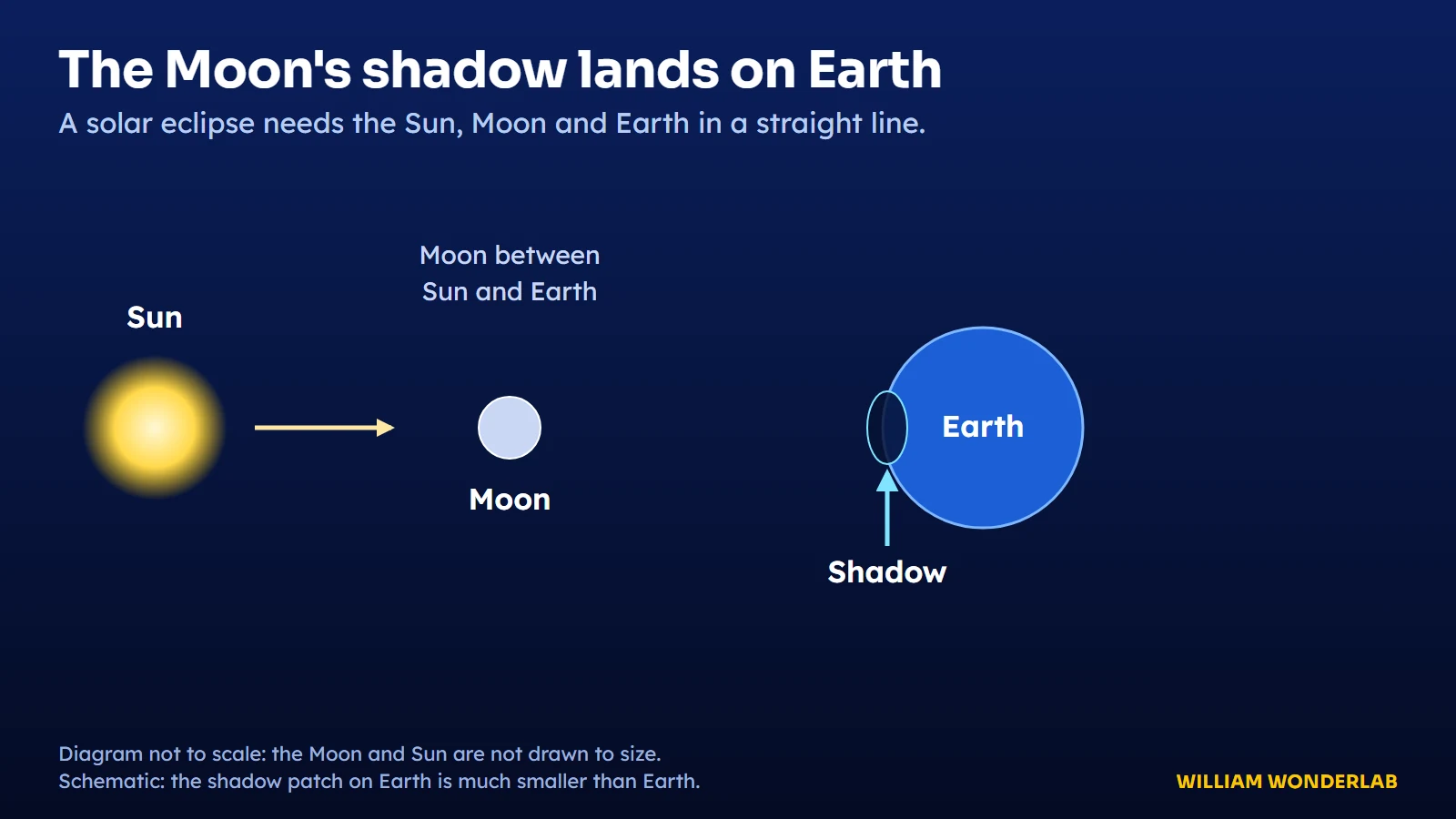
The Sun is a very bright light source. The Moon is a solid ball that does not give off its own light, so it can block the Sun’s light from reaching part of Earth. Imagine holding a coin in front of a torch. The coin’s shadow falls on the wall behind it. In a solar eclipse, the Moon is the coin, Earth is the wall, and the Sun is the torch.
This only happens when the Moon is in the correct position. It must be between Earth and the Sun. NASA’s Moon phases page describes this position as New Moon: “the illuminated side of the Moon facing the Sun and the night side facing Earth.”[2] From Earth, the lit side is turned away from us, which is why the Moon is hard to see at New Moon.
Why eclipses are not every month
If the Moon passes between Earth and the Sun every New Moon, we would see a solar eclipse every month. We do not, because the Moon’s orbit is tilted. NASA notes that the Moon “doesn’t usually pass directly between Earth and the Sun, due to the inclination of the Moon’s orbit.”[2]
Most months, the Moon passes just above or just below the Sun as seen from Earth. Only when the Moon’s path lines up with the Sun at the right time does the Moon’s shadow reach Earth.
Where the shadow falls
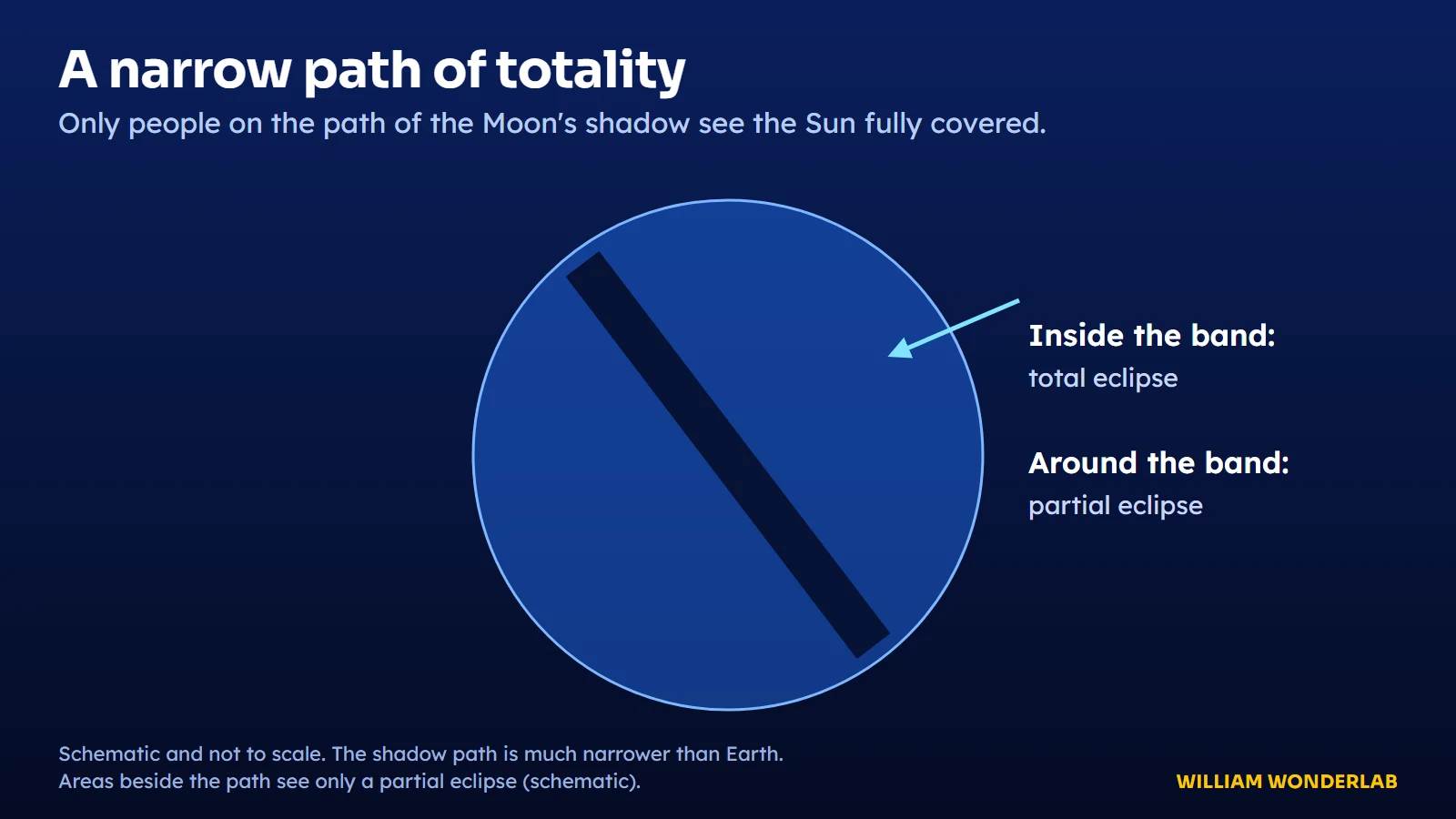
The Moon’s shadow crosses only a narrow part of Earth. Within that path, people see the Sun covered completely for a short time. This is a total eclipse. Outside the path, people see only a partial eclipse, where the Moon covers part of the Sun. NASA’s Space Place says a partial eclipse happens at least twice a year somewhere on Earth, and a total eclipse about every year and a half somewhere on Earth.[1]
Any one spot on Earth is much less lucky. NASA says that on average, the same spot on Earth sees a solar eclipse for only a few minutes about every 375 years.[1]
A lunar eclipse works differently. NASA says: “During a lunar eclipse, Earth gets in the way of the Sun’s light hitting the Moon.”[3] In a solar eclipse the shadow comes from the Moon. In a lunar eclipse the shadow comes from Earth.
Eye safety comes first
Looking at the Sun can seriously harm your eyes, and an eclipse does not make it safe. The Sun is still very bright when part of it is hidden.
NASA’s eclipse safety page says that viewing any part of the bright Sun “through a camera lens, binoculars, or a telescope without a special-purpose solar filter” can injure your eyes.[4] It also says “Do NOT use eclipse glasses or handheld viewers with cameras, binoculars, or telescopes,” because these devices need different types of solar filters.[4]
Safe solar viewers should meet the ISO 12312-2 international standard. NASA says that safe solar viewers “are thousands of times darker and ought to comply with the ISO 12312-2 international standard.” NASA “does not approve any particular brand of solar viewers.”[4]
Cancer Council Australia gives the same standard. It says “Only filters specially designed for viewing the sun and complying with ISO 12312-2 should be used when viewing an eclipse,” and that “Sunglasses do not offer any protection when looking directly at the sun.”[5] The Western Australian Department of Health advises people to “never look directly at the sun with the naked eye during an eclipse.”[6]
Safety first: Do not look at the Sun during an eclipse without a filter that is specially designed for viewing the Sun and meets ISO 12312-2.[5] Ordinary sunglasses do not protect your eyes.[5] Keep children under close adult supervision, because the Western Australian Department of Health advises supervising them so they do not look at the Sun.[6]
Check eclipse glasses before use. NASA says to “always inspect your eclipse glasses or handheld viewer before use,” and if they are torn, scratched or damaged, to “discard the device.”[4]
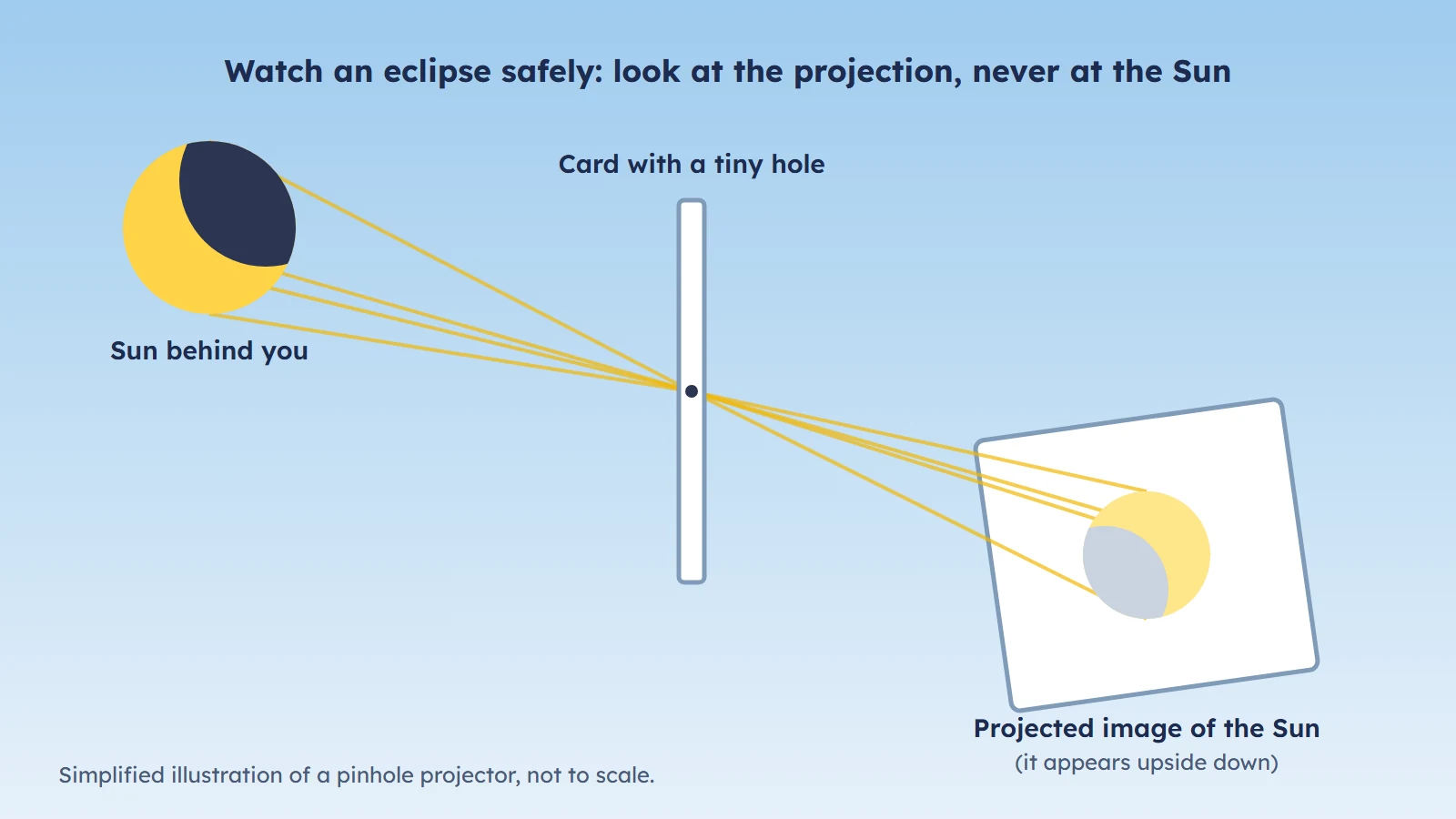
No eclipse glasses or handheld viewer? NASA describes an indirect method that “does not involve looking directly at the Sun”: a pinhole projector, which “projects an image of the Sun onto a nearby surface.” With the Sun at your back, you can then safely view the projected image.[4]
Go deeper: why the timing matters
Three bodies in a line
A solar eclipse needs three things to line up: the Sun, the Moon and Earth, with the Moon in the middle. Because the Moon’s path is tilted compared with Earth’s orbit around the Sun, the three bodies line up only occasionally, not every month.[1][2]
Reading the diagram
The diagram above shows the alignment for a solar eclipse. The Moon is drawn much smaller than the Sun, and the distances are not to scale. The dark patch on Earth is where the Moon’s shadow falls. In the real Solar System the shadow is far smaller than the planet, so the diagram exaggerates it for clarity.
Frequently asked questions
What causes a solar eclipse?
The Moon moves between the Sun and Earth, and its shadow falls on part of Earth. NASA says it “casts its shadow on Earth.”[1]
Why don’t we get a solar eclipse every month?
The Moon’s orbit is tilted, so it usually passes above or below the Sun as seen from Earth.[2]
Can I look at the Sun during an eclipse?
Not without proper eye protection. Use a filter specially designed for viewing the Sun that meets ISO 12312-2. Sunglasses do not protect your eyes, and NASA says eclipse glasses and handheld viewers must not be used with cameras, binoculars or telescopes.[4][5]
What is the difference between a solar and a lunar eclipse?
In a solar eclipse, the Moon blocks the Sun’s light. In a lunar eclipse, Earth’s shadow falls on the Moon.[3]
The big idea
A solar eclipse is a shadow from the Moon. When the Moon moves between the Sun and Earth, its shadow crosses a narrow part of the planet. On average, the same spot on Earth sees a solar eclipse for only a few minutes about every 375 years,[1] and eye protection is always needed.
Related reading
More from William Wonderlab:
- Why Does the Moon Change Shape?
- Why Does the Moon Turn Red During a Lunar Eclipse?
- Why Is the Sun So Hot?
Explore more from scientists:
- Eclipses (NASA Space Place)
- Eclipse safety guidance (NASA Science)
- Solar eclipse safety (Western Australian Department of Health)
References
[1] NASA Space Place, “Eclipses” (accessed 25 October 2026)
[2] NASA Science, “Moon phases” (accessed 25 October 2026)
[3] NASA Space Place, “Eclipses” (lunar eclipse wording) (accessed 25 October 2026)
[4] NASA Science, “Eclipse 2024 safety” (page last updated 4 November 2024) (accessed 25 October 2026)
[5] Cancer Council Australia, “Fact sheet: Eye protection” (accessed 25 October 2026)
[6] Western Australian Department of Health, “Don’t risk your eyesight in a solar eclipse” (news, 13 March 2023) (accessed 25 October 2026)
Keep exploring
Now try the science yourself
Reading is a great start. Experimenting is even better: these interactive models use the same science as this article.