Why Does Your Phone Get Hot?
Your phone gets warm because some of the electricity it uses turns into heat, mostly in the processor and the battery. Here is how that happens, and the safe charging habits that help.

Pick up a phone after a long video or a long charge and it can feel warm, sometimes quite warm. Phones are small and packed with electronics, so where does the extra heat come from? The answer starts with electricity, and with what happens to energy when it moves through a circuit.
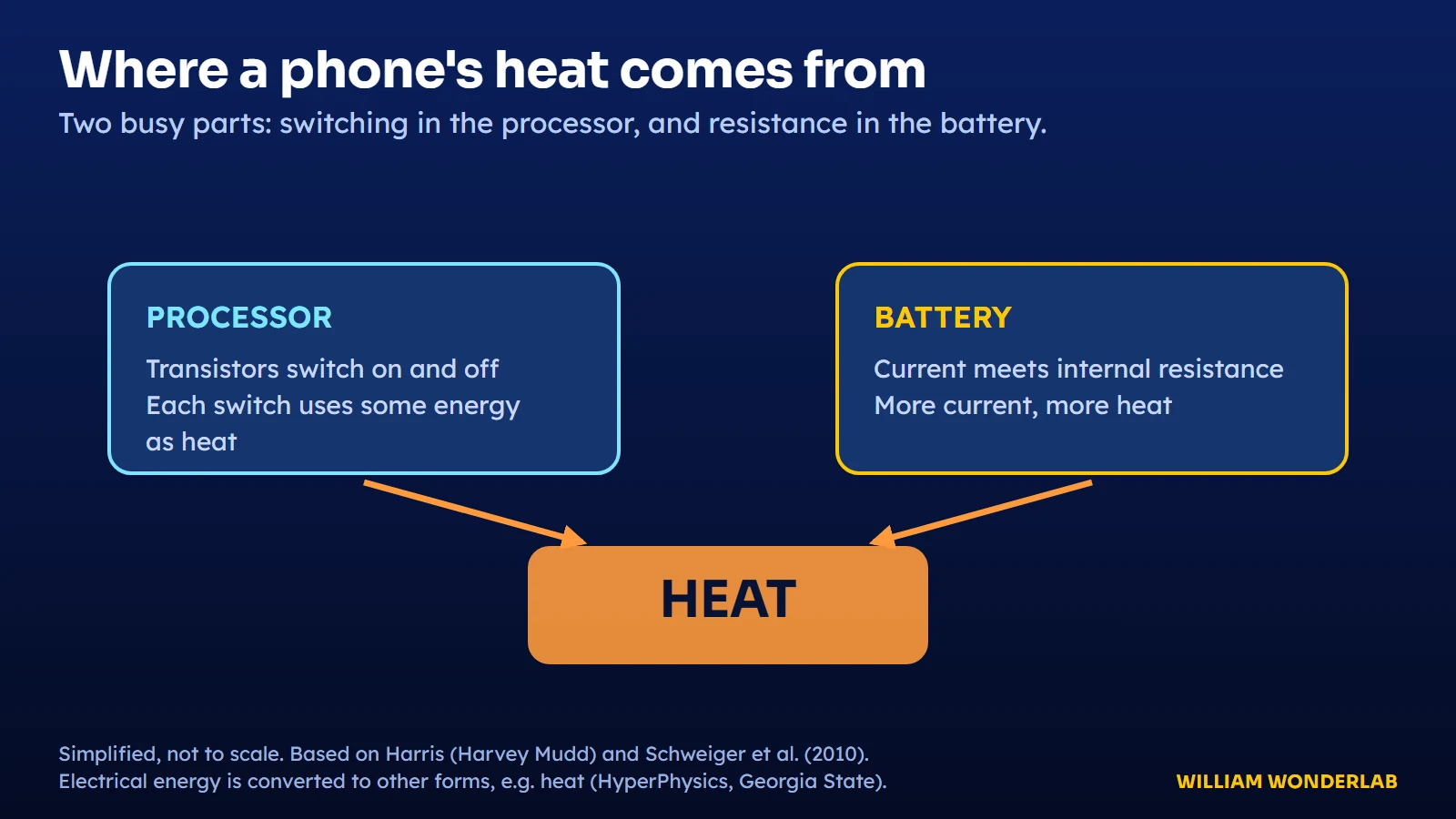
The short answer: Electricity flowing through a phone turns part of its energy into heat.[1] Two common sources are the processor (the chip that does the thinking) and the battery.[2][3] Fire and Rescue NSW gives simple charging habits that help keep batteries safe.[4]
Electricity turns into heat
HyperPhysics, a physics reference from Georgia State University, puts it this way: “energy is converted from the electrical energy of the moving charges to some other form, e.g., heat.”[1]
Think of a wire that is warm when a current flows through it. The warmth is energy that did not do the job you wanted. A phone’s circuits use electricity to do their work, but some of that electricity still ends up as heat.
HyperPhysics also notes that “the power dissipated in a given resistance” depends “upon the square of the current.”[1] In plain words, a bigger current wastes much more energy as heat. Doubling the current makes the heat loss four times bigger in the same resistance.
The processor: switching costs energy
A processor is built from very large numbers of tiny switches called transistors. Each time a transistor switches on or off, a small amount of energy is used. Harris, in a Harvey Mudd College lecture on CMOS circuit design, writes the switching power as P = α × C × V² × f.[2]
Here, f is the clock frequency (how many times per second the circuit’s timing signal ticks), V is the supply voltage, C is the capacitance that gets charged and discharged, and α is the activity factor (how often each part of the chip actually switches).[2]
The formula shows three things. A faster clock (larger f) uses more power. More switching (larger α) uses more power. A higher voltage matters a lot, because it is squared. When a phone runs a game or records a video, many parts of the processor switch more often, so the processor gives off more heat.
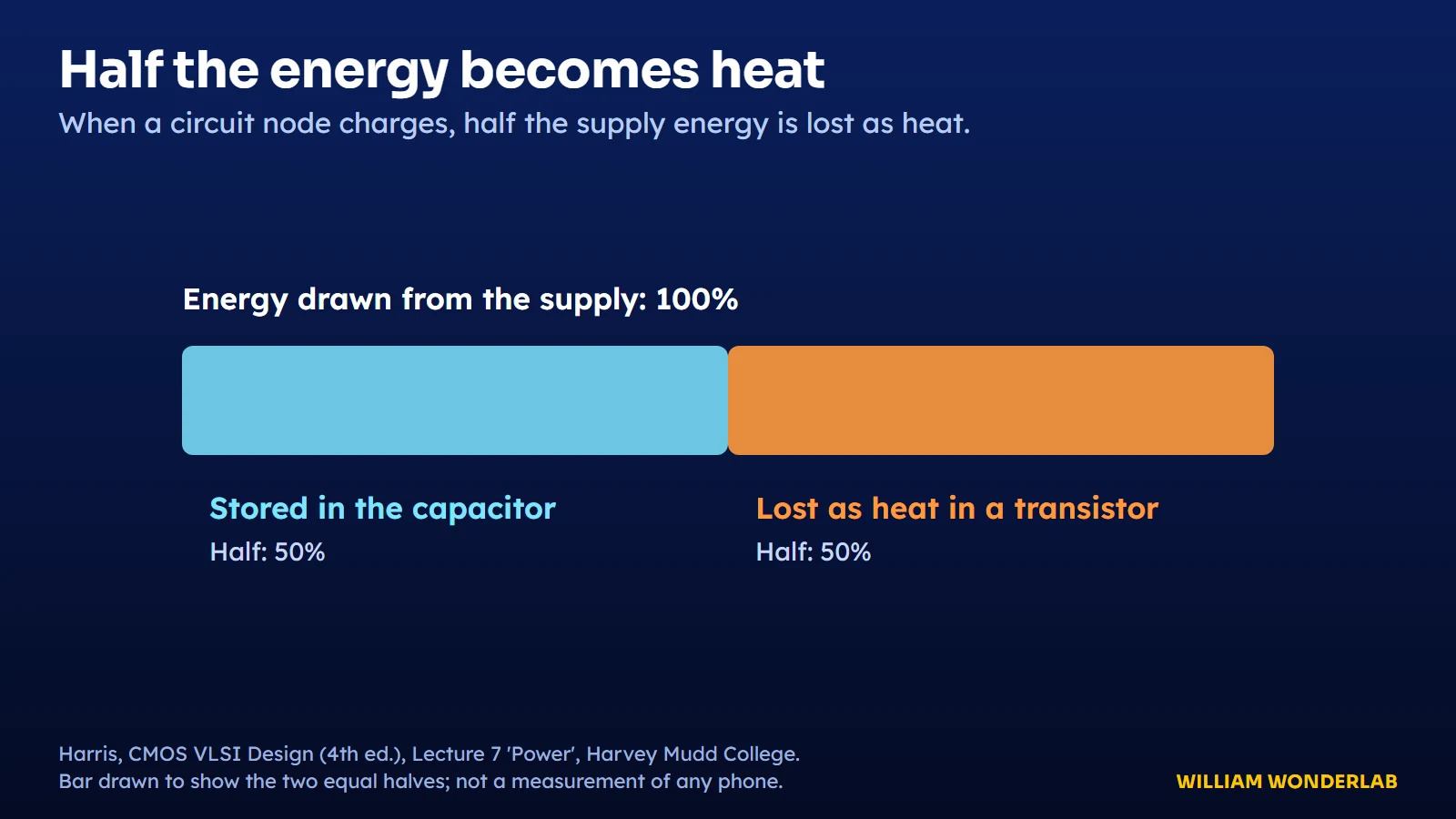
Harris also gives a striking detail about one switching step. He writes: “Half the energy from VDD is dissipated in the pMOS transistor as heat, other half stored in capacitor.”[2] So when a circuit node is charged, half of the energy drawn from the supply is turned into heat in the transistor. The rest is stored in the capacitor until it is needed.
The battery warms up too
Inside a battery, resistance to the flow of charge also makes heat. A 2010 study in the journal Sensors, now on the US National Library of Medicine’s PubMed Central, explains: “Heat generation in batteries is mainly caused by exothermic overpotential resistance,”[3] and it lists other heat sources too, including “endothermic or exothermic heat by entropy change” and “exothermic heat caused by side reactions.”[3] The authors also write that “under high current loads the heat evolution of the battery and energy efficiency are also primarily determined by its internal resistance.”[3] For fast heating under heavy current, the resistance is the part that matters most.
Put simply, the more current a battery pushes out or takes in, the more heat its internal resistance makes. This helps explain why a phone can feel warmer while it is charging quickly or running demanding apps.
Charging safely: what the fire service advises
Warm is not the same as dangerous, but overheating is a warning sign. Fire and Rescue NSW lists these habits for charging lithium-ion batteries, the type used in most phones:[4]
- “Disconnect devices once fully charged to prevent overheating.”
- “Only use approved chargers to charge your battery.”
- “Never charge on beds, sofas, or carpets.”
- “Avoid charging batteries while sleeping or away from home.”
Fire and Rescue NSW also warns about damaged batteries: “Don’t use and charge batteries that are swelling or bulging, leaking, or overheating.”[4] It adds: “Never use or charge a damaged battery.”[4] If you are worried about a phone or battery that is smoking or on fire, the fire service directs people to separate, specific advice.[4]
Safety first: Charge your phone on a hard, non-flammable surface such as concrete or tiles, not in bed, and unplug it once it is full. Stop using and charging any phone that is swelling, leaking or overheating, and follow the fire service’s advice for damaged batteries.[4]
Everyday comparisons
These are comparisons to help picture the idea. They are not measurements.
- A wire that warms when a current flows. The energy the current carries does not all become useful work. Some of it becomes heat.
- A phone under load. Running a game keeps the processor busy, so more of its switches are working at once. More switching means more of the energy becomes heat.
Go deeper: where the energy goes
Working with the formula
For the switching power formula, the factors multiply. Doubling the clock frequency f doubles the switching power, if everything else stays the same. Doubling the supply voltage V multiplies the switching power by four, because V is squared.[2] These are direct results of the formula, not separate measurements of any phone.
Why heat is a design problem
Harris describes a set of ways to cut dynamic power. These include lowering the activity factor and turning off the clock to parts of a chip that are not in use.[2] Engineers balance these choices against how fast the phone must be. The sources used here do not describe any particular phone, so this article makes no claim about a specific model.
Frequently asked questions
Is a warm phone always dangerous?
Not always. Fire and Rescue NSW lists overheating as a reason to stop using and charging a battery, especially if it is swelling, leaking or overheating.[4]
Does a fast charge make the battery hotter?
Higher current leads to more heat in a battery’s internal resistance. The authors of the 2010 study say high current loads are “primarily determined” by internal resistance for the heat evolution.[3]
Why does playing games make the phone hot?
Games keep the processor switching, and switching uses power. The switching power formula shows that more switching and a faster clock both increase it.[2]
Can I charge my phone under my pillow?
No. Fire and Rescue NSW advises to “Avoid charging batteries while sleeping or away from home,” and never to charge on beds, sofas or carpets.[4]
Does the charger matter?
Yes. Fire and Rescue NSW advises that you “Only use approved chargers to charge your battery.”[4]
The big idea
Electricity makes heat. Some energy in a phone always turns into heat, in parts such as the processor and the battery. Charging and using the phone sensibly keeps that heat from becoming a safety problem.
Related reading
More from William Wonderlab:
Explore more from scientists:
- Electrical Power (HyperPhysics, Georgia State University)
- Comparison of Several Methods for Determining the Internal Resistance of Lithium Ion Cells (Sensors, PubMed Central)
- Lithium-ion batteries: shop, charge, and recycle safely (Fire and Rescue NSW)
References
[1] Georgia State University, HyperPhysics, “Electrical Power” (accessed 25 October 2026)
[2] David Harris, Harvey Mudd College, “CMOS VLSI Design, 4th Edition, Lecture 7: Power” (accessed 25 October 2026)
[3] Schweiger et al., “Comparison of Several Methods for Determining the Internal Resistance of Lithium Ion Cells”, Sensors, 2010, PubMed Central (accessed 25 October 2026)
[4] Fire and Rescue NSW, “Lithium-ion batteries: shop, charge, and recycle safely” (accessed 25 October 2026)