Why Does the Moon Turn Red During a Lunar Eclipse?
During a total lunar eclipse, the Moon glows red because sunlight has to pass through Earth's atmosphere before it reaches the Moon. The air scatters away most of the blue light.
On a few special nights, the full Moon turns a deep copper red instead of its usual silver-white. People sometimes call it a blood moon. The Moon has not caught fire, and it has not changed colour in the sky. The reason is in the air around our own planet.
The short answer: During a total lunar eclipse, Earth’s shadow falls on the Moon. Sunlight can still reach the Moon, but only after it has bent through the edge of Earth’s atmosphere. The air scatters away most of the blue light, so the red light that is left reaches the Moon and gives it a red glow.[1][2]
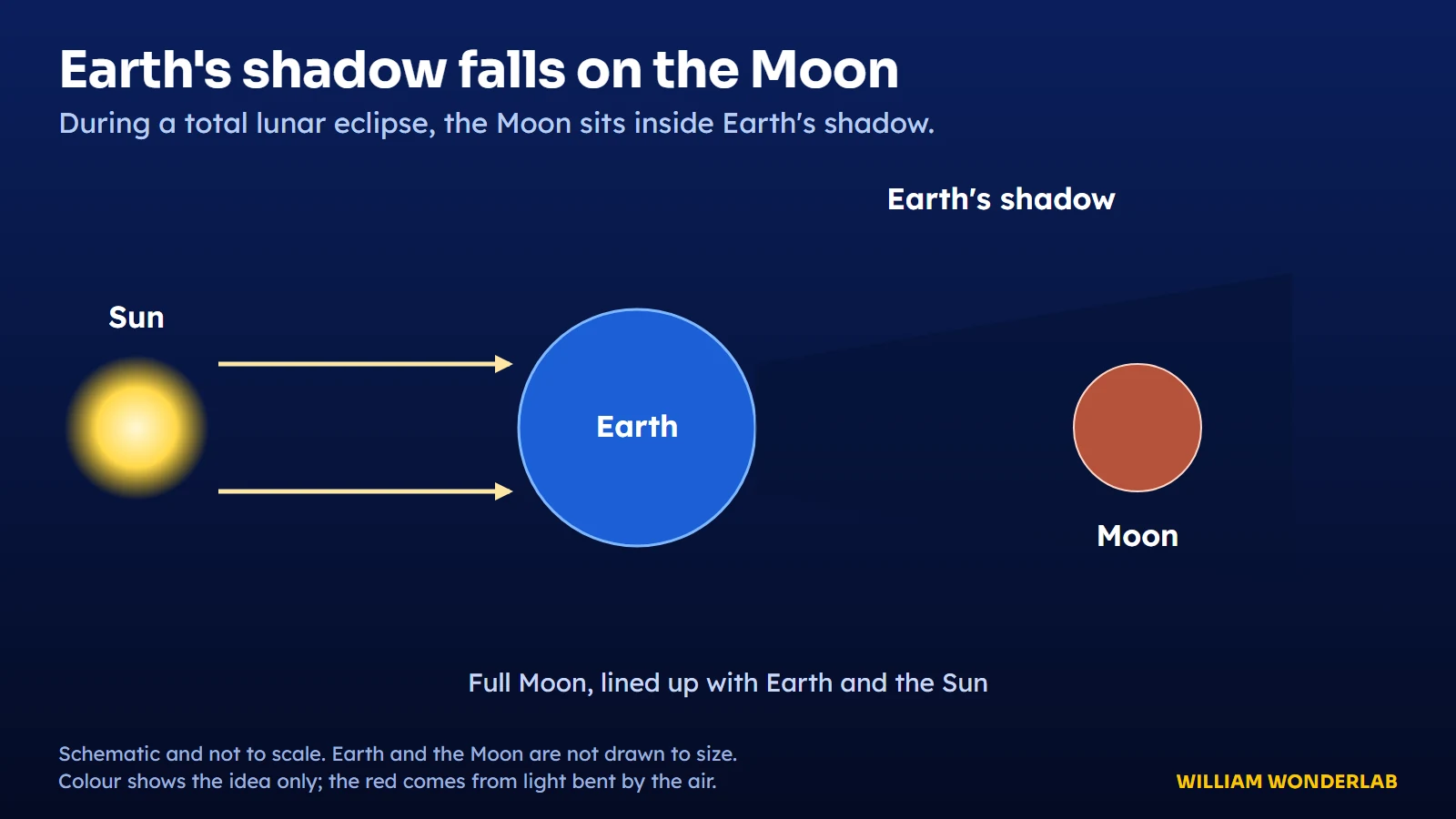
Earth’s shadow falls on the Moon
A lunar eclipse happens when Earth moves between the Sun and the Moon. NASA says: “During a lunar eclipse, Earth gets in the way of the Sun’s light hitting the Moon.”[1]
A lunar eclipse can only happen at Full Moon. At Full Moon the Moon is on the far side of Earth from the Sun. NASA describes this as “The Moon is opposite the Sun, as viewed from Earth, revealing the Moon’s dayside.”[4] When Earth’s shadow sweeps across that dayside, the Moon darkens.
If you want to know why the Moon can look huge when it rises, that is a different effect. See Why Does the Moon Look Bigger Near the Horizon?
Sunlight bends around the edge of Earth
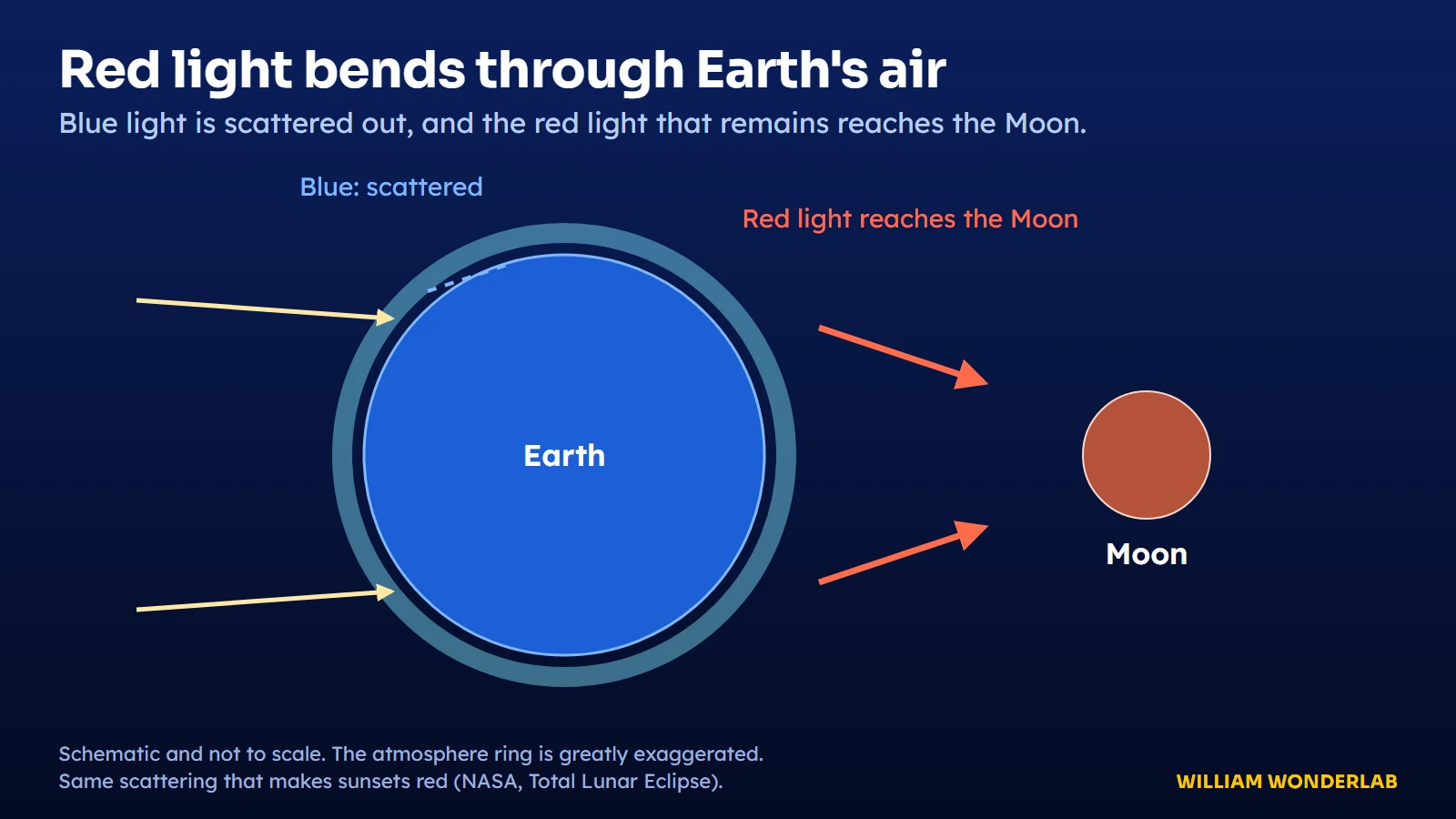
Earth’s shadow is not completely black. Some sunlight still reaches the Moon, because it bends as it passes Earth. NASA’s Space Place says that “Earth’s atmosphere absorbs the other colors while it bends some sunlight toward the Moon.”[1]
NASA’s Scientific Visualization Studio explains the route the light takes: “When light from the sun goes by the side of the Earth, it passes through a long and thick layer of Earth’s atmosphere.”[3] Only the light that skims the edge of Earth reaches the Moon. NASA puts it plainly: “the only light that reaches the Moon’s surface is from the edges of Earth’s atmosphere.”[2]
Think of a ring of glass around a ball. Light entering from the side bends and passes through the ring’s edges. Earth’s atmosphere works in a similar way, bending sunlight into the shadow.
Why the light turns red
Sunlight is a mixture of colours, and each colour has a different wavelength. Wavelength is the distance between the peaks of a light wave. Blue light has a shorter wavelength than red light. Air molecules scatter shorter wavelengths more strongly, so blue light is pushed out of the beam as it travels through the atmosphere.
NASA’s Scientific Visualization Studio explains: “Shorter wavelengths of sunlight, like blue, are scattered by the atmosphere,” so “more of the longer wavelengths, like red, are left over.”[3]
The air filters out most of the blue. The red and orange light that remains is what lands on the Moon. NASA’s Visualization page describes the result as “The remaining light reflects onto the Moon’s surface with a red glow, making the Moon appear red in the night sky.”[2]
The amount of dust and cloud in the air also matters. NASA’s Earth Observatory notes that “The presence of clouds or dust in Earth’s atmosphere can make the Moon appear redder during an eclipse.”[5]
The same effect as sunsets
You can see this same effect every day. At sunrise and sunset, the Sun is low, so its light passes through much more air before it reaches your eyes. The blue light is scattered away, and the sky turns pink, orange and red. NASA says that the lunar eclipse effect “is the same effect that turns the sky pink, orange, and red at sunrise and sunset.”[2]
Why is the sky blue for the rest of the day? That is the same scattering acting on sunlight, which is explained in a separate article, Why Is the Sky Blue?
Did you know? During a total lunar eclipse, the Moon is still visible even though Earth’s shadow covers it. The only light reaching it is the light that bends through Earth’s atmosphere, so the Moon glows dimly rather than going dark.[2]
Go deeper: why the edge of the atmosphere matters
Why the whole Moon glows at once
Every bit of light that lands on the Moon during totality has passed through the edge of Earth’s atmosphere. That is why the whole disc of the Moon takes on the same colour, rather than just one side. The diagram above shows the light paths in a simplified way. The Moon and Earth are not drawn to scale.
A check on the reasoning
If the red light came from the Moon itself, the Moon would look red all the time. It does not. The red only appears during the eclipse, when the sunlight has to pass through Earth’s atmosphere on its way to the Moon. This points to the atmosphere as the cause.
Frequently asked questions
Why does the Moon turn red during a lunar eclipse?
Sunlight bends through the edge of Earth’s atmosphere, and the air scatters away most of the blue light. The red light that is left reaches the Moon and gives it a red glow.[2][3]
Is the Moon on fire?
No. The Moon does not burn or give off its own light. The red colour comes from sunlight that has passed through Earth’s atmosphere.[2]
Why does a lunar eclipse only happen at Full Moon?
Earth has to sit between the Sun and the Moon, and at Full Moon the Moon is on the far side of Earth from the Sun.[1][4]
The big idea
The red comes from Earth’s sunsets. A total lunar eclipse puts the Moon in Earth’s shadow. The only light that reaches it has bent through the edge of Earth’s atmosphere, where blue light is scattered away, so the Moon glows red.
Related reading
More from William Wonderlab:
Explore more from scientists:
References
[1] NASA Space Place, “Eclipses” (accessed 25 October 2026)
[2] NASA, “Total Lunar Eclipse” (image article) (accessed 25 October 2026)
[3] NASA Scientific Visualization Studio, “Lunar eclipse” (narration transcript) (accessed 25 October 2026)
[4] NASA Science, “Moon phases” (accessed 25 October 2026)
[5] NASA Earth Observatory, “By the Warm Light of the Moon” (Image of the Day, 7 September 2025) (accessed 25 October 2026)
Keep exploring
Now try the science yourself
Reading is a great start. Experimenting is even better: these interactive models use the same science as this article.