Why Do Koalas Sleep So Much?
Koalas sleep for around 18 to 20 hours a day because the eucalyptus leaves they eat give them very little energy. Here is what that means for their bodies.

A koala asleep in a tree looks like the laziest animal in the bush. But sleep is not laziness for a koala. It is a sensible way to save energy when your food gives you very little to work with.
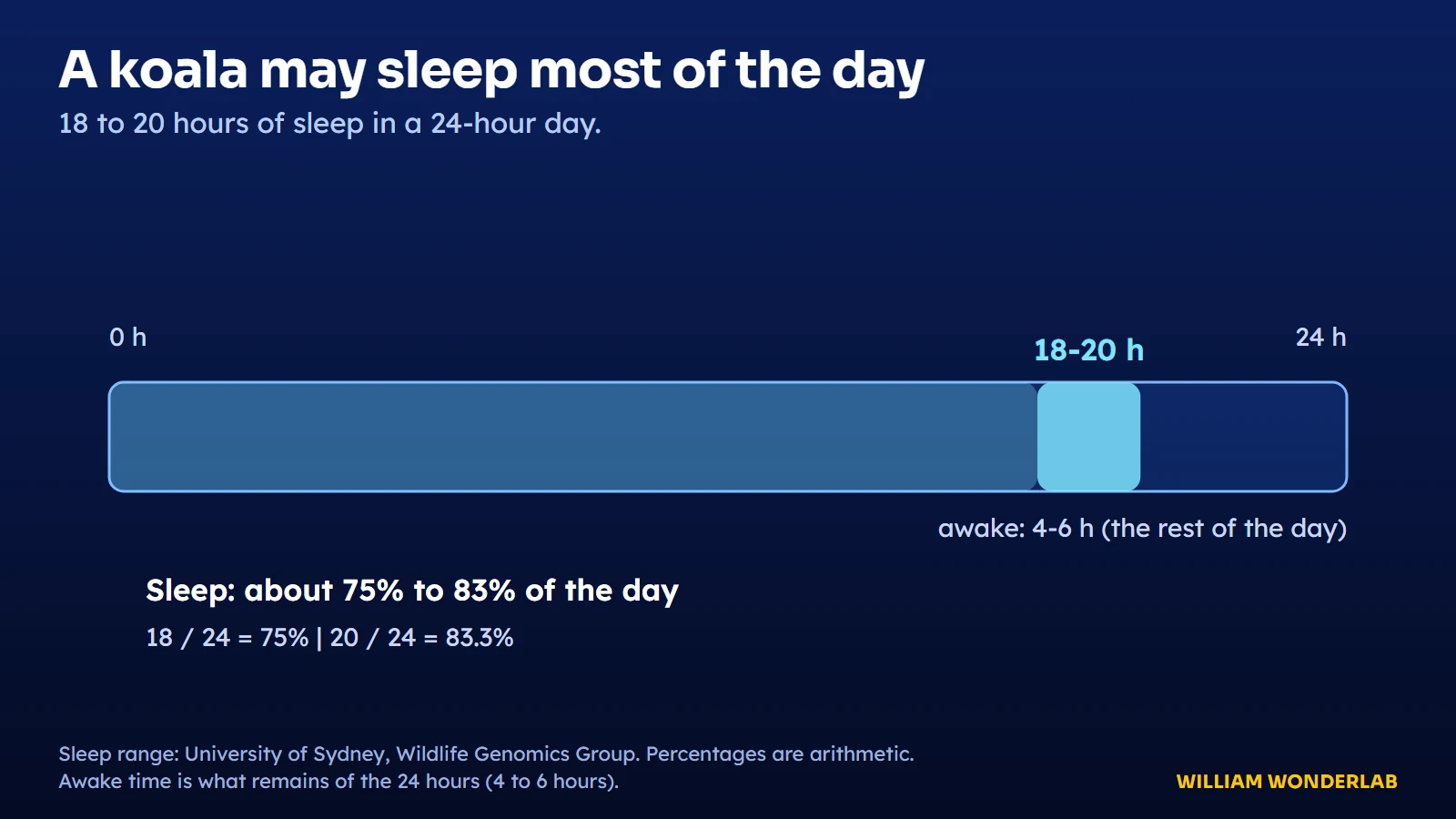
The short answer: Koalas sleep for about 18 to 20 hours a day. National Geographic gives a range of up to 22 hours.[1][2] Their food is almost all eucalyptus leaves, and those leaves give the koala very little energy, so it saves its strength by resting.[1][2]
A very long nap, in a tree
National Geographic describes where koalas sleep: “Tucked into forks or nooks in the trees, koalas may sleep for 18 to 22 hours.”[1] The University of Sydney’s Australasian Wildlife Genomics Group gives a slightly narrower range: “They sleep for 18-20 hours per day.”[2] Estimates vary a little between sources, but in every case that is most of the day.
Eighteen hours is 75 per cent of a 24-hour day, and 20 hours is about 83 per cent.
The menu problem: eucalyptus
Koalas eat eucalyptus leaves, and almost nothing else. The Australian Museum describes a “highly specialised diet made up of the leaves of certain species of eucalypts as well as some flowers and stems.”[3] The Australian Koala Foundation says that eucalyptus trees are the food koalas “rely on.”[4]
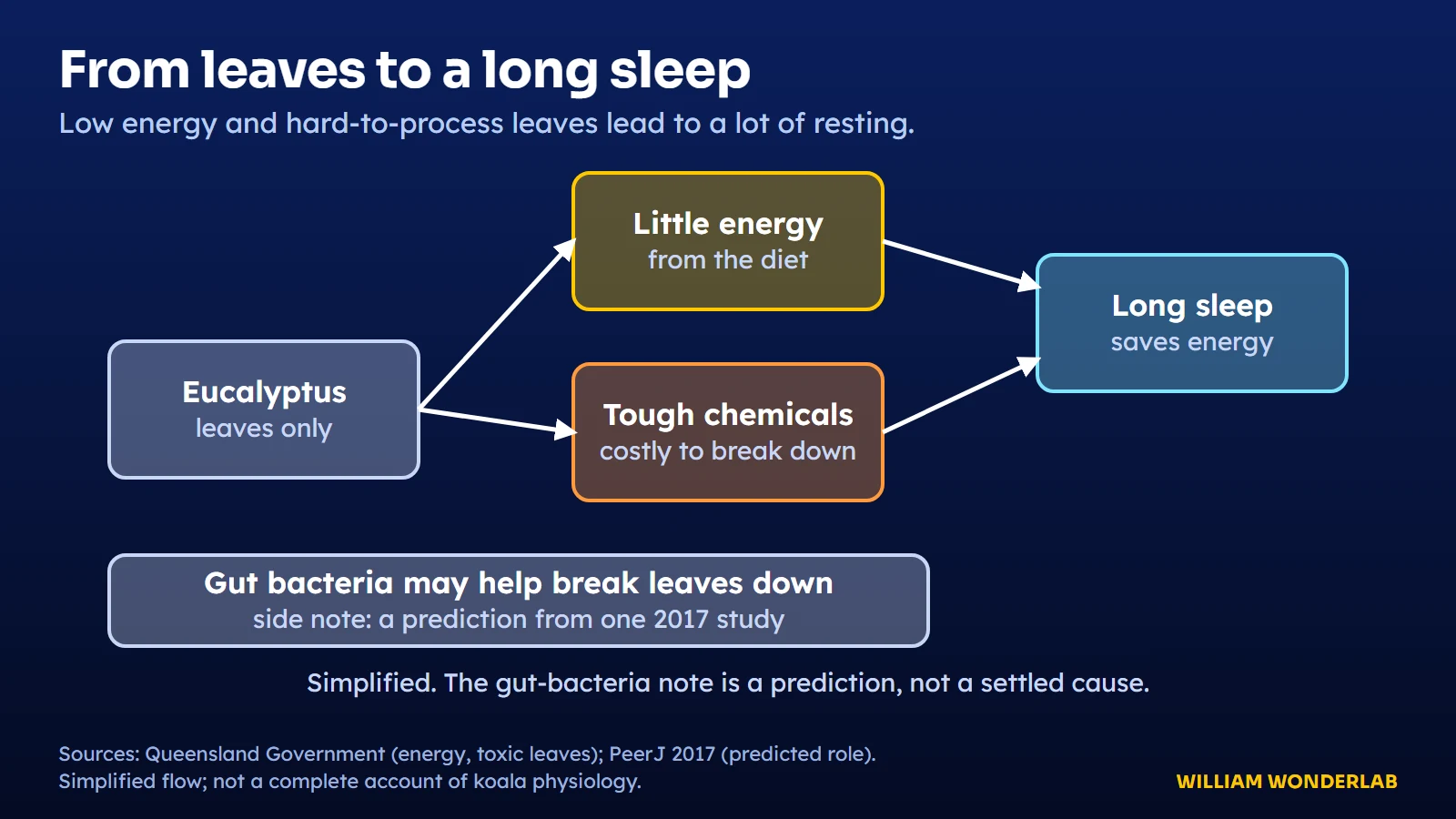
Eucalyptus is a poor source of energy. The Queensland Government’s koala facts say that “The leaves are also very low in energy comprising only 5% sugars and starches on average.”[5] So a koala must be careful with the energy it has. Resting uses very little energy, which makes sleep a sensible way to make the most of a small food supply.
Think of it like a bike with a very small battery. If the battery does not charge much from each ride, you need to rest more between rides.

Why the leaves are hard to use
Eucalyptus leaves also contain chemicals that are hard for most animals to eat. The Queensland Government’s koala facts say that “Eucalypt leaves contain many toxic compounds similar to that of cyanide, which most animals cannot eat.”[5] The koala breaks these down in a long, coiled sac called the caecum, which uses specialised bacteria.[5]
A 2017 study in the journal PeerJ looked at the droppings of koalas and wombats and found that “Secondary metabolism was overrepresented in the koala fecal samples, consistent with the need to process Eucalyptus secondary metabolites.”[6]
The same paper says a group of gut bacteria called Synergistaceae “is predicted to be a key player in detoxification of the koala’s diet.”[6] The word “predicted” matters here. The researchers worked this out from genetic data, and the bacteria were not yet fully studied in the lab.
Young koalas get these bacteria from their mother. The Queensland facts describe how a joey eats a sticky substance called pap from its mother, which gives it the bacteria it needs to eat leaves as an adult.[5]
In short, a koala must do extra work to get food energy out of its leaves, and its gut bacteria may help with that job. Processing tough, low-energy food takes effort, and rest is part of how the koala manages.
Did you know? Koalas get most of their water from the eucalyptus leaves they eat, and usually do not drink much water. National Geographic says that “Koalas usually don’t drink much water as they get most of their moisture from these leaves.”[1]
Myth: “koalas are lazy”
A koala’s long rest is not laziness. The Queensland facts link the sleep to the low-energy diet and to the “intense amount of energy required to break down toxic leaves.”[5] Resting is how the koala balances its energy budget.
Try it: count the hours in a day
Proposed at-home activity. This is a simple maths exercise, using the figures in this article.
You need: paper and a pencil.
- Write down 24 hours for one day.
- Work out the number of hours in a day for a koala asleep for 18 hours, then for 20 hours.
- Divide each number by 24 and multiply by 100 to get a percentage. Check your answers against the percentages in this article.
- Compare those hours with how many hours you sleep. Do you sleep for a smaller or larger share of the day?
Safety first: This is a paper activity, so there is nothing to handle. Do not go near wild koalas or their trees, and do not touch any animal you find. If you see a koala in trouble or on the ground, tell an adult and contact your local wildlife rescue or council.
Go deeper: the energy budget
Why the numbers add up
A koala has limited energy from each meal. The long sleep helps the animal keep its energy stable across the day. The sources here describe the link between the low-energy diet and the sleep, but they do not give a full energy budget, so this article does not give one.
What is still unknown
The gut-microbe research is recent and based on genetic data from wild animals. The PeerJ paper describes the bacteria as “predicted” to help with detoxification, and this article treats that as an active area of research, not a settled answer.[6]
Frequently asked questions
How long do koalas sleep?
The University of Sydney’s Australasian Wildlife Genomics Group says 18 to 20 hours a day. National Geographic gives up to 22 hours.[1][2]
Why do koalas sleep so much?
Their eucalyptus diet gives them very little energy, and breaking down toxic leaves takes a lot of energy, so sleep helps them save it.[5]
Do koalas drink much water?
Not usually. They get most of their moisture from eucalyptus leaves.[1]
What makes eucalyptus hard to digest?
Eucalyptus leaves contain toxic compounds, and koalas use specialised gut bacteria to process them. Researchers have found gut bacteria that may help, though this is still being studied.[5][6]
Why are koalas threatened?
The Australian Koala Foundation says the biggest threat is the loss of natural habitat, including the eucalyptus trees koalas rely on for food.[4]
The big idea
Rest is how a koala saves energy. Eucalyptus gives a koala very little energy, so it sleeps for much of the day. Its gut bacteria may help it process those leaves.
Related reading
More from William Wonderlab:
Explore more from scientists:
- Koala facts (Queensland Government)
- Gene and genome-centric analyses of koala and wombat fecal microbiomes (PeerJ, 2017)
- Koala (Australian Museum)
References
[1] National Geographic, “Koalas 101” (accessed 25 October 2026)
[2] University of Sydney, Australasian Wildlife Genomics Group, “Why should we care about koalas?” (accessed 25 October 2026)
[3] Australian Museum, “Koala” (accessed 25 October 2026)
[4] Australian Koala Foundation, “About koalas” (accessed 25 October 2026)
[5] Queensland Government, “Koala facts” (accessed 25 October 2026)
[6] PeerJ (2017), “Gene and genome-centric analyses of koala and wombat fecal microbiomes point to metabolic specialization for Eucalyptus digestion” (accessed 25 October 2026)