How Do Our Eyes See Colour?
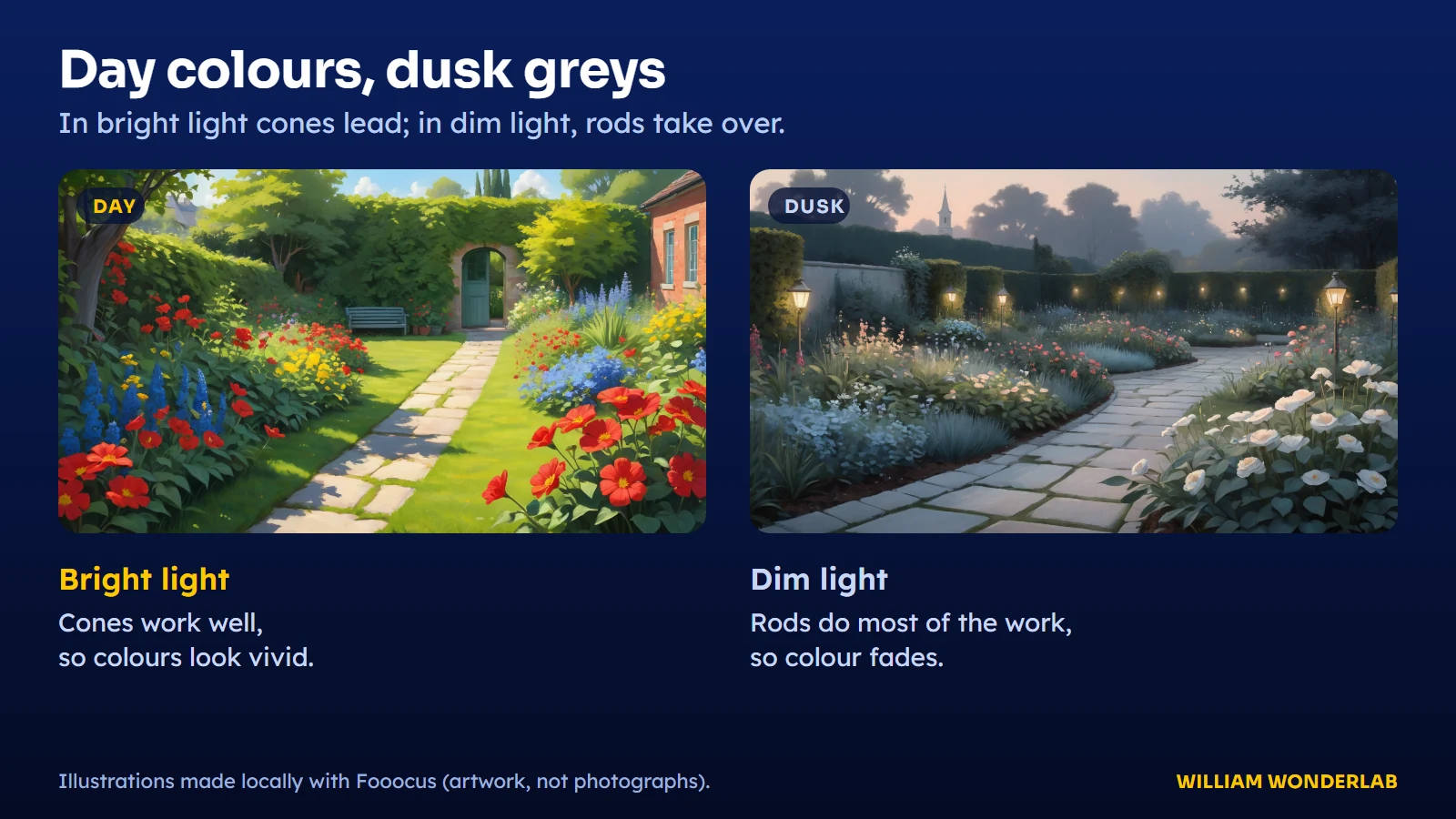
Your eyes see colour using three types of cone cells, each sensitive to a different range of light. Rods help you see in dim light but do not sense colour.

Look at a ripe strawberry, a blue sky or a green leaf. Each one looks like a different colour, yet all you are actually detecting is light of different energies bouncing off things. How does a soft, squishy eye turn that into the colours you see?
The short answer: Light-sensitive cells at the back of your eye send signals to your brain. Rods work in dim light but do not sense colour. Cones handle colour and sharp detail in brighter light. Your eyes have three types of cone, each most sensitive to a different range of light, roughly blue, green and red. Your brain compares how strongly each type responds to work out the colour.[1][2]
Two kinds of light sensor
Your retina is a layer of light-sensing cells at the back of the eye. It holds two main types of sensor, rods and cones.
Rods are very sensitive. The UBC course project on colour vision says that “Rods can work with a very fast response rate, and are incredibly sensitive at low light levels.” But there is a trade-off: “they are generally insensitive to colours.” In that sense, the page says, “rods form the ‘black and white’ or ‘contrast’ portion of what we see.”[1]
Cones need more light. The same source explains that “cones need more light intensity than rods, so they are limited in low light levels.”[1] That is why colours fade at night and everything looks grey. Cones are the ones that see colour in bright light. MedlinePlus, the US National Library of Medicine’s health site, notes that “Cones provide vision in bright light, including color vision and high visual acuity.”[3]
Visual acuity is a clear way of saying how sharp your vision is. Cones give you the detail you need to read this sentence.
Three cones, three ranges of light
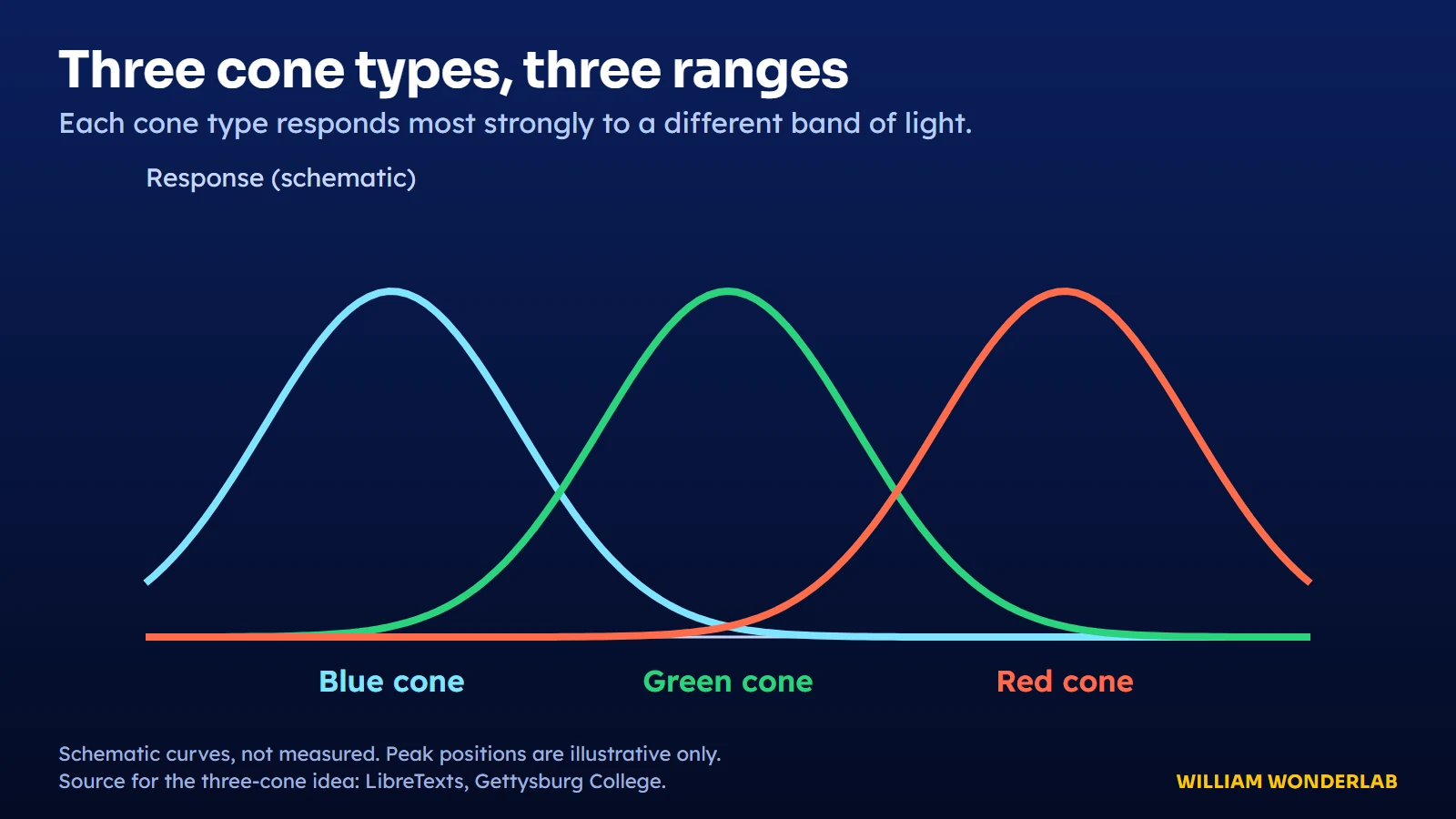
Here is the key idea. There is not one cone type but three. Gettysburg College’s open textbook on light explains that “There are three types of cones, and each type is sensitive to different ranges of wavelengths.”[2] The cones are named after the wavelength of light they respond to most strongly. In everyday words, one type is most responsive to blue light, one to green and one to red.
The UBC page puts it this way: “In cones, there are pigments that respond to three colours: blue, green and red.”[1] A pigment here is a light-sensitive molecule inside the cell. When light hits it, the cell sends a signal.
A useful way to picture it is three dimmer switches, one for each cone type. Each switch turns up or down depending on the light that arrives. The brain reads the three settings together.
How the brain makes colour
Each cone type does not give you a single colour. Instead, every cone responds to a range of light. The UBC page says that “Each of these pigments gets ‘excited’ by a different wavelengths of light to varying degrees,” and that “The higher the absorbance, the more excitations occur, and the intensity of that colour (as we observe it) increases.”[1]
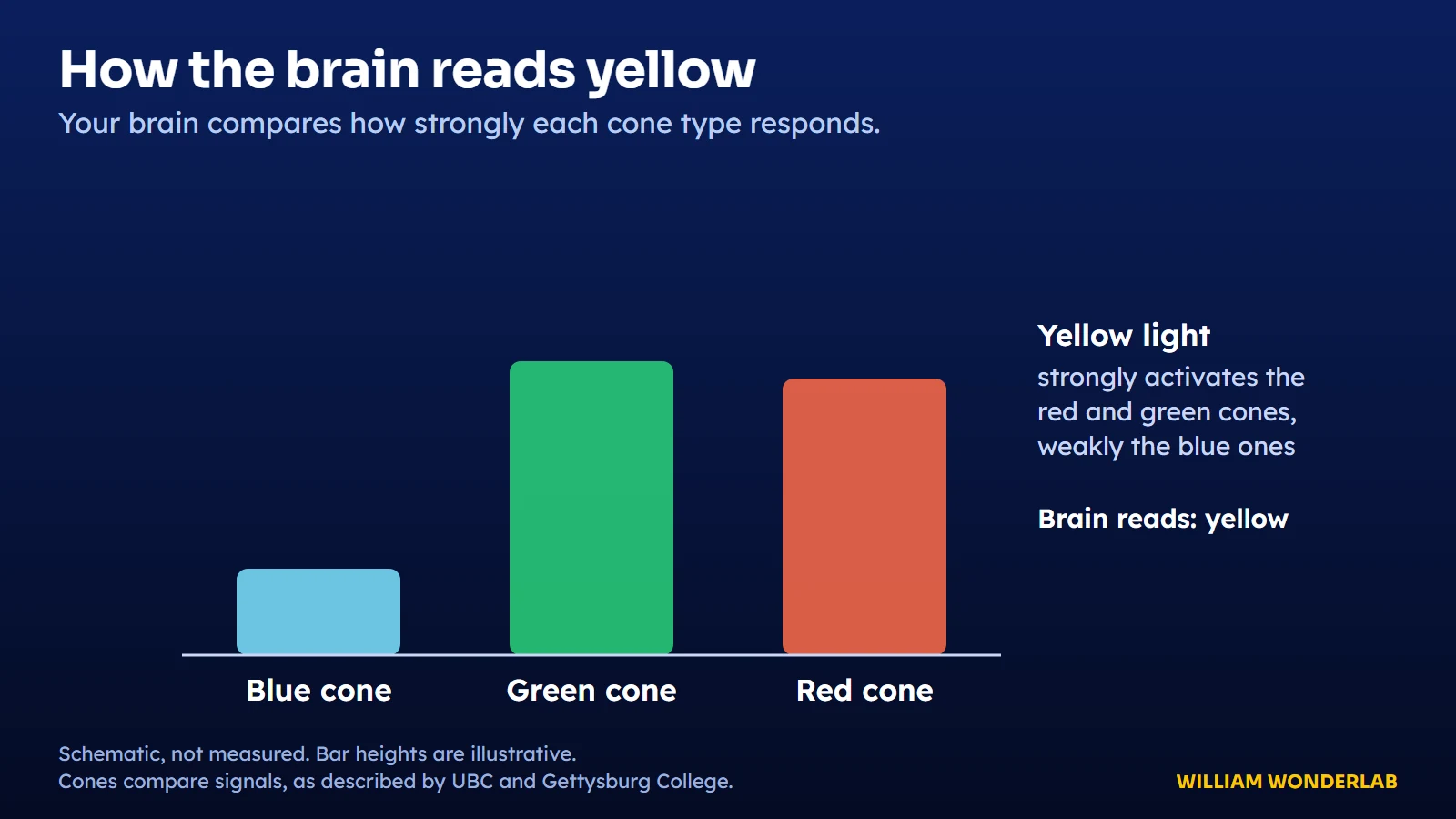
So a patch of yellow light is not picked out by one special cone. It strongly stimulates the red-sensitive and green-sensitive cones, and only weakly stimulates the blue-sensitive ones. The brain reads that pattern as yellow.
The brain also does more than read raw signals. The Gettysburg textbook notes that the eye-brain system can, “by comparing various objects in its view, perceive the true color of an object,” even when the lighting changes.[2] That is why a white shirt still looks white in shade and in sunlight, even though the light reaching your eye is different.
Did you know? Colour is created inside your brain by comparing signals from different cones. A colour is not a property that light carries on its own; it is the result of your eyes and brain working together.[1][2]
When colour vision works differently
Colour vision deficiency, often called colour blindness, means that some colours are harder to tell apart. It is not a lack of sight. Most people with it can see clearly, but some colours look the same or very alike.
MedlinePlus explains that “Pathogenic variants in several different genes can cause color vision deficiency.” The genes that code for the cone pigments, OPN1LW, OPN1MW and OPN1SW, are common causes.[3] A change can mean a cone type is missing, or that its pigment does not work properly. The MedlinePlus page gives one example: “Pathogenic variants in the OPN1SW gene can prevent S cones from producing opsins that function properly.”[3]
Opsins are the light-sensitive proteins that make up cone pigments, so changes in these genes change the colour signal the brain receives.
The most common kind is the red-green form. The Better Health Channel, a Victorian Government health resource, says it “occurs in about eight per cent of males and only about 0.4 per cent of females.”[4] Worldwide, MedlinePlus estimates that colour vision deficiency affects “about 2.5 percent of individuals worldwide.”[3]
Colour vision can also change later in life. The Better Health Channel notes that “Colour vision problems can also arise later in life due to disease, trauma or exposure to toxins.”[4] If you notice a sudden change in how colours look, a health professional should check it.
Go deeper: genes, cones and inheritance
Why males are affected more often
The genes for the red and green cone pigments sit on the X chromosome. MedlinePlus says that “Red-green color vision deficiency and blue cone monochromacy are inherited in an X-linked pattern.”[3] Because males have one X chromosome, a single changed copy is enough to affect them. Females have two X chromosomes, so one healthy copy often covers for a changed one.[3] This is why the condition is more common in males. The Better Health Channel says it “affects more males than females.”[4]
Why the condition usually cannot be cured
Because the change is in the genes that build the cone pigments, the difference is usually present from birth. The Better Health Channel states that “There is generally no treatment to cure colour vision deficiency.”[4]
Frequently asked questions
Why do colours look dull at night?
At night, light levels are low. Rods work well in dim light, but they do not sense colour, and cones need more light. So your night vision is mostly in shades of grey.[1]
Is colour blindness the same as being unable to see?
No. Colour vision deficiency usually makes some colours harder to tell apart. Most people with it can see clearly.[4]
Can colour blindness be cured?
There is generally no cure, according to the Better Health Channel.[4]
The big idea
Colour is built by your brain. Rods give you dim-light vision, and three types of cone respond to different ranges of light. Your brain compares those signals and turns them into the colours you see.[1][2]
Related reading
More from William Wonderlab:
Explore more from scientists:
- Colour Vision, UBC Mathematics course project (University of British Columbia)
- Color deficiency, MedlinePlus Genetics (US National Library of Medicine)
- Colour vision deficiency (colour blindness), Better Health Channel (Victoria)
References
[1] University of British Columbia, Mathematics 309 project, “Colour Vision” (accessed 25 October 2026)
[2] Gettysburg College, “5.3: Color and Color Vision”, LibreTexts Physics (accessed 25 October 2026)
[3] US National Library of Medicine, MedlinePlus Genetics, “Color vision deficiency” (accessed 25 October 2026)
[4] Better Health Channel (Victoria, Department of Health), “Colour vision deficiency (colour blindness)” (accessed 25 October 2026)