How Do LED Lights Make Light?
An LED makes light when electrons drop into empty spaces inside a semiconductor and release energy as light. The material decides the colour.
Look around you. The screen you are reading, the bulbs in the ceiling, the tiny light on a charger: many of them are LEDs. Unlike an old-style bulb, an LED does not need a glowing wire to make light. So how does it do it?
The short answer: An LED makes light when electrons fall down an energy step inside a special material called a semiconductor. As they fall, they release energy as particles of light, called photons. The size of the step decides the colour.[1][2]
A material that can carry electricity, sometimes
A semiconductor is a material that carries electricity better than an insulator, such as plastic, but not as freely as a metal wire. Think of it like a door that opens only when it is given the right push.
Inside a semiconductor, electrons sit in two groups of energy levels, called bands. The lower group is the valence band, where electrons are held in place. The higher group is the conduction band, where electrons can move around and carry electricity. The University of Wisconsin’s materials science education site explains that “Conduction occurs when electrons are promoted from the valence band to the conduction band.”[1]
When an LED is connected to a battery or power supply, electricity pushes electrons into the material. This is what lights it up.
Electrons and holes meet
The lower band has empty spaces too. These are called holes. The Wisconsin page calls them “open circles (holes) in the valence band.”[1] You can think of a hole as a gap in a row of seats, which another person can fill.
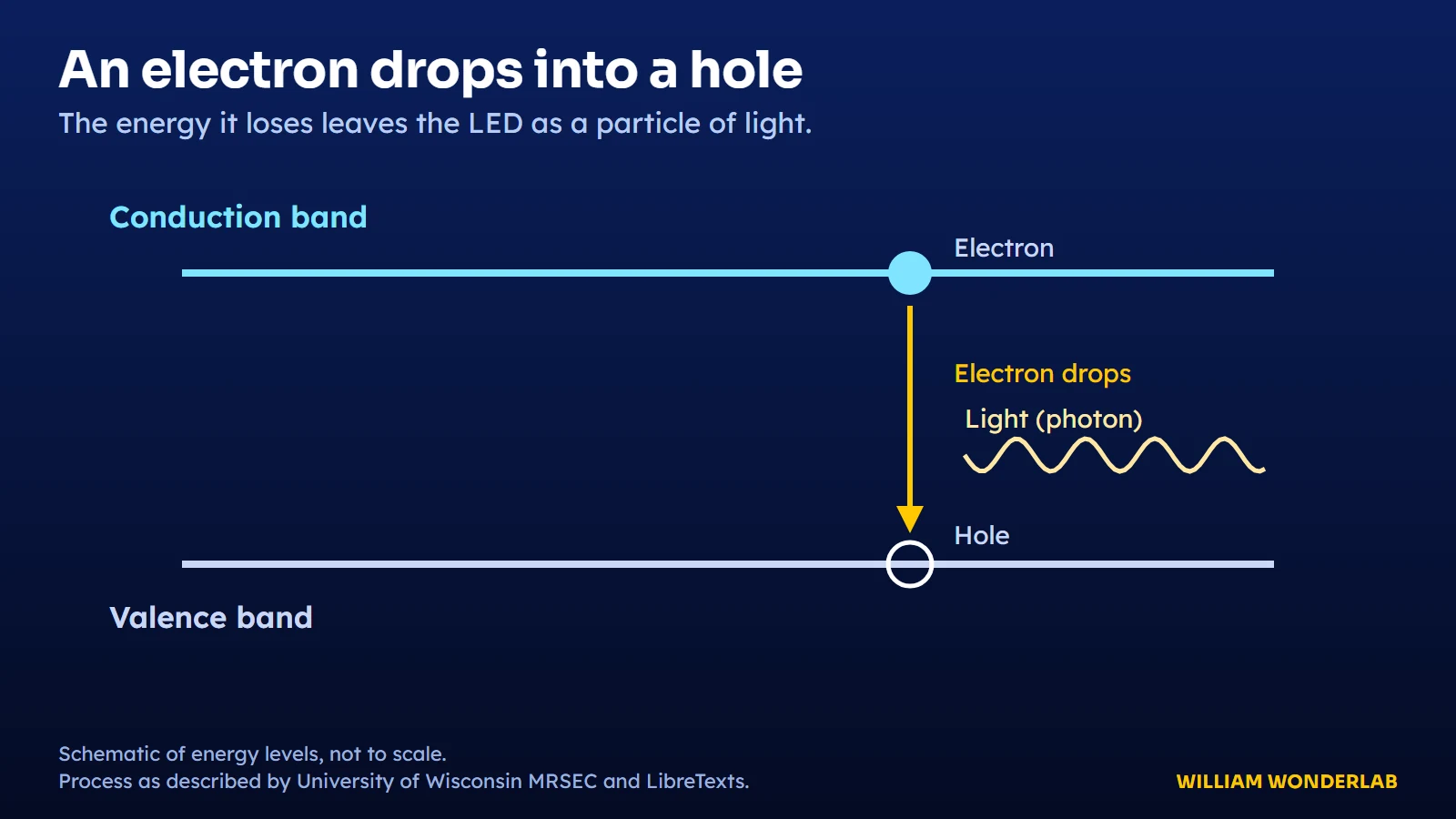
Inside an LED, one side of the material has extra electrons, and the other side has extra holes. Where the two meet, an electron can fall into a hole. The LibreTexts engineering module describes it this way: “When an electron in the conduction band meets a hole in the valence band it falls to a lower energy level.”[2]
That fall is the important step. The electron drops into a lower energy level, and the energy it gives up has to go somewhere.
The leftover energy becomes light
The energy from the fall is released as a photon. The LibreTexts page says that “In each collision an electron and hole essentially annihilate each other and the energy left over is used to emit a photon.”[2] In everyday words, the electron and the hole disappear together, and the energy they leave behind escapes as a tiny packet of light.
The Wisconsin site describes the same idea for LEDs: “Some of the energy released is in the form of light.”[1] This is why LEDs are often described as light-emitting diodes. A diode is a device that lets electricity flow in one direction, and the light comes from the electrons falling as the current passes through.
Solar panels use a related set of energy steps in the other direction. You can read about that in How Do Solar Panels Make Electricity?
The material decides the colour
The energy difference between the conduction band and the valence band is called the band gap. It is like the height of a step. A bigger step releases more energy per photon, and a photon with more energy is a bluer colour.
Wisconsin’s page says that “for many LEDs the color of light is a rough measure of the band gap energy of the semiconductor comprising the LED.”[1] The band gap is set by the material, so engineers choose the chemicals in the semiconductor to get the colour they want. As the page puts it, “The band gap energy can be tuned by varying the chemical composition of the semiconductor.”[1]
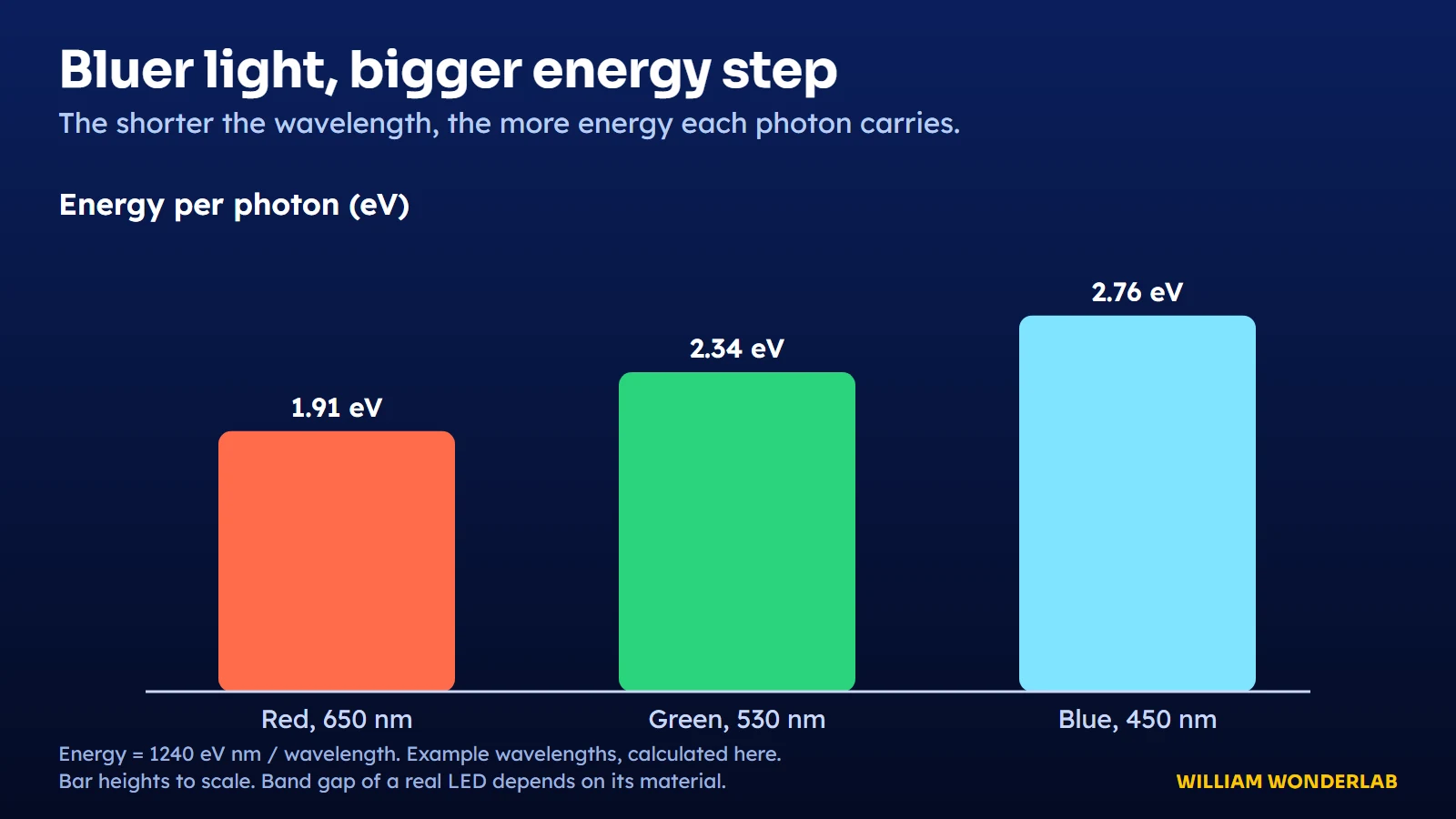
The diagram shows how the same idea works for three colours. Redder light has a smaller step; bluer light has a bigger step.
Why blue was the hard colour
For decades, red and green LEDs were common, but a good blue LED was much harder to make. In 2014, the Nobel Prize in Physics went to Isamu Akasaki, of Meijo University and Nagoya University; Hiroshi Amano, of Nagoya University; and Shuji Nakamura, of the University of California, Santa Barbara. The Royal Swedish Academy of Sciences honoured them “for the invention of efficient blue light-emitting diodes which has enabled bright and energy-saving white light sources.”[3]
Why did blue matter so much? Physics World explains: “A source of white light needs LEDs that deliver red, green and blue light.”[4] Mixing those three colours gives white light. Without a blue LED, that mix of three colours could not be made from LEDs alone.
The researchers focused on a material called gallium nitride. Physics World notes that it “had a large band-gap energy corresponding to ultraviolet light,” which made it promising for creating blue LEDs.[4] A large step is needed for blue light, and gallium nitride had one.
Did you know? The Royal Swedish Academy credited the blue LED with enabling “bright and energy-saving white light sources.”[3] Blue was the colour that white light made from LEDs needed.
Everyday examples
- A torch. An LED torch makes light without a glowing wire, using the same electron-and-hole process.
- A power light on a charger. Many small indicator lights are LEDs, and each one is a tiny semiconductor chip.
- A bulb in the ceiling. Many modern bulbs use LEDs instead of a thin wire that glows when heated.
Try it: look at light through a grating
This is a proposed at-home activity. It does not show LED physics directly, but it lets you compare how different lights spread into colours.
You need: a cardboard diffraction-grating viewer or a piece of diffraction-grating film, a few different lights such as an LED torch and a phone screen, and an adult.
- Predict which light will show the widest band of colours through the grating.
- Hold the grating close to one eye, and look at a light at an angle, not straight into it.
- Compare the lights. Which one gives the clearest bands of colour?
- Write down what you noticed, and whether the colours matched your prediction.
What to expect: Each light shows a band of colours. Some lights show brighter or clearer colours than others.
Safety first: Never look straight at a bright light, the Sun or a laser pointer. Look only at the light at an angle, and keep the grating away from your eyes and face when you lift it. Use only battery-powered lights that open easily. Do not use coin-cell batteries in this activity, and keep any small batteries away from children. An adult should help with any battery or torch.
Go deeper: the energy of a photon
Calculating the colour
LibreTexts gives the relationship for the energy of a photon: “Energy of the emitted photon is given by E = hf = hc/λ.”[2] Here E is the energy, f is frequency, and λ is wavelength. Using the standard value hc ≈ 1240 electron-volt nanometres (eV·nm), you can check the example colours in the diagram.
- Red light at 650 nm: 1240 ÷ 650 ≈ 1.91 eV.
- Green light at 530 nm: 1240 ÷ 530 ≈ 2.34 eV.
- Blue light at 450 nm: 1240 ÷ 450 ≈ 2.76 eV.
These values are calculated for this article. The wavelengths are example colour choices, not measurements of a specific LED. The pattern is clear: the shorter the wavelength, the bigger the energy step.
Why LEDs can be efficient
The Royal Swedish Academy’s citation credits blue LEDs with enabling energy-saving white light.[3] The sources used for this article do not give figures for how efficient a particular LED is, so no efficiency number is given here.
Frequently asked questions
Does an LED have a filament like an old bulb?
No. An old bulb makes light by heating a thin wire until it glows. An LED makes light when electrons fall into holes inside a semiconductor.[1][2]
Why do LEDs come in different colours?
The material inside the LED sets the size of the energy step. A different chemical mix gives a different step, and so a different colour.[1]
Why was blue light so hard to make?
Blue light needs a larger energy step. Researchers needed a material with a large band gap and a way to make it emit blue light, and this took many years.[3][4]
Is white light from an LED just one colour?
White light is usually made by combining colours, such as red, green and blue, or by using a coating that changes the colour of the light. The Physics World article explains that a source of white light needs red, green and blue LEDs.[4]
Can an LED light be dangerous?
Bright lights can hurt your eyes if you stare into them. Never look directly at any bright light, and follow the safety guidance for any batteries or electrical equipment.
The big idea
Electrons fall, and light escapes. An LED turns electricity into light by letting electrons drop into holes in a semiconductor. The energy step is set by the material, so the material also sets the colour.
Related reading
More from William Wonderlab:
- How Do Touchscreens Know Where You Touch?
- How Does Wi-Fi Send Information Through the Air?
- How Does a Microwave Heat Food?
Explore more from scientists:
- Light Emitting Diodes (LibreTexts, Engineering)
- LED: Light Emitting Diodes (University of Wisconsin MRSEC education)
- The Nobel Prize in Physics 2014 (Royal Swedish Academy of Sciences)
References
[1] University of Wisconsin-Madison, MRSEC Education, “LED: Light Emitting Diodes” (accessed 25 October 2026)
[2] LibreTexts Engineering, “Light Emitting Diodes” (accessed 25 October 2026)
[3] Royal Swedish Academy of Sciences, “The Nobel Prize in Physics 2014” (accessed 25 October 2026)
[4] Physics World, “Isamu Akasaki, Hiroshi Amano and Shuji Nakamura win 2014 Nobel Prize for Physics” (accessed 25 October 2026)