How Does a Microwave Heat Food?
A microwave heats food by making water molecules vibrate, and the friction between them produces heat. Here is how it works, and the simple safety rules that keep it safe.
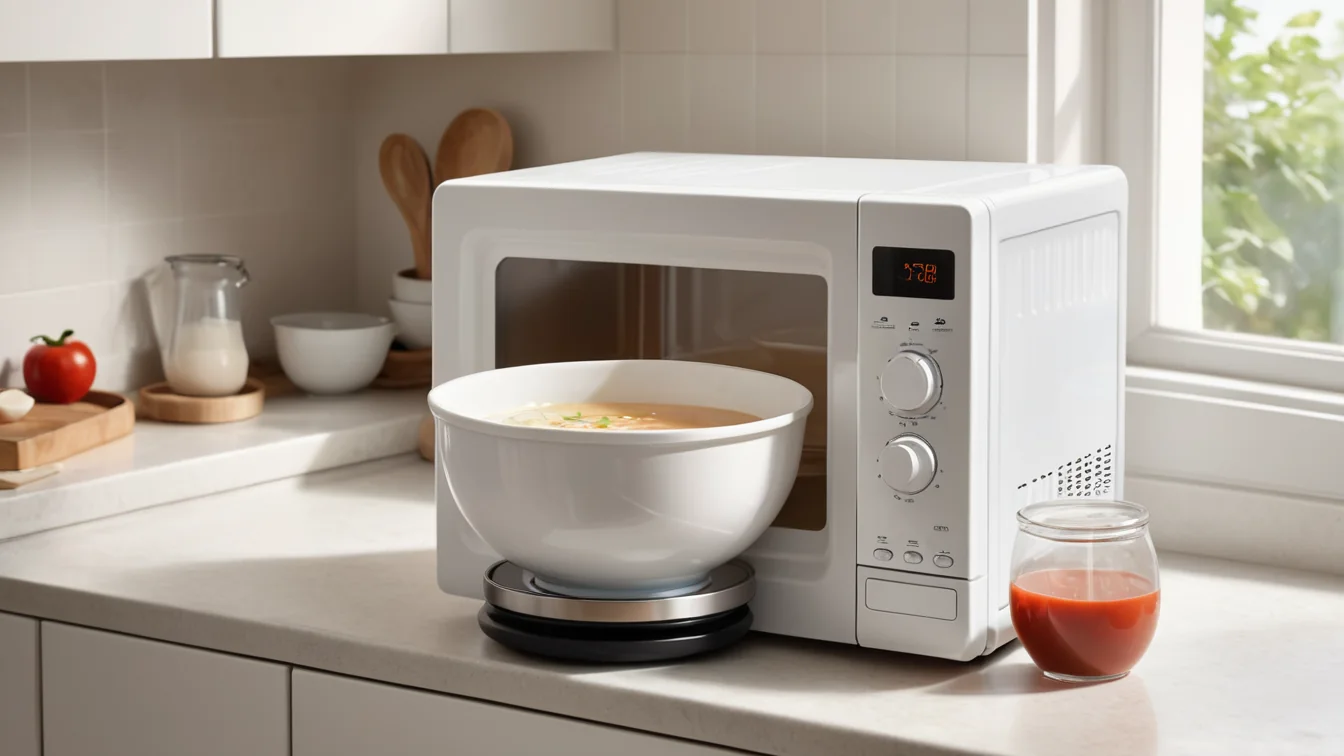
Put a cup of soup in a microwave for two minutes and it is steaming hot. The oven walls stay cool to touch, and the plate is often barely warm. So how does a box of electronics heat the food and skip everything else? The answer is that the microwaves are picky about what they heat.
The short answer: A microwave oven makes microwaves, which are a kind of radio wave. Water molecules in the food absorb their energy and vibrate. The vibration causes friction between the molecules, and that friction produces the heat that cooks the food.[1][2]
Inside the oven
A microwave oven has a device called a magnetron. The US Food and Drug Administration (FDA) explains that “a device called a magnetron inside the oven produces microwaves.”[1] The microwaves fill the metal box that holds the food, which is called the cavity.
ARPANSA, the Australian Radiation Protection and Nuclear Safety Agency, describes the cavity like this: “Microwave ovens generate intense microwaves within the cavity of the oven.”[3] The FDA says the microwaves “reflect off the metal interior of the oven and cause the water molecules in food to vibrate.”[1]
The oven walls stay cool for a simple reason. ARPANSA states that “the oven walls and most non-metallic cooking utensils are not directly heated by microwaves because they do not absorb microwave energy.”[3]
Water is the target
Water does most of the work in food. The Engineering and Technology History Wiki notes that “there is enough water in most foods to allow the microwave to do its work.”[4] Water also absorbs microwaves very well. CSIRO notes that “water absorbs microwaves far more easily than ice does.”[5] That is why frozen food can take longer to heat than food that is already warm.
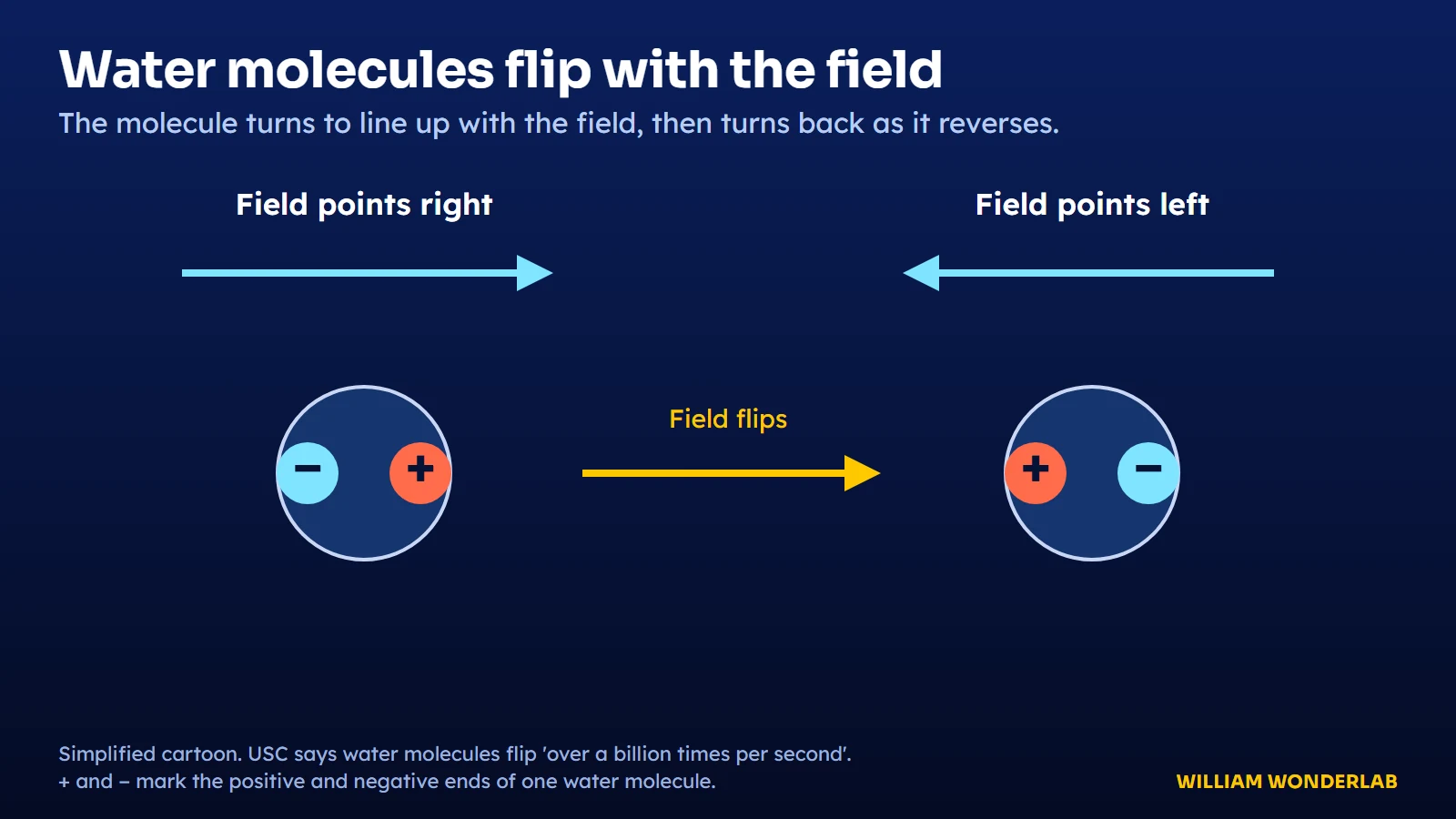
A University of Southern California engineering article explains what the water molecules do. Water molecules have a positive end and a negative end. When an electric field reverses direction many times, “water molecules spin backwards and forward, getting hotter and hotter each time.”[2] The article adds: “It is this thermal energy that cooks the food.”[2]
Here is the process in simple steps. The microwave field pushes the water molecules one way. Then the field flips, and the molecules swing the other way. Each swing makes the molecules bump into their neighbours, and that friction turns some of their energy into heat.
The 2.45 GHz frequency
Microwave ovens use a particular frequency. The USC article says: “Microwave ovens use 2.45 GHz microwaves to flip water molecules back and forth at a rate of over a billion times per second.”[2] The GHz (gigahertz) unit means billions of cycles per second, so 2.45 GHz is 2.45 billion cycles per second.
The Engineering and Technology History Wiki, run by the IEEE History Center, says that “All microwave ovens used for heating food operate at 2450 MHz.” It adds that this “is the frequency at which radio waves interact strongly with water molecules in the food, while passing through other things (like plastic and dishes) without heating them.”[4]
Regulators also set this band aside. The US federal rules list 2450 MHz, with a tolerance of plus or minus 50 MHz, as a frequency designated for industrial, scientific and medical (ISM) equipment.[6]
Did you know? Some sources say this frequency was chosen because it was “not in use for communications.”[2] Others focus on how strongly it interacts with water. The reasons are discussed, so treat any single explanation with some care.
Why plates can stay cool
Different materials respond to microwaves in different ways. The FDA lists three characteristics: microwaves “are reflected by metal,” they “pass through glass, paper, plastic, and similar materials,” and they “are absorbed by foods.”[1]
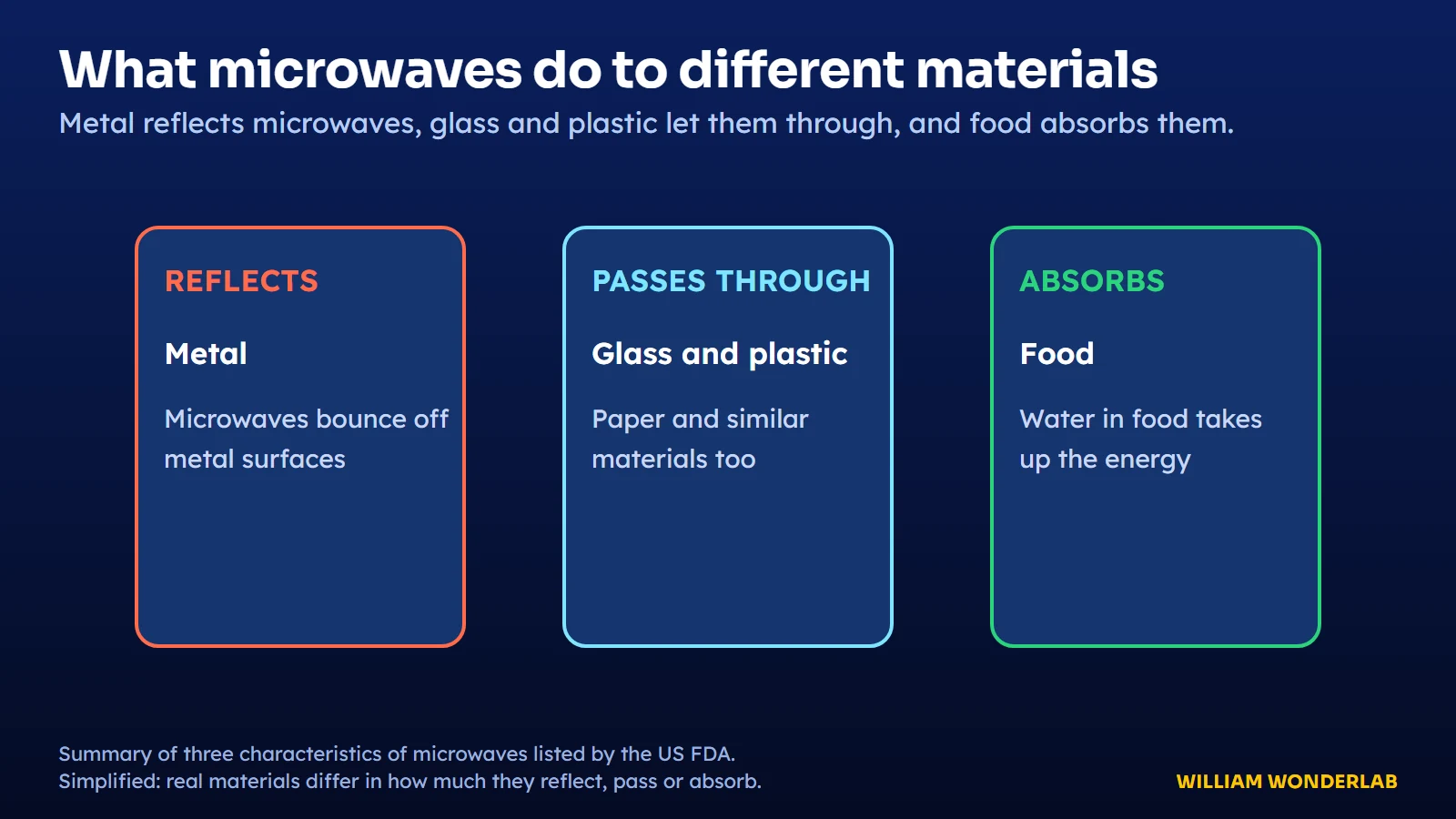
This explains the rules for dishes. Glass and many ceramics let the waves through to the food. Metal reflects them, which is why metal can cause problems in an oven. Water in food absorbs the energy and becomes hot.
Why food heats unevenly
Microwave heating is not perfectly even. ARPANSA notes that “uneven heating can occur in some foods where the outside may be only warm while the inside may be close to boiling.”[3] This is why it helps to stir and let food stand before eating.
Liquids can be dangerous. ARPANSA warns: “be careful when removing liquids from a microwave oven as they can become super-heated (heated beyond boiling point without actually boiling) and may suddenly erupt when stirred or knocked.”[3]
Do microwaves stay in the food?
No. ARPANSA says that “microwaves generated in microwave ovens cease to exist once the electrical power is turned off,” and “they do not remain in the food when the power is turned off.”[3] The same page adds that they “do not make the food or the oven radioactive.”[3]
Scientists have looked for health effects. ARPANSA reports that “there is no established evidence that microwave ovens cause any health effects when used according to the manufacturer’s instructions and maintained in good working order.”[3] The key phrase is “according to the manufacturer’s instructions” and “in good working order.”
Safety first: Use a microwave only as its maker’s instructions describe. ARPANSA advises: “Never operate the oven without a load (i.e. an absorbing material such as food or water) in the oven cavity unless specifically allowed in the manufacturer’s instructions.”[3] Do not let foil touch the sides of the oven, because “this may cause sparking.”[3] Avoid dishes with metallic glazes, and use only utensils designed for the purpose.[3][5]
Doors and damage
Modern ovens have built-in protection. ARPANSA says that “all microwave ovens have at least two safety interlock switches which stop the generation of microwaves immediately if the door is opened.”[3] The FDA gives simple rules about damage: “don’t operate a microwave oven if the door does not close firmly or is bent, warped, or otherwise damaged.”[1] It also says “stop using a microwave oven if it continues to operate with the door open.”[1]
The FDA adds that “microwave energy will not leak from a microwave in good condition,” but that “a damaged microwave oven may present a risk of microwave energy leaks.”[1] If the door does not seal properly, get it checked by a qualified technician.[3]
Go deeper: why water absorbs the energy
Polar molecules
The USC article says that water molecules are “electrically polar in nature”, with “both positively and negatively charged ends.”[2] In an electric field, the molecules tend to rotate into line with it.[2] A microwave field keeps reversing, so the molecules keep trying to turn, and their motion is turned into heat.
What about the other ingredients?
Food with less water has less material to absorb the energy, so it tends to heat more slowly. The ETHW sentence quoted earlier explains why water in food matters.[4]
Frequently asked questions
Does a microwave make food radioactive?
No. ARPANSA states that microwaves “do not make the food or the oven radioactive.”[3]
Why does the plate stay cool?
Most non-metallic cooking utensils do not absorb microwave energy, so they are not heated directly by microwaves.[3]
Why does frozen food take longer to heat?
Water absorbs microwaves far more easily than ice does, so frozen food can be slower to heat.[5]
Can I put metal in a microwave?
Be careful. ARPANSA warns that foil touching the sides of the oven “may cause sparking,” and that “dishes with metallic glazes should not be used.”[3]
Is it safe to use a microwave oven?
ARPANSA says there is no established evidence of health effects when the oven is used according to the manufacturer’s instructions and kept in good working order.[3]
The big idea
Water in the food does the heating. A microwave oven sends microwaves that make water molecules flip back and forth. The friction produces heat, and the oven itself is designed so the microwaves stay inside.
Related reading
More from William Wonderlab:
Explore more from scientists:
- Microwave Ovens (US Food and Drug Administration)
- Microwave ovens and health (ARPANSA)
- The Engineering Behind the Microwave Oven (University of Southern California)
References
[1] US Food and Drug Administration (FDA), “Microwave Ovens” (accessed 25 October 2026)
[2] Jaime Clevenger, “The Engineering Behind the Microwave Oven”, Illumin Magazine, University of Southern California (accessed 25 October 2026)
[3] Australian Radiation Protection and Nuclear Safety Agency (ARPANSA), “Microwave ovens and health” (accessed 25 October 2026)
[4] IEEE History Center, “Microwave Ovens”, Engineering and Technology History Wiki (ETHW) (accessed 25 October 2026)
[5] CSIRO, “Microwave oven safety” (accessed 25 October 2026)
[6] US Code of Federal Regulations, Title 47, Section 18.301, “Operating frequencies” (ISM equipment), via Cornell Law School Legal Information Institute (accessed 25 October 2026)