Why Do Some Things Dissolve in Water?
Salt vanishes into a glass of water, but oil stays on top. Water is a polar solvent, so the rule like dissolves like explains which substances mix with it.
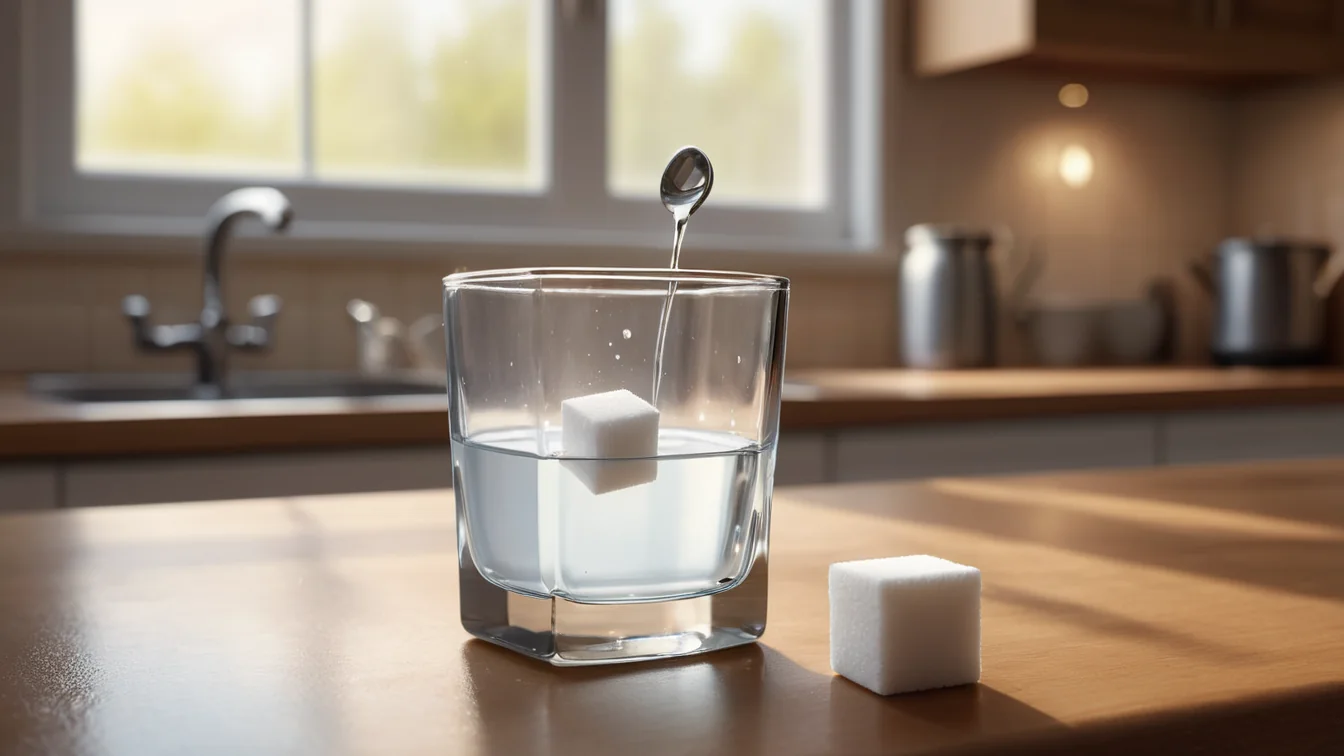
Stir a spoonful of salt into a glass of water and, after a little stirring, the salt seems to disappear. Now try the same with a spoonful of cooking oil. The oil does not vanish. It stays on top or breaks into droplets. Why does water treat the two so differently?
The short answer: Water is a polar solvent, and many polar or ionic substances, such as salt, dissolve in it. Some ionic substances hardly dissolve at all. Substances that are nonpolar, such as oil, do not dissolve in water. This is summed up by the rule “like dissolves like.”[1][2][3]
What “like dissolves like” means
Chemists use the phrase “like dissolves like” as a shortcut. It predicts which substances will mix. A LibreTexts chemistry page explains that “polar compounds dissolve polar compounds, nonpolar compounds dissolve nonpolar compounds,” but “polar and nonpolar do not dissolve in each other.”[1]
Think of it like a group of friends. Some people get on well with each other and some do not. Polar substances get on with polar water. Nonpolar substances prefer to keep to themselves.
Water: the universal solvent
Water is an unusual liquid. Science Learning Hub, the New Zealand science education site, says: “Another unusual feature of water is that it can dissolve many things.”[2] It adds that “water is often called the universal solvent because more substances dissolve in water than in any other liquid.”[2]
Water is not universal, though. The same page warns: “Not everything dissolves in water, though. Oils, waxes and fatty things like butter don’t.”[2]
The solvent is the liquid that does the dissolving, here water. The solute is the substance that dissolves, such as salt. A solution is the clear mixture that forms.
Salt dissolves in water
Table salt is an ionic compound. Its particles are charged ions, and a LibreTexts page describes salt as “a very polar substance because it is composed of ions,” which “dissolves in water, which is very polar.”[1] The page adds that “ion-dipole interactions are formed when ionic compounds dissolve in water.”[1]
In everyday words, the charged ions in the salt are pulled into the mix by the charged parts of the water. A LibreTexts biology page explains the same idea for salts such as sodium chloride: the ions attract the charged parts of water molecules more strongly than water molecules attract each other.[4] That is why salt vanishes into the water rather than sitting at the bottom.
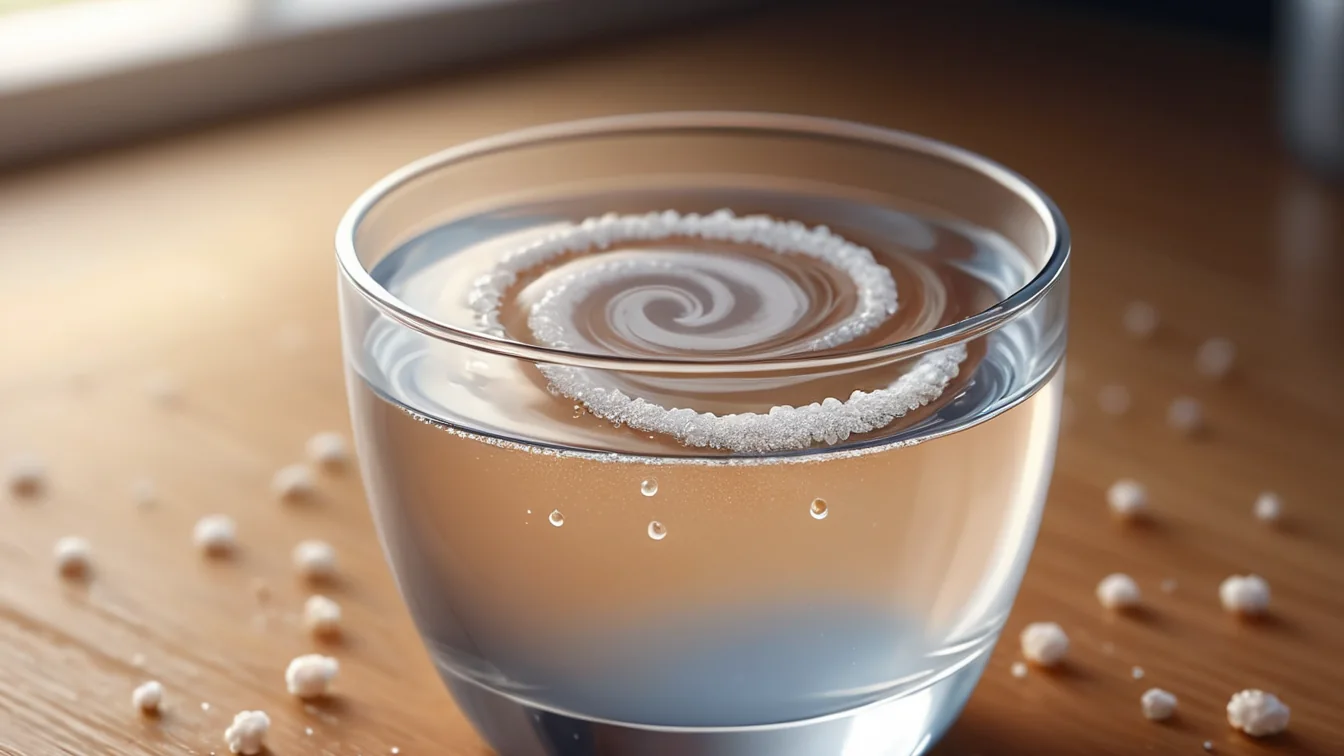
Did you know? Not every ionic compound dissolves. A LibreTexts course page says that “an insoluble compound just doesn’t dissolve in any noticeable or appreciable amount.”[3]
Oil does not dissolve
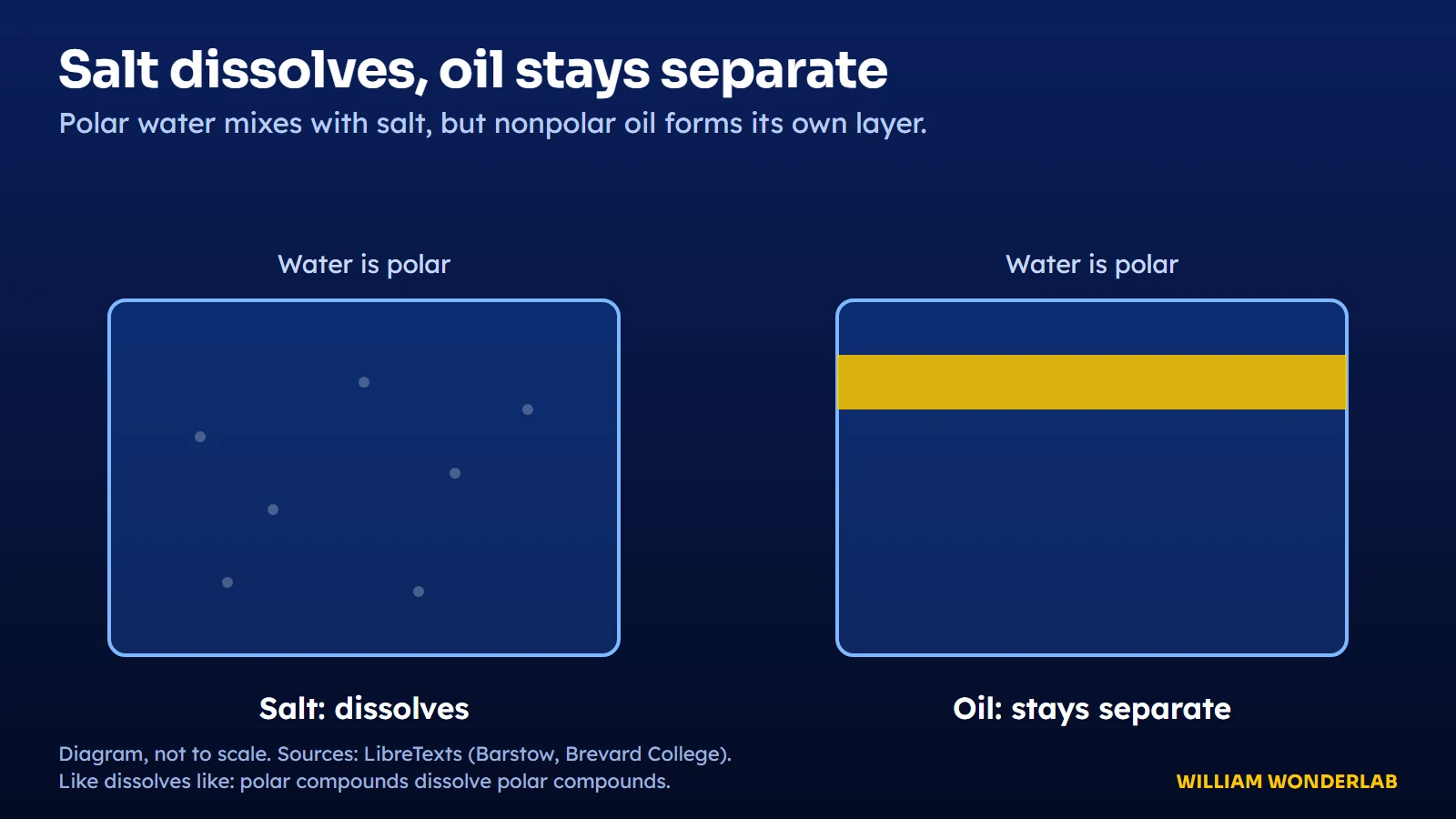
Oil is a nonpolar substance. It does not have the charged parts that water is drawn to, so it does not mix. A LibreTexts course page says, “Nonpolar wax dissolves in nonpolar hexane, but not in polar water.”[3] A figure on the same page shows that “water (clear liquid) and oil (yellow) do not form liquid solutions.”[3]
A second LibreTexts page gives the same reasoning for octane, a nonpolar hydrocarbon: “Like other hydrocarbons, octane is nonpolar, so we expect that it would not be soluble in water.”[1]
The diagram below compares the two. It is a simple picture of the idea, not to scale.
Everyday examples
- Salt in soup. Salt stirred into the water in a pot dissolves into the liquid, the same process as the glass in the activity below.[1]
- Oil floating on a soup. The oil stays as a separate layer, the same result you will see in the activity.[3]
Try it: salt, oil and water
You need: a clear glass of room-temperature tap water, one teaspoon of table salt, one teaspoon of cooking oil and a clean spoon.
- Predict what will happen when you stir salt into the water. Predict the same for the oil.
- Add the salt, then stir gently for about a minute. Watch whether the crystals disappear.
- Let the water settle. Then add a teaspoon of oil on top and stir gently.
- Watch where the oil goes. Write down what you saw and compare it with your prediction.
What to expect: the salt should disappear into the water, while the oil stays separate as droplets or a layer on top.
Safety first: Use only the table salt and cooking oil listed here, and do not taste any of the mixtures. Work on a bench that wipes clean, and wipe up any oil straight away so no one slips. Use a clean spoon and keep the glass away from the edge of the bench. Wash your hands afterwards. Do not pour oil down the sink. Wipe it into a paper towel and put that in the bin. Younger scientists should do this with an adult.
Go deeper: polar and nonpolar, in more detail
Water as a polar solvent
The LibreTexts page lists water as a polar solvent, so polar and ionic substances dissolve in it.[1]
Frequently asked questions
Why does salt dissolve in water?
Salt is an ionic compound, and water is a polar solvent. A LibreTexts page describes ion-dipole interactions when ionic compounds dissolve in water.[1]
Why doesn’t oil dissolve in water?
Oil is nonpolar, and water is polar. The LibreTexts course page says nonpolar wax does not dissolve in polar water.[3]
What does “like dissolves like” mean?
It means polar substances dissolve in polar solvents, and nonpolar substances dissolve in nonpolar ones.[1]
Is water the universal solvent?
Water dissolves more substances than any other common liquid, which is why it is often called the universal solvent. It does not dissolve everything, and oils and waxes are examples.[2]
The big idea
Like dissolves like. Water is a polar solvent, so polar and ionic substances such as salt mix with it. Nonpolar substances such as oil stay separate.
Related reading
More from William Wonderlab:
Explore more from scientists:
References
[1] LibreTexts, “6.03: Intermolecular Forces in Solutions” (Brevard College, CHE 103) (accessed 25 October 2026)
[2] Science Learning Hub (New Zealand), “Water” (accessed 25 October 2026)
[3] LibreTexts, “2.6.01: Like Dissolves Like” (Barstow Community College) (accessed 25 October 2026)
[4] LibreTexts, “Water Chemistry” (Bergtrom, Cell and Molecular Biology, section 2.4) (accessed 25 October 2026)