Why Do Astronauts Float in Space?
Astronauts float because they are in free fall, not because gravity has gone. At the International Space Station, Earth's pull is still about 90 per cent of its surface strength.

Watch video from the International Space Station and you will see astronauts drifting, turning and floating through the cabin. It looks as if gravity has switched off. It has not. The reason they float is more surprising than that.
The short answer: Astronauts float because they are in free fall. The station and everything in it are falling towards Earth all the time, but they also move sideways so fast that they keep missing it. NASA says, “The answer is because they are in free fall.”[1]
Not zero gravity
It is tempting to say that astronauts float because there is “zero gravity” in space. NASA says this is wrong: “Microgravity is sometimes called ‘zero gravity,’ but this is misleading.”[1]
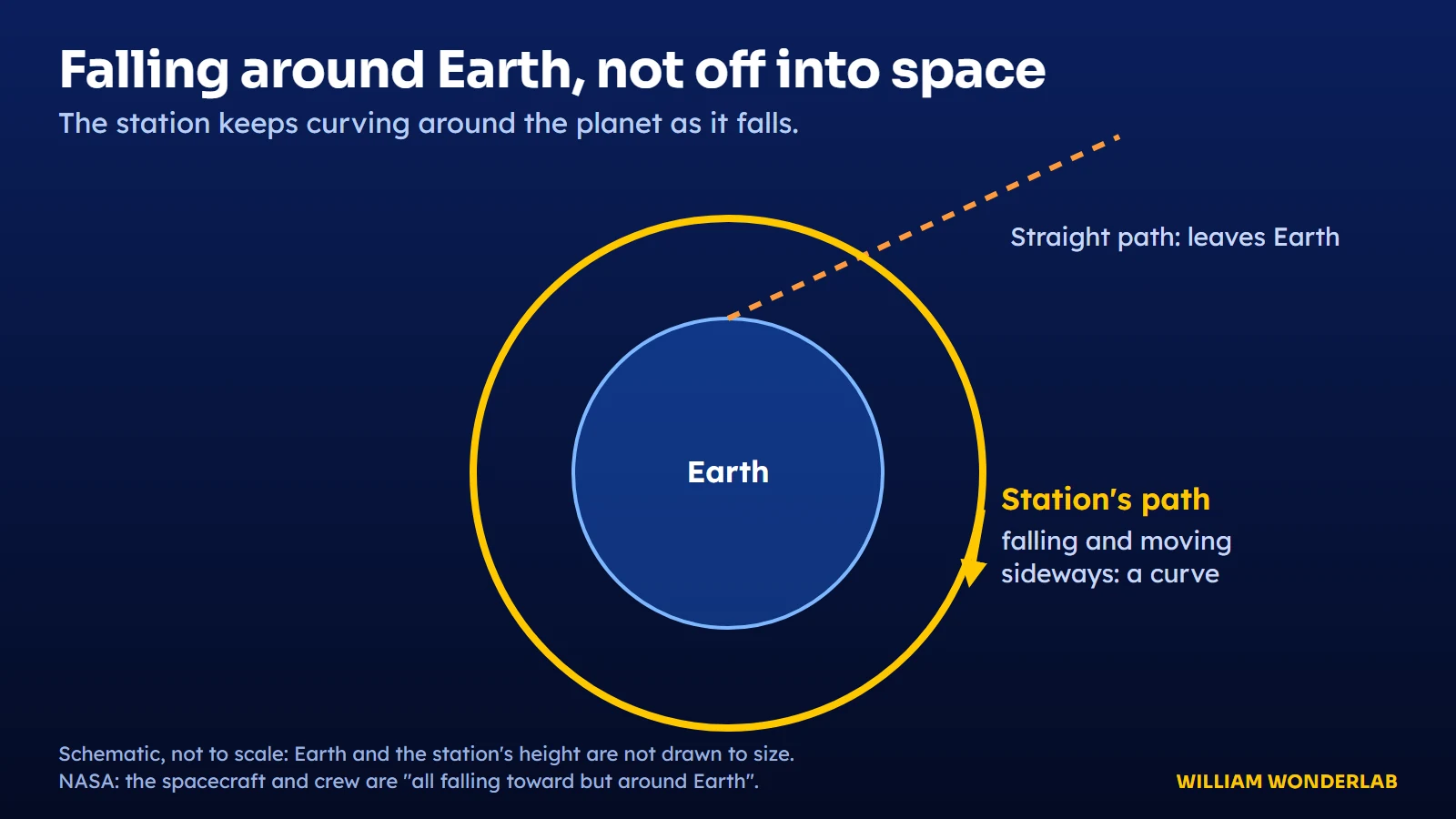
Gravity is still strong where the station flies. NASA says that “at that altitude, Earth’s gravity is about 90 percent of what it is on the planet’s surface.”[1] NASA’s photograph caption places the station 259 miles, about 417 kilometres, above Earth.[2] A NASA reference page says the station “orbits at an altitude of between 370–460 km (200–250 nmi).”[3] Earth’s pull has weakened a little at that height, but not by much.
Free fall: falling around Earth
NASA defines free fall as “the condition of moving freely in an environment in which gravity, and nothing else, is causing acceleration.”[1] In plain words, an object in free fall has only gravity acting on it.
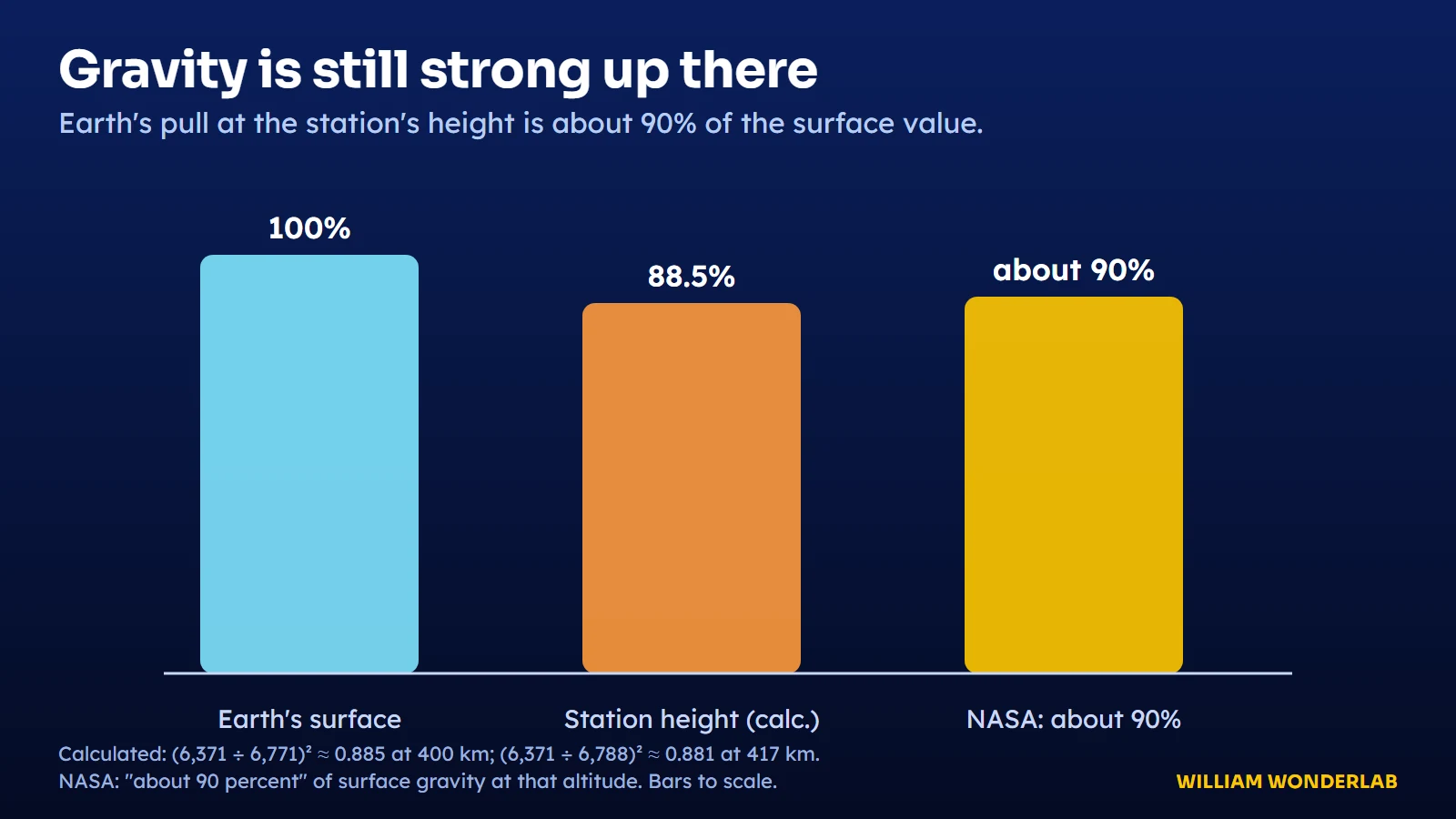
NASA also says that “the spacecraft, its crew and any objects aboard are all falling toward but around Earth.”[1] So the whole station is falling together, and so are the astronauts inside it. Because the astronauts and the station fall together, nothing pushes the astronauts against the floor, so they seem to float.
How much gravity is left?
You can check NASA’s 90 per cent figure with a simple formula. Gravity gets weaker with distance from Earth’s centre, and it weakens with the square of that distance. So the fraction of surface gravity is:
(Earth’s radius ÷ (Earth’s radius + altitude)) squared
Use these values:
- Earth’s mean radius: 6,371 km.[4]
- Station altitude: about 400 km. NASA’s photograph caption gives 259 miles, which is about 417 km.[2]
With 400 km: (6,371 ÷ 6,771)² = 0.885, or about 88.5 per cent.
With 417 km: (6,371 ÷ 6,788)² = 0.881, or about 88 per cent.
Our calculation gives about 88 to 89 per cent, which is close to NASA’s “about 90 percent.” The small difference comes from rounding and the exact altitude, which changes a little over time.
Why the station keeps missing the ground
Falling is only half the story. The station also moves sideways very fast. NASA says the station is “traveling at a speed of five miles per second” and “orbiting Earth about every 90 minutes.”[5]
Check that with arithmetic. Five miles per second is about 8.05 km per second. The circle around Earth at 400 km altitude is 2 × π × 6,771 km, which is about 42,500 km. Divide that distance by the speed:
- 42,500 km ÷ 8.05 km/s ≈ 5,280 seconds
- 5,280 seconds ÷ 60 ≈ 88 minutes
That is close to NASA’s “about every 90 minutes.” So the station’s sideways speed is what makes its fall into an orbit.
Try it: paper and ball drop
This is a proposed at-home activity. It does not copy free fall in space, because air pushes on the objects here. It is a simple test of how falling objects behave in air.
You need: a sheet of paper, a small ball of paper of the same weight, and a clear floor space.
- Predict which will reach the floor first if you drop the flat sheet and the crumpled ball from the same height.
- Hold the sheet and the ball side by side, at shoulder height, and let go of both together.
- Watch which lands first. Drop them again and time them if you can.
- Crumple the sheet into a tight ball and repeat. What changed?
What to expect: The flat sheet usually drifts and lands slower. The tight ball lands much sooner, because air pushes on a flat sheet more than on a tight ball.
Safety first: Drop objects from shoulder height while standing on the floor, and do not climb on chairs or tables to reach. Keep the area clear of people, pets and breakable things, and make sure nobody is standing under the drop. Pick up any paper from the floor straight away so no one slips. An adult should supervise.
Go deeper: free fall in numbers
Orbit as falling around the Earth
The station in the diagram above is falling all the time. Its sideways motion keeps it going around the planet rather than straight into it. If it moved more slowly, its path would dip towards Earth sooner. That is why the speed matters as much as the fall.
Checking the speed
Use the numbers in the speed section. The distance around the circle is about 42,500 km, the speed is about 8.05 km/s, and the time is about 88 minutes. NASA rounds this to “about every 90 minutes.”[5] The match is within a couple of minutes, which is good enough for a check.
Frequently asked questions
Do astronauts float because there is no gravity?
No. Gravity is still about 90 per cent of its surface strength at the station’s height.[1]
What is free fall?
Moving freely with only gravity acting on you, so you and the station fall together.[1]
Is the space station out of Earth’s gravity?
No. It is still pulled by Earth, and it falls around the planet.[1]
Why does the station not fall into Earth?
Its sideways speed is high enough that it keeps missing the ground as it falls.[5]
The big idea
Falling together. Astronauts float because the station and everything in it are in free fall around Earth. Gravity is still strong; the fall is simply shared.
Related reading
More from William Wonderlab:
Explore more from scientists:
References
[1] NASA, “What Is Microgravity? (Grades 5-8)” (accessed 25 October 2026)
[2] NASA, “International Space Station soars above Earth” (image article) (accessed 25 October 2026)
[3] NASA, “International Space Station” (reference page) (accessed 25 October 2026)
[4] NASA NSSDC, “Earth Fact Sheet” (accessed 25 October 2026)
[5] NASA, “International Space Station: Facts and Figures” (accessed 25 October 2026)