Why Does Hot Air Rise?
Hot air rises because it is less dense than the cooler air around it. Here is what happens to the molecules, and why the cycle keeps going.

Hot-air balloons have no engine, yet they lift people into the sky. The secret is the air inside the balloon, which is warmer than the air around it. But why does warm air go up instead of staying where it is?
The answer has three parts: density, molecules, and a push from the air around it.
The short answer: Warm air is less dense than the cooler air around it, which means it has less mass packed into the same space. The cooler, denser air sinks and pushes the warm air upwards.[1][2] This steady movement of warm and cool air is called convection.[5]
Density: how much mass fits in a space
Density tells you how much mass is packed into a given space. Picture two bags of the same size, one full of marbles and one full of feathers. The marbles weigh far more, so they have much more mass packed into the same space. That makes them denser.
Air works the same way. The National Data Buoy Center, part of NOAA, puts it simply: cold air is more dense than warm air, so cold air weighs more and tends to sink.[1]
Molecules: faster and further apart
Air is a mixture of gases, and gases are made of tiny particles called molecules that are always moving. Heating a gas makes its molecules move faster. The kinetic-molecular theory, a model that textbooks use to describe gases, says that when the temperature of a gas rises, the average speed and kinetic energy of its molecules rise too.[3] Kinetic energy is the energy an object has because it is moving, so a faster molecule carries more of it.
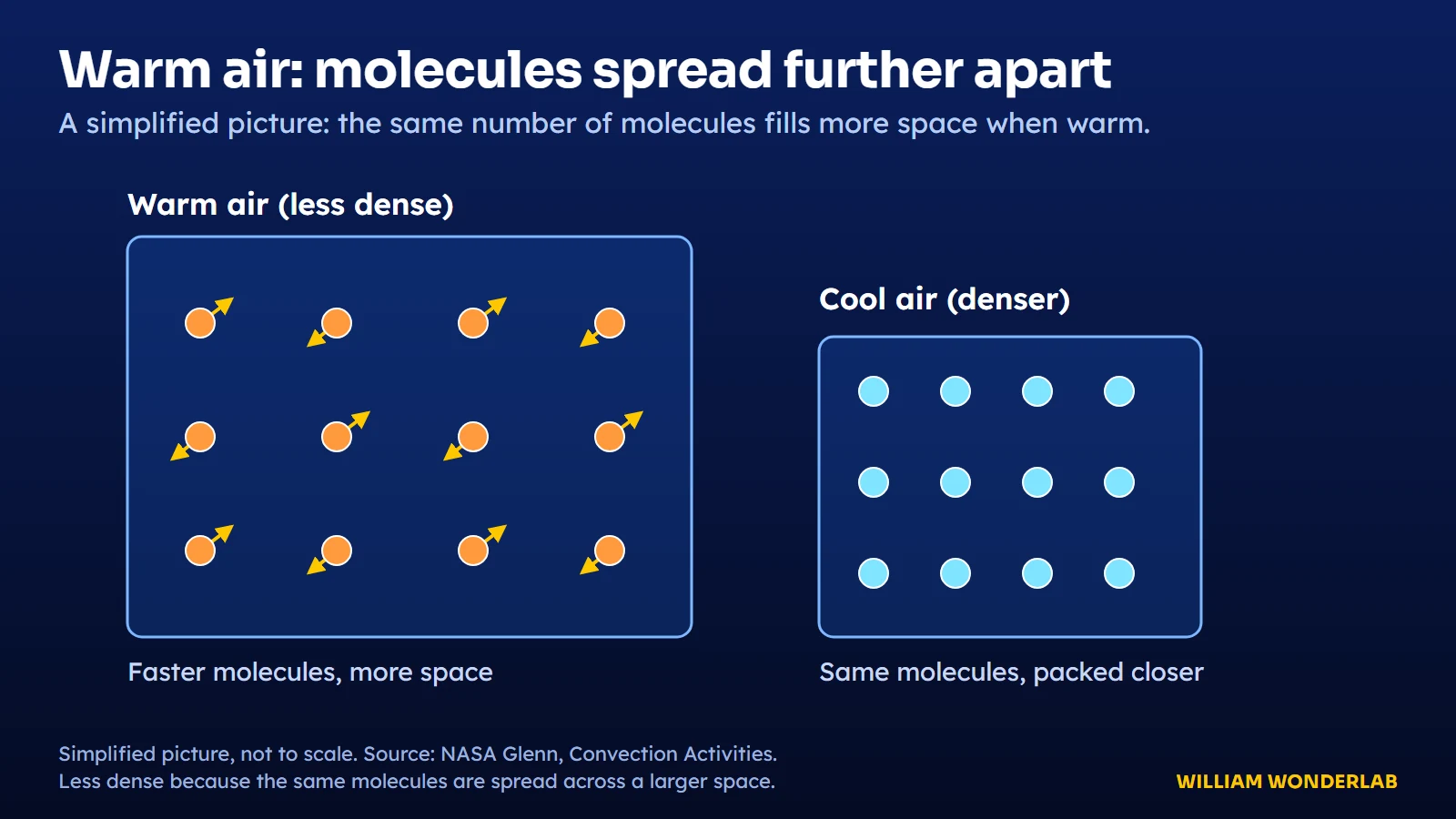
Heating also makes air expand. NASA’s convection activity explains that air, like most other substances, expands when it is heated, so there is more space between its molecules. That makes warm air less dense than the air around it.[4]
A simplified picture: the molecules themselves do not swell up. The same molecules are spread across a bigger space, so each cubic centimetre holds less mass.
Why warm air is pushed up
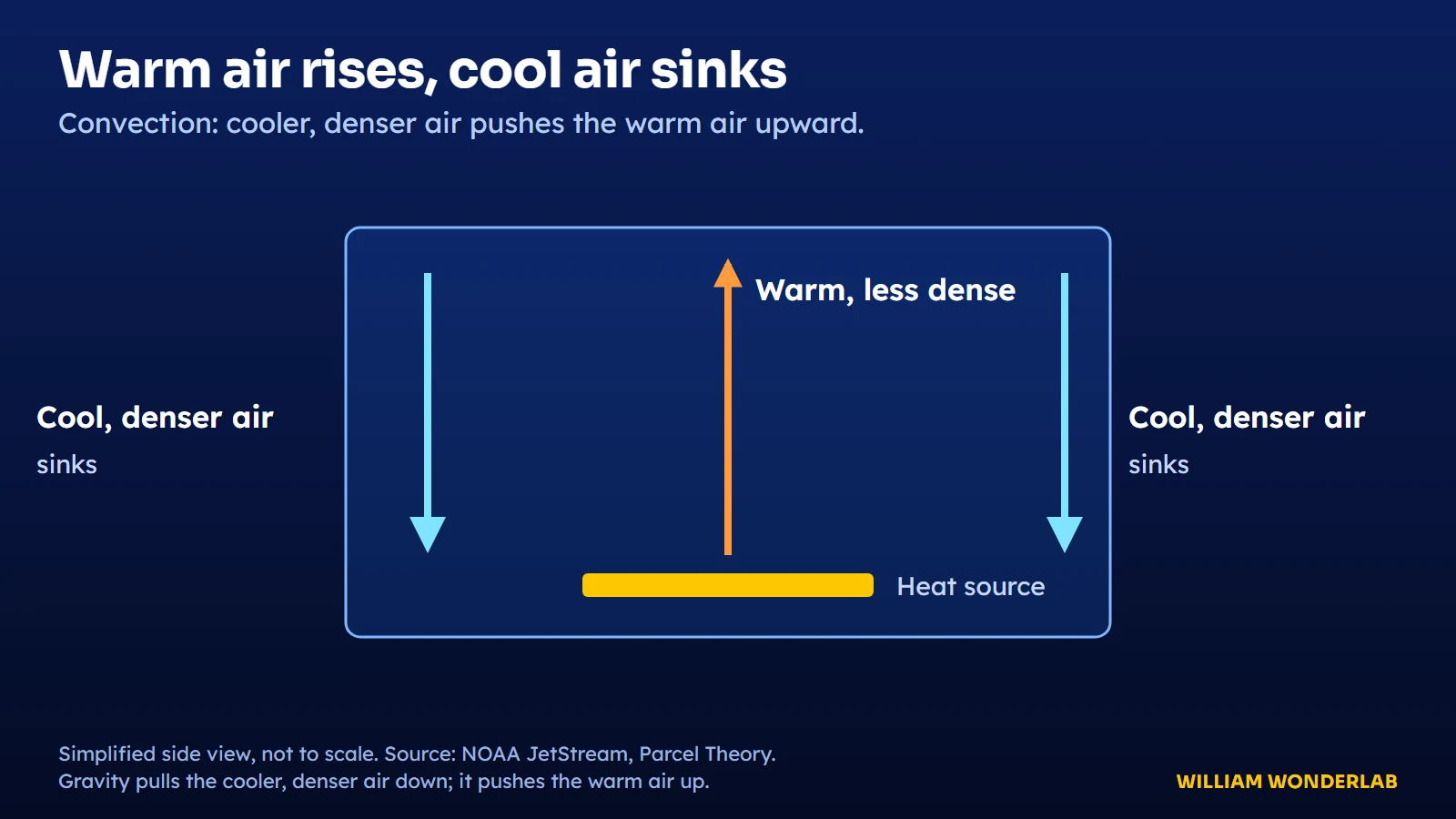
Here is the surprising part. Being less dense does not, on its own, make air rise. NOAA’s JetStream explains that the density difference alone does not account for why warm air rises, because something has to push it.[2] That something is gravity. Gravity pulls cooler, denser air down toward the ground. When this heavier air reaches the ground, it spreads out underneath the warm air and forces it upward.[2]
A simplified picture helps here. A cork rises in water because the water around it is denser than the cork. Air behaves a little like that, with cooler air playing the part of the denser water.
Hot-air balloons use exactly this push. A flame heats the air inside the balloon and makes it less dense. Outside, the cooler, denser air is pulled down by gravity and undercuts the warmer air trapped inside, which lifts the balloon.[2]
The cycle: rise, cool, sink, repeat
Convection is the way heat energy moves through a fluid, and the air in the atmosphere acts as a fluid. A fluid is any substance that flows, which includes gases and liquids.
Warm air does not stay warm forever. As it rises, it cools, and its heat moves into the air around it.[5] If it cools enough to become denser than its surroundings, gravity slows its climb or even reverses it.[2] The cooler air then sinks, and new warm air rises from below. The large loops formed this way are called convection currents, and they are responsible for many weather patterns in the troposphere, the lowest layer of the atmosphere.[5]
Everyday examples
- Hot-air balloons. The air inside stays warm and less dense than the air outside, so the balloon keeps rising.
- A room with a heater. A simplified picture: the heater warms the air next to it, that air rises, and cooler air moves in to replace it. Air movement in a real room is more complicated, so treat this as a starting point for thinking, not a final answer.
Did you know? Scientists treat the air in the atmosphere as a fluid, so convection can happen in it.[5]
Go deeper: density, temperature and pressure
Density and temperature are linked
For a gas kept at constant pressure, density and temperature are inversely proportional. That means they move in opposite directions in a fixed pattern: as the temperature goes up, the density goes down. A university’s course notes on the ideal gas law state this relationship.[6] Real air is more complicated than this rule, so think of it as a simplified picture of the basic idea.
When rising air stops
NOAA’s JetStream calls a rising chunk of air a parcel, a bubble of air that keeps its general characteristics as it moves.[2] If a parcel cools to a temperature below its surroundings, it becomes denser than them, and gravity slows or reverses its rise. If it stays warmer than its surroundings, it stays less dense and keeps rising.[2]
Frequently asked questions
Does hot air rise because it is lighter?
Warm air has less mass packed into the same space, so it is less dense. Lighter is a handy everyday word, but density is the more accurate idea.[1]
Why doesn’t warm air simply float up on its own?
Being less dense is not enough. Something must push the air, and in the atmosphere that push comes from cooler, denser air pulled down by gravity.[2]
Why do air molecules move faster when they are hot?
Their average speed and kinetic energy increase when the temperature rises.[3]
Does warm air keep rising forever?
No. As it rises, it cools. Once it is cooler than the air around it and denser, gravity slows its climb or reverses it.[2][5]
Is heat the thing that rises?
Not exactly. The air carries heat with it, and as the air rises, its heat moves into the surrounding atmosphere.[5]
Does the same science lift a hot-air balloon?
Yes. The air inside is heated, becomes less dense than the cooler air outside, and that denser air pushes the balloon up.[2]
The big idea
Less dense, so it is pushed up. Warm air molecules move faster and spread further apart, so warm air is less dense than the cooler air around it. Gravity pulls the denser cool air down, and that air pushes the warm air upward. As the warm air rises it cools, and the cycle continues.
Related reading
More from William Wonderlab:
Explore more from scientists:
- Does air pressure vary with respect to air temperature? (NOAA National Data Buoy Center)
- Parcel Theory (NOAA JetStream)
- Convection Activities (NASA Glenn Research Center)
References
[1] National Data Buoy Center (NOAA), “Does air pressure vary with respect to air temperature?” (accessed 26 October 2026)
[2] NOAA JetStream, “Parcel Theory” (accessed 26 October 2026)
[3] OpenStax, “8.5: The Kinetic-Molecular Theory”, Chemistry: Atoms First, via Chem LibreTexts (accessed 26 October 2026)
[4] NASA Glenn Research Center, “Convection Activities” (accessed 26 October 2026)
[5] NOAA JetStream, “The Transfer of Heat Energy” (accessed 26 October 2026)
[6] “Ideal Gas Law”, course page, faculty.luther.edu (accessed 26 October 2026)