How Do Volcanoes Erupt?
Volcanoes erupt when magma rises and the gas inside it escapes. How gentle or violent the eruption is depends mainly on how thick the magma is.

A volcano can look like a quiet mountain for thousands of years. Underneath, though, rock is melting, gas is building up and pressure is pushing upwards. An eruption happens when that molten rock finds a way to the surface.
The short answer: A volcano erupts when magma, which is melted rock under the ground, rises towards the surface and the gas dissolved in it escapes. How violent the eruption is depends mostly on how thick the magma is. Thick magma traps gas and pressure builds, so it can burst. Most of the world’s active volcanoes sit along or near the edges of shifting tectonic plates.[1][2][3]
What is magma, and why does it hold gas?
Magma is hot, melted rock that lies below the surface. Deep underground, the pressure is very high. The USGS explains that “Magma that is deep within the earth, where the pressure is high, contains dissolved water-, carbon-, and sulfur-rich gases.”[1]
You can think of this like a sealed bottle of fizzy drink. The gas stays in the liquid while the pressure is high. (This is an everyday comparison to help picture the idea, not a measurement of a volcano.)
Pressure falls, gas escapes
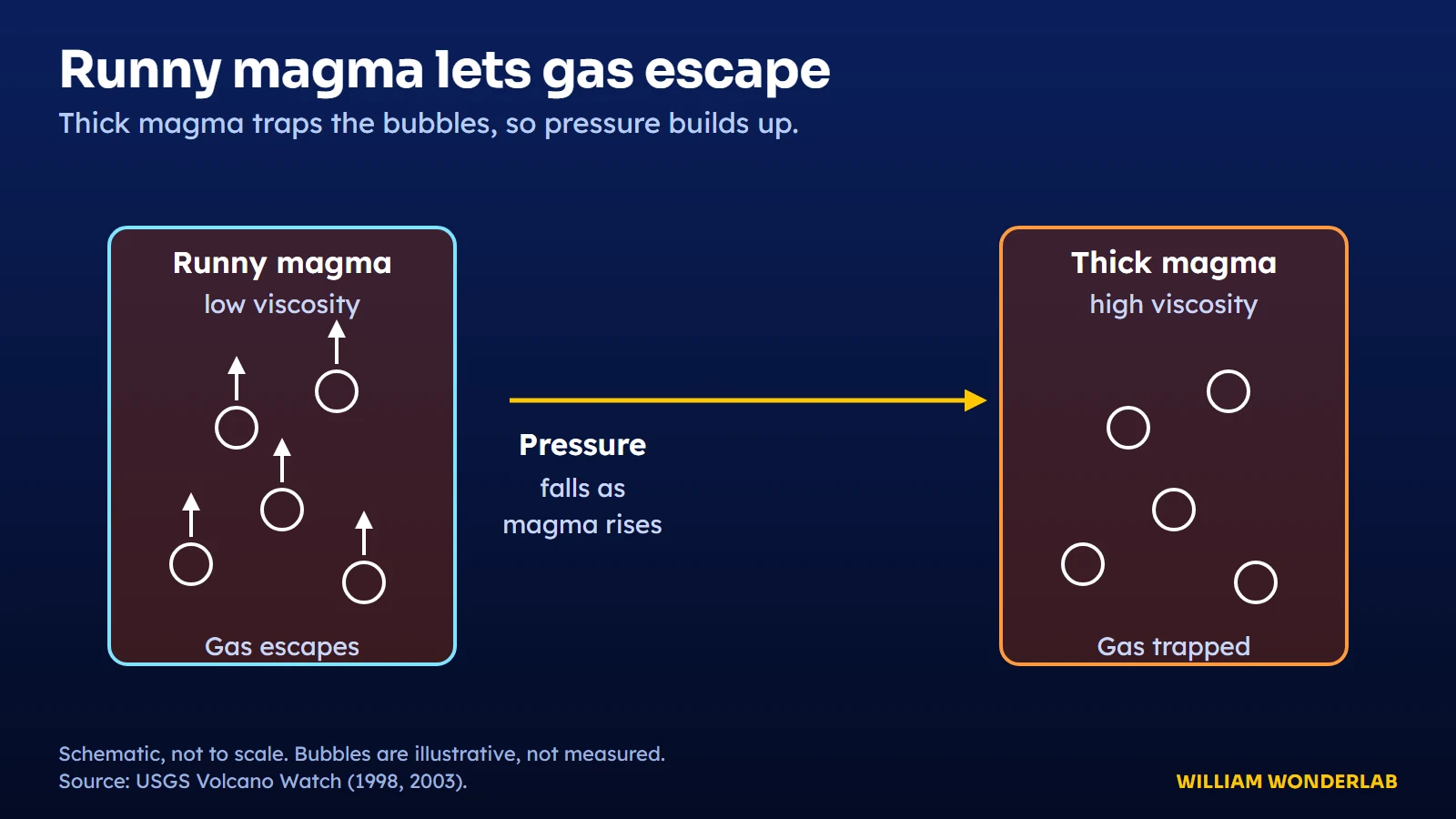
As magma climbs, the pressure around it drops. The USGS says that “As it rises to the surface, where the pressure is lower, these gases are released.”[1] The gas forms bubbles, a process that volcanologists call vesiculation. The USGS calls this fizzing “the force that propels the magma out of the vent.”[1]
So the bubbles are doing real work. They push magma upwards, much like the gas in a shaken bottle pushes the drink out when you open it.
Why thick magma can explode
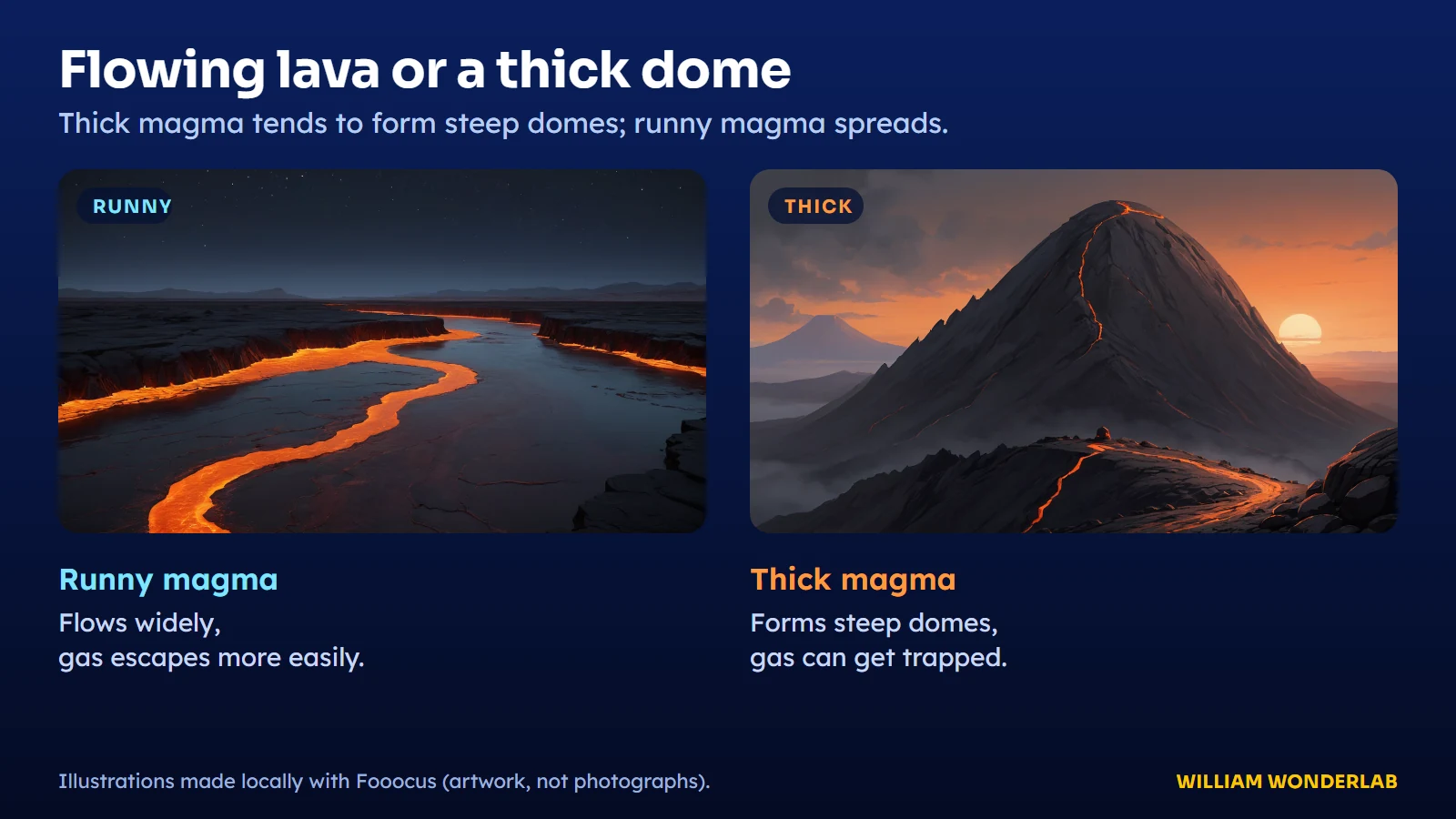
Whether the bubbles escape quietly or violently depends on viscosity, which is how easily a liquid flows. The USGS defines it this way: “A liquid is said to have a high viscosity if it flows slowly and a low viscosity if it flows freely.”[2] Honey is thicker than water, so it is more viscous.
The main control on viscosity in magma is silica, a compound that is common in rock. The USGS notes that “increasing the silica content of the magma liquid increases the lava’s viscosity.”[2] Silica-rich magma is thick and sticky.
Thin magma lets the gas bubbles rise and leave without much fuss. Thick magma does not. The USGS explains that “In high-viscosity magma, bubbles also form, but they can’t float upward because the resistance to flow is too great.” The bubbles then build up:
- The bubbles “arrive at the surface trapped in the magma at a pressure greater than the atmospheric pressure.”[2]
- Because the pressure outside is lower, the trapped gas can shatter the magma. The USGS calls this difference “a recipe for an explosion.”[2]
Did you know? The amount of gas is not the whole story. The USGS notes that in its experiments, “What is different … is not how much gas is released, but how fast the gas is released.”[1]
Where volcanoes form
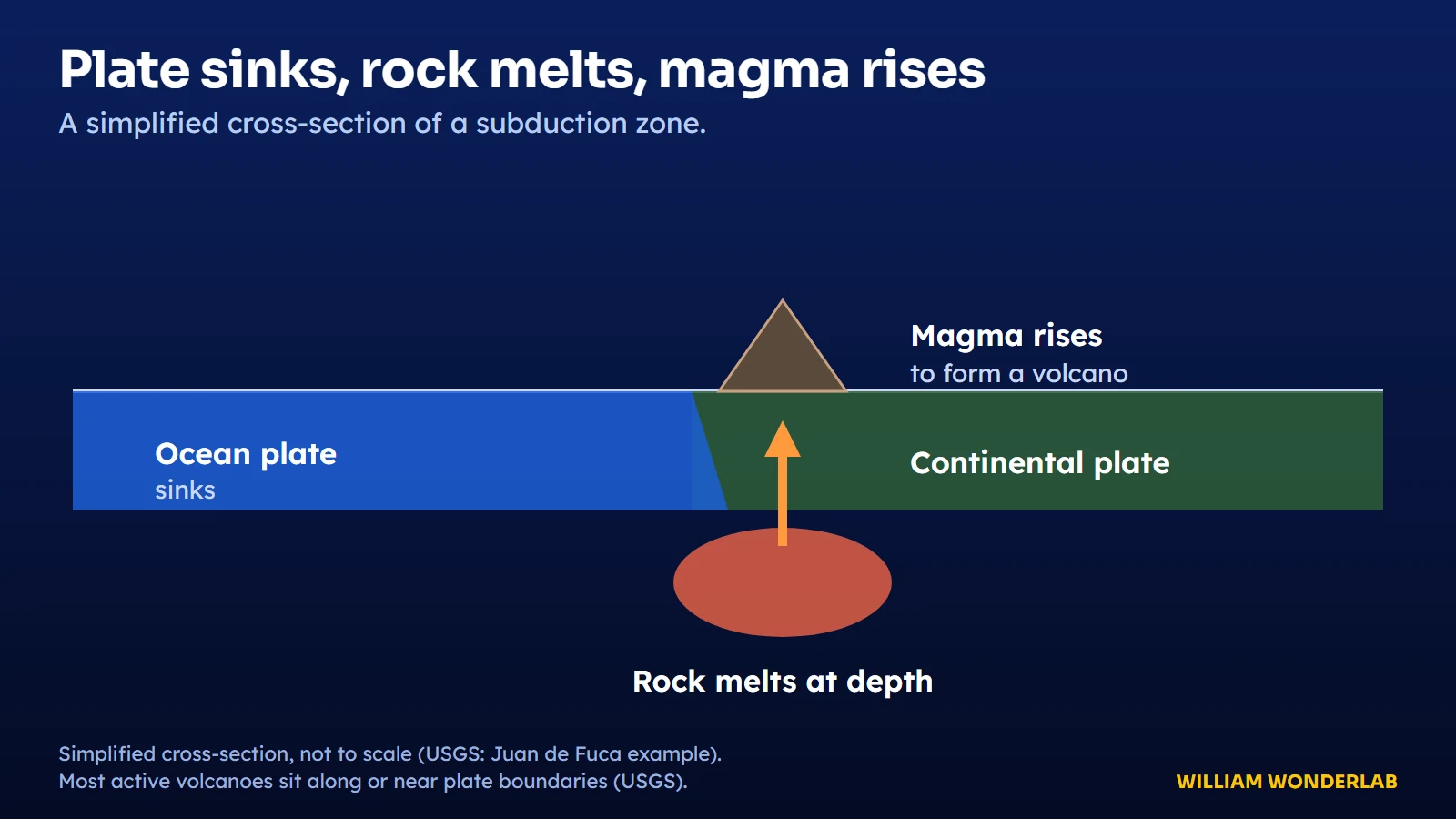
Tectonic plates are huge slabs of the Earth’s outer shell that move very slowly over time. The USGS says that “Most of the world’s active volcanoes are located along or near the boundaries between shifting plates.”[3]
One clear example is at a subduction zone, where one plate sinks beneath another. The USGS describes the Juan de Fuca Plate in the Pacific Northwest of the United States: it “plunges beneath the North American Plate, locally melting at depth; the magma rises to feed and form the Cascade volcanoes.”[3]
Not every volcano sits at a plate edge. The USGS also says that “some active volcanoes are not associated with plate boundaries.” Its example is Hawaii, which formed as the Pacific plate moves over an “inferred ‘hot spot'” that starts the magma-generation process.[3]
Australia’s volcanoes
Australia has had volcanoes too. Oregon State University’s Volcano World names Mt Gambier, in the Newer Volcanic Province, as the site of Australia’s most recent eruption. The same page says that four shield volcanoes near Mt Gambier (Red Rock, Mt Napier, Mt Schank and Mt Gambier) last erupted between 5850 and 2900 BC.[4]
Did you know? Counting from 2026, those eruptions happened roughly 4,900 to 7,900 years ago. That is recent in geological time, but long before any written records in Australia.[4]
Try it: a baking-soda and vinegar model
This is a model of gas bubbles forming in a liquid. It is not how real volcanoes work. Real magma is melted rock, far hotter than anything in a kitchen, and it is under enormous pressure.
You need: a tall, open plastic or glass container, a tray to catch spills, 2 tablespoons of bicarbonate of soda, a small cup of white vinegar, and a squirt of dish soap.
- Put the tray down and stand the container in it.
- Add the bicarbonate of soda and a squirt of dish soap.
- Pour the vinegar in slowly and watch the foam rise.
- Write down how the foam behaves. Add a little more dish soap next time and compare how the foam moves. Which part of this model matches a real volcano, and which parts do not?
Safety first: Do this with an adult. Never seal the container, because the gas needs somewhere to go. Wear eye protection, and keep the container away from faces. Do not taste or drink anything in the activity. Wipe up spills straight away and wash your hands afterwards. Keep it away from electrical sockets.
Go deeper: gas, pressure and the eruption cycle
Why gas pressure drives the eruption
Gas bubbles are the engine. In thin magma, the gas can get out, so the pressure stays manageable. In thick magma, bubbles cannot rise through the liquid, so they reach the surface still under more pressure than the air.[2] This is why the USGS describes the difference between the inside and outside pressure as the cause of the explosion.[2]
Why Mount St Helens and Kīlauea differ
The USGS asked why Mount St Helens in the United States has generally erupted more explosively than Kīlauea in Hawaii. Its answer centres on the magma’s silica content and viscosity, which control how easily gas can escape.[2]
Frequently asked questions
What makes a volcano erupt?
Magma rises, and the gases dissolved in it come out of solution as the pressure drops. Those gases push the magma upward and out of the vent.[1]
Why do some volcanoes flow and others explode?
Thick, silica-rich magma traps gas, so pressure builds. Thin magma lets gas escape more easily.[2]
Are volcanoes only found at plate edges?
Most active volcanoes are near plate boundaries, but some, such as Hawaii, are not.[3]
Has Australia had volcanic eruptions recently?
Yes, in geological terms. Oregon State University says four shield volcanoes near Mt Gambier (Red Rock, Mt Napier, Mt Schank and Mt Gambier) last erupted between 5850 and 2900 BC.[4]
Does the baking-soda activity show a real volcano?
No. It is a model of gas bubbles forming. Real magma is melted rock under far greater pressure and heat.
The big idea
Gas pressure decides the drama. Magma rises, gas escapes and bubbles push it upwards. Thin magma lets the gas go quietly, while thick magma traps it until the pressure breaks out.[1][2]
Related reading
More from William Wonderlab:
Explore more from scientists:
- Volcano Watch: Volcano: Will It Flow or Blow? (USGS, 1998)
- Volcanoes: Plate-Tectonics Theory (USGS)
- Has there ever been any volcanic activity in Australia? (Oregon State University Volcano World)
References
[1] US Geological Survey (USGS), Volcano Watch, “Volcano: Will it Flow or Blow?” (Hawaiian Volcano Observatory, 19 February 1998) (accessed 25 October 2026)
[2] US Geological Survey (USGS), Volcano Watch, “Why are Mount St. Helens’ eruptions generally more explosive than those of Kīlauea?” (Hawaiian Volcano Observatory, 20 March 2003) (accessed 25 October 2026)
[3] US Geological Survey (USGS), “Volcanoes: Plate-Tectonics Theory” (accessed 25 October 2026)
[4] Oregon State University, Volcano World, “Has there ever been any volcanic activity in Australia?” (accessed 25 October 2026)