How Does a 3D Printer Work?
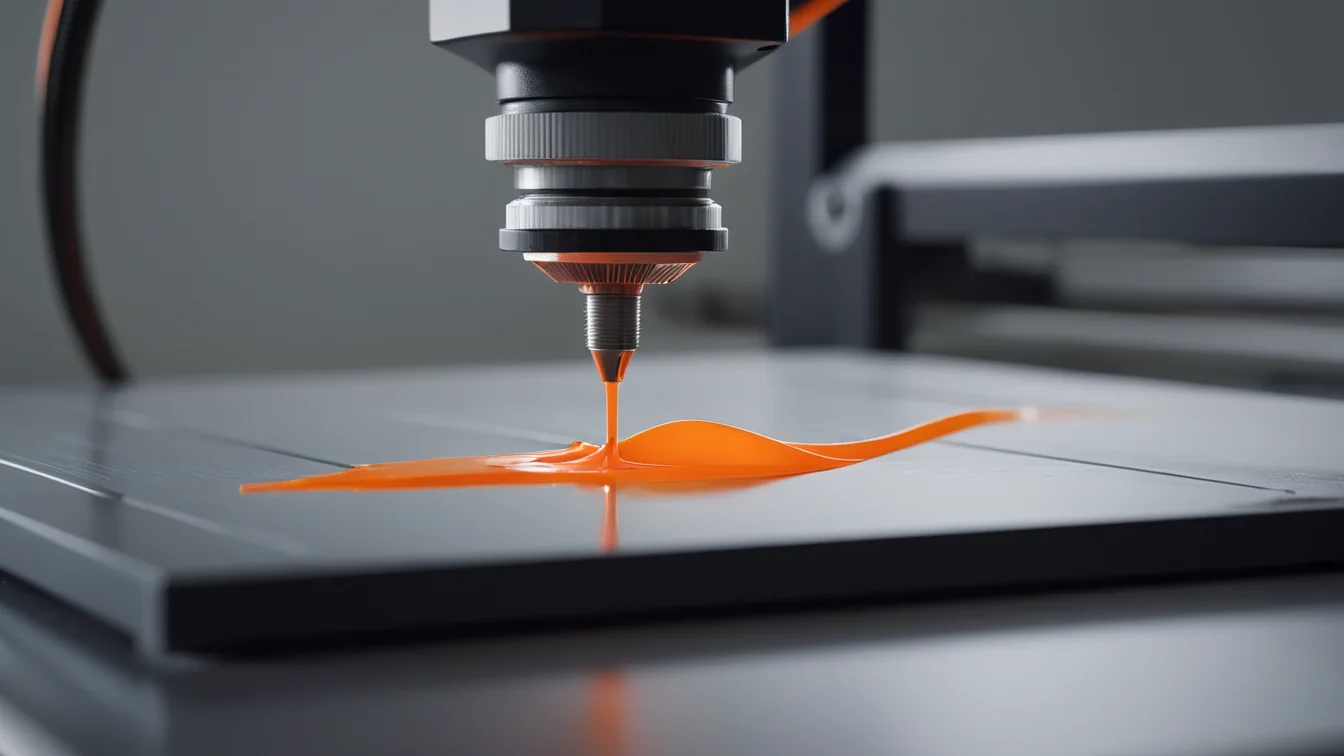
Most home 3D printers build an object one thin layer at a time, melting plastic through a hot nozzle. Each layer sticks to the one below.
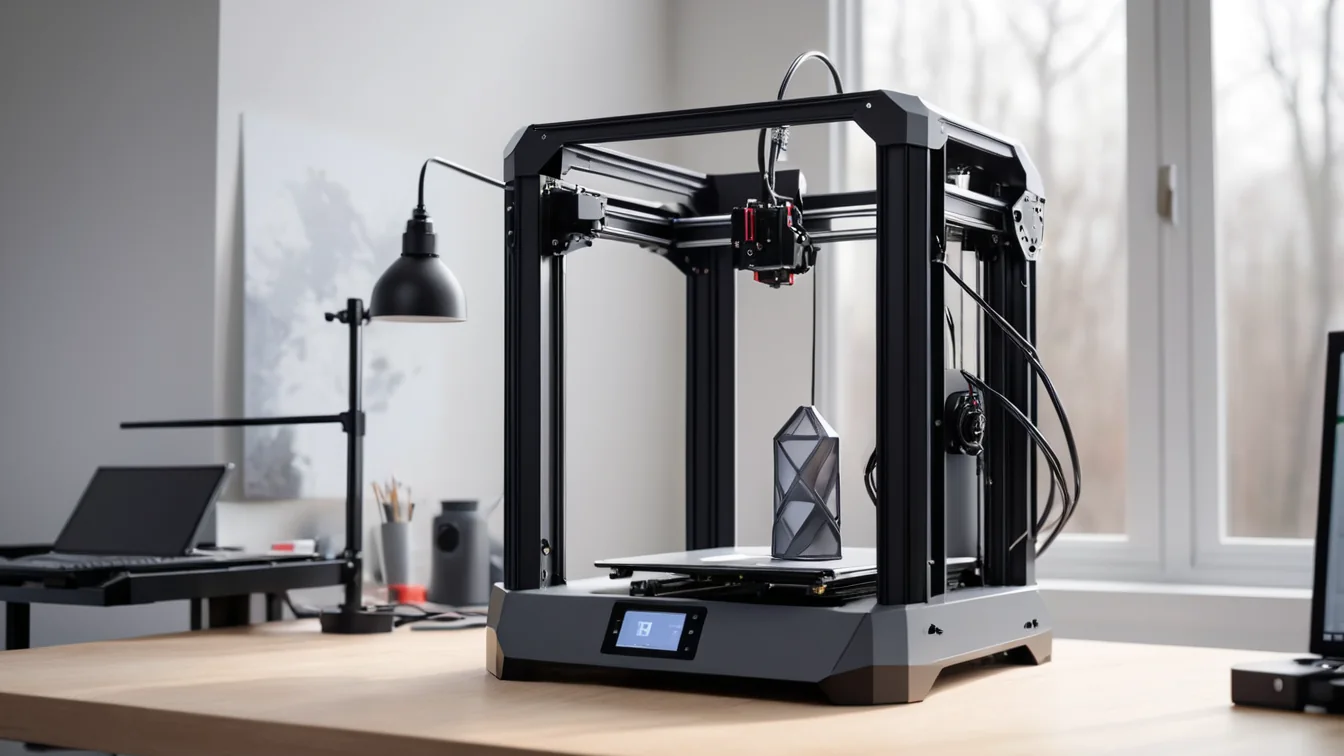
A 3D printer can turn a computer design into a real object you can hold. Unlike a normal printer, it does not put ink on paper. It builds the object itself. How does it make something solid out of nothing but a plan?
The short answer: Most desktop 3D printers use material extrusion. They melt plastic, push it through a small nozzle, and lay it down in thin layers. Each new layer sticks to the one below until the whole object is built.[1][2]
Start with a digital design
Every 3D print begins with a digital model, a file that describes the shape of the object in three dimensions. Printing software then cuts that shape into many thin horizontal slices. Each slice becomes one layer for the printer to make.
You can think of it like a loaf of sliced bread. The whole loaf is the object, and each slice is a layer the printer builds in turn.
Build it one layer at a time
This method is called additive manufacturing, because the object is made by adding material. The US National Institute of Standards and Technology (NIST) describes the method this way: “Material extrusion can produce three-dimensional structures by building up material layer-by-layer.”[1]
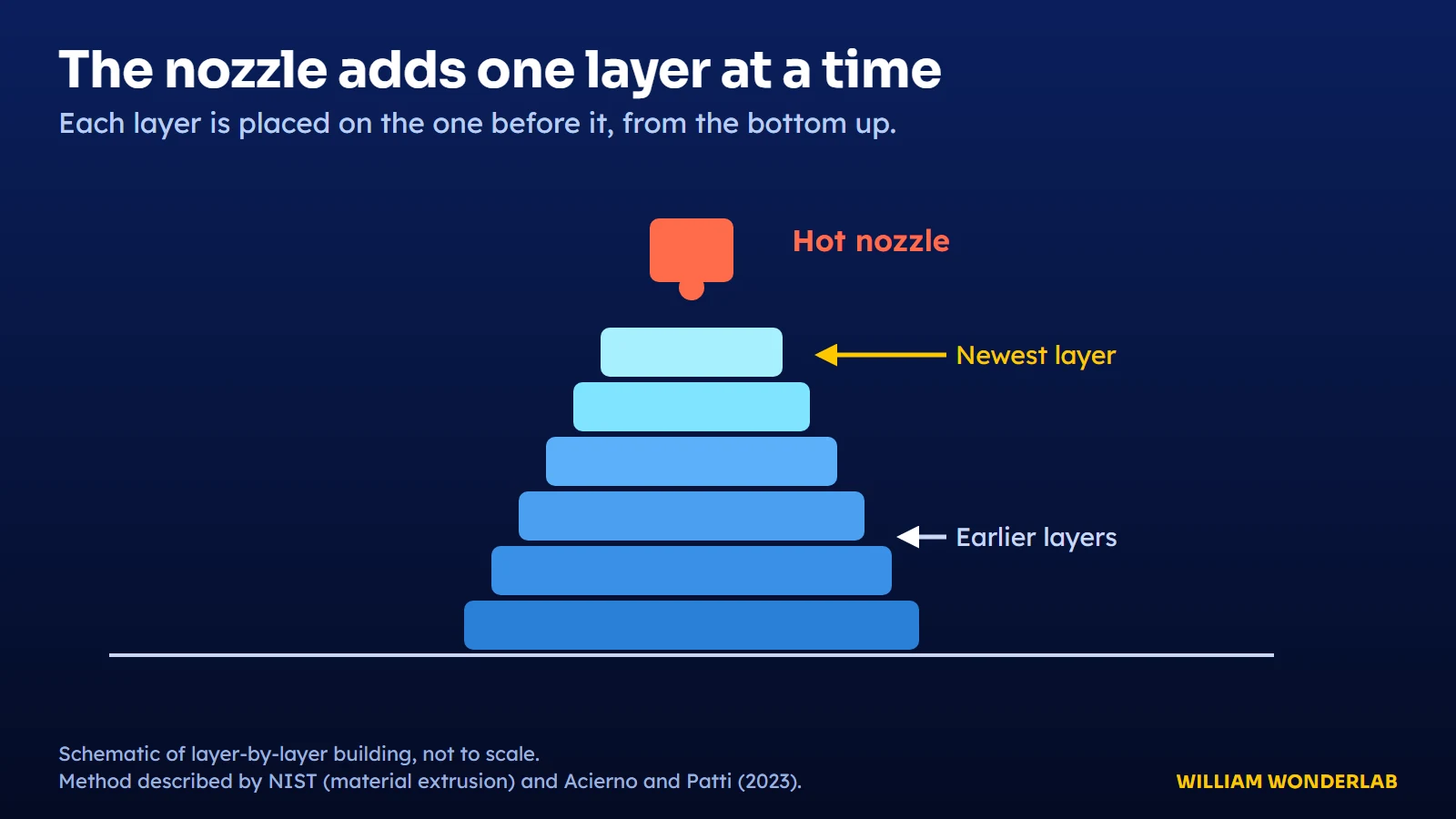
Building an object layer by layer means the printer only has to make a flat path on each layer, one after another. The shape grows upwards as the layers stack.
Melt, push and place the plastic
Most desktop printers use a plastic thread called filament, which is wound on a spool. The Acierno and Patti review of this process, published in the journal Materials, describes the main steps as “the feeding of solid filament into a molten chamber, capillary flow of a non-Newtonian fluid through a nozzle, layer deposition on the support base, and layer-to-layer adhesion.”[2]
In everyday words: the printer pulls in solid plastic, melts it, pushes the soft plastic through a small nozzle, and places it exactly where the design says.
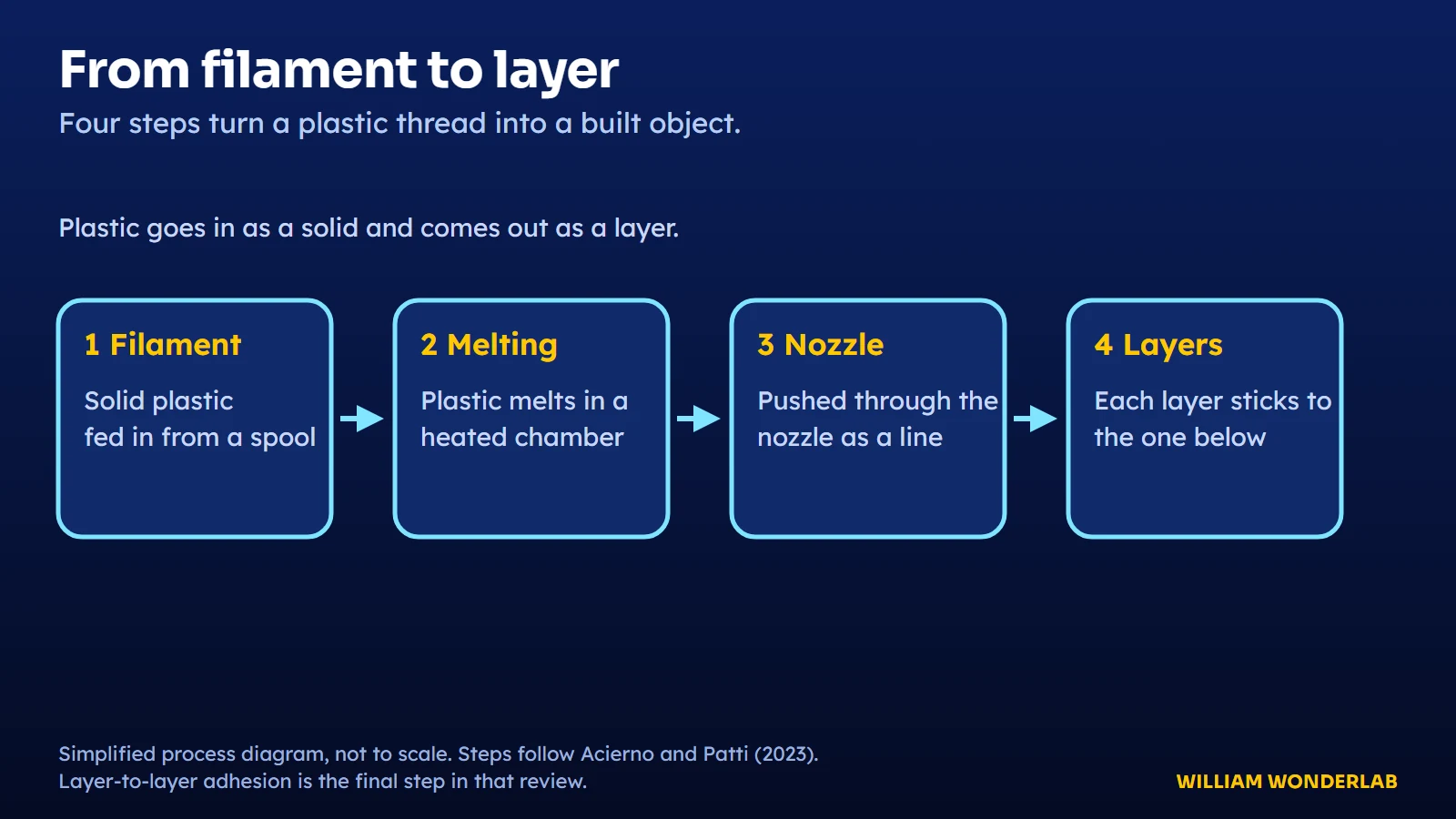
The melted plastic is not like water. It is a thick, flowing material that comes out of the nozzle as a line. The printer moves the nozzle across the platform to draw each layer.
Layers stick together
A layer is useful only if it holds on to the layer below. Acierno and Patti name this step “layer-to-layer adhesion.”[2] The new plastic is still soft when it is laid down, so it joins with the layer underneath as it cools.
This is why the object gets built from the bottom up. Each layer has to be placed on something already there.
Did you know? The Acierno and Patti review breaks the process into four main phases: feeding the filament, melting it, flowing it through a nozzle and depositing layers that bond to each other.[2]
Try it: slice a paper model
This is a proposed at-home activity that copies the layer idea without a 3D printer.
You need: a sheet of thick card or cereal-box cardboard, scissors, a pencil, sticky tape, and an adult to help with cutting.
- Draw a simple shape on the card, such as a tower with three steps, and mark it into four even horizontal bands.
- With an adult’s help, cut out each band as its own piece.
- Stack the pieces in order, from the bottom band to the top, and tape them together.
- Look at the stepped outline. Which band was made first, and how does the shape show the layers?
What to expect: You will get a stepped model that looks like a set of layers. It is a paper model of the layer idea, not a printed object.
Safety first: Use blunt-tipped or child-safe scissors, and have an adult do the cutting. Keep fingers clear of the blade, and put the scissors away when you are finished. Do not use the tape near your mouth or eyes.
Hot nozzles need care
A printer that melts plastic has hot parts, and it also releases fumes. Wichita State University’s environmental health and safety page says that “3D processes may involve hot surfaces such as the print head block and UV lamp.”[3] The Ohio State University page says that “excess heat can pose additional safety risks, including the potential for burns, fire hazards.”[4]
Fumes are a second concern. Ohio State explains that “3D printer emissions primarily stem from the heating and melting of thermoplastic filaments.”[4] Wichita State notes that “Most 3D printers are not designed with exhaust ventilation or filtration provisions,” and that “A minimum of 4 air exchanges/hour is required to prevent occupant irritation and the risk of fire or explosion.”[3]
Wichita State also sets training rules. It says that “All persons working with 3D printers must receive training on the chemical, physical and biological hazards.”[3] For this reason, a 3D printer should only be used with an adult who knows the machine, and a child should never touch the nozzle or bed while they are hot.
Go deeper: why the process is hard to control
Heat, flow and strength
The printer has to melt the plastic at the right temperature, push it at the right speed and place it in the right position. If the timing is off, the layers may not join well. Acierno and Patti describe the process as depending on filament feeding, flow through the nozzle, layer deposition and adhesion.[2]
Why the joins matter
Because each layer must stick to the one below, the joins between layers are part of what holds the finished object together.[2]
Frequently asked questions
What does 3D printing mean?
3D printing builds an object from a digital design. Most common home printers add material in layers, which is why the method is called additive manufacturing.[1]
What is filament?
Filament is a thread of solid plastic on a spool. The printer melts it and pushes it through the nozzle.[2]
Why does a 3D printer build from the bottom up?
Each layer must be placed on top of something already there, so the object grows layer by layer from the base.[2]
Is a 3D printer safe for children?
Printers have hot parts and can release fumes. They should be used only with trained adult supervision and in a well-ventilated room.[3][4]
Why do printers need ventilation?
Many printers do not come with exhaust ventilation or filtration, and emissions come from melting the plastic. Ventilation or local exhaust reduces exposure.[3][4]
The big idea
Layers make the object. A 3D printer melts plastic, places it in thin layers and lets each layer stick to the one below. The same idea builds everything from small parts to whole products.
Related reading
More from William Wonderlab:
- How Do Bridges Hold So Much Weight?
- How Does a Fridge Keep Food Cold?
- How Do Touchscreens Know Where You Touch?
Explore more from scientists:
- Material Extrusion (NIST, Additive Manufacturing)
- Fused Deposition Modelling (FDM) of Thermoplastic-Based Filaments: Process and Rheological Properties, an Overview (Acierno and Patti, Materials, 2023)
- 3D Printer Safety (Ohio State University, Environmental Health and Safety)
References
[1] NIST, Additive Manufacturing Program, “Material Extrusion” (accessed 25 October 2026)
[2] Domenico Acierno and Antonella Patti, “Fused Deposition Modelling (FDM) of Thermoplastic-Based Filaments: Process and Rheological Properties, An Overview”, Materials, 2023 (accessed 25 October 2026)
[3] Wichita State University, Environmental Health and Safety, “3D Printer Safety” (accessed 25 October 2026)
[4] Ohio State University, Environmental Health and Safety, “3D Printer Safety” (accessed 25 October 2026)