How Does a Fridge Keep Food Cold?
A fridge does not make cold. It moves heat from inside the cabinet into the kitchen, using a refrigerant that keeps changing between liquid and gas.
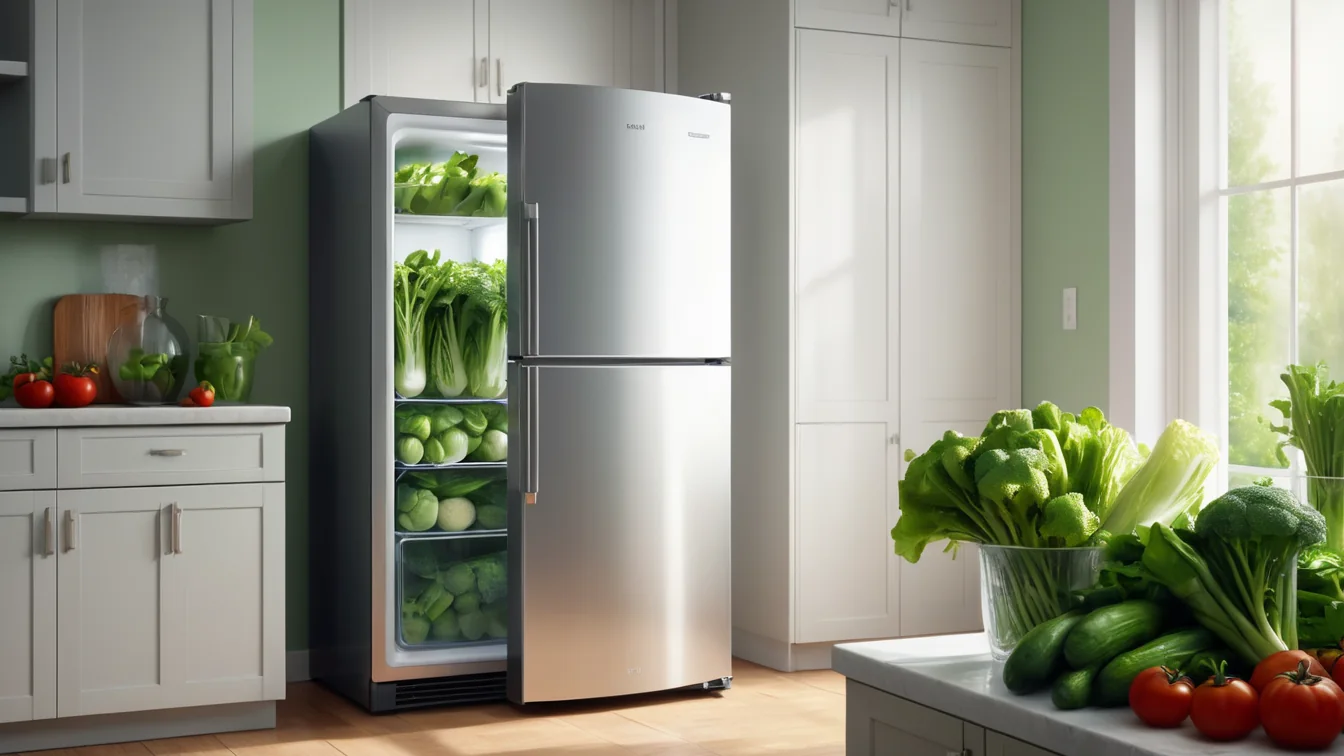
Open a fridge and a cool breeze drifts out. Milk, leftovers and salad stay fresh for days in there. It is tempting to think the fridge stores cold the way a bucket stores ice. It does not. A fridge is a machine that pumps heat out of the box and into the kitchen. Once you see it that way, the whole process makes sense.
The short answer: A fridge keeps food cold by moving heat from inside the cabinet to the room. A liquid called refrigerant absorbs heat as it evaporates (turns into a gas) inside the fridge, then gives that heat away as it condenses (turns back into a liquid) in coils at the back. An electric compressor keeps the refrigerant moving round the loop.[1][2]
Cold is not stored, heat is moved
Scientists call the energy that flows because of a difference in temperature heat. The Science Learning Hub, a New Zealand science education site, describes it as “the flow of energy from a warm object to a cooler object.”[3]
Think of a can of cola on a hot day. Heat flows from your warm hand into the cold can, so the can warms up and your hand feels cooler. A fridge does the same kind of job on a much bigger scale, except a machine does the moving. It takes heat from the food and air inside, and pushes that heat out into the room. Cold is what you notice when heat has been taken away.
The four parts of the loop
The refrigerant is a fluid that flows round a sealed loop of pipes. Its changes between liquid and gas do the work. The loop has four main parts, shown in the diagram below.
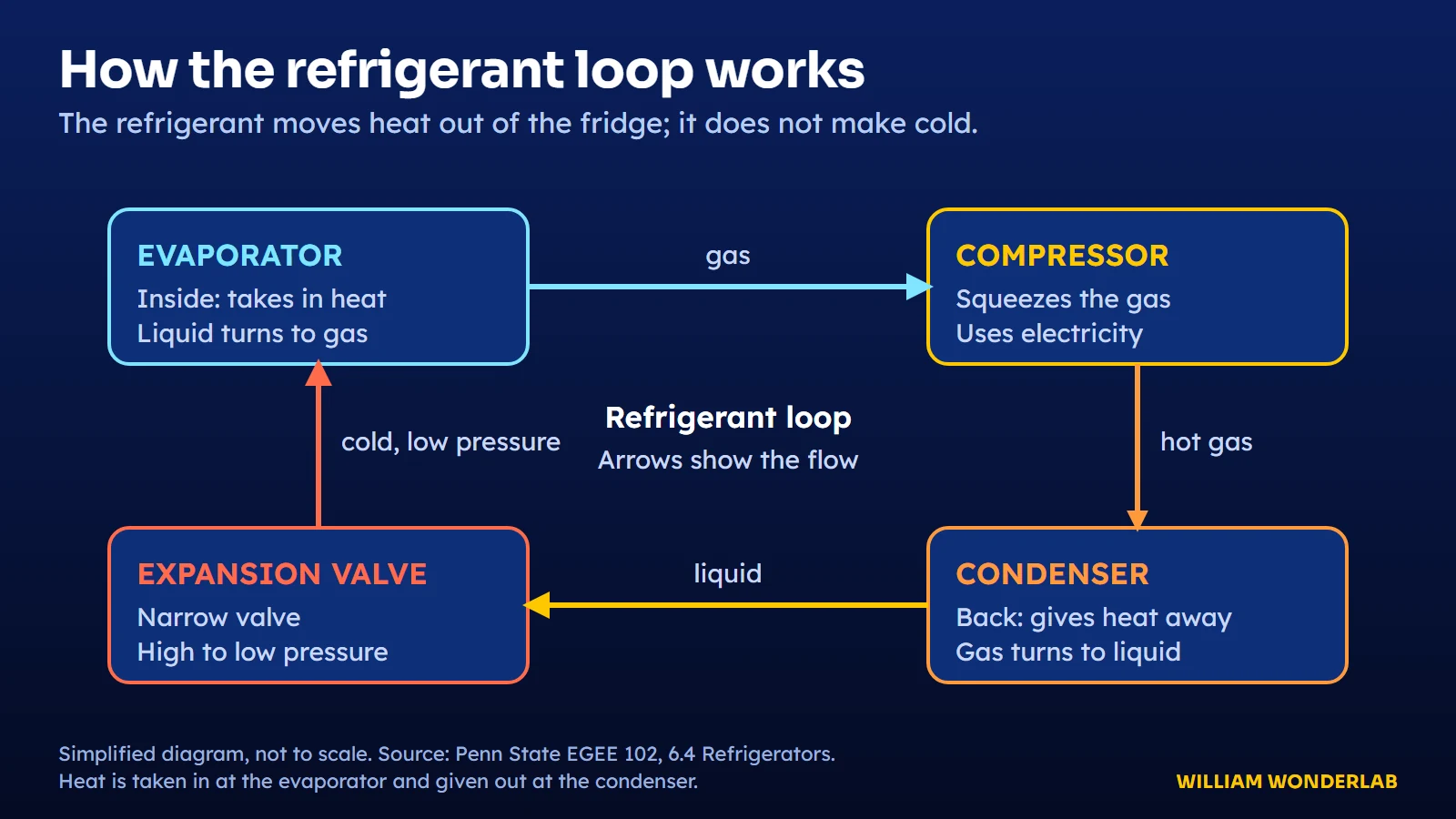
- The evaporator (inside the fridge). Cold, low-pressure liquid refrigerant flows through pipes inside the cabinet and evaporates. Penn State’s engineering course puts it this way: “The refrigerant steals that energy as heat from the air and food inside the fridge.”[1]
- The compressor. A motor-driven pump squeezes the gas. Penn State says it “squeezes the now-warm refrigerant gas, increasing its pressure and temperature dramatically,” and compares it to “pumping up a bike tire: the pump gets hot.”[1] This is the part that uses electricity. The U.S. Department of Energy calls the compressor “the primary energy-consuming component in a refrigerator, refrigerator-freezer, or freezer.”[4]
- The condenser (the coils at the back). The refrigerant is now hotter than the room, so “heat naturally flows out of the coils and into the room.”[1] As it loses that heat, the gas condenses back into a liquid.
- The expansion valve. Penn State says the valve “acts like a nozzle.” “High-pressure liquid refrigerant squeezes through it and suddenly expands into a low-pressure zone.”[1] The refrigerant is now low-pressure and ready to evaporate again inside the fridge, so the loop repeats.
Where the heat ends up
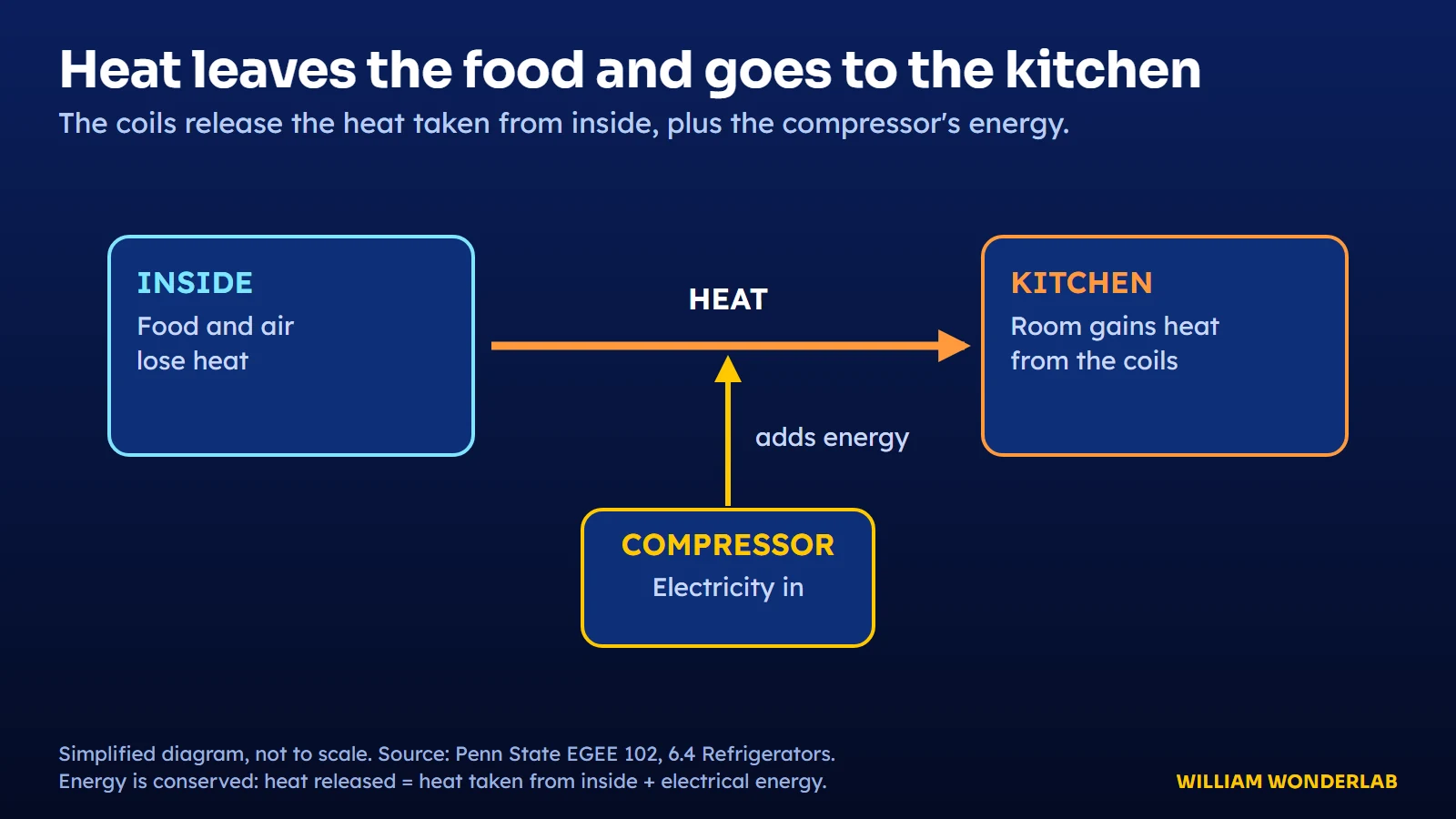
Penn State sums up the energy balance in one sentence: “That’s the heat originally taken from your food, plus the energy used by the compressor.”[1] The coils at the back therefore give out more heat than the food lost. That is why the back of many fridges feels warm when you touch it.
Physicists describe a refrigerator as a machine that absorbs heat from a cold place and discards it to a warmer place. A LibreTexts physics page describes it as one that “absorbs heat Q_c from the cold reservoir” and “discards heat Q_h to the hot reservoir.”[2] That movement does not happen for free. The same page notes that the required work is “for which we pay in our electricity bill.”[2]
Why food must stay at 5 °C or colder
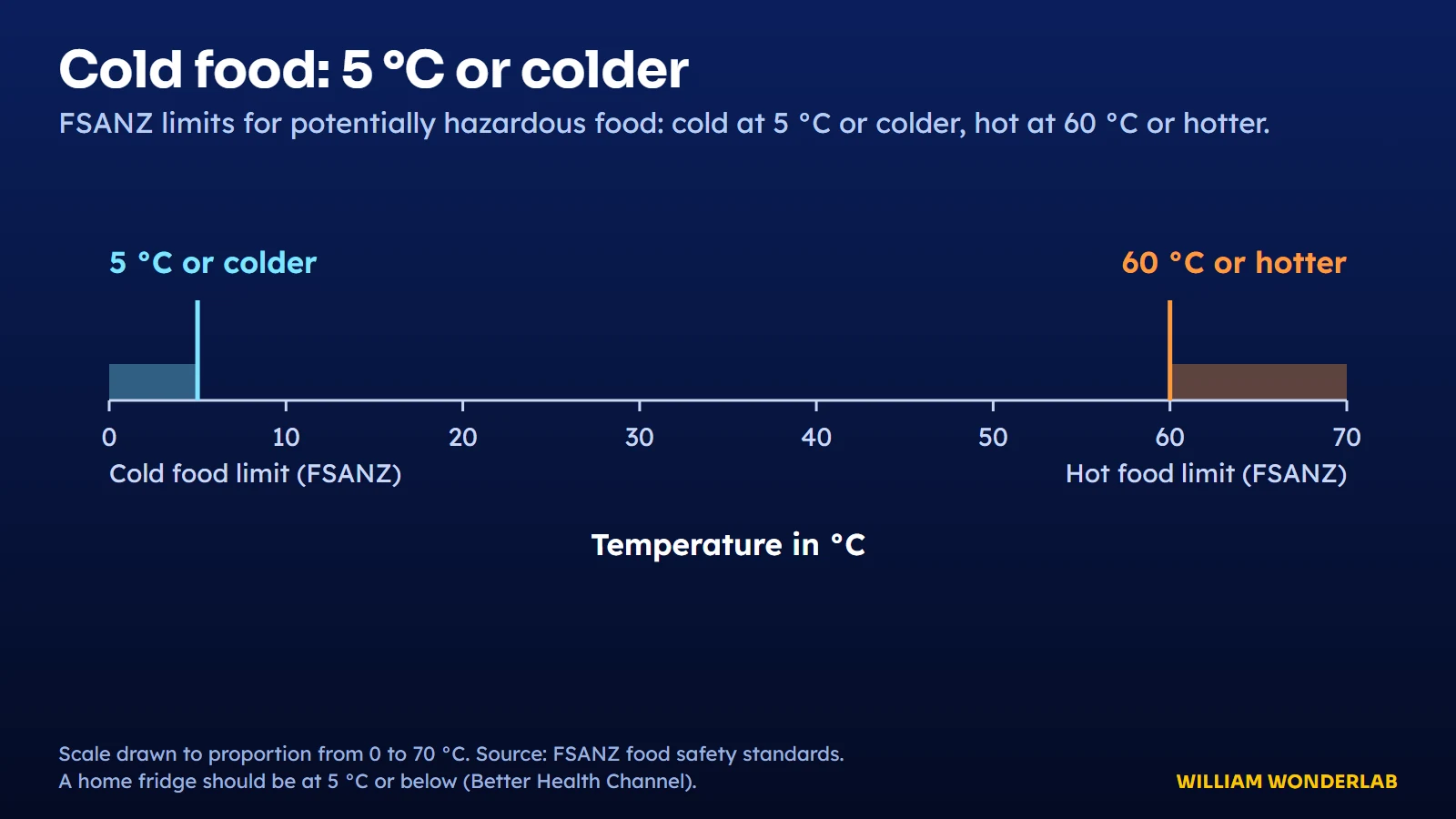
Keeping food cold is about more than comfort. Food Standards Australia New Zealand (FSANZ) sets the rule for food businesses: “You must ensure that the temperature of potentially hazardous food is either at 5°C or colder or at 60°C or hotter.”[5]
FSANZ explains that potentially hazardous foods “might contain food poisoning bacteria” and are “capable of supporting growth of these bacteria or formation of toxins to levels that are unsafe for consumers” if they are not stored at correct temperatures.[5] The 5 °C limit is about keeping that bacterial growth in check.
For a home fridge, the Better Health Channel gives a simple target: “Your fridge temperature should be at 5 °C or below.”[6]
Try it: a cool-box race
Proposed at-home activity. This uses only water, so there is nothing to eat or drink. It lets you test whether an insulated bag slows the flow of heat into a cup. Better Health suggests an insulated cooler bag or ice pack “on hot days or for trips longer than 30 minutes” to keep frozen foods cold.[6]
You need: two identical clean cups of cool tap water, a kitchen thermometer, an insulated cooler bag, a reusable ice pack in its cover, a timer and a sheet of paper.
- Measure and write down the temperature of each cup. Both should start at the same temperature.
- Predict which cup will warm up more slowly, and why.
- Put one cup inside the cooler bag with the ice pack beside it, but not touching the water. Leave the other cup on the bench, out of direct sun.
- Every 10 minutes for about an hour, read and record the temperature of both cups.
- Compare your results with your prediction. Did the heat flow where you expected?
Safety first: An adult should supervise. Use cool tap water, not hot, and do not drink or taste the water afterwards. Keep the ice pack in its cover and never place it directly into a cup. Do not touch or open the back of any fridge, freezer or appliance, and keep all power cords away from the water. Wash the cups and thermometer when you finish, and wash your hands after handling the ice pack.
If you enjoyed this, Why Does Metal Feel Colder Than Wood? uses the same idea of heat flowing into your skin.
Go deeper: energy in, energy out
Counting the heat
Energy is not created or destroyed, so the heat leaving the back of a fridge must equal the heat taken from inside plus the electrical energy the compressor uses. Here is a hypothetical example with made-up numbers, to show the bookkeeping only:
- Heat taken from inside the fridge: 100 units
- Electrical energy used by the compressor: 20 units
- Heat released to the room: 100 + 20 = 120 units
How efficient is a fridge?
Engineers measure a refrigerator’s performance with a number called the coefficient of performance. LibreTexts defines it as “the heat removed from the cold reservoir divided by the work done by the working substance cycle by cycle.”[2] In the hypothetical example above, the coefficient of performance would be 100 ÷ 20 = 5. A higher number means more heat moved for each unit of energy used. This is a worked example, not a measurement of any real fridge.
Frequently asked questions
Does a fridge make cold air?
No. It removes heat from the air and food inside and releases that heat into the room.[1]
Why is the back of a fridge warm?
The coils at the back release the heat taken from inside, plus the energy the compressor adds.[1]
Why does a fridge need electricity?
Electricity powers the compressor that keeps the refrigerant moving round the loop. Without that work, heat would not be pumped out of the cabinet.[2]
What temperature should a home fridge be?
Better Health says a fridge temperature should be at 5 °C or below.[6]
The big idea
Heat is moved, not cold made. Refrigerant absorbs heat from inside the fridge as it evaporates, then gives that heat, plus the compressor’s energy, to the room as it condenses. The food stays cold because the heat keeps leaving.
Related reading
More from William Wonderlab:
Explore more from scientists:
- Refrigerators and Heat Pumps (LibreTexts Physics)
- Food safety standards: temperature control requirements (FSANZ)
- Food safety and storage (Better Health Channel)
References
[1] Penn State, EGEE 102 Energy Conservation for Environmental Protection, “6.4 Refrigerators” (accessed 25 October 2026)
[2] LibreTexts Physics, “4.4: Refrigerators and Heat Pumps” (accessed 25 October 2026)
[3] Science Learning Hub (New Zealand), “Heat energy” (accessed 25 October 2026)
[4] U.S. Department of Energy, “Research & Development Roadmap for Next-Generation Appliances” (Navigant Consulting, October 2014), section 5.1.1 (accessed 25 October 2026)
[5] Food Standards Australia New Zealand (FSANZ), “Food safety standards – temperature control requirements” (accessed 25 October 2026)
[6] Better Health Channel (Victoria, Australia), “Food safety and storage” (accessed 25 October 2026)