How Does a Lift Go Up and Down?
A motor turns a grooved wheel, and friction moves the ropes that carry the lift car. A counterweight balances much of the load, and safety devices stop a car that moves too fast.
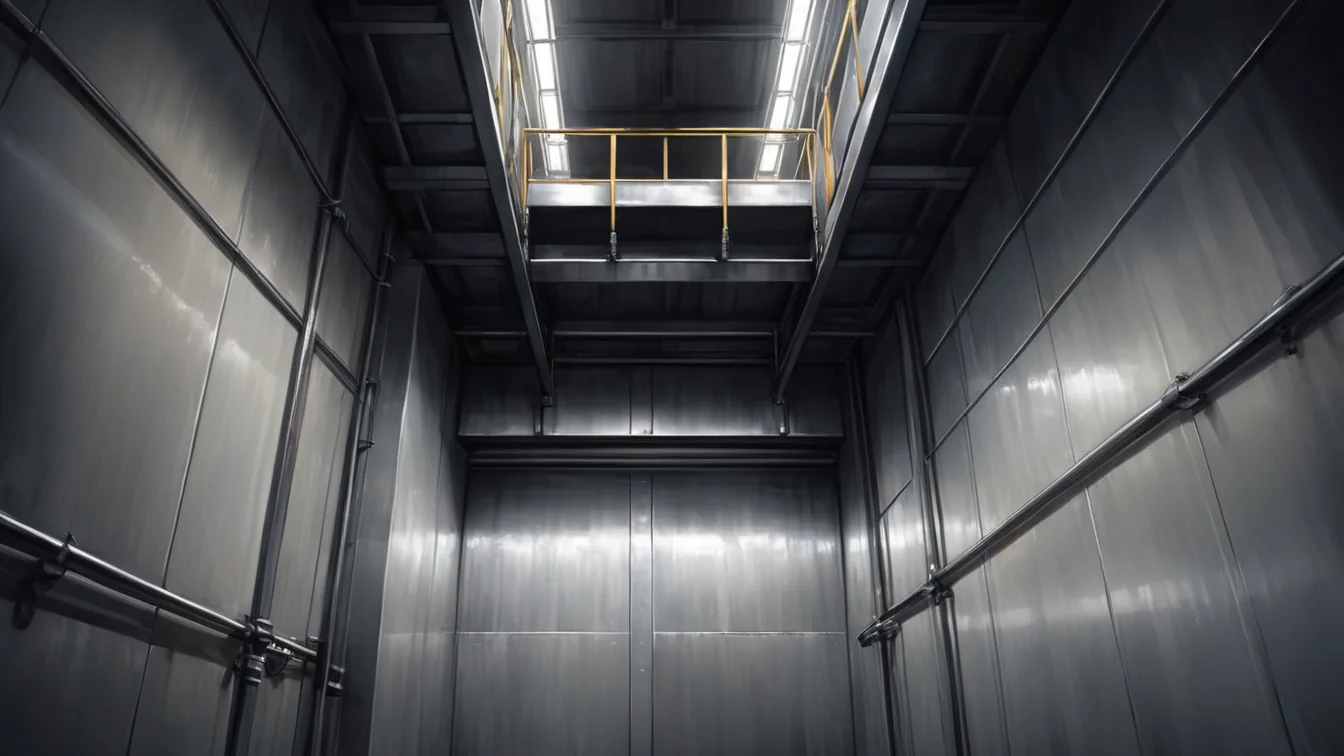
Lift cars can carry people and heavy loads, yet they rise smoothly, stop level with each floor and wait while you step in. What moves the car, what does the hard work, and what stops it if something goes wrong?
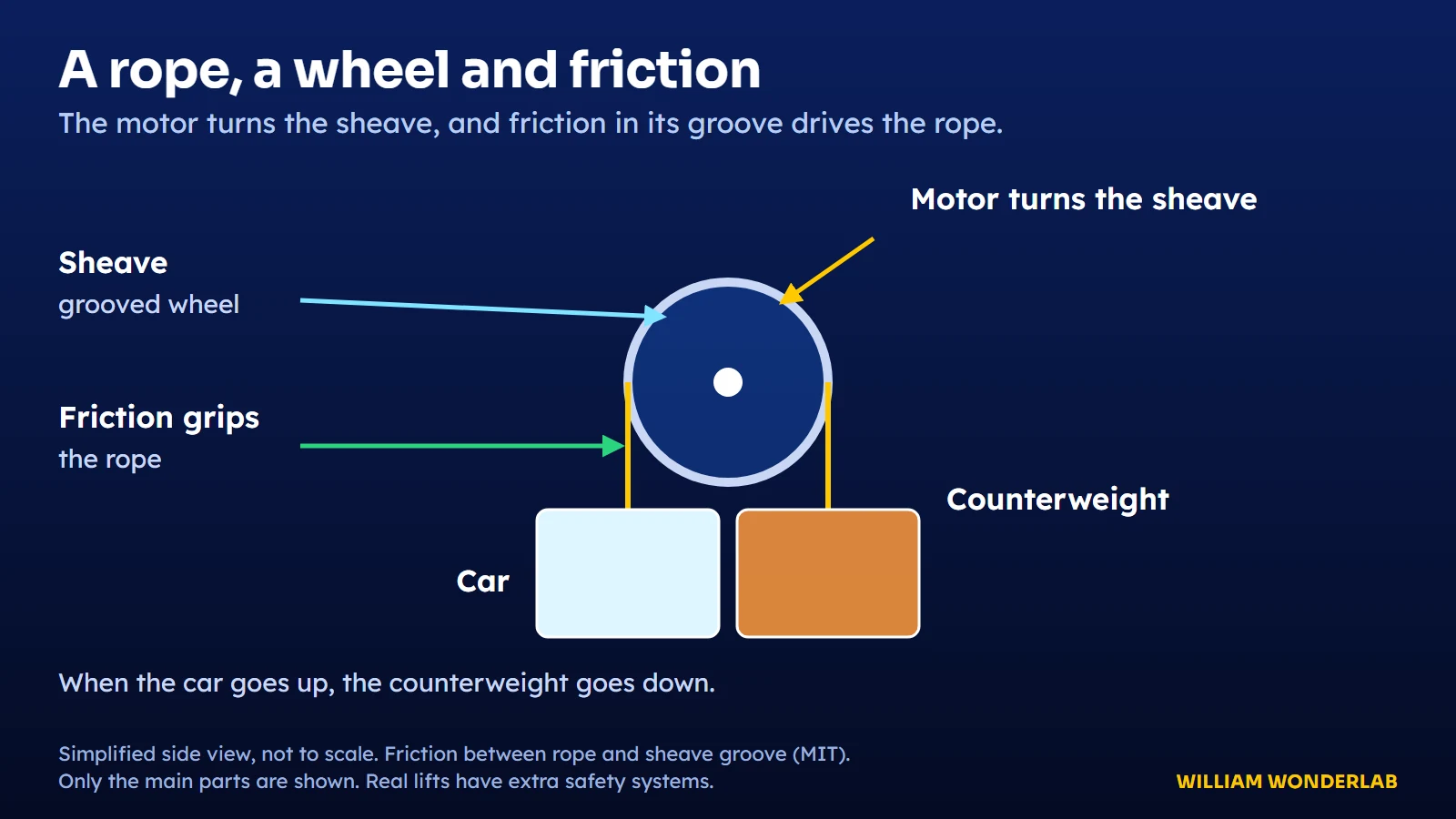
The short answer: A motor turns a large grooved wheel called a sheave. Ropes run over the sheave, with the car hanging from one end and a heavy counterweight hanging from the other. Friction in the grooves grips the ropes, so turning the wheel moves the car. Brakes and a speed-sensing governor stop the car if it moves too fast.[1][2]
Pulleys and the counterweight
A pulley is a wheel with a groove around its edge that guides a rope. A lift uses a large grooved wheel called a sheave. The rope runs over the sheave, with the car on one end and a counterweight on the other. The counterweight is a heavy block that hangs on the rope.
Think of a playground see-saw. When one end goes down, the other goes up. The counterweight works the same way. When the car rises, the counterweight falls, and when the car falls, the counterweight rises.
The counterweight does more than hang there. A US Mine Safety and Health Administration technical paper explains that it “adds accelerating force when the elevator car is ascending” and “provides a retarding effort when the car is descending so that less motor horsepower is required.”[2]
The MIT report puts the idea in one line: “Power is only needed to move the unbalanced load between the elevator and the counterweight.”[1] The unbalanced load is the difference between the car’s weight and the counterweight’s weight. The motor mainly has to move that difference, not the whole weight of the car.
Traction: friction does the lifting
Friction is the grip between two surfaces, like the rubber of your shoe on a footpath. Friction is what lets the sheave pull the rope along.
The MIT report describes it this way: “The friction between the ropes and the sheave grooves, which are cut on the pulley, initiates the traction force.”[1] It also explains what happens when the wheel turns: “When the traction drive is rotated power is transferred from the traction drive to the elevator car and counter weight.”[1]
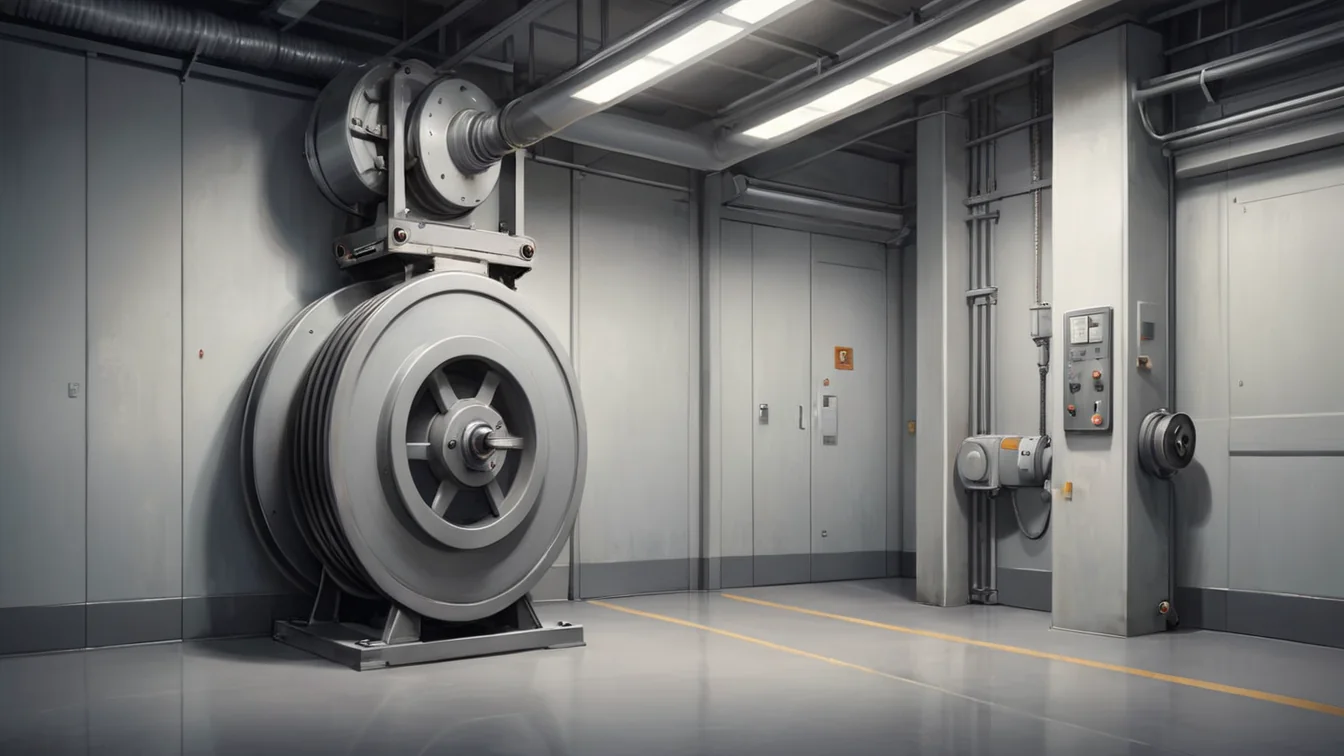
The motor is part of the lift’s machine. The MIT report says that “The elevator is composed of a motor and, most commonly, a worm gear reducer system.” It adds that “The motor component of the elevator machine can be either a DC motor or an AC motor.”[1]
Brakes that hold the car
A lift also needs brakes. The MIT report describes a brake that is pushed on by a spring: “When the solenoid is not energized, the spring forces the brake shoes to grip the brake drum and induce a braking torque.”[1] A solenoid is an electromagnet that pulls when power flows through it. In this design, when the power is cut, the spring wins and the brake grips.
The same report says the brake has a harder job too. It “must also be able to engage in extreme cases in which the elevator cable is broken.”[1]
The governor and safety gear
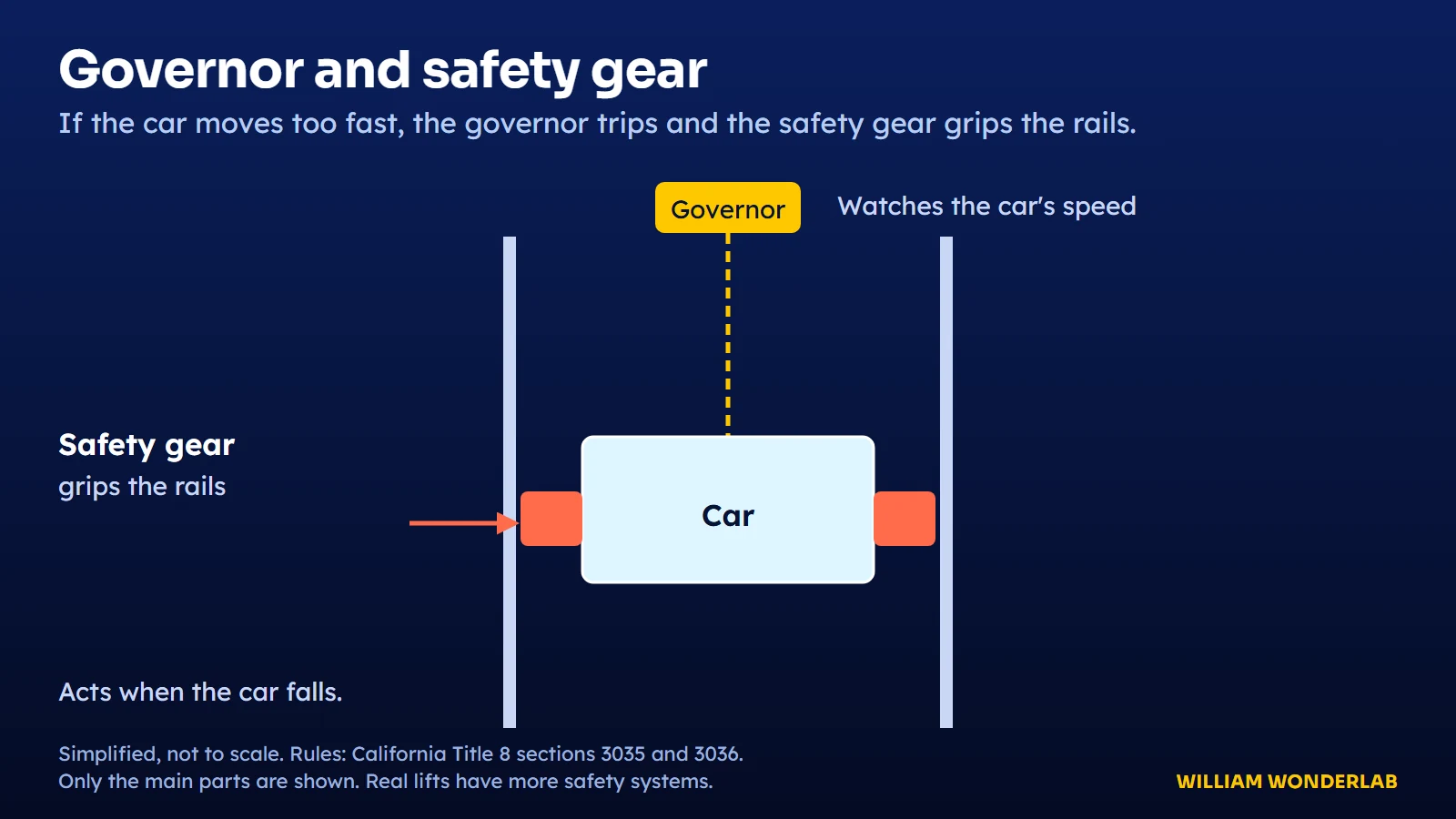
A brake on the motor may not be enough if a rope breaks. That is why lifts have a governor, a device that watches the car’s speed. If the car moves too fast, the governor trips, which means it sets off the next stage of protection.
California’s lift safety rules set the trip speed at “not less than 115 percent of rated speed.”[3] The rated speed is the speed the lift is designed to run at. A governor set this way acts when the car is moving at least 15 per cent faster than its design speed.
When the governor trips, the safety gear on the car clamps onto the guide rails. A US mining safety paper describes it simply: “Elevator cars are fitted with safeties that grip the guide rails and stop a falling car.”[2] The California rules say the safety must be strong enough to hold the car: “The safety device, or the combined safety devices where furnished, shall be capable of stopping and sustaining the entire car with its rated load from governor tripping speed.”[4]
The rules also cover a broken rope, which is called a free fall. “On the parting of the hoisting ropes (free fall), Type A governor-operated safeties shall apply without appreciable delay.”[4] In other words, the car does not have to rely on the governor’s speed reading to be caught.
Try it: a paper pulley model
This is a proposed at-home activity. It shows balance and how a rope moves over a wheel. It is a simple model, not a lift.
You need: a pencil or cardboard tube, two small paper cups, a piece of string about 60 cm long, a few coins, and a table.
- Predict what will happen if both cups have the same number of coins. Then predict what happens if one cup has more.
- Tie one end of the string to each cup. Rest the pencil on the edge of the table, hold it in place with a book, and lay the string over it so one cup hangs on each side.
- Put two coins in each cup, then add one more coin to one cup. Watch what happens.
- Move coins between the cups until they hang level. Count how many coins it took, and compare it with your prediction.
Safety first: A grown-up should help you set this up. Use only a few coins and keep them away from babies and toddlers, because coins can be a choking hazard. Keep the string away from your neck, and never wrap it around your fingers. Do not stand on a chair or climb to reach anything. Never try this with a real lift, a lift shaft or any lift parts. Lifts have brakes and safety systems that a home model cannot copy.
Go deeper: balance, layers and energy
A hypothetical example
Imagine a lift where the car and the counterweight weigh exactly the same. This is a hypothetical example, not a measured lift. The two sides would balance, so the motor would have no unbalanced load to move. Real lifts use the counterweight to reduce the motor’s work, as the MSHA paper explains, but real loads change from trip to trip.[2]
Several layers of protection
Lifts use more than one safety system, and each does a different job. The brake holds the car and stops it in normal use. The governor watches speed. The safety gear grips the rails if the car falls.
If you are curious how machines get their power, read How Do Solar Panels Make Electricity?
Frequently asked questions
Why does a lift not fall when a rope breaks?
The safety gear is designed to grip the guide rails if the car falls. For a free fall, the California rules say the governor-operated safeties “shall apply without appreciable delay.”[4]
Does the counterweight make a lift use less energy?
It reduces the work the motor does. The MSHA paper says the counterweight provides a retarding effort when the car is descending “so that less motor horsepower is required.”[2]
What is a sheave?
A sheave is a grooved wheel that a rope runs over. The MIT report describes friction between the rope and the sheave grooves.[1]
Can lift safety gear stop a lift that is going up?
Not under the rules. They say that safeties “shall not stop an ascending car or counterweight.”[4]
The big idea
Balance, friction and layers of safety. A motor turns a grooved wheel, friction moves the rope, and a counterweight balances much of the load. A governor and safety gear are ready to stop the car if it moves too fast.
Related reading
More from William Wonderlab:
Explore more from scientists:
- Elevator report (MIT, course 2.972 web pages)
- Title 8, Section 3035: Car and Counterweight Safeties (California Department of Industrial Relations)
- Elevator safety: give the miner a brake (US Mine Safety and Health Administration)
References
[1] MIT, “Elevator report” (student report, MIT course 2.972 web pages) (accessed 25 October 2026)
[2] US Mine Safety and Health Administration (MSHA), “Elevator safety: give the miner a brake” (accessed 25 October 2026)
[3] Cornell Legal Information Institute, “Cal. Code Regs. Tit. 8, § 3036 – Governors” (accessed 25 October 2026)
[4] California Department of Industrial Relations, “Title 8, Section 3035. Car and Counterweight Safeties” (accessed 25 October 2026)