Why Do Stars Twinkle?
Stars look like they flicker, but they are small, steady points of light. Moving air in our atmosphere bends their light on the way down to your eyes.
On a clear night, stars seem to flicker and shimmer, changing brightness and even colour from moment to moment. Planets, in the same sky, often look steadier. So why does the sky behave in two different ways?
The short answer: Starlight is bent slightly as it passes through moving air in Earth’s atmosphere. Each small bend changes how much light reaches your eyes, so the star seems to flicker. Planets look steadier because they appear as tiny discs rather than points.[1][2][3]
Starlight passes through moving air
Stars twinkle because we view them through our atmosphere.[3] NASA explains that “the movement of air (sometimes called turbulence) in the atmosphere of Earth causes the starlight to get slightly bent” as it travels down to the ground.[1]
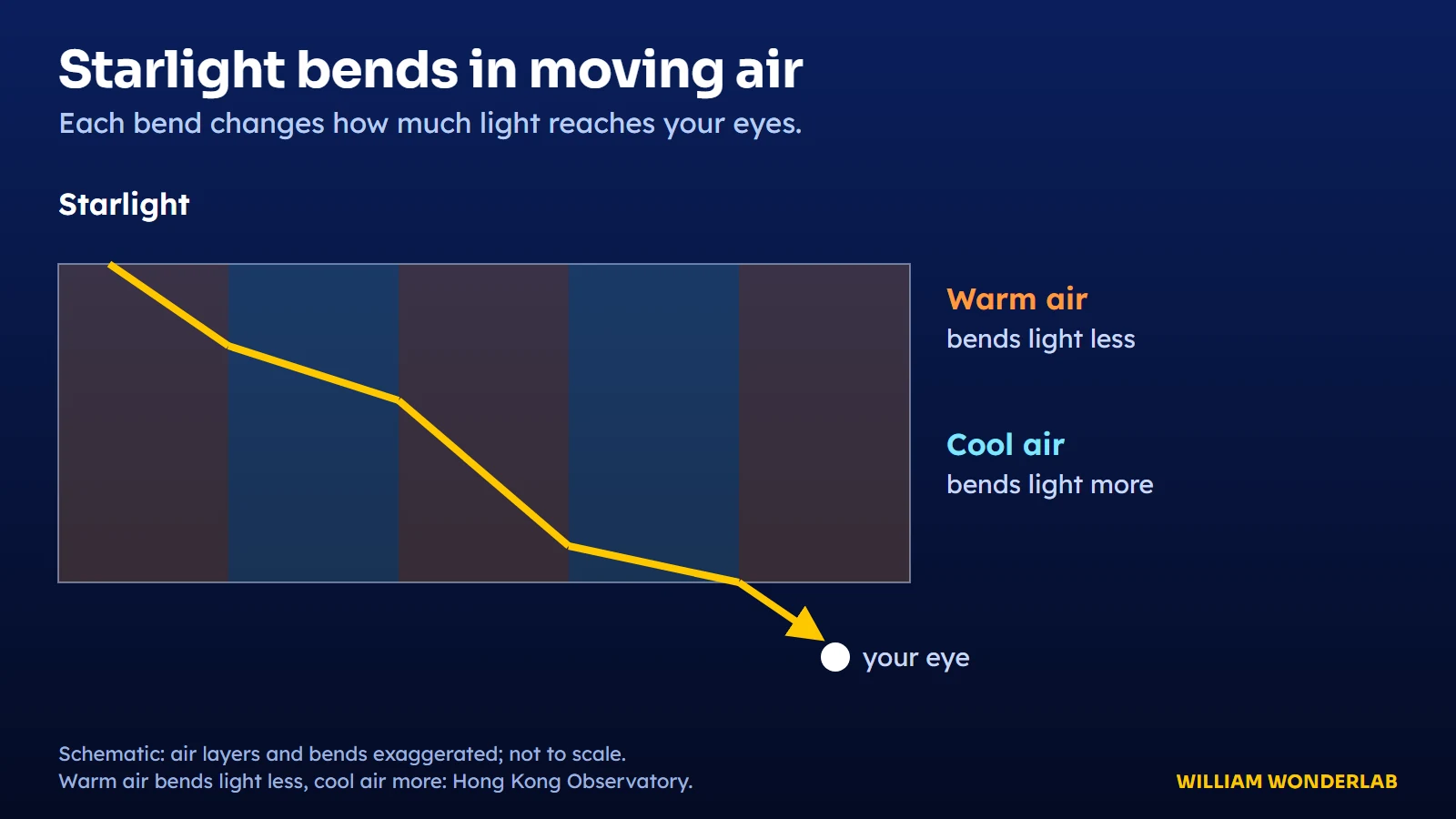
The air is not the same everywhere. The Hong Kong Observatory says that “what distorts the light coming from a star is temperature variations in the air.”[2] A ray of starlight bends a little each time it moves from warmer air into cooler air, or the other way around.[3]
Because the air keeps moving, different pockets of air sit in the light’s path at different moments. NASA puts it this way: “different air pockets produce different images of a single point-like star.”[4]
Why the star seems to flicker
Each bend sends a little more or a little less light towards your eyes. The Hong Kong Observatory describes the result: “When it is scattered away from us, the star seems to disappear for a moment. When it is scattered into our eyes, it seems to reappear, resulting in a twinkle.”[2]
The light from a star is being shaken from one moment to the next, so its brightness changes quickly.
Why planets look steadier
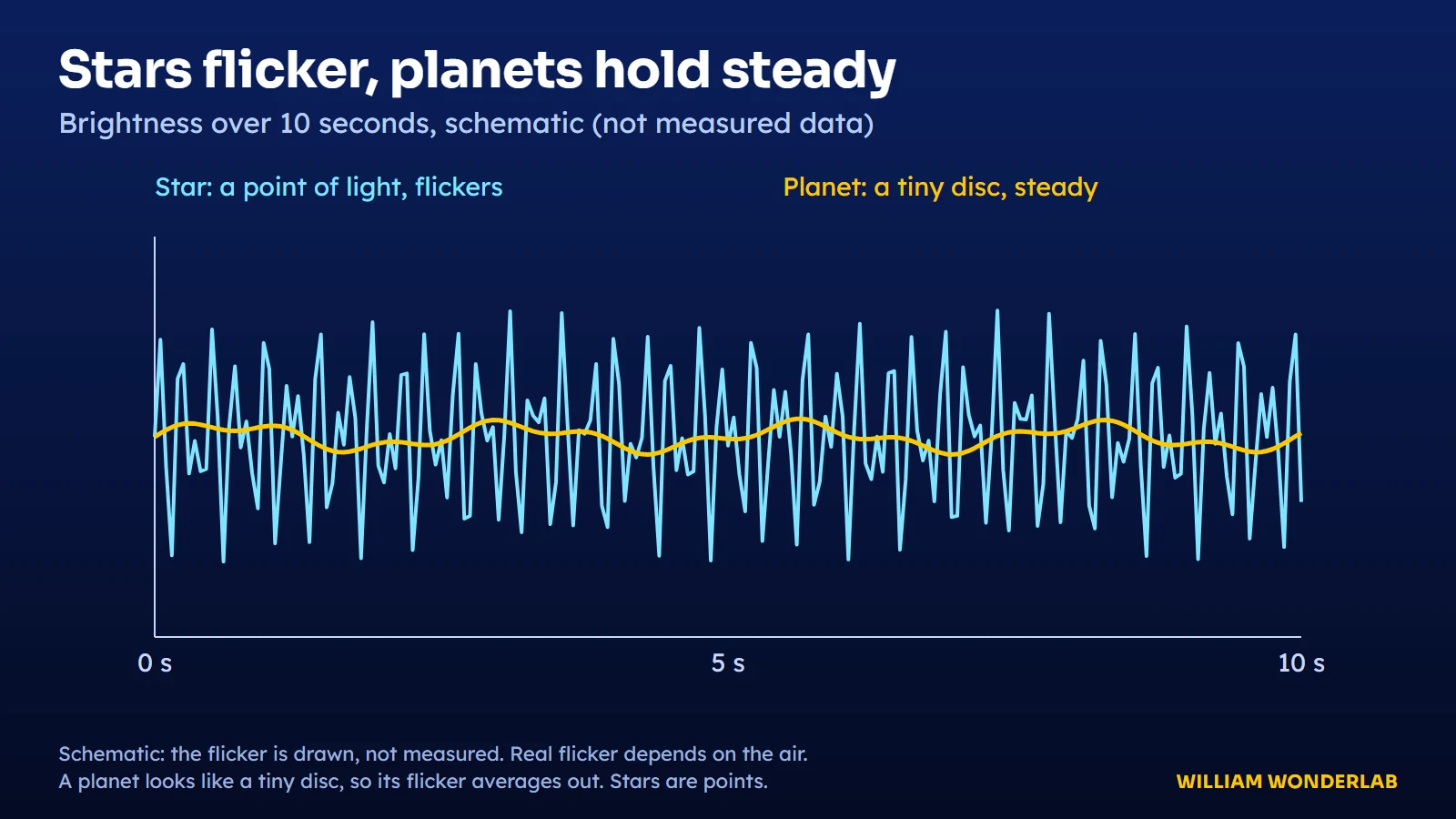
Planets are much closer than stars. As a result, “planets are so much closer that we can actually see their disks,” and “planets generally don’t twinkle nearly as much as stars.”[3]
A planet’s disc is made of many points of light. Light from one edge is bent one way, and light from the opposite edge is bent the other way. EarthSky describes it this way: “The zigs and zags of light from a planetary disk cancel each other out, and that’s why planets appear to shine steadily.”[5] A physics demonstration with a wide laser beam makes the same point: the flicker is “averaged over the wider image.”[6]
Why stars near the horizon twinkle more
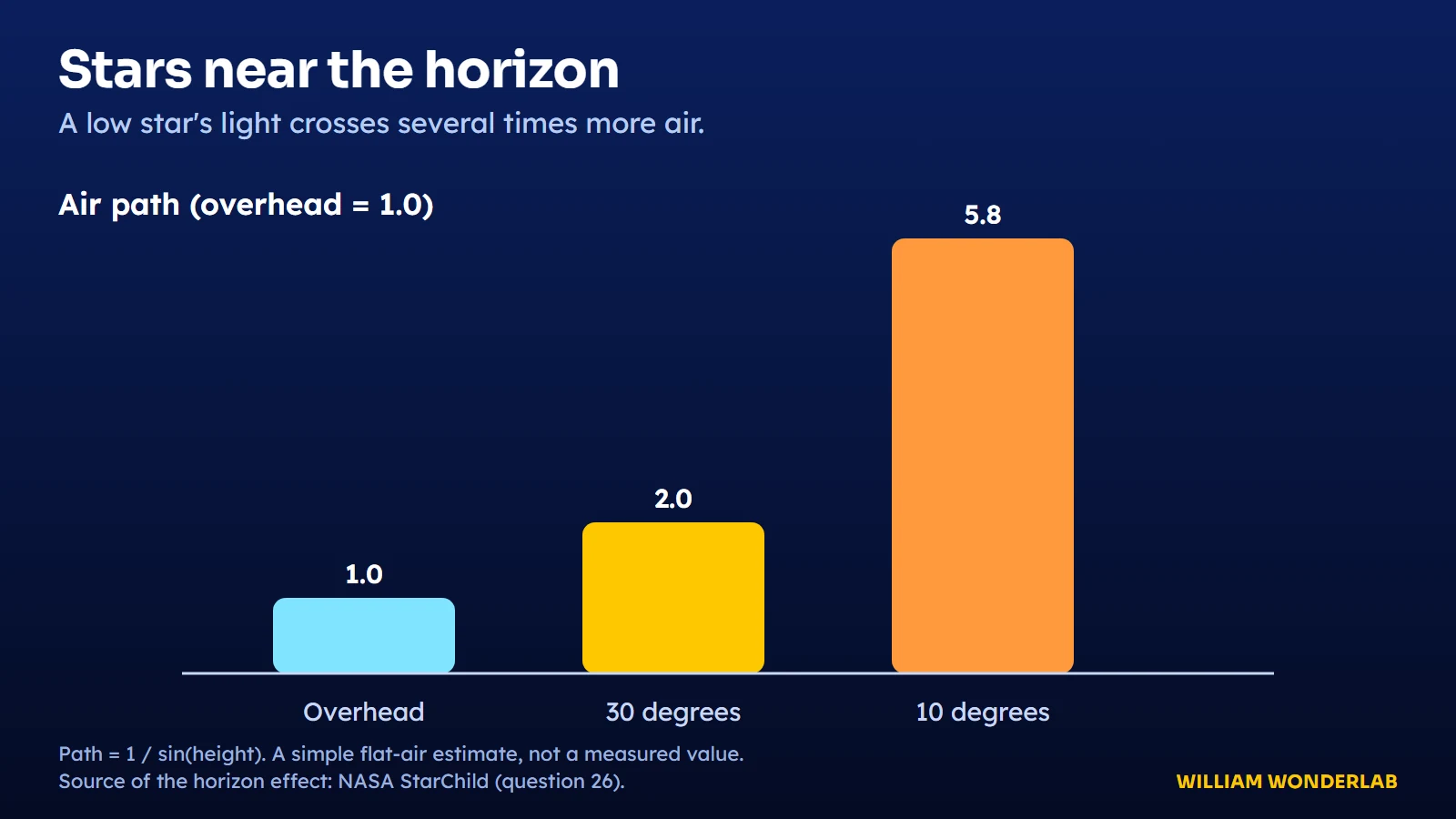
NASA’s StarChild explains that “stars closer to the horizon will appear to twinkle more than other stars.” The reason is simple: “there is a lot more atmosphere between you and a star near the horizon.”[1]
A rough estimate shows how much more air the light crosses. If you use a simple flat-air model, the path length is 1 divided by the sine of the star’s height above the horizon. A star overhead has a path of 1. A star 30 degrees up has a path of about 2. A star 10 degrees up has a path of about 5.8, nearly six times as much air.
Try it: the twinkle watch
You will need a clear night, a notebook, a watch or clock with a second hand, and an adult to come outside with you.
- Pick one bright star that is high in the sky, well away from the horizon. Look at it for 10 seconds and count how many times it seems to flicker or change brightness.
- Pick a star that is low over the horizon, and do the same count.
- If you can, look at a planet and compare it with a star. Use a free star-map app or a printed chart to identify the planet.
- Write down your counts. Compare them with the NASA explanation.
What to expect: NASA’s explanation says stars closer to the horizon should twinkle more than stars higher up.[1]
Safety first: never look at the Sun. Stars are visible at night, so this activity needs no Sun-watching at all. Never point binoculars, a telescope or a camera at the Sun, even near sunrise or sunset. Stay somewhere safe and well-lit, watch where you are walking, and go outside with an adult if you are younger.
Go deeper: refraction and the air
Why air bends light
Light bends when it passes between regions where it travels at different speeds. Warm air bends light less, while cool air bends it more.[2] Starlight crosses many layers of air, each with its own temperature, so the total bending changes from moment to moment.
Why the air keeps changing
NASA’s APOD explains that “the atmosphere is always windy and changing, with the result that stars appear to twinkle.”[4] NASA’s Space Place offers a hands-on version: the moving air makes the light rays “travel at just a little bit different speeds, so the stars appear to wiggle.”[7]
Why the Moon is different
Astronauts would see something different. The Moon has no air to bend the light, and University of Wisconsin–Madison News notes that “seen from the moon, where there is no atmosphere, stars do not twinkle at all.”[3] That fact is strong evidence that the twinkle is caused by the atmosphere, not by the star.
Frequently asked questions
Do stars really flicker?
Stars are point-like sources of light. The flicker happens on the way to your eyes, because the atmosphere bends their light.[4]
Why do stars twinkle more near the horizon?
Light from a low star crosses much more air than light from a star overhead, so there is more air to bend it.[1]
Is twinkling caused by wind?
Not exactly. The Hong Kong Observatory says the effect “must be atmospheric, i.e. due to air”, and that what distorts the light is “temperature variations in the air.”[2]
Why do planets twinkle less?
Planets appear as small discs. The bending on different parts of the disc cancels out, so planets generally twinkle much less than stars.[3][5][6]
Would stars twinkle from the Moon?
No. Without an atmosphere, the light is not bent, so stars do not twinkle there.[3]
The big idea
Twinkling comes from the air, not the star. Stars are small points of light, and moving pockets of air bend their light on the way down. The lower a star sits, the more air it shines through, and the more it twinkles.
Related reading
More from William Wonderlab:
Explore more from scientists:
References
[1] NASA StarChild, “Why do stars twinkle?” (accessed 25 October 2026)
[2] Hong Kong Observatory, “Why do stars twinkle?” (accessed 25 October 2026)
[3] University of Wisconsin-Madison News, “Curiosities: Why do stars appear to twinkle in the night sky?” (accessed 25 October 2026)
[4] NASA Science, “APOD: 2000 July 25 – Why Stars Twinkle” (accessed 25 October 2026)
[5] Deborah Byrd, “Why don’t planets twinkle as stars do?”, EarthSky (accessed 25 October 2026)
[6] Texas A&M University Physics & Astronomy, “Why don’t planets twinkle?” (accessed 25 October 2026)
[7] NASA Space Place, “Make colorful star cookies!” (accessed 25 October 2026)
Keep exploring
Now try the science yourself
Reading is a great start. Experimenting is even better: these interactive models use the same science as this article.