Why Can’t Emus Fly?
Emus are tall, fast runners with wings too small to lift them. Here is what flight needs, and what scientists have found about how emu wings develop.
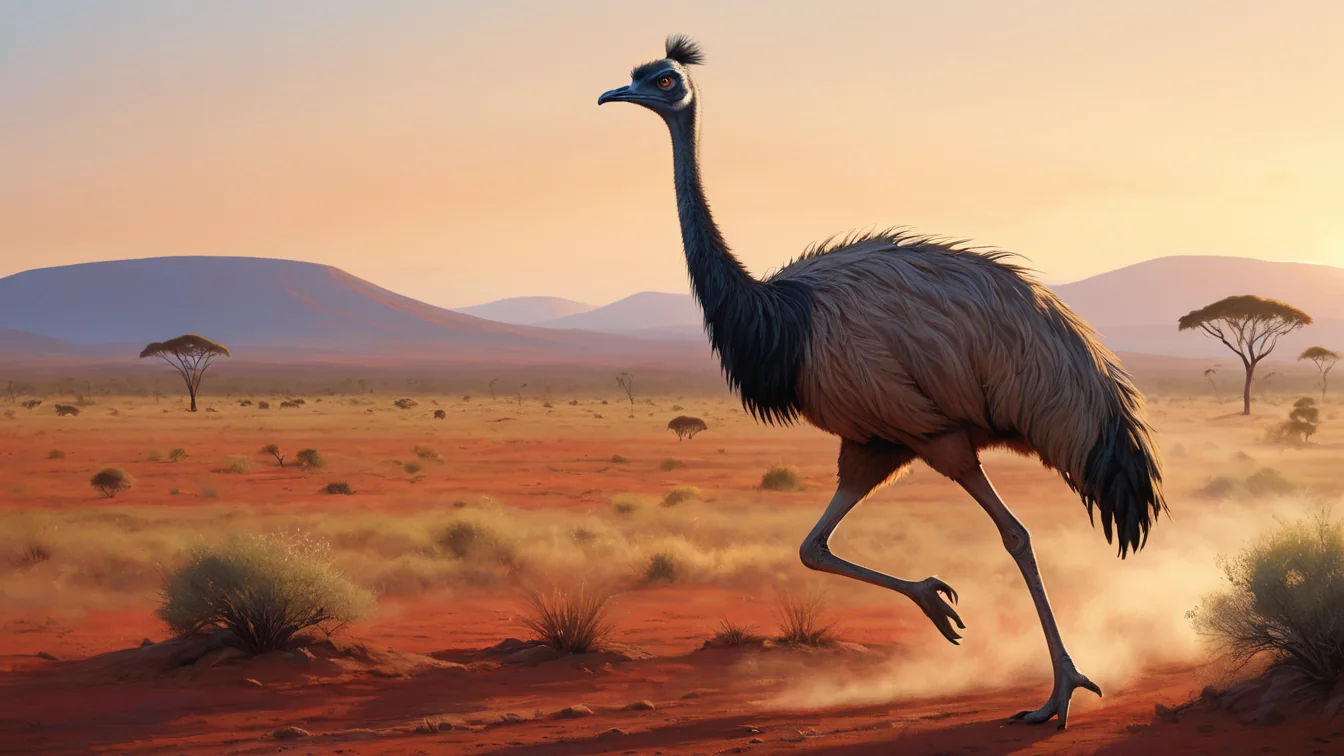
An emu can stand between 1.6 and 1.9 metres tall, which makes it Australia’s tallest native bird.[1] It has feathers, a beak and a bird’s skeleton, yet it cannot fly. So what stops a bird this big from taking off?
The short answer: Emus cannot fly because their wings are greatly reduced, and their bodies are built for walking and running on the ground. Flying birds use large chest muscles to pull their wings down. Scientists have found that emu wings develop differently from the wings of flying birds, and that flight has probably been lost more than once among the big birds called ratites.[1][2][3][4]
What does flight need?
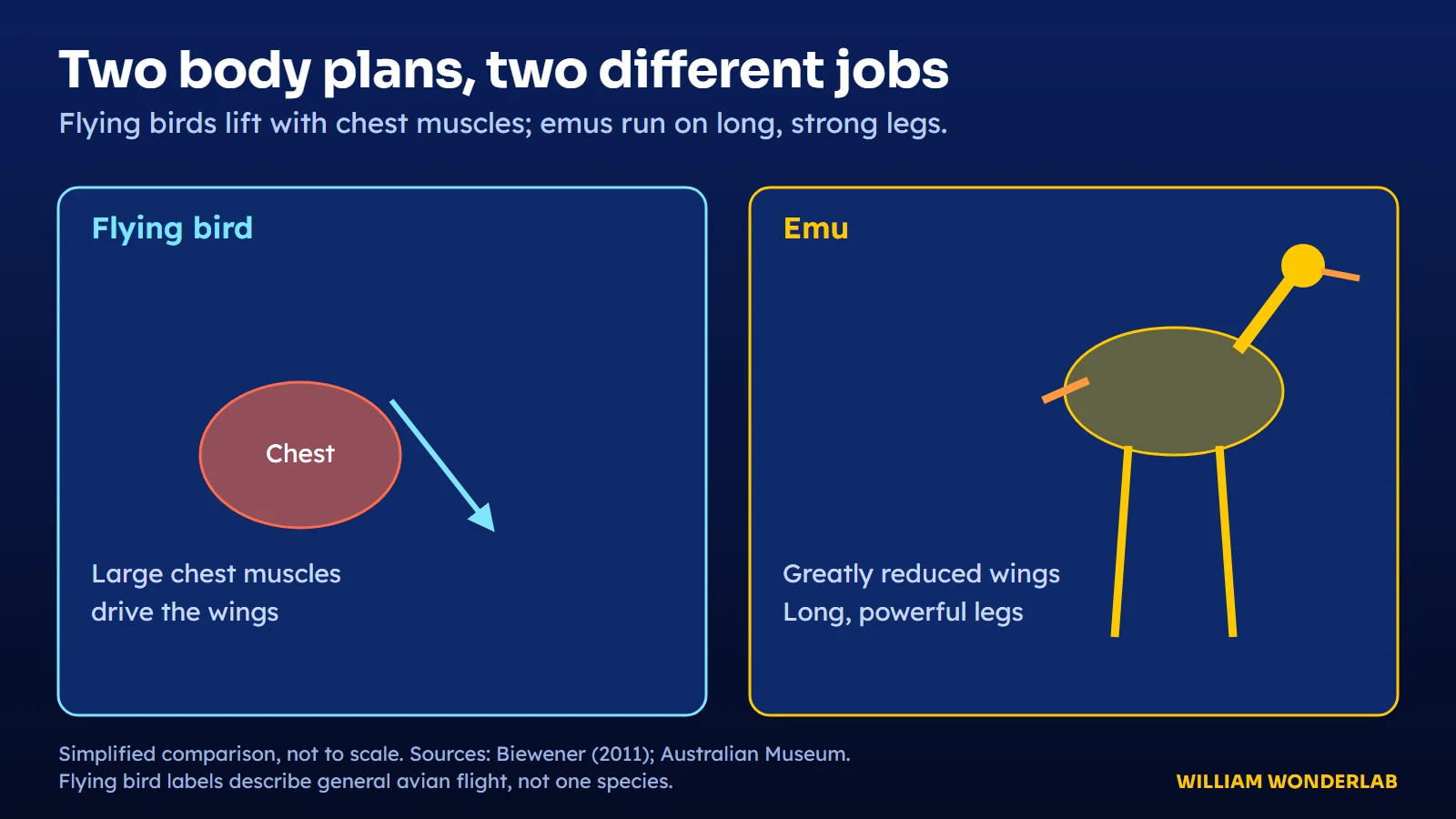
To fly, a bird must push air down with its wings hard enough to lift its body. Most of the power comes from the pectoralis, the large muscle on the chest. In flying birds, the pectoralis pulls the wings down at the shoulder on each downstroke.[2]
An everyday comparison helps. Think about rowing a boat. The strong muscles of your arms and back do the hard work, and the oars only work as well as the power behind them. A bird’s chest muscles are the power behind its wings.
The emu’s wings are greatly reduced
The Australian Museum describes the emu’s wings as “greatly reduced”, while its legs are described as long and powerful.[1] Its wings are much too small to lift its body, so the emu cannot fly.
The emu is a heavy bird. Taronga Zoo gives its weight as between 30 and 55 kilograms and states that it cannot fly.[5] A heavy body needs a lot of lift, and small wings give very little.
Emus are built for distance on foot. The Australian Museum notes that they can move hundreds of kilometres, sometimes covering 15 to 25 kilometres in a day, depending on food and water.[1]
Built for the ground
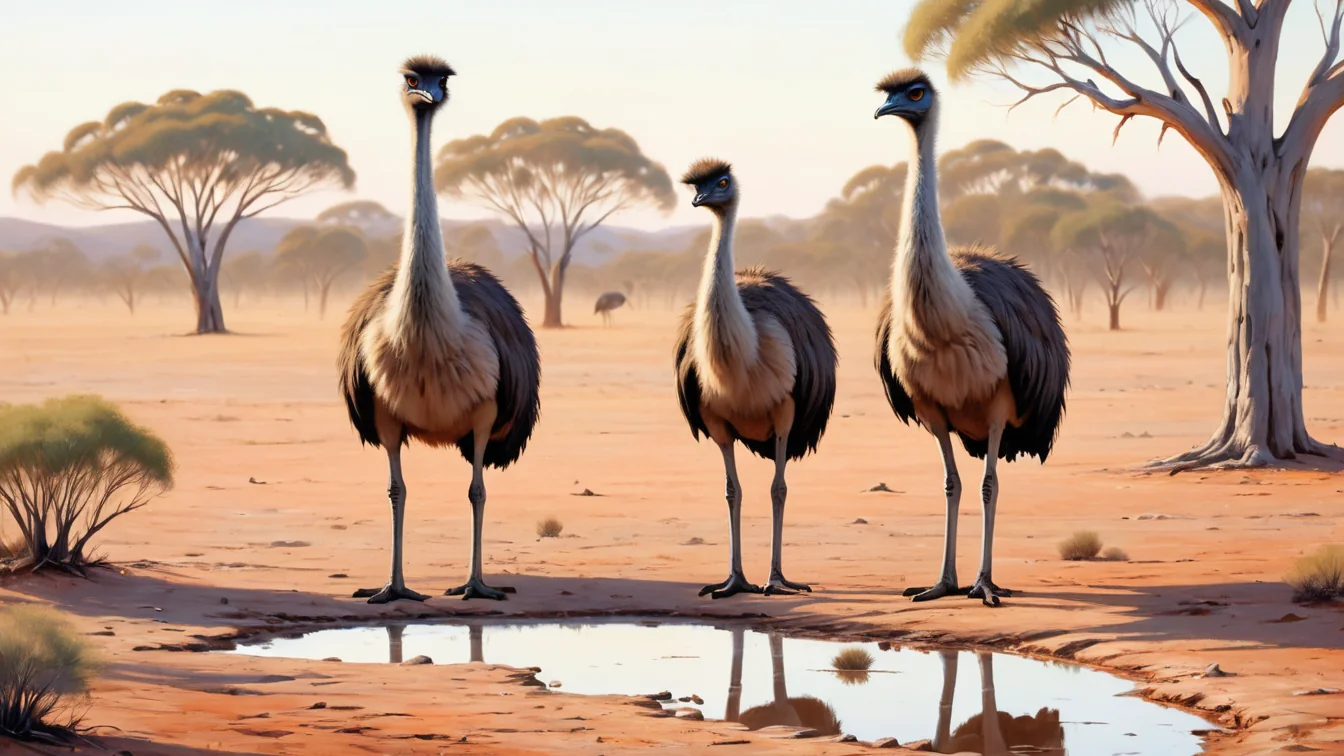
Compare the two plans side by side. A flying bird invests in a big chest muscle that drives the wings. An emu invests in long, strong legs that drive it across the plain. Both are successful body plans, but they solve different problems.
How an emu wing develops
Birds grow their wings during development, long before they hatch. A 2024 study in Nature Communications looked at emu embryos and found that some of the cells that should form the wing’s muscles die early on. The authors linked this loss to the lack of distal muscle at the far end of the developing wing, which leaves the wing with less movement.[3]
The researchers reported that this reduced movement contributes to shorter bones in the emu wing. Scientists are still working out the full chain of events, so this is one important piece of the picture rather than the whole story.
Flight was lost more than once
The emu belongs to a group of large flightless birds called ratites, which also includes the ostrich and the cassowary. A 2017 study in Biology Letters compared wing growth in ostriches, emus, tinamous, which can fly, and chickens.[4]
The study found that ostrich wing growth fell within the range seen in flying birds. Emu wing growth was extremely slow. The authors found that the ostrich and the emu follow different developmental routes, and their results support the hypothesis that flight has been lost repeatedly among the ratites.[4]
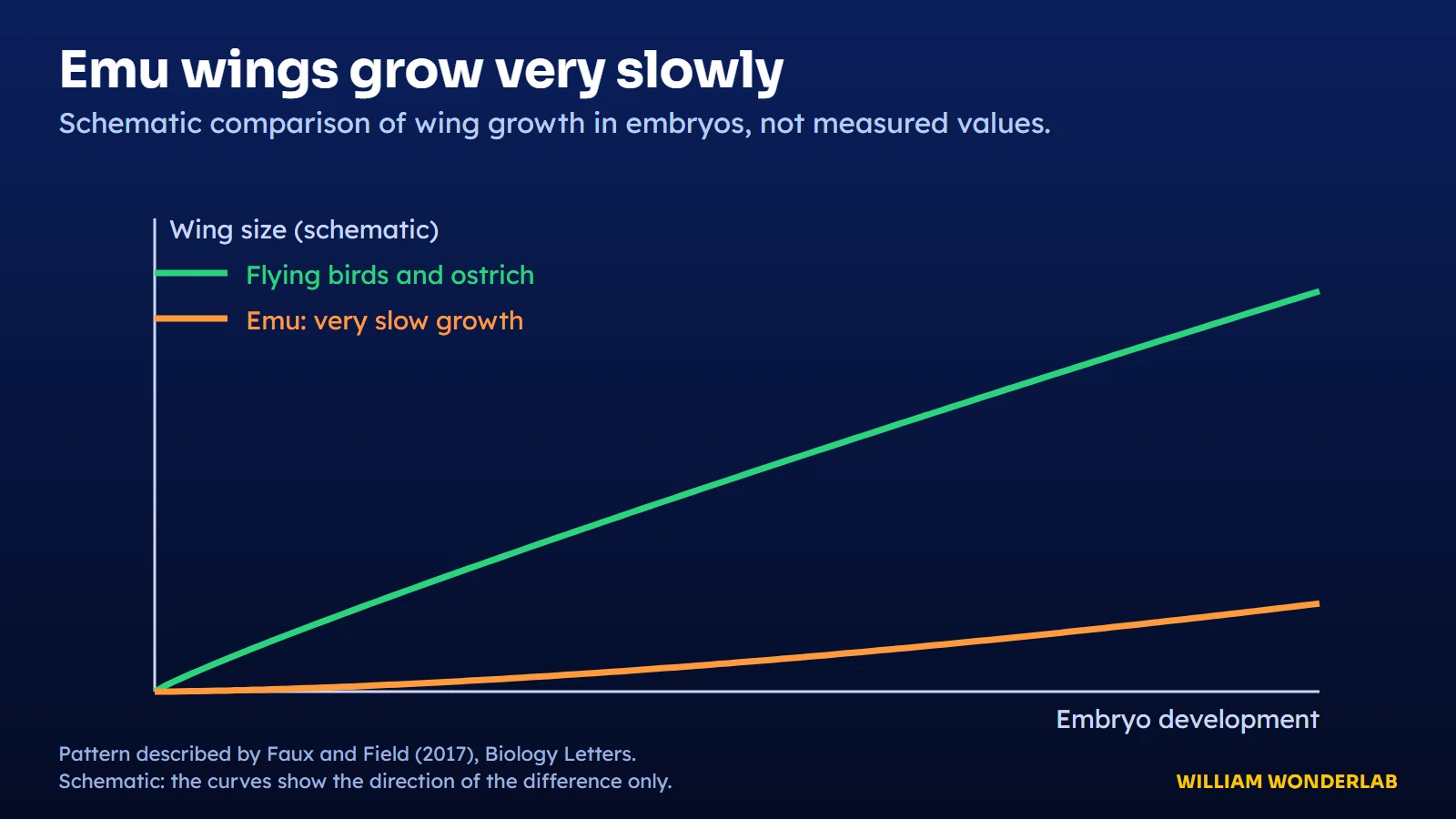
Did you know? The ostrich and the emu both cannot fly, but scientists think they got there in different ways. Their wings develop along different paths, so one lost flight by a different route from the other.[4]
Try it: paper gliders, one with bigger wings
This is a proposed at-home activity, to try with a grown-up. A paper glider is not a bird, but it can show how wing size changes how well something stays in the air.
- Predict which glider will stay up longer: one with large wings, or one with small wings.
- Take two sheets of paper of the same size. Fold one into a simple glider with the wings spread wide. Fold the other with the wings folded in to make them small. Do not cut the paper.
- Stand in a clear room, hold each glider at shoulder height and let it go gently. Time or count how long each one stays up.
- Repeat each glider three times and write down your results. Did the bigger wings help?
Safety first: Use fold-only paper gliders with no scissors or cutters. Play in a clear room with no stairs, glass or hot stoves nearby, and keep gliders away from eyes. Tidy up any paper so no one trips. Ask a grown-up before using any tape or glue. Younger scientists should always do this with an adult.
Go deeper: two lineages, two routes
Why the comparison matters
Scientists can learn a lot from two closely related lineages that both lost flight. If they lost it in the same way, the cause may be shared. The 2017 study found that the ostrich and the emu took different developmental routes to flightlessness, so the two cases are not just copies of each other.[4]
What the experiments show, and what they do not
The 2024 study worked with emu embryos. Its findings show how reduced movement can shape bone growth in a developing wing, but they do not explain exactly how the first emus lost flight millions of years ago. That is a question for fossils and genetic studies, which are still developing.[3]
Frequently asked questions
Can an emu fly even a little?
No. Taronga Zoo says the emu “can’t actually fly”[5], and the Australian Museum describes its wings as greatly reduced.[1]
Are emus the only big birds that cannot fly?
No. The ostrich and the cassowary are also flightless ratites, and the 2017 study compared ostriches and emus.[4]
Do emus need their wings for anything?
Its wings are too small to lift it, and no firm account of what they are used for instead is available.
How tall is an emu?
An emu can stand between 1.6 and 1.9 metres tall when upright.[1]
Did emus choose to stop flying?
No. Changes in wing development build up over many generations, and no individual bird chooses them. The 2017 study found that the ostrich and the emu took different developmental routes.[4]
The big idea
The emu’s body is built for the ground. Flying birds rely on big chest muscles and wings to lift themselves. The emu has greatly reduced wings and strong legs, and its wings develop differently from those of flying birds.
Related reading
More from William Wonderlab:
Explore more from scientists:
- Emu (Australian Museum)
- Emu (Taronga Zoo)
- Muscle function in avian flight: achieving power and control (Biewener, 2011)
- Distinct developmental pathways underlie independent losses of flight in ratites (Faux and Field, 2017)
References
[1] Australian Museum, “Emu” (accessed 26 October 2026)
[2] Biewener, A. A. (2011), “Muscle function in avian flight: achieving power and control”, Philosophical Transactions of the Royal Society B (accessed 26 October 2026)
[3] Nature Communications (2024), “Immobilization secondary to cell death of muscle precursors with a dual transcriptional signature contributes to the emu wing skeletal pattern” (accessed 26 October 2026)
[4] Faux, C. and Field, D. (2017), “Distinct developmental pathways underlie independent losses of flight in ratites”, Biology Letters (accessed 26 October 2026)
[5] Taronga Conservation Society Australia, “Emu” (accessed 26 October 2026)