How Do Aeroplanes Stay Up?
A wing stays up by turning air downward, and the air pushes the wing upward. Here is how lift works, and why a popular myth about it is wrong.
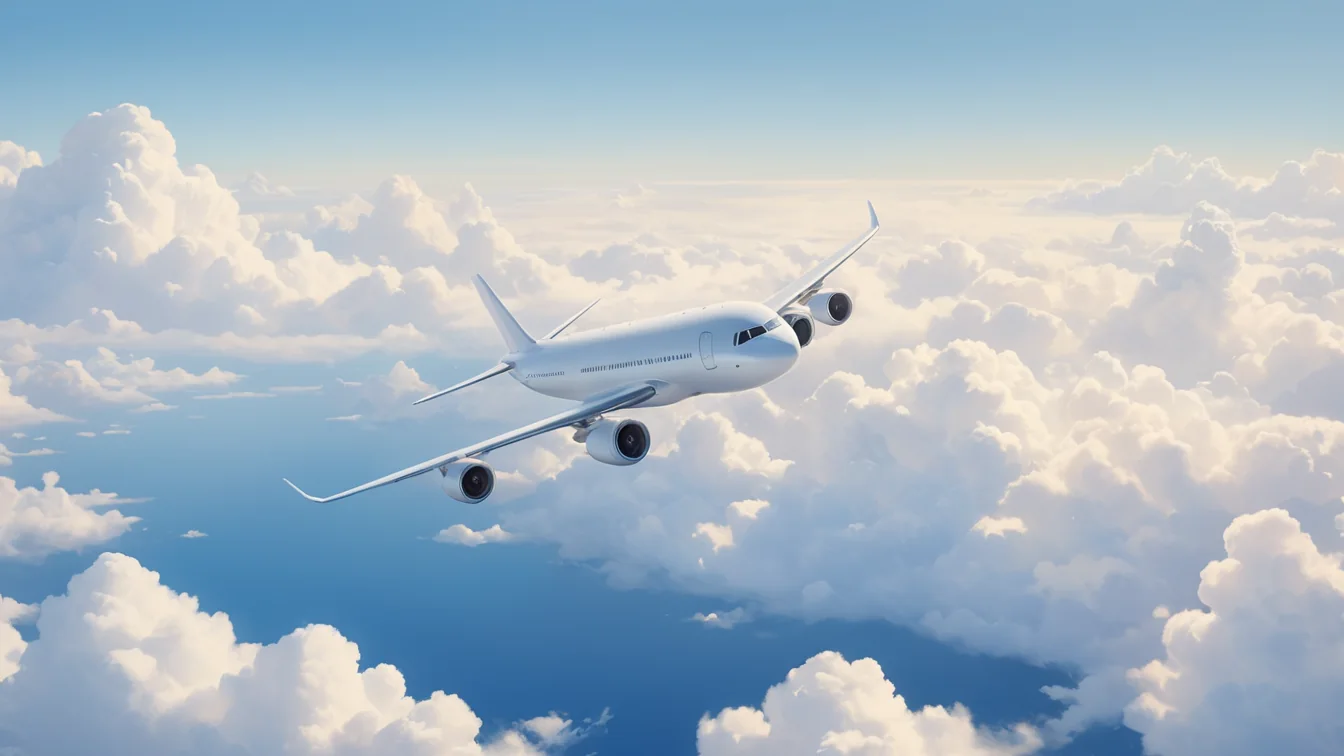
A passenger aeroplane is very heavy. Yet it rolls down a runway, lifts into the sky and flies for hours above the clouds. Gravity is pulling it down the whole time, so something must be pushing it up. That push is called lift.
The short answer: A wing stays up because it turns air downward. When air is pushed down, the air pushes the wing up. NASA describes lift this way: it “occurs when a moving flow of gas is turned by a solid object.”[1] In steady cruise, lift is equal to the aeroplane’s weight.[2]
Lift is a reaction to turned air
Air is a gas, and a flow of gas is what a wing turns. A wing is a solid object moving through the air. NASA’s wording is that lift happens when that flow is turned by the solid object.[1]
Isaac Newton’s third law explains what happens next. NASA states the law as: “for every action (force) in nature there is an equal and opposite reaction.”[3] For a wing, NASA says “the air is deflected downward by the airfoil’s action,” and “in reaction, the wing is pushed upward.”[3]
Here is an everyday comparison. When you push a ball forward, your hand is pushed back. When the wing pushes air down, the air pushes the wing up. The comparison is a way to picture the idea, not a measurement.
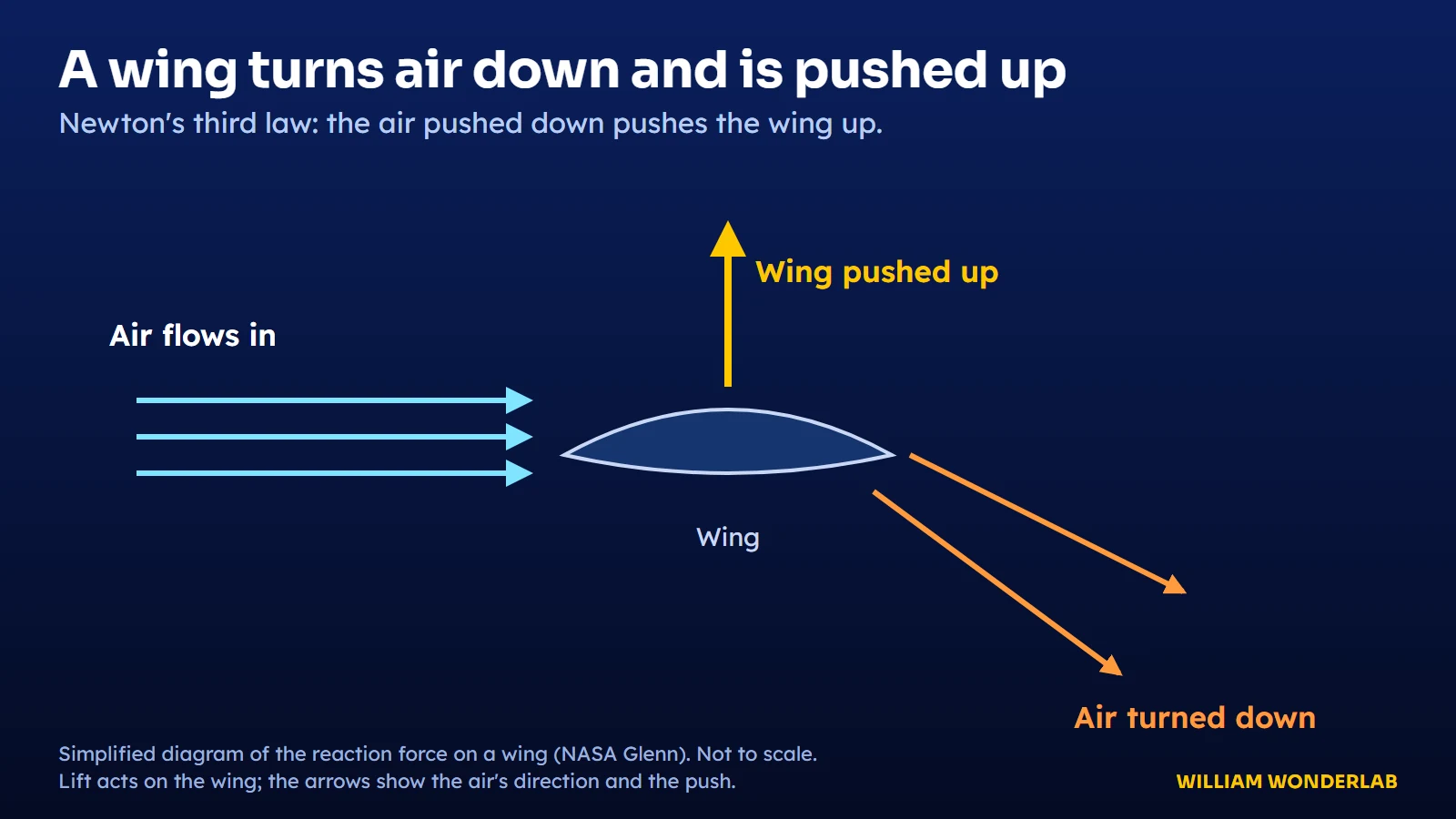
NASA adds that “for an aircraft wing, both the upper and lower surfaces contribute to the flow turning.”[1] So the air is turned by the top of the wing and by the underside too. The result is a push upward on the whole wing.
Lift depends on movement through the air
NASA also says that “lift is generated by the difference in velocity between the solid object and the fluid.”[1] In plain words, lift depends on how fast the wing moves compared with the air around it.
This is why an aeroplane has to keep moving to fly. A wing sitting still in still air has no air flowing past it, so there is no flow to turn.
The myth about longer paths
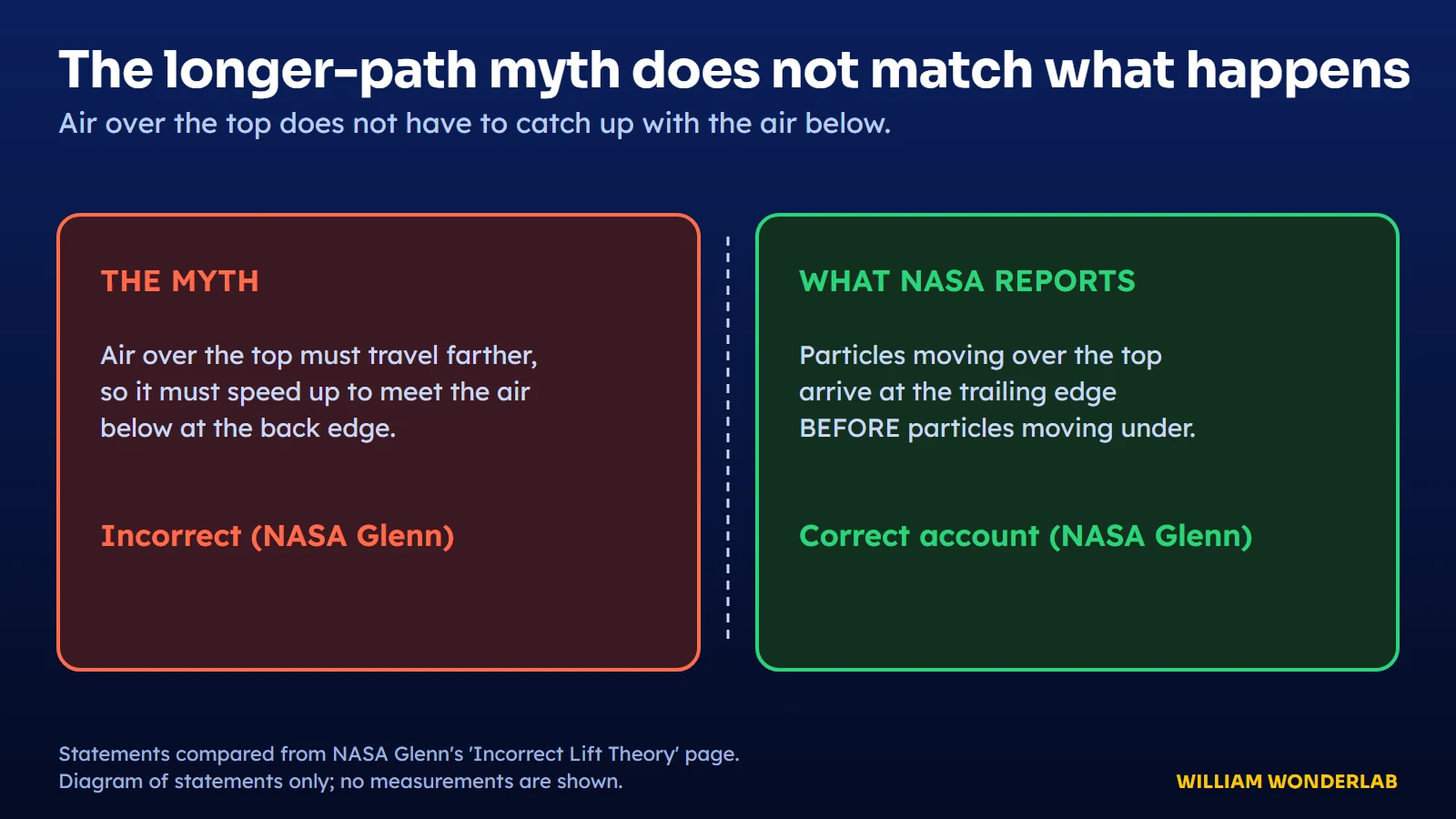
You may have read that wings are curved so that air over the top has farther to travel. The story goes that this air must speed up to meet the air below at the back edge of the wing. NASA calls this the “Longer Path” or “Equal Transit Time” theory, and it says the theory is wrong.[4]
NASA warns that “many of the theories found in encyclopedias, on web sites, and even in some textbooks are incorrect.”[4] NASA’s test of the idea is what really happens to the air. It reports that “particles moving over the top arrive at the trailing edge before particles moving under the airfoil.”[4] The air over the top does not wait for the air below.
NASA’s page on Bernoulli’s equation adds that “the most popular incorrect theory of lift arises from a mis-application of Bernoulli’s equation.”[5] The mistake it describes is about the speed of the air over the upper surface: “the error in this theory involves the specification of the velocity on the upper surface.”[5] So if you read a neat story about equal travel times, treat it with caution.
Did you know? NASA’s “Incorrect Lift Theory” page warns that many explanations in encyclopedias, websites and textbooks are wrong.[4] Checking the source is a good habit, even for tidy explanations.
Lift balances weight in steady flight
Weight is the force that gravity puts on an aeroplane. NASA defines it as “the force generated by the gravitational attraction of the earth on the airplane.”[6]
To stay at the same height in steady flight, the forces must balance. NASA’s cruise page says that “in an ideal situation, the forces acting on an aircraft in flight can produce no net external force.” In that case, “the lift is equal to the weight, and the thrust is equal to the drag.”[2]
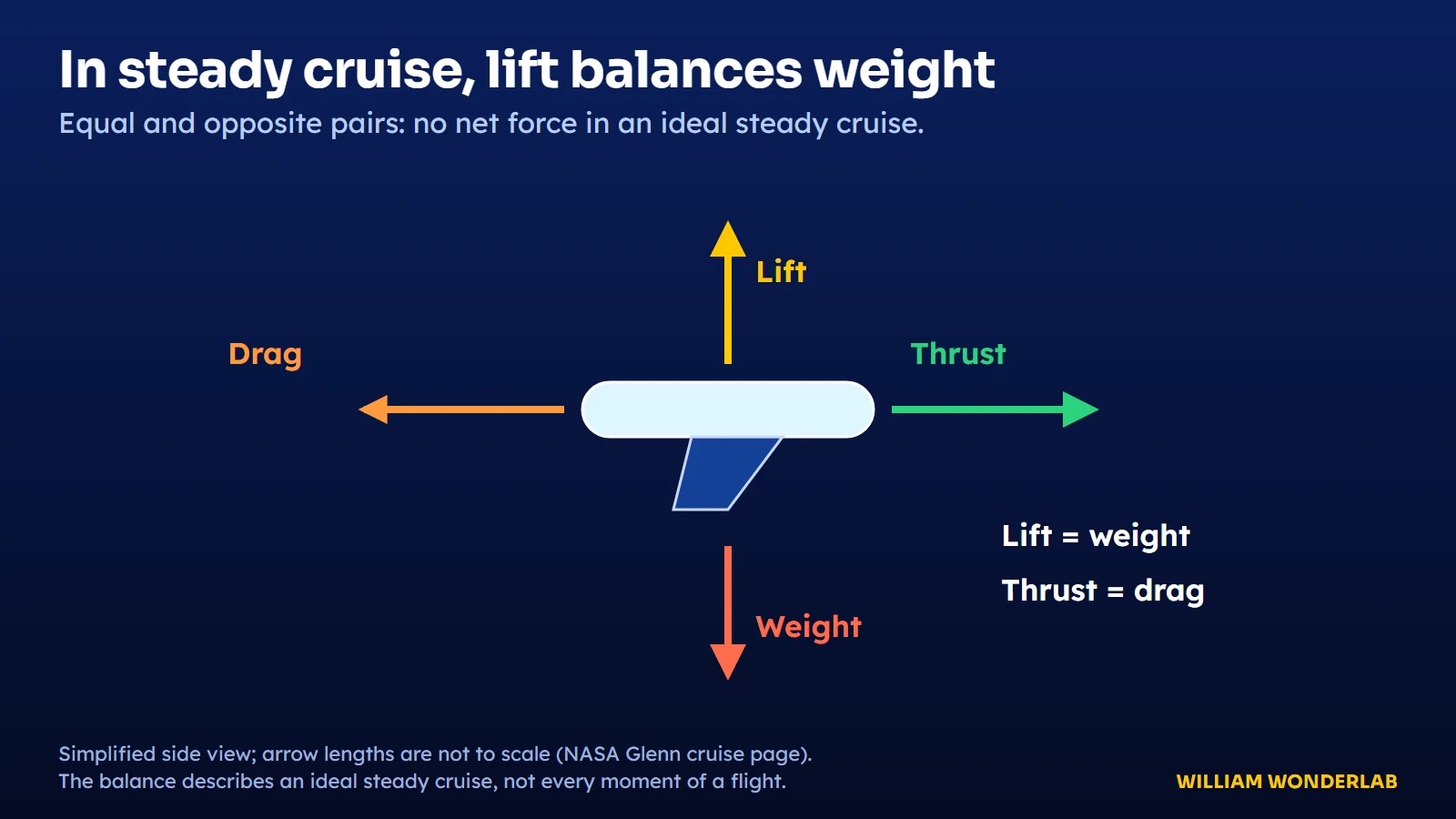
The word “ideal” matters. This is a simple model of a plane flying straight at a steady speed, not a description of every moment of a flight.
Everyday comparisons
These comparisons are analogies to help picture action and reaction. They are not measurements.
- A swimmer’s arms. Pushing water backward moves a swimmer forward. The water pushes back, just as the air pushes the wing up.
- A ball thrown from a skateboard. Throwing the ball forward pushes the skateboarder backward. Action and reaction, again.
Go deeper: forces and flow
Why balanced forces matter
When lift and weight are equal and opposite, the aeroplane’s upward and downward pushes cancel. NASA’s cruise description calls this a case where there is “no net external force.”[2] An aeroplane in this condition keeps the same height. If lift were smaller than weight, the net force would point down. NASA’s pages do not put that last step in words, so treat it as a reasoning step from the balance above rather than a sourced quote.
What “turning the flow” means
Imagine a stream of air hitting the underside of a wing and leaving it heading down. The wing has changed the air’s direction. NASA says that “the flow is turned in one direction, and the lift is generated in the opposite direction, according to Newton’s Third Law of action and reaction.”[1] Changing the direction of moving air takes a force, and the air pushes back with an equal and opposite force.[3]
Frequently asked questions
Does lift come only from the air pushing up underneath the wing?
No. NASA says that for an aircraft wing, both the upper and lower surfaces contribute to turning the flow.[1]
Do wings work because the air over the top has to speed up to catch up?
No. NASA calls the “Equal Transit Time” explanation incorrect and reports that particles over the top arrive at the trailing edge before particles below.[4]
What does lift have to match in steady flight?
Weight. NASA defines weight as the force of gravity acting on the aeroplane.[6]
Is lift always equal to weight?
Not always. NASA describes the equal balance as the case for an aeroplane in an ideal steady cruise, when lift equals weight and thrust equals drag.[2]
Is it Newton’s third law or Bernoulli’s equation that explains lift?
NASA’s main explanation is that a wing turns the flow of air, with Newton’s third law explaining the reaction.[1][3] NASA also warns about the mistakes made when Bernoulli’s equation is misapplied.[5]
The big idea
Wings turn air down, and the air pushes them up. That upward push is lift. When lift balances weight, an aeroplane can fly straight and level at a steady speed.
Related reading
More from William Wonderlab:
Explore more from scientists:
- What Is Lift? (NASA Glenn Research Center)
- Incorrect Lift Theory (NASA Glenn Research Center)
- Airplane Cruise: Balanced Forces (NASA Glenn Research Center)
References
[1] NASA Glenn Research Center, “What Is Lift?” (accessed 25 October 2026)
[2] NASA Glenn Research Center, “Airplane Cruise: Balanced Forces” (accessed 25 October 2026)
[3] NASA Glenn Research Center, “Newton’s Laws of Motion” (accessed 25 October 2026)
[4] NASA Glenn Research Center, “Incorrect Lift Theory” (accessed 25 October 2026)
[5] NASA Glenn Research Center, Bernoulli and lift page (Virtual Aeronautics, Bottle Rocket section) (accessed 25 October 2026)
[6] NASA Glenn Research Center, “Determining Aircraft Weight” (accessed 25 October 2026)