How Do Kangaroos Hop So Far?
Kangaroos store energy in springy tendons in their back legs. As they hop faster, posture changes may help keep the energy cost steady.

A kangaroo bounding across a paddock is one of the most striking sights in Australia. Its back legs are long, its tail swings for balance, and it seems to travel a long way with each hop. You might expect moving this fast to need a lot of energy. So how does a kangaroo manage it?
The short answer: Kangaroos hop using springy tendons in their back legs, especially the Achilles tendons above the heel. The tendons stretch when the kangaroo lands, store energy, and return it when the kangaroo pushes off. A 2025 study found that as kangaroos hop faster, they crouch more, which loads the tendons more and stores more energy. The authors suggest this may help explain why the energy cost of hopping stays steady.[1][2]
Tendons work like springs
Tendons are the tough cords that join muscles to bone. Some tendons can also stretch and spring back, like a rubber band. Scientists describe this as elasticity. The kinds of stored energy involved are often called elastic strain energy: energy kept in a material when it is stretched.
Researchers McGowan, Skinner and Biewener, who studied the legs of kangaroos and wallabies, describe the key feature. Larger macropods, the family that includes kangaroos and wallabies, “are capable of storing substantial amounts of elastic strain energy in their long, relatively thin Achilles tendons.”[2] Their analysis concludes that the major ankle extensor muscles, which pull on those tendons, “likely play the predominant role in elastic strain energy storage and recovery during hopping.”[2]
The 2025 eLife study describes the same cycle in plain terms. As a kangaroo lands, “kinetic and gravitational potential energy was converted to elastic potential energy.”[1] Kinetic energy is the energy of moving, and gravitational potential energy is the energy an object gains from height. Some of that energy is stored in the tendon, and when the kangaroo pushes off, the tendon springs back and helps launch the next hop.
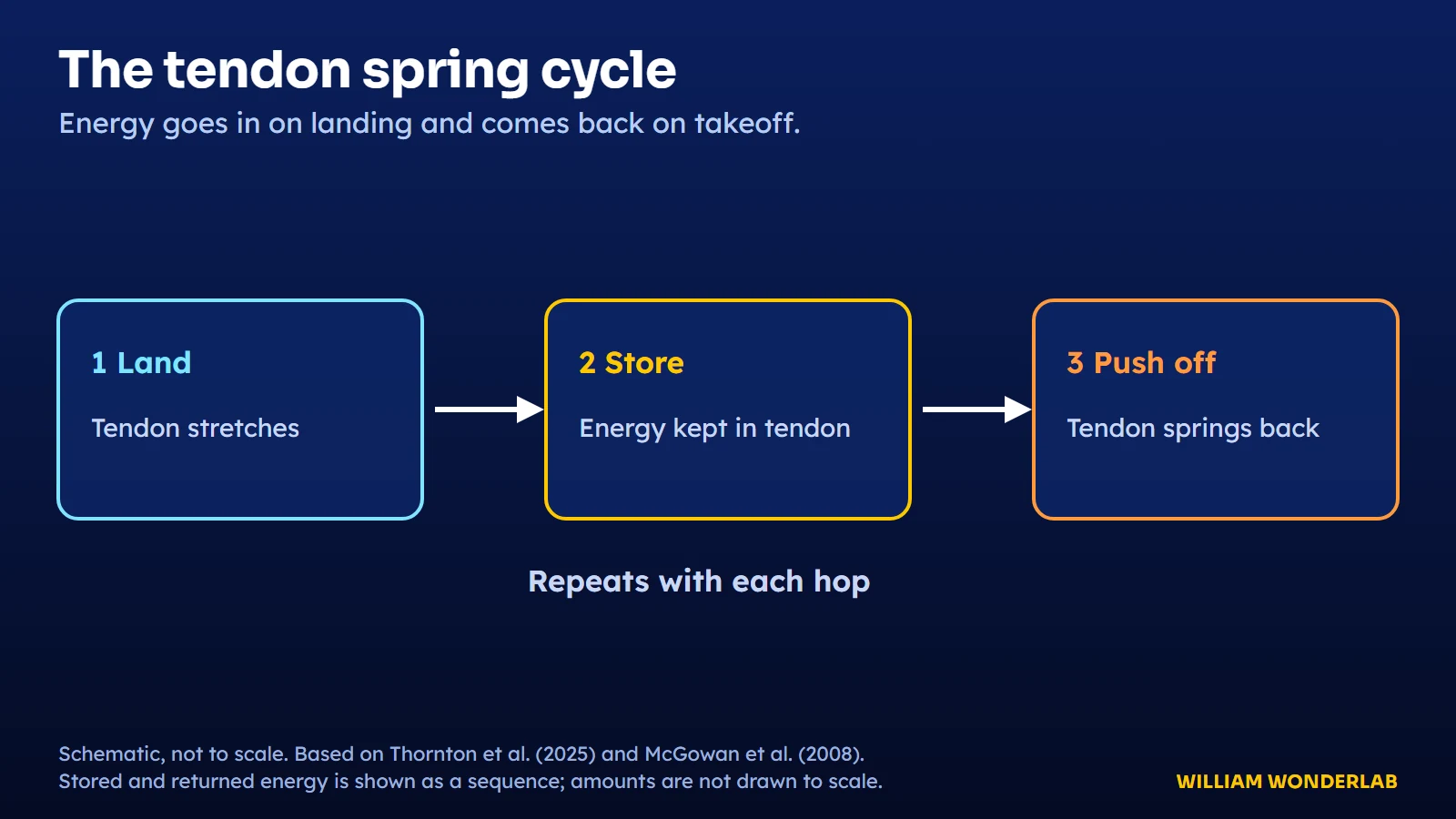
Did you know? The energy stored in a tendon is not created from nothing. It comes from the kangaroo’s movement and height as it lands, and it is returned as the kangaroo pushes off again.[1]
Why the energy cost stays steady
You might expect that going faster would use much more energy. For many animals, it does. For kangaroos, researchers have long reported the opposite. The 2025 study opens with this puzzle: “Hopping kangaroos exhibit remarkably little change in their rate of metabolic energy expenditure with locomotor speed.”[1]
Metabolic energy expenditure means the rate at which the body uses energy. So the puzzle is that a kangaroo does not burn much more energy each second when it hops faster. The 2025 study did not measure energy use itself. Its metabolic claims rely on earlier studies of kangaroo oxygen use, and the study set out to explain why the pattern happens.[1]
Posture changes the spring
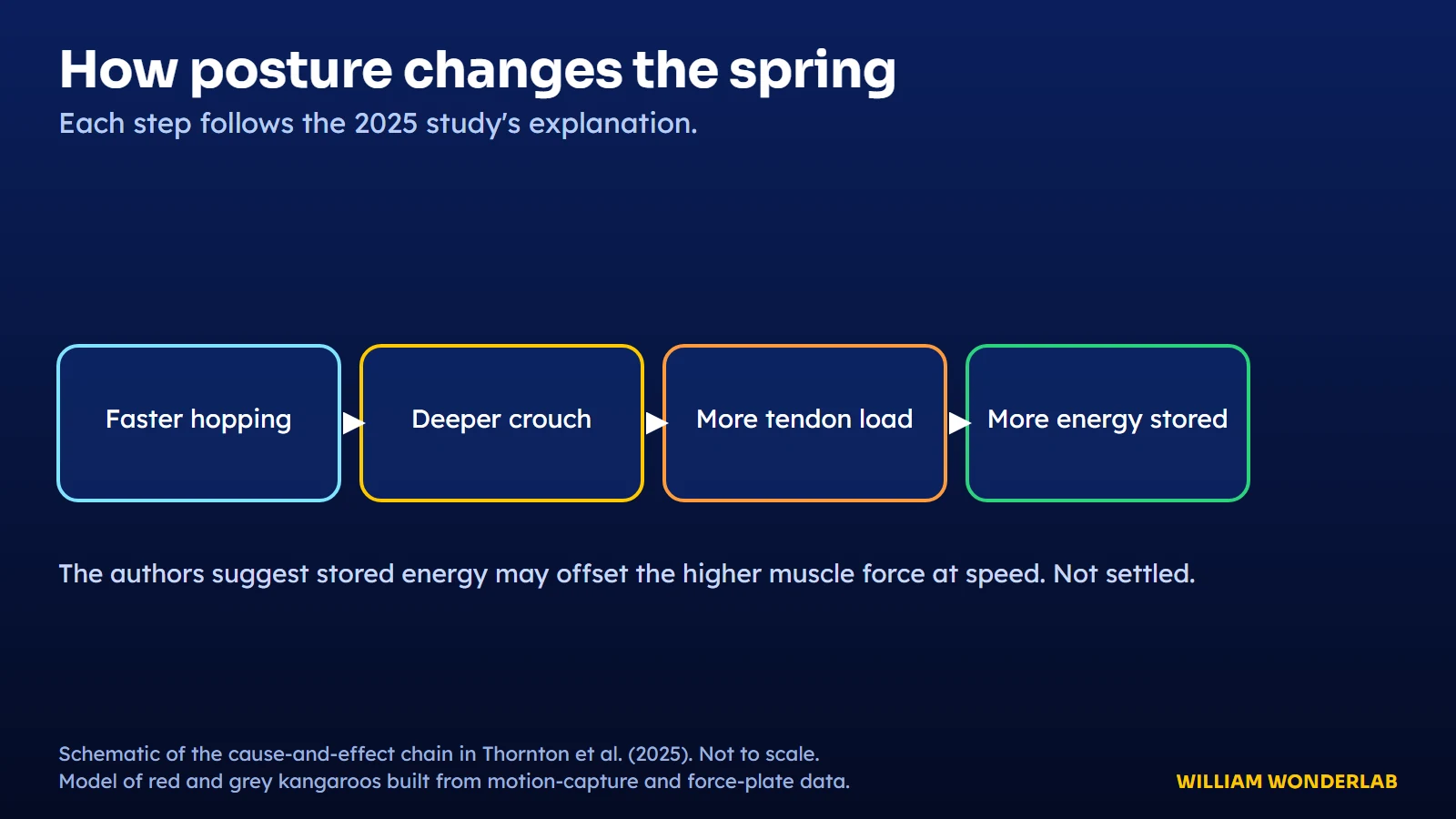
The authors point to the kangaroo’s posture as one explanation. The study reports that “greater masses and faster speeds were associated with more crouched hindlimb postures.”[1] A crouched hindlimb means the joints of the back leg, particularly the ankle and the foot, bend more.
The researchers, from the University of the Sunshine Coast, built a three-dimensional computer model of kangaroos from motion-capture and force-plate data.[1][3] In the model, a deeper crouch changes the leverage at the ankle. That raises the load on the Achilles tendon, so the tendon stores more energy on each hop.[1] Importantly, the authors found that “net ankle work did not change,” so the stored energy is not simply the ankle doing more work.[1]
The authors suggest that the stored energy may help offset the cost of faster hopping, which needs stronger muscle force. This part of the explanation is not settled. Peer reviewers were not fully convinced: one wrote that the authors “oversell their findings, but the mystery still persists.”[4]
Did you know? The main ankle extensors are thought to be the key players. McGowan and colleagues say that these muscles “likely play the predominant role in elastic strain energy storage and recovery during hopping.”[2]
Why bigger kangaroos may face limits
The same springs that help a kangaroo hop efficiently may have limits. The 2025 study says that posture-driven tendon loading “may limit the performance of large kangaroos due to the risk of tendon rupture.”[1] A tendon that carries more load is at greater risk of tearing if it is pushed too far.
A 2017 study of the western grey kangaroo, Macropus fuliginosus, found that “large kangaroos store and recover more strain energy in their tendons.”[5] The same study reports that the strain energy return capacity of the ankle tendons increases with body size, with a mean exponent of about 1.0.[5] An exponent is a number that tells you how one quantity grows with another. An exponent of 1.0 means the two grow in close to direct proportion.
The 2025 authors also suggest that this mechanism may restrict how large a hopping kangaroo can become: the posture-based efficiency is “likely limiting the maximum body mass that hopping kangaroos can achieve.”[1]
Try it: bounce a ball
A bouncy rubber ball is not a kangaroo, and it does not show tendon physics. But it is a handy way to think about how something can store energy and give it back.
You need: a bouncy rubber ball, a measuring tape, a hard floor, and a notebook.
- Clear the area so there is nothing breakable nearby, and stand in a clear space.
- Hold the ball at shoulder height and drop it straight down onto the hard floor. Watch how high it comes back up.
- Repeat the drop three times, then measure how high the ball rebounds on average.
- Drop the ball from knee height and repeat step 3.
- Write down what changed between the two drops. Ask yourself: what could make the ball bounce higher?
What to expect: The ball rebounds from the floor each time. Keep notes on the heights and compare them; the bounce is an analogy for the spring, not a kangaroo test.
Safety first: Do this with a grown-up nearby. Use a soft, light ball and drop it only, never throw it. Keep clear of windows, lamps, glass and stairs. Do not do this on a wet or slippery floor, and never stand on a chair or table to drop the ball.
Go deeper: the science in more detail
How a computer model helps
The 2025 study used a model to connect what it measured to what the tendon does. Models are useful because they let researchers change one feature at a time, such as the crouch, and see what happens to the tendon load. The study describes the model as built from motion capture and force-plate data.[1] Future measurements may refine these results, as any model can be tested against new data.
Scaling up
Snelling and colleagues measured how the ankle tendons scale with body mass in the western grey kangaroo. They report that the strain energy return capacity “increases with a mean exponent of ~1.0,” and they compare this with a steeper exponent in other hopping mammals.[5] This is why the question of size matters: bigger animals may gain stored energy, but they also face greater tendon loads.[1][5]
Frequently asked questions
Do kangaroos really use their tendons like springs?
Scientists describe the long Achilles tendons of large macropods as able to store substantial amounts of elastic strain energy. McGowan and colleagues made this point in 2008.[2]
Does a kangaroo get more tired when it hops faster?
The 2025 study did not measure tiredness or energy use directly. Its metabolic claims rely on earlier treadmill and oxygen studies of kangaroos, which found little change in energy use with speed.[1]
Why do kangaroos crouch when they go faster?
The study found that faster speeds were associated with more crouched hindlimb postures, which appear to raise tendon load and the energy stored per hop.[1]
Could a much bigger kangaroo hop as well as a small one?
Researchers suggest there may be limits. The 2025 study says large kangaroos may face a risk of tendon rupture, and that the mechanism may limit the maximum body mass that hopping kangaroos can achieve.[1]
Is the posture explanation proven?
No. It is a suggested explanation from a 2025 study that used a model rather than direct measurements of energy use. Peer reviewers questioned parts of it, so later work may change the picture.[1][4]
The big idea
Kangaroos hop like spring-loaded toys. Their Achilles tendons store energy as they land and return it as they push off. As they speed up, their posture changes may load the tendons more, which could help explain why the energy cost of hopping stays steady. The same springs may limit how large a kangaroo can grow.
Related reading
More from William Wonderlab:
Explore more from scientists:
- Postural adaptations may contribute to the unique locomotor energetics seen in hopping kangaroos (eLife, 2025)
- Hind limb scaling of kangaroos and wallabies (Journal of Anatomy, 2008)
- Scaling of the ankle extensor muscle-tendon units in the post-pouch kangaroo (Journal of Anatomy, 2017, University of Western Australia repository)
References
[2] McGowan, C. P., Skinner, J. and Biewener, A. A., “Hind limb scaling of kangaroos and wallabies (superfamily Macropodoidea): implications for hopping performance, safety factor and elastic savings”, Journal of Anatomy 212(2) (2008), 153-163 (accessed 25 October 2026)
[3] University of the Sunshine Coast, Queensland, research record for Thornton et al., “Postural adaptations may contribute to the unique locomotor energetics seen in hopping kangaroos” (2025) (accessed 25 October 2026)
[4] eLife, peer reviews for the reviewed preprint of Thornton et al., “Postural adaptations may contribute to the unique locomotor energetics seen in hopping kangaroos” (reviewer 1 comment) (accessed 25 October 2026)