What Is a Nebula?
A nebula is a giant cloud of gas and dust in space. Some nebulae glow, some reflect starlight and some block the light behind them.
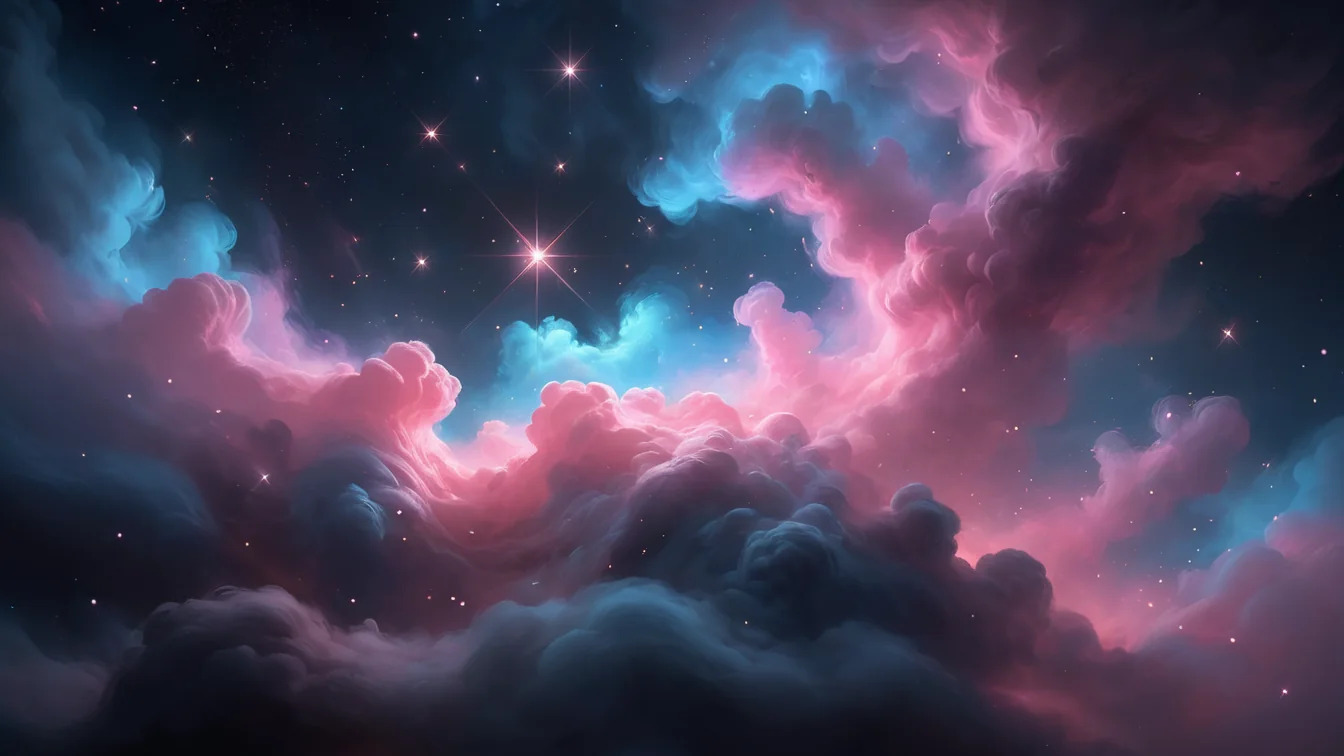
Astronomers use the word nebula for many different objects in space, and they do not all look the same. Some are bright and colourful. Others look like dark patches cut out of the starry background. So what is a nebula, and why do some glow while others hide the light behind them?
The short answer: A nebula is a giant cloud of gas and dust in space.[1] Some nebulae glow on their own, some scatter the light of nearby stars, and some are dark clouds that block the light behind them.[2][3][4] Many nebulae are also places where new stars form.[1][5]
What a nebula is
A nebula is a giant cloud of dust and gas in space.[1] Here, gas means invisible material that fills the space between stars. Dust means tiny solid specks, a little like the fine powder you can see floating in a sunbeam at home.
Clouds like these are very large. Stars form in large clouds of gas and dust called molecular clouds.[5] NASA says these clouds range from 1,000 to 10 million times the mass of the Sun, and they can span as much as hundreds of light-years.[5] A light-year is the distance that light travels in one year.
Three ways a nebula shows up
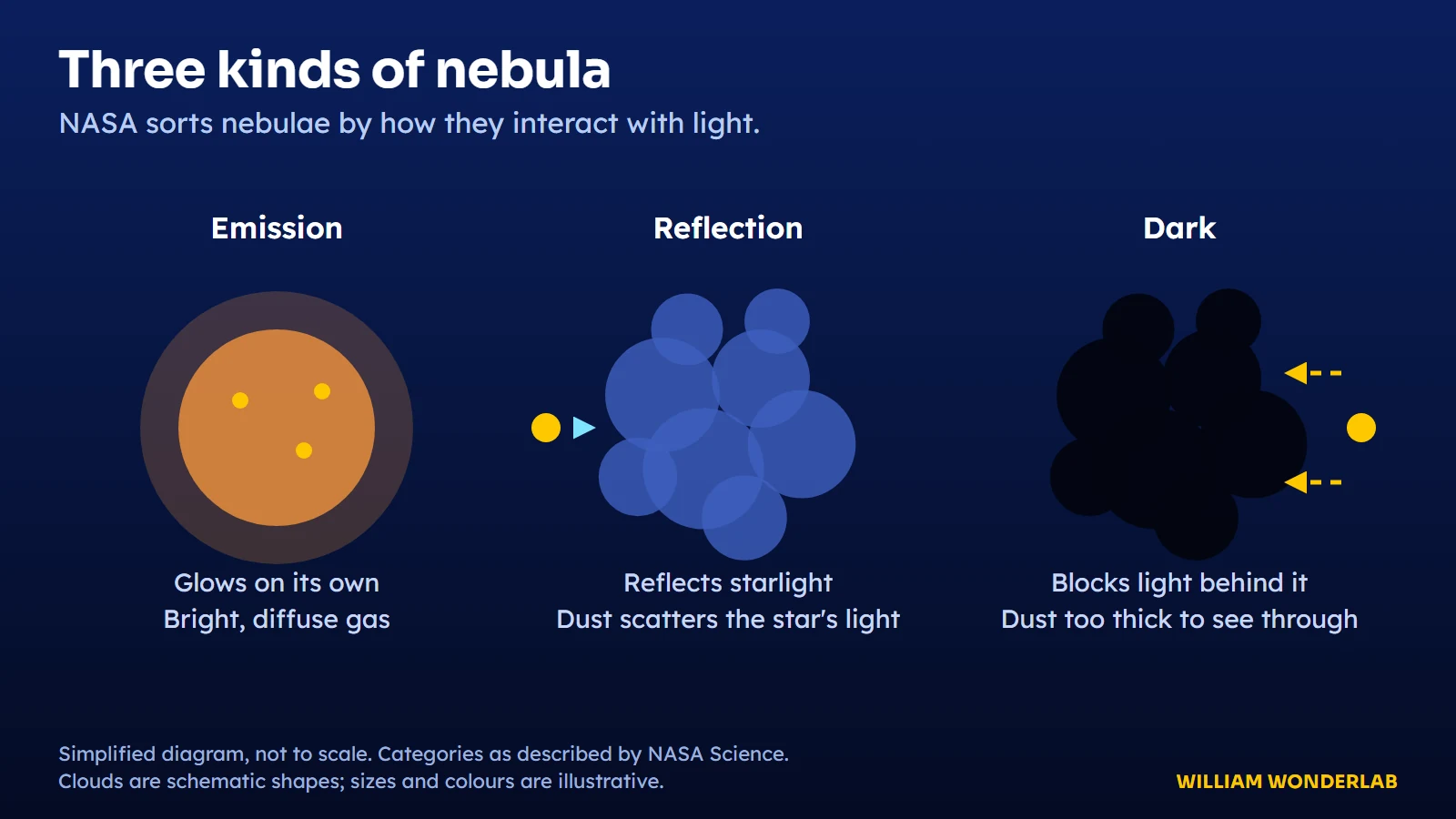
Scientists sort nebulae by how they deal with light. NASA’s Science pages describe three main kinds.[2]
Glowing nebulae
Emission nebulae are bright, diffuse clouds of ionised gas that emit their own light.[2] Diffuse means spread out and soft, rather than having a sharp edge. The light comes from the gas itself.
Reflecting nebulae
Some nebulae scatter the light of stars hiding in or near them. These are called reflection nebulae.[2] NASA’s Hubble image of the reflection nebula NGC 1999 explains that such a nebula “shines only because the light from an embedded source illuminates its dust”.[3]
A simplified picture is a dusty sheet lit by a torch. The sheet is not making its own light. It is bouncing back light that came from somewhere else.
Dark nebulae
Some nebulae contain dust so thick that the visible light from young stars behind them cannot get through.[2] NASA calls these dark nebulae, also known as absorption nebulae. They are “clouds of gas and dust that neither emit nor reflect light, instead blocking light coming from behind them.”[4]
Where stars are born
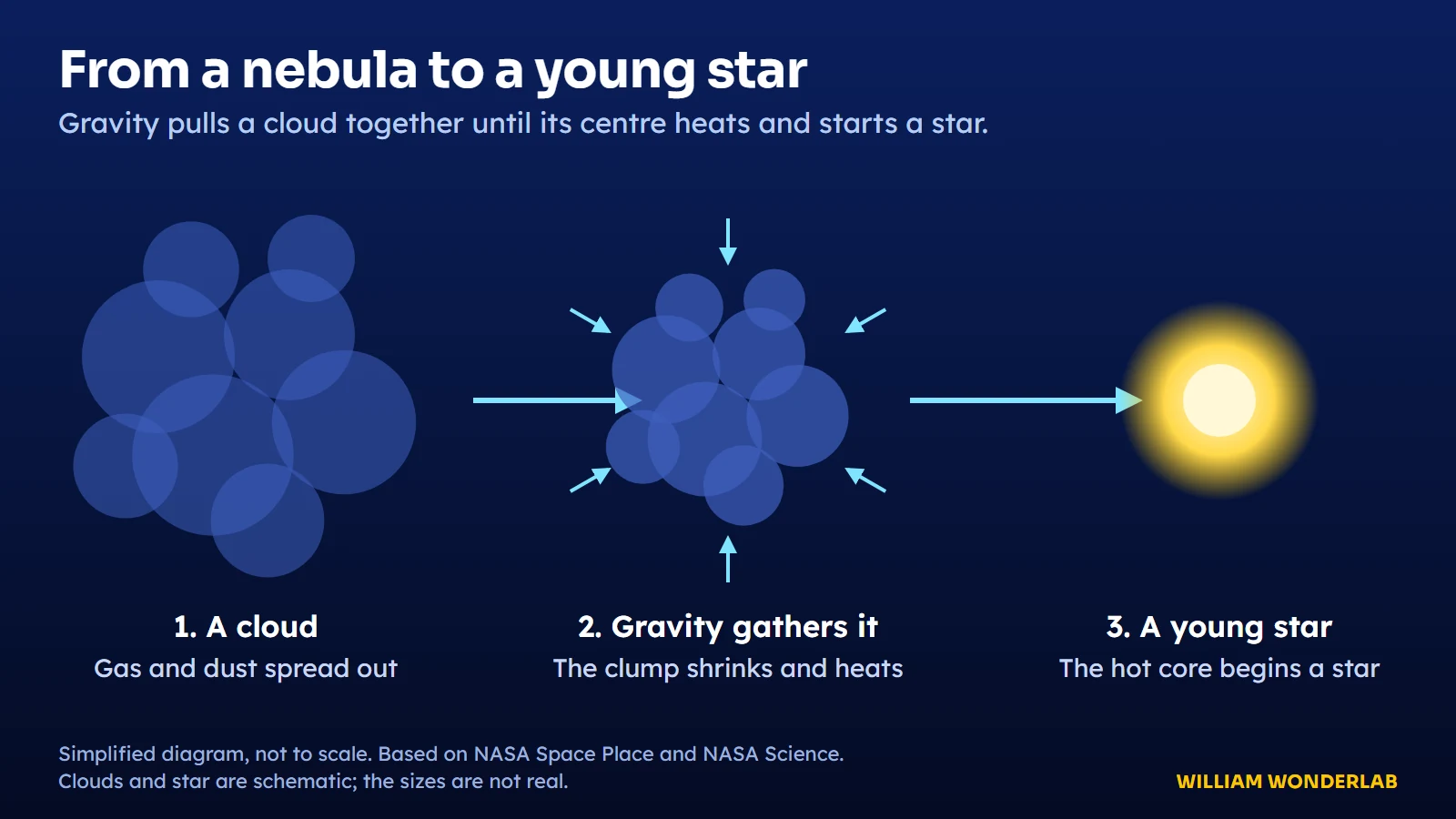
Many nebulae are star nurseries. NASA’s Space Place page says: “Other nebulae are regions where new stars are beginning to form.” For this reason, some nebulae are called “star nurseries.”[1]
Here is the simplified process. Gravity pulls on the gas and dust in a cloud. NASA describes what happens next: “Eventually, the clump of dust and gas gets so big that it collapses from its own gravity.”[1] As the clump collapses, its centre heats up, and “this hot core is the beginning of a star.”[1]
A simplified picture is a big, fluffy heap of snow that slowly packs down into a dense ball under its own weight. The clump gets denser as the material gathers.
The Sun has a nursery story too. NASA’s Decoding Nebulae page says: “Over 4.5 billion years ago, some gas and dust in a nebula clumped together due to gravity, and a baby Sun was born.”[2]
Not every nebula is a nursery. NASA’s Stars page describes a different kind of nebula: “Eventually, all the star’s outer layers blow away, creating an expanding cloud of dust and gas called a planetary nebula.”[5]
Try it: a dusty torch beam
This is a proposed at-home activity and a simulation of dust scattering light. It is a model, not a real nebula, and it does not show what a nebula looks like.
You need: a clear glass, cool tap water, a few drops of milk, a torch and a dark room.
- Fill the glass with water. Predict whether you will see the torch beam from the side of the glass.
- Add a few drops of milk and stir gently. Shine the torch through the side of the glass in the dark room.
- Compare the beam with plain water. Write down what the milk seems to do to the beam.
What to expect: the milky water should show a faint glow along the path of the beam. This is a rough model of dust scattering light, as in a reflection nebula.
Safety first: Use a torch, not a laser pointer, and never shine it into anyone’s eyes. Keep the glass on a steady surface away from the edge of the bench, and wipe up spills straight away. Do not drink from the glass afterwards. A grown-up should help with the torch and its batteries. If the torch uses button batteries, keep them well out of reach of young children.
Go deeper: the mass arithmetic
Comparing the lightest and heaviest clouds
NASA’s range runs from 1,000 to 10 million times the mass of the Sun.[5] The top of that range is 10,000 times the bottom:
- 10,000,000 ÷ 1,000 = 10,000
So the heaviest cloud in that range can hold 10,000 times as much material as the lightest one. These are rough ranges for molecular clouds in general, not measurements of one particular cloud.
Frequently asked questions
Is a nebula the same thing as a star?
No. A nebula is a cloud of gas and dust. NASA’s Space Place says the hot core of a collapsing clump is the beginning of a star.[1]
Do all nebulae glow?
No. Emission nebulae glow on their own. Reflection nebulae shine only because they scatter light from stars in or near them, and dark nebulae neither emit nor reflect light.[2][3][4]
Are nebulae where stars are born?
Some are. NASA says that nebulae can be nurseries forming new baby stars.[2]
Does a dark nebula make its own light?
No. A dark nebula neither emits nor reflects light. It blocks the light coming from behind it.[4]
Did the Sun come from a nebula?
NASA’s Decoding Nebulae page says that over 4.5 billion years ago, some gas and dust in a nebula clumped together, and a baby Sun was born.[2]
The big idea
A nebula is a cloud of gas and dust. Some glow, some bounce starlight back and some block the light behind them. Many are where new stars are born, as gravity pulls their gas and dust together.
Related reading
More from William Wonderlab:
- Why Do Stars Twinkle?
- What Is the Milky Way?
- Why Do Some Stars Look Red and Others Blue?
Explore more from scientists:
References
[1] NASA Space Place, “Nebula” (accessed 26 October 2026)
[2] NASA Science, “Decoding Nebulae” (accessed 26 October 2026)
[3] NASA Science, “Reflection Nebula NGC 1999” (accessed 26 October 2026)
[4] NASA Science, “Hubble Images Dark Nebula Cloaking Stars Within Dusty Depths” (accessed 26 October 2026)
[5] NASA Science, “Stars” (accessed 26 October 2026)