How Do Hydro Dams Make Electricity?
Water held high behind a dam can turn into electricity. Here is the path the water takes, from the reservoir to the generator.

A coal-fired power plant burns coal to heat water into steam, but a hydro dam does not burn fuel. As the USGS puts it, a hydroelectric plant “uses falling water to turn the turbine.”[1] It uses water that is already sitting high in the landscape and lets gravity pull it down through machines that make power.
The short answer: A dam holds back a large reservoir of water. When gates open, water falls through a pipe called a penstock and pushes on a turbine. The turbine turns a generator, and the generator converts that motion into electrical energy.[1][2][3]
Water held high behind a wall
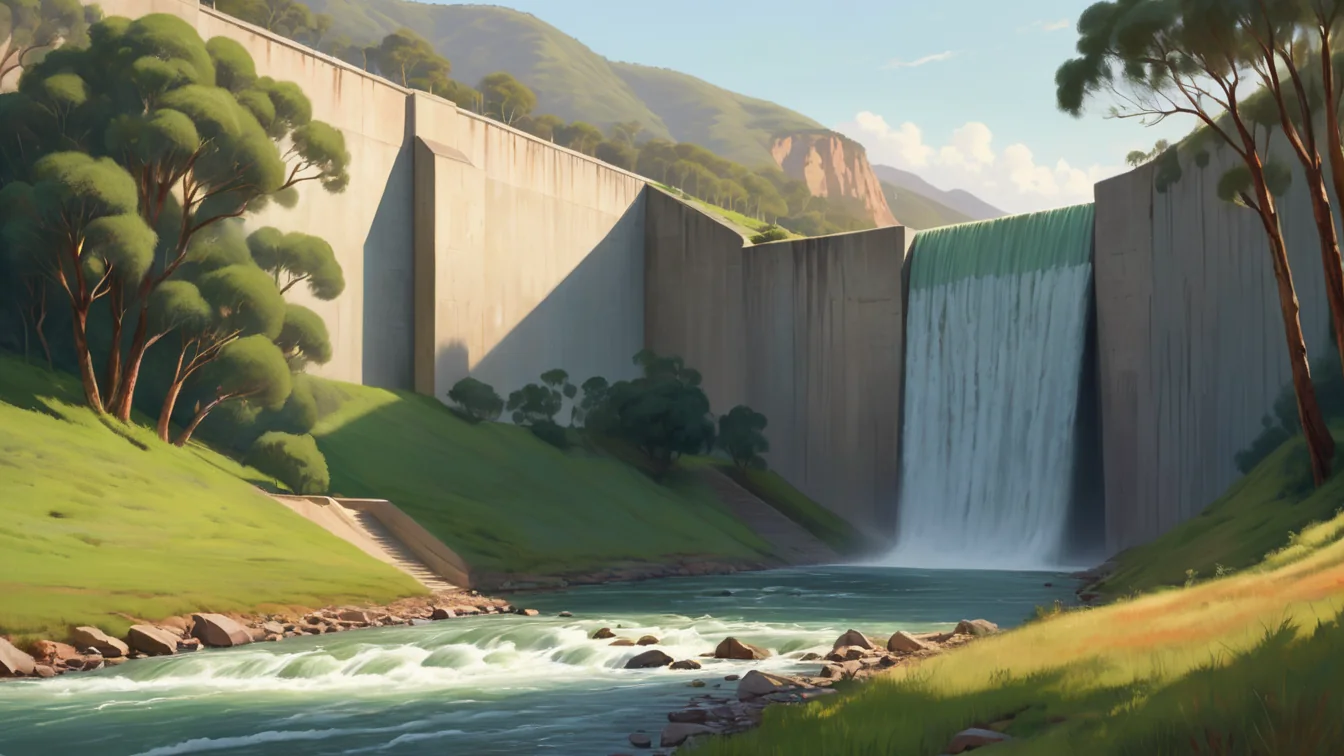
A dam is a wall built across a river valley. The USGS explains it simply: “The dam stores lots of water behind it in the reservoir.”[1] The lake that forms behind the wall is the reservoir.
The water in a reservoir is higher than the water downstream, and that height is the key. The USGS adds that “Gravity causes it to fall through the penstock inside the dam.”[1]
Falling water turns height into motion
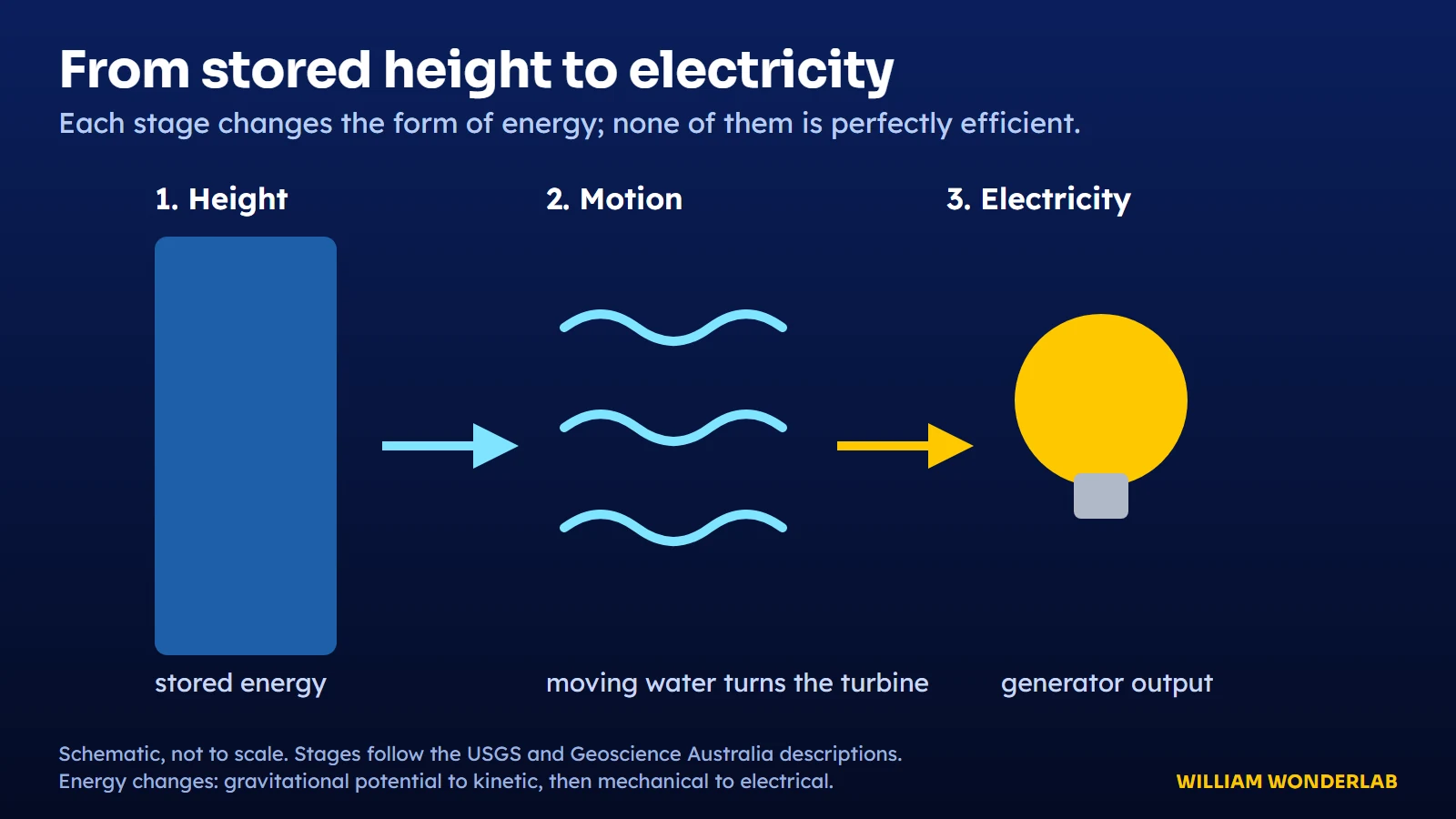
Water high up has stored energy because of its height. Physics calls this gravitational potential energy. OpenStax physics, published through LibreTexts, says that “Gravitational potential energy may be converted to other forms of energy, such as kinetic energy.”[4] Kinetic energy is the energy of movement.
As water falls, its stored energy becomes movement. The same OpenStax text explains that releasing a mass lets gravity do work on it, which increases its kinetic energy by the same amount.[4] A simple way to picture this is a ball dropped from a shelf. The higher it starts, the faster it is moving when it lands.
Turbine and generator
At the bottom of the penstock, the moving water pushes on the blades of a turbine. The USGS describes the turbine as a propeller-like piece that the moving water turns.[1]
The turbine is joined by a shaft to a generator. Geoscience Australia explains that “The pressure of the flowing water on the turbine blades causes the shaft to rotate and the rotating shaft drives an electrical generator which converts the motion of the shaft into electrical energy.”[3]
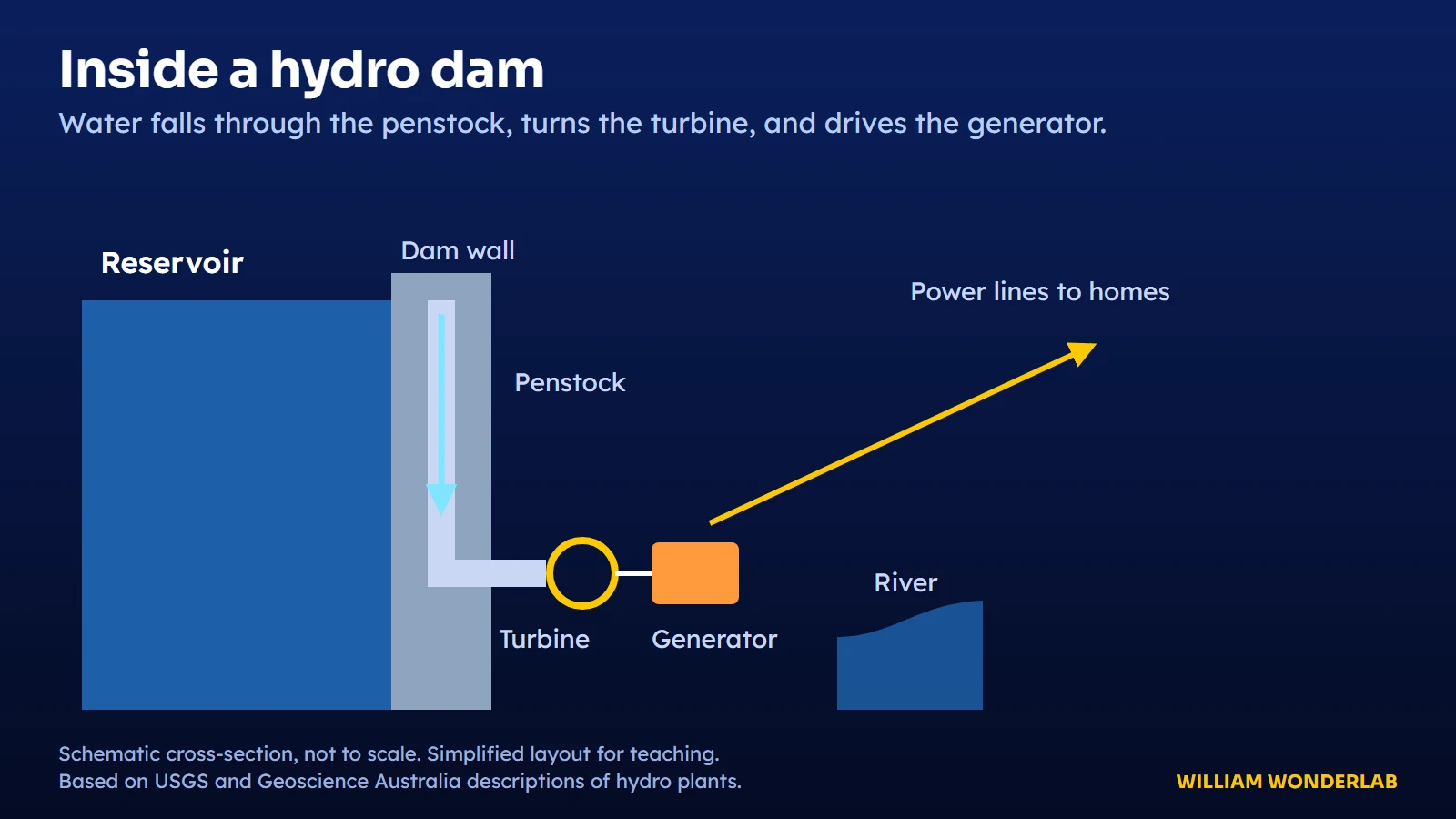
So the chain has three steps: stored height becomes moving water, moving water turns the turbine, and the turbine’s spin is converted into electricity. Power lines connected to the generator then carry the electricity onward.[1]
Why flow and height both matter
The amount of electricity depends on how much water flows and how far it falls. The US Department of Energy describes this as the change in elevation, called the head. In its words, “The greater the flow and the higher the head, the more the electricity that can be generated.”[2]
An Australian example: the Snowy Mountains Scheme
Australia has large hydro systems, and one of the best known is the Snowy Mountains Hydro-Electric Scheme. A 1986 feature article by the Australian Bureau of Statistics describes the proposals being implemented at that time as falling into two groups, the Tumut Development and the Snowy-Murray Development. Each group had its own plans for hydro-electric power production.[5]
The same article says that the Snowy River “has never been controlled in any way, either for the production of power or for irrigation, and a great proportion of its waters flow to waste into the sea.”[5] It also says that regulation is “essential if the waters impounded are to be fully utilized for irrigation purposes.”[5] Dams therefore do more than make power: they also store water for other uses.
Try it: a paper-cup water wheel
This is a proposed at-home activity. It is a simplified model of a turbine, not a power generator, and it does not make electricity.
You need a small plastic tub or a washing-up bowl, a few paper cups, a pencil, a cup of water, and a kitchen sink or a tray to work over.
- Push a pencil through the middle of a paper cup so it sits like a shaft, then tape or tie a few more cups around the edge of the pencil.
- Rest the pencil across two stacked books on the edge of the tray, so the cups can spin freely.
- Slowly pour water from a small height onto the cups, and watch which way the wheel turns.
- Try a higher pour and a lower pour, and compare how fast the wheel spins.
Think about the stored height of the water in the cup and how it becomes movement. That is the first two steps of a dam.
Safety first: Work over a sink or tray, and keep electrical appliances, power points and cords well away from the water. Mop up spills straight away because wet floors are slippery. Use only plastic or paper cups, and ask an adult to help if you are young. Never try this near a real dam, spillway or river outflow, where water flow can be strong and dangerous.
Go deeper: the energy chain and its limits
From height to electricity
Three energy changes happen in a hydro plant. Stored gravitational energy becomes kinetic energy as the water falls.[4] The moving water turns the turbine, which is a mechanical motion.[1] The generator then converts that motion into electrical energy.[3]
Control through gates
Geoscience Australia notes that “Most commonly, water is dammed and the flow of water out of the dam to drive the turbines is controlled by the opening or closing of sluices, gates or pipes.”[3] Because the flow is controlled, operators can decide how much water passes through the turbines at any time.
Frequently asked questions
Do hydro dams burn fuel?
The process described by the USGS and Geoscience Australia uses falling water to turn the turbine, not burning.[1][3]
What is a penstock?
A penstock is a pipe that carries water from the reservoir down to the turbine.[2][3]
What does the turbine do?
The turbine is turned by the moving water. Its spin drives the generator through a shaft, which produces electricity.[1][3]
Why does a higher dam make more electricity?
The energy depends on flow and head. The greater the flow and the higher the head, the more electricity can be generated.[2]
The big idea
Water falling through a dam carries energy from the landscape into the grid. The reservoir stores height, the penstock guides the fall, the turbine turns, and the generator makes electricity.[1][3][4]
Related reading
More from William Wonderlab:
- How Do Wind Turbines Make Electricity?
- How Do Solar Panels Make Electricity?
- How Does Tap Water Get to Your House?
Explore more from scientists:
References
[1] US Geological Survey, “Hydroelectric Power: How it Works”, Water Science School (accessed 26 October 2026)
[2] US Department of Energy, “How Hydropower Works” (accessed 26 October 2026)
[3] Geoscience Australia, “Hydro Energy” (accessed 26 October 2026)
[4] OpenStax, “7.3 Gravitational Potential Energy”, College Physics, via LibreTexts Physics (accessed 26 October 2026)
[5] Australian Bureau of Statistics, “1986 Special Article: The Snowy Mountains Hydro-Electric Scheme, 1986” (accessed 26 October 2026)