Why Is Mars Red?
Mars looks red because iron in its rocks has rusted, and wind lifts that dust into the air. Scientists are still working out exactly which iron oxide it is.
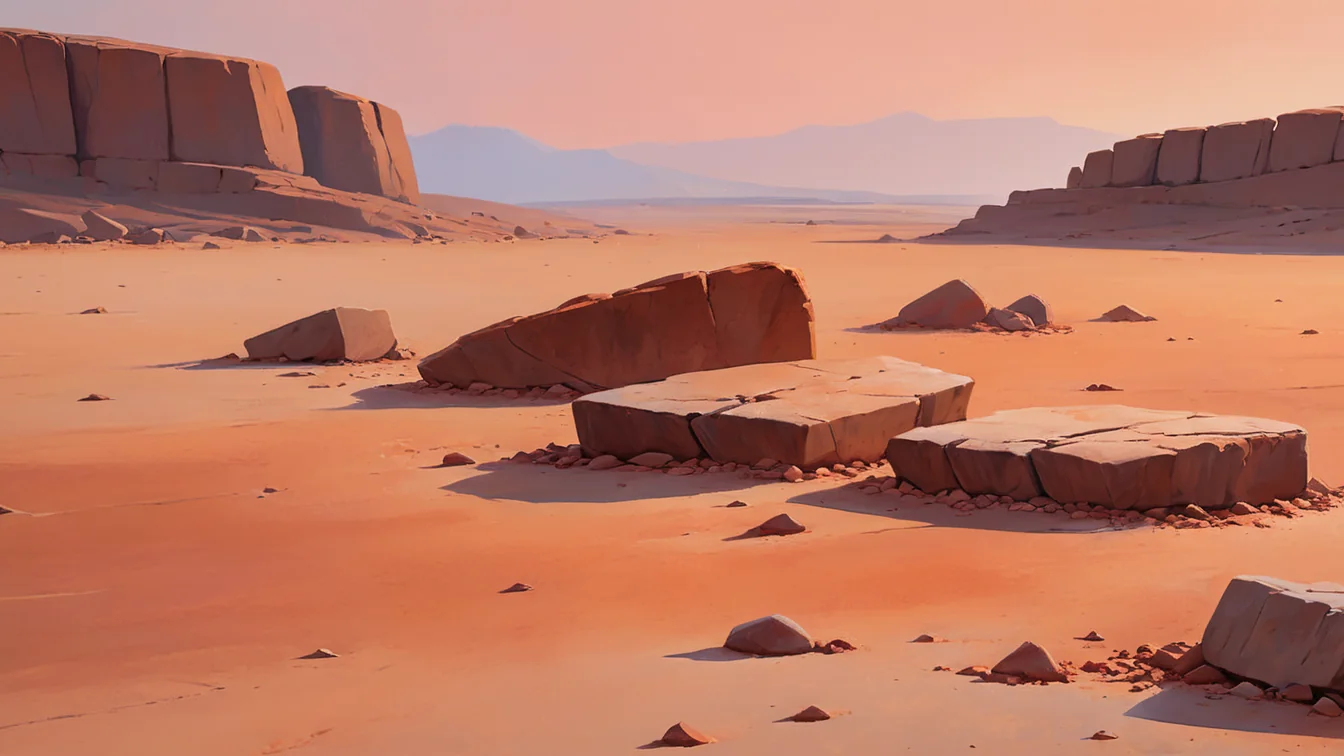
Look at a photo of Mars and it seems to glow orange-red, like a rusty gate. That is no accident. Mars really is a rusty world, and the colour you see is the colour of its dirt.
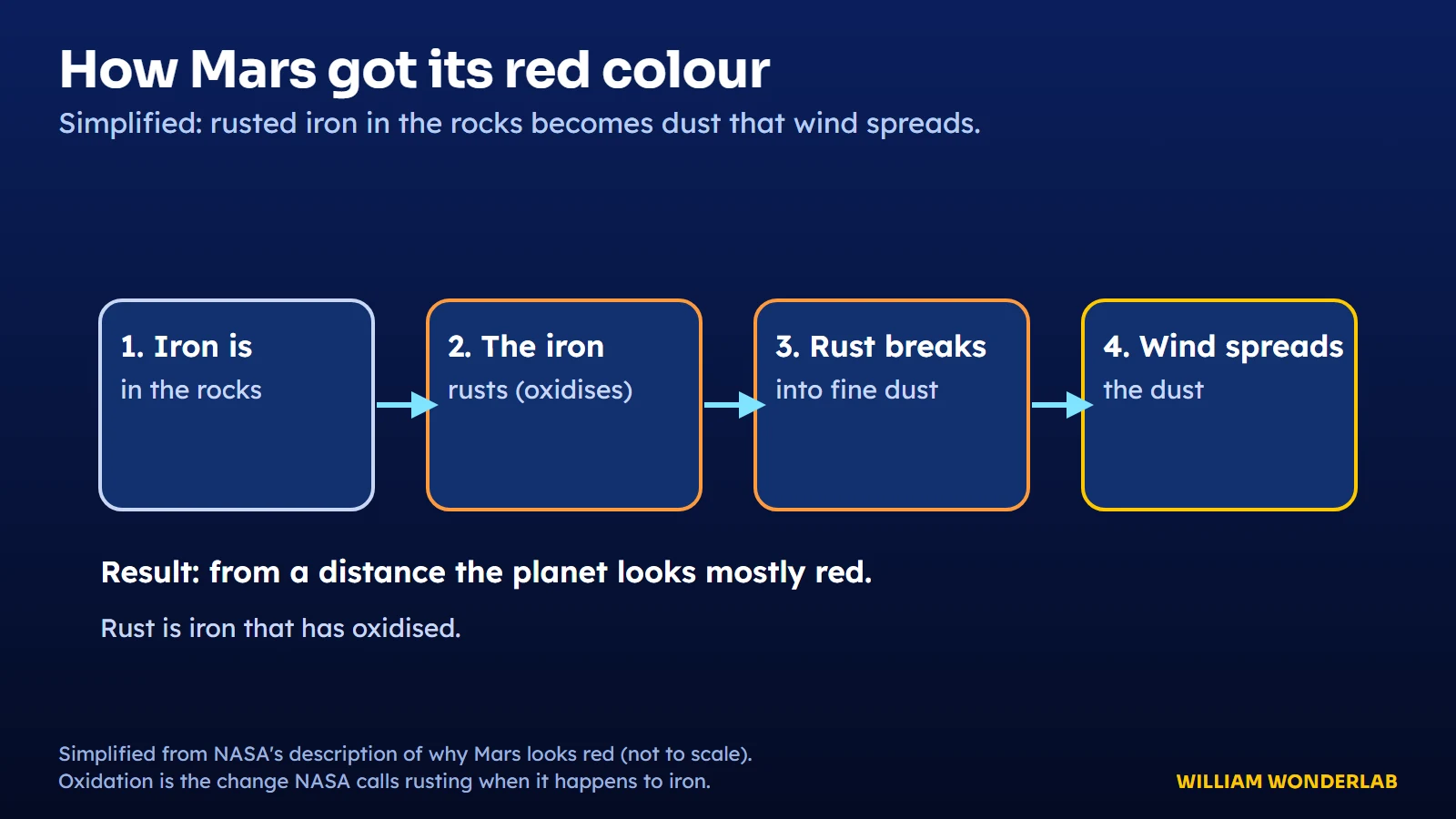
The short answer: Mars is red because iron in its rocks has rusted, and the rusty dust has been spread across the planet by wind. NASA describes this as the oxidation, or rusting, of iron in the rocks, and says the dust makes the planet look mostly red from a distance.[1]
Iron in the rocks
NASA explains the colour in one sentence: “The reason Mars looks reddish is due to oxidization — or rusting — of iron in the rocks.”[1] Oxidation is the word scientists use for iron slowly changing when it meets substances in its surroundings. It is the same change that turns an old garden gate orange.
Iron is common in Martian rock, so the change happened on a large scale. NASA adds that “iron minerals in the Martian dirt oxidize, or rust, causing the surface to look red.”[1]
Rusty dust covers the planet
The rusty material did not stay in one place. Over a very long time it broke down into dirt and dust. NASA says that “this dust gets kicked up into the atmosphere and from a distance makes the planet appear mostly red.”[1]
Wind does the spreading. In 2001, NASA reported a dust storm so large that it “has raised a cloud of dust that has engulfed the entire planet.”[2] A storm like that carries the red dust into every corner of the surface, so the colour looks much the same almost everywhere.
Which rust is it? An open question
Earlier work had considered minerals such as hematite, a dry form of iron oxide, as the cause.[3] In February 2025, a study in Nature Communications argued that a different form fits the evidence better. NASA reports that “this new study suggests one of those iron oxides, ferrihydrite, is the reason for the planet’s color.”[3] ESA adds that “Mars’s red colour is better matched by iron oxides containing water, known as ferrihydrite.”[4]
This matters because ferrihydrite “typically forms quickly in the presence of cool water.”[4] If the dust contains it, the dust may point to a wetter, earlier Mars. ESA also notes that “the exact chemistry of martian rust has been intensely debated.”[4] So the answer to “why is Mars red?” is settled in outline, but the exact chemistry is still being worked out.
How big is Mars?
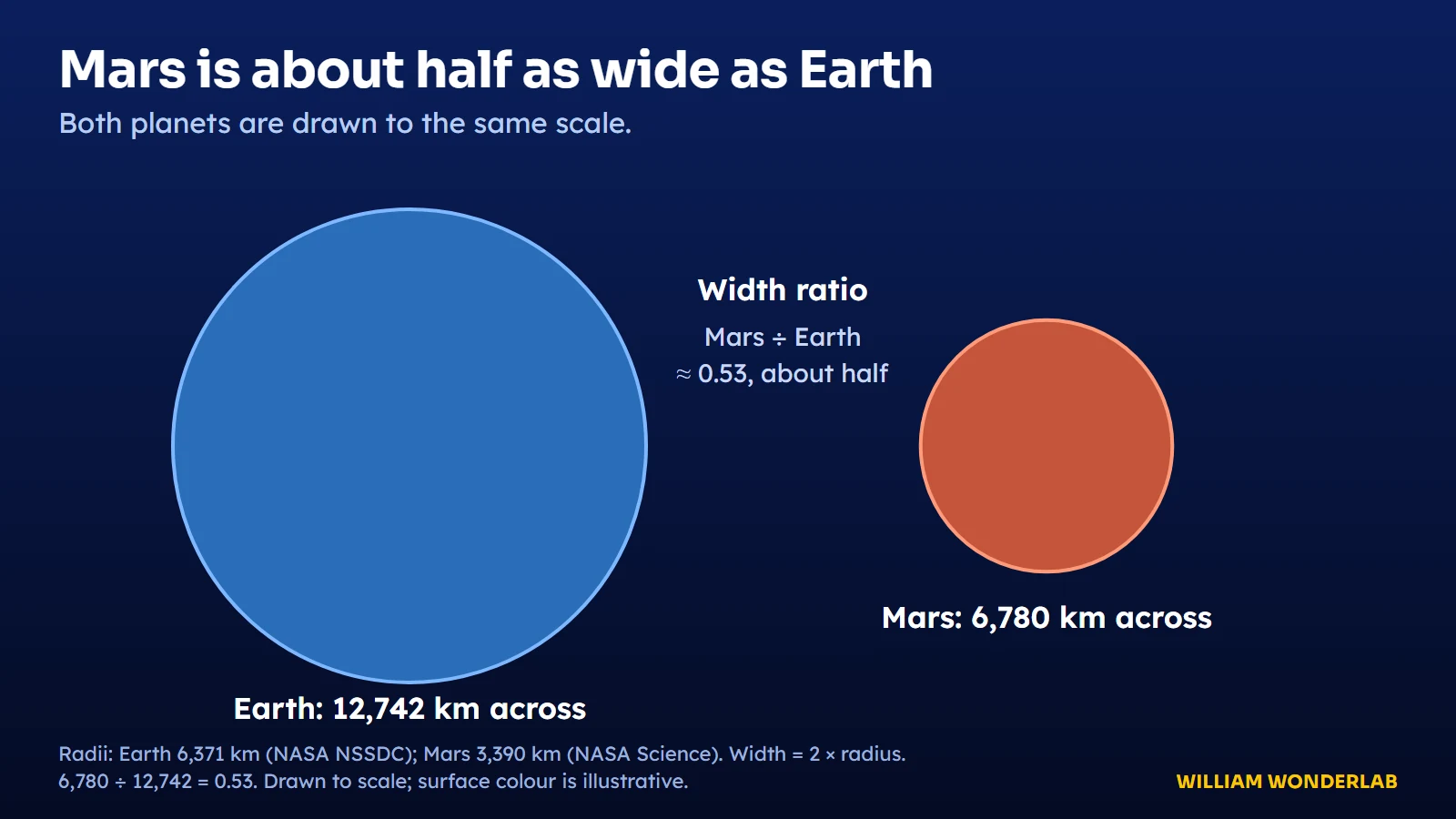
Mars is the fourth planet from the Sun. NASA gives its radius as 3,390 kilometres, and says that it is “about half the size of Earth.”[1]
The arithmetic is simple. Earth’s mean radius is 6,371 kilometres,[5] so its width is about 12,742 kilometres. Mars is about 6,780 kilometres across. Divide one by the other and you get 6,780 ÷ 12,742 ≈ 0.53. Mars is about half as wide as Earth.
Try it: the dirt colour test
This is a proposed at-home activity, and it is an observation, not a test of the chemistry.
You need: a handful of dry soil or sand from different places outside, a sheet of white paper, a magnifying glass and a notebook.
- Predict which sample will look most like Mars.
- Put a small heap of each sample on the white paper, well apart from each other.
- Look at each one with the magnifying glass. Note the colour, and whether it has pale grains, dark grains or red-brown grains.
- Put the samples in order from the reddest to the least red. Did your prediction match?
What to expect: Different soils look different. You may find some that are close to orange-brown. Your results will depend on where you collect them.
Safety first: Do this outside or near an open window, and only with an adult’s permission to collect soil. Do not put soil in your mouth, and wash your hands afterwards. Do not sweep dry dust, which can get into your eyes and lungs; brush up any spills with a damp cloth. Use only the magnifying glass, not a sharp tool, to examine the samples.
Go deeper: the science behind the colour
Why the dust stays in the air
NASA’s dust-storm story describes a cloud raised by the wind that stayed up for months. The 2001 article describes what happened once the storm eased: the planet’s surface cooled, “this allowed the winds to die down and the fine dust to begin settling.”[2] So the dust does not vanish quickly. It hangs in the air for a long time, and the wind keeps moving it, which helps explain why the colour is so widespread.
Reading the iron story carefully
It is tempting to say Mars is “covered in rust”. That is not quite the picture the sources give. NASA’s wording is that the colour comes from iron minerals in the dirt that oxidise, and the dust carries that colour around the planet.[1] Scientists are still checking exactly which iron oxide is responsible.
Frequently asked questions
Is Mars covered in rust?
Not in the way a rusty bike is. The rusted iron is in the rock and the dust. Wind spreads that dust around the planet, and from a distance the surface looks mostly red.[1]
Is the red colour because of iron?
Yes. NASA says the colour comes from oxidisation, or rusting, of iron in the rocks.[1]
Which iron mineral makes Mars red?
Scientists have long thought it was hematite. A 2025 study argues that ferrihydrite fits the evidence better, and the question is still debated.[3][4]
Why does the wind matter?
Wind lifts the dust into the air. A storm can carry it across the whole planet.[2]
Would Mars look red from space?
From a distance, NASA says the dust makes the planet appear mostly red.[1]
The big idea
Rust, carried by wind. Iron in Martian rock rusted over a very long time. The rusty dust then spread across the planet, so the whole world looks red.
Related reading
More from William Wonderlab:
Explore more from scientists:
References
[1] NASA Science, “Mars: Facts” (accessed 25 October 2026)
[2] NASA Science, “Scientists Track ‘Perfect Storm’ on Mars” (accessed 25 October 2026)
[3] NASA Science, “NASA: New Study on Why Mars Is Red Supports Potentially Habitable Past” (25 February 2025) (accessed 25 October 2026)
[4] European Space Agency (ESA), “Have we been wrong about why Mars is red?” (accessed 25 October 2026)
[5] NASA NSSDC, “Earth Fact Sheet” (accessed 25 October 2026)