How Far Away Are the Stars?
Stars are so far away that kilometres are hard to use. Astronomers measure them in light-years, and the nearest star is about 4.2 light-years away.
On a clear night, the stars look like tiny points of light scattered across the sky. They look close enough to touch, but they are not. They are so far away that the usual units of distance, like kilometres or miles, become hard to picture. So astronomers use a different measure.
The short answer: Stars are measured in light-years. One light-year is the distance light travels in one year. The nearest star to our Sun, Proxima Centauri, is about 4.22 light-years away.[1][2]
What is a light-year?
A light-year is a unit of distance, not a unit of time. NASA’s Space Place says that “a light-year is the distance light travels in one Earth year.”[1] Light moves very fast. NASA says that “light zips through interstellar space at 186,000 miles (300,000 kilometers) per second.”[3]
Because light moves so quickly, a light-year is a very large distance. NASA gives it as “5.88 trillion miles (9.46 trillion kilometers) per year.”[3]
The arithmetic: from speed to distance
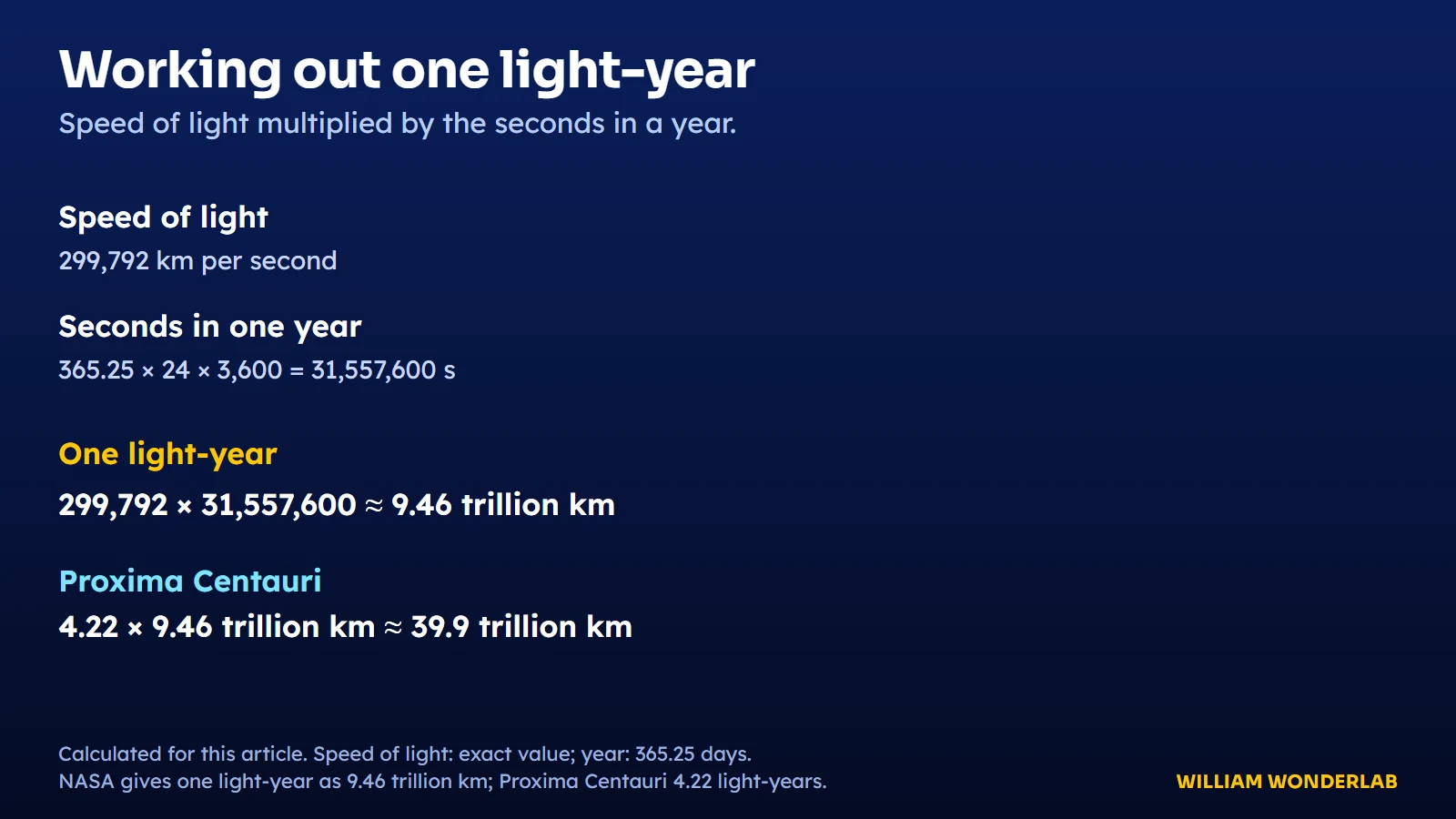
You can check the 9.46 trillion kilometres yourself. You need two numbers: the speed of light and the number of seconds in a year.
- Speed of light: NASA gives it as 300,000 km per second, a rounded figure.[3] The calculation below uses the standard exact value, 299,792.458 km per second. NIST gives the exact value as 299,792,458 metres per second.[4]
- Seconds in a year: 365.25 days × 24 hours × 3,600 seconds = 31,557,600 seconds.
Multiply them together:
- 299,792.458 km/s × 31,557,600 s ≈ 9,460,730,000,000 km
- That is 9.46 trillion kilometres, the same figure NASA gives for one light-year.
Proxima Centauri: the nearest star
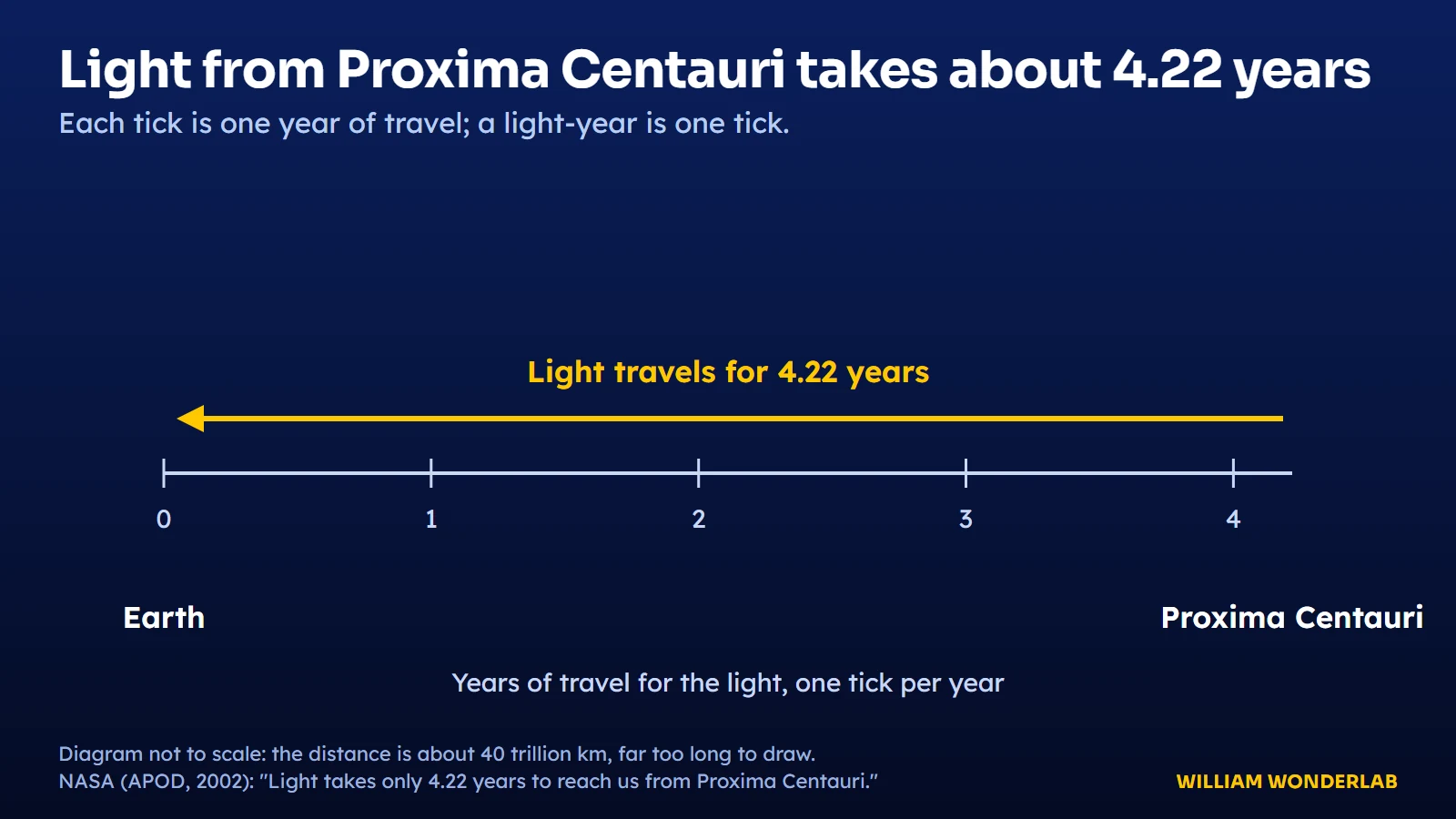
NASA describes Proxima Centauri as “the nearest member of the Alpha Centauri triple star system.”[2] NASA’s Astronomy Picture of the Day says that “light takes only 4.22 years to reach us from Proxima Centauri.”[2]
So the light you would see from Proxima Centauri has been travelling for more than four years before it reaches your eyes. NASA’s Science page puts it simply: “A little more than four light-years away.”[3] ESO says that “at a distance of only 4.2 light-years, Proxima Centauri is the nearest star to the Sun currently known.”[5]
Turning light-years into kilometres
Here is the calculation for Proxima Centauri. Take the 4.22 years of light travel and multiply by the distance light covers in one year:
- 4.22 light-years × 9.46 trillion km per light-year ≈ 39.9 trillion km
That is about 40 trillion kilometres. In miles, 39.9 trillion km ÷ 1.609 ≈ 24.8 trillion miles. This is our calculation, from the cited figures for the speed of light and the 4.22-year travel time.
Why light-years make sense
Measuring the stars in kilometres gives very long numbers, which are hard to compare. A light-year turns the same distance into a single number that describes time as well as space. If you know a star is 4.22 light-years away, you know that the light you see tonight left it more than four years ago.
Everyday examples of distance and time
Distance and time are linked in everyday life too. A sound takes a moment to reach you across a sports field. In the same way, starlight arrives after a delay that depends on the star’s distance. These are analogies to help picture the idea, not measurements of starlight.
NASA’s wording helps to see the link: a light-year is “the distance light travels in one Earth year,”[1] so a star 4.22 light-years away sends light that takes 4.22 years to arrive.[2]
Try it: a light-travel timer
This is a proposed at-home activity that shows the idea of travel time, using a stopwatch. It uses a short distance, not a real light-year.
You need: a stopwatch or phone timer, a torch, and a clear, open space such as a hallway or garden at night.
- Predict how long a torch beam takes to reach a wall about 10 metres away.
- Switch the torch on at the same moment you start the timer, and point it at the far wall. Stop the timer when the spot of light lands.
- Compare your answer with your prediction. Did light take longer than you expected?
- Write down what you noticed. Why does a nearby wall seem to light up at once?
What to expect: Light is so fast that the wall lights up almost immediately, which is why this activity cannot measure the speed of light.
Safety first: Never point a torch or any light at the sky through a lens or binoculars, and never point it at anyone’s eyes. Keep the area clear of furniture and trip hazards, and go inside if the space is dark or unfamiliar. An adult should supervise.
Go deeper: why the numbers matter
Using the light-year to think about time
A light-year links distance and time. Light that leaves a star today arrives at Earth after the time that matches the distance. So when astronomers look at a star 4.22 light-years away, they see it as it was about 4.22 years ago.[2]
Checking the scale
Multiply the light-year by 4.22 and you get about 40 trillion kilometres, as the calculation above shows.
Frequently asked questions
What is a light-year?
The distance light travels in one Earth year. It is about 9.46 trillion kilometres.[1][3]
Is a light-year a measure of time?
No. It measures distance, although it is based on a year of travel time.[1]
How far away is the nearest star?
Proxima Centauri is about 4.22 light-years away, which is about 40 trillion kilometres.[2]
Why do stars twinkle if they are so far away?
That is a different question. You can read about it in Why Do Stars Twinkle?
Do we see stars as they are now?
Not exactly. Their light takes time to reach us, so we see them as they were when the light left.[2]
The big idea
Light takes time. Stars are measured in light-years, the distance light travels in one year. The nearest star is about 4.22 light-years away, so its light is more than four years old when it reaches us.
Related reading
More from William Wonderlab:
Explore more from scientists:
References
[1] NASA Space Place, “What Is a Light-Year?” (accessed 25 October 2026)
[2] NASA Science, “APOD: 2002 July 15 – Proxima Centauri: The Closest Star” (accessed 25 October 2026)
[3] NASA Science, “What is a light-year?” (accessed 25 October 2026)
[4] NIST, “Fundamental Physical Constants: speed of light in vacuum, c” (accessed 25 October 2026)
[5] European Southern Observatory (ESO), “How Small are Small Stars Really?” (press release eso0232) (accessed 25 October 2026)