What Causes the Aurora Australis?
The aurora australis, or southern lights, is caused by charged particles from the Sun that follow Earth's magnetic field and make gases in the upper atmosphere glow.
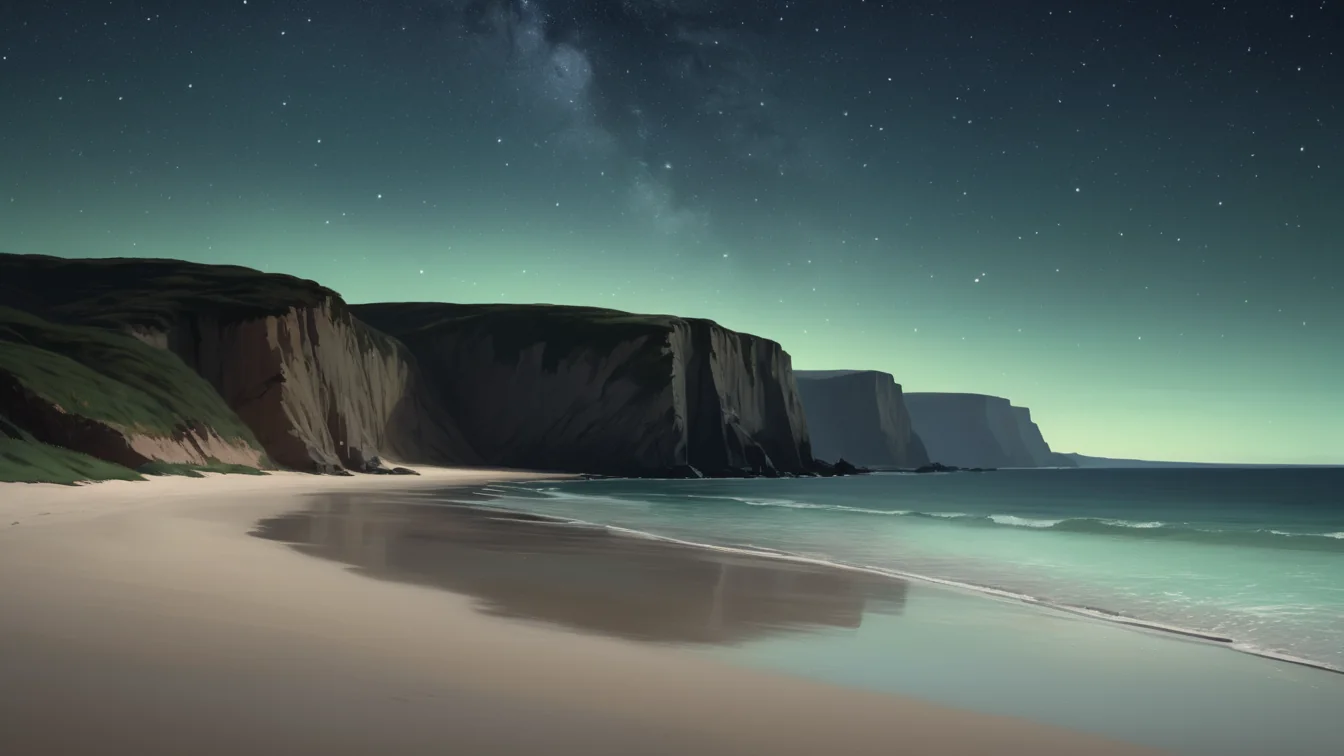
On a very dark night near the bottom of the world, the sky can shimmer with green, and sometimes red, light. This is the aurora australis, also called the southern lights. It is not clouds, and it is not a fire in the sky. It is the sky itself, glowing.
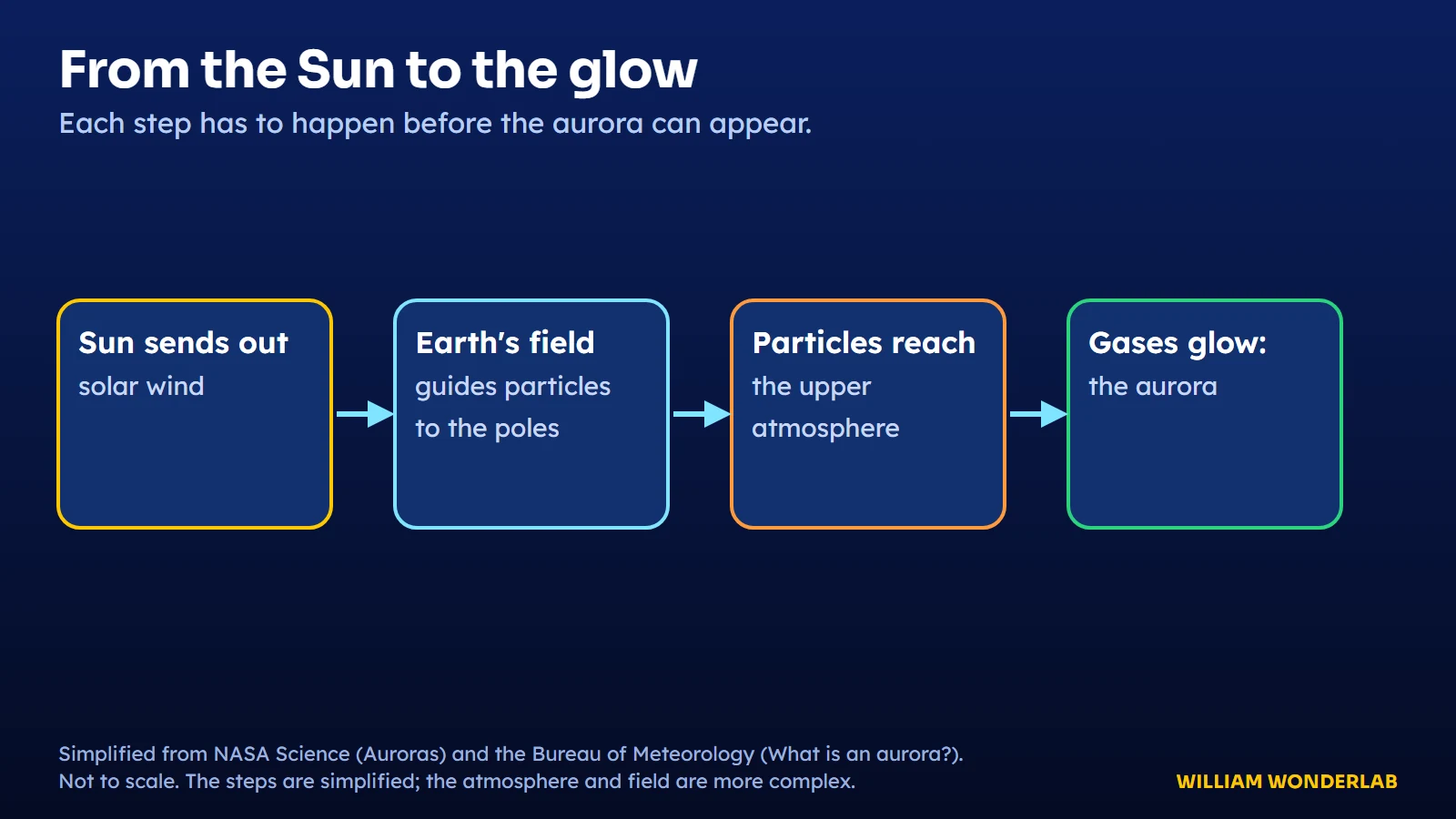
The short answer: The Sun constantly sends out charged particles called the solar wind. Earth’s magnetic field guides some of them towards the poles, where they crash into gases in the upper atmosphere. Those gases glow, and the glow is the aurora.[1][2]
Charged particles from the Sun
NASA explains that “the Sun continuously produces an outflow of charged particles into the solar system known as the solar wind.”[1] These particles are electrically charged, which means they respond to magnetic fields.
Earth’s magnetic shield
Earth has a magnetic field, and it acts like a shield. The Bureau explains that “the interaction of the solar wind with this magnetic field creates a protective cavity called the magnetosphere.”[2] Most of the solar wind is pushed around the planet rather than hitting the ground.
Some particles still get in, mainly near the poles, and reach the upper atmosphere. NASA says that auroras “usually happen where a planet’s magnetic field lines meet its atmosphere.”[1]
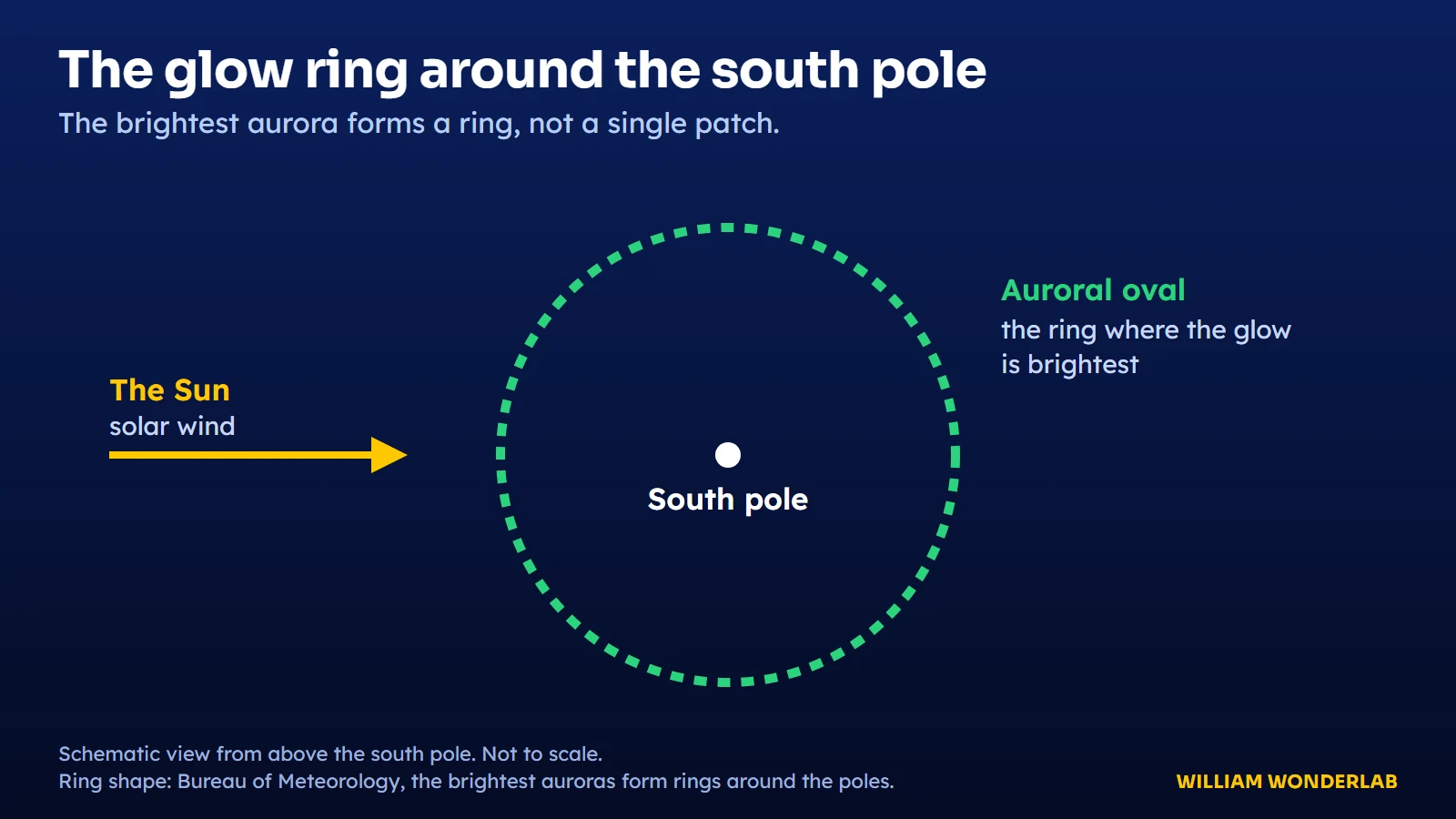
The Bureau notes that “the brightest auroras are concentrated in rings, called the auroral ovals, around the north or south poles.”[2] NASA calls the southern form the “southern lights (aurora australis).”[1]
Where the colours come from
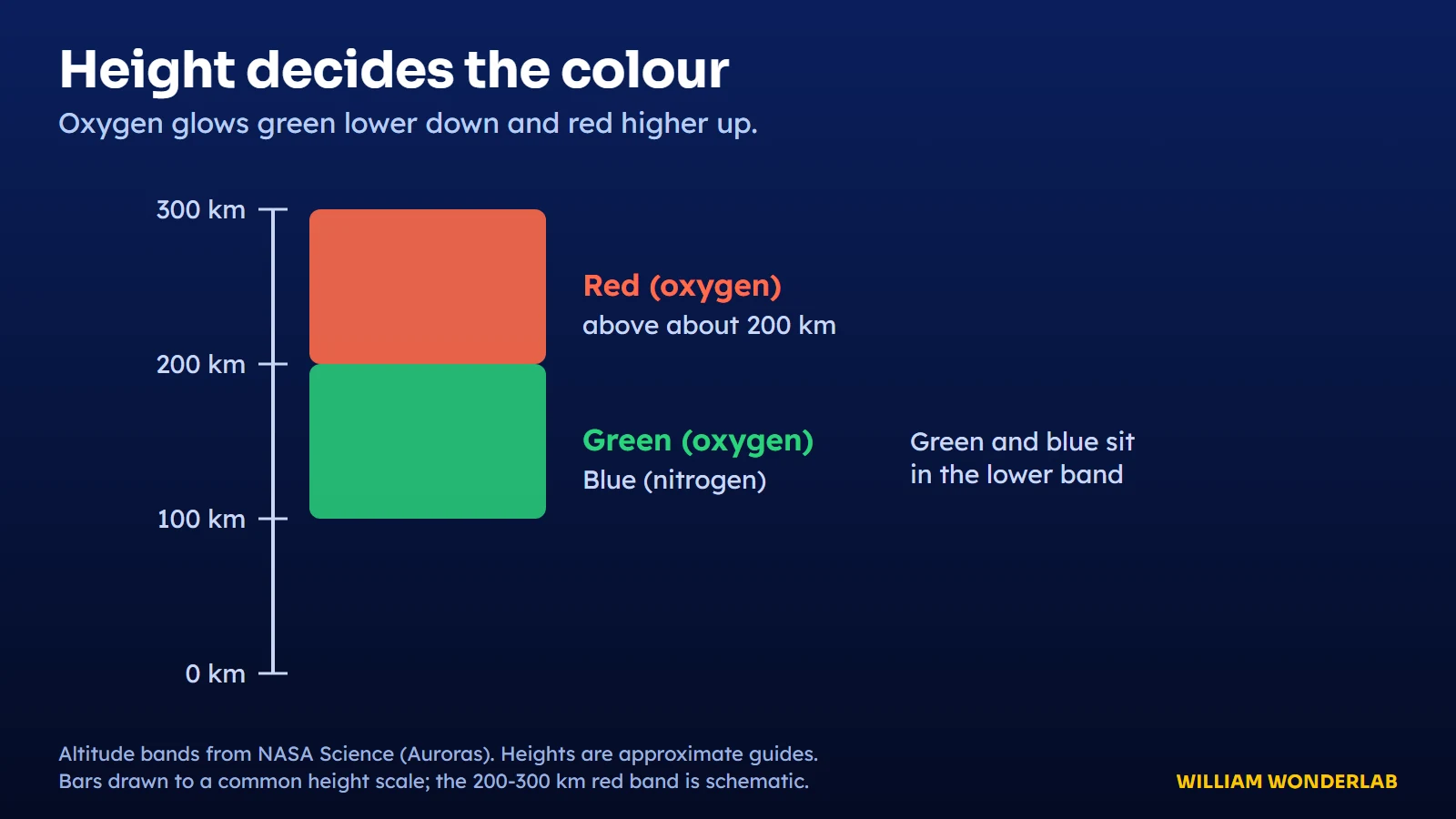
In the upper atmosphere, NASA says that “oxygen excited to different energy levels can produce green and red.”[1] Nitrogen can also glow: “excited nitrogen gas from about 60 to 120 miles (100-200 km) glows blue.”[1]
Green and red come from oxygen, and blue from nitrogen. Purple and pink come from mixing. NASA adds that “the light emitted by these gases can appear to mix, making the auroras seem purple, pink, or even white.”[1]
Height decides the colour
Where the glow happens matters. NASA gives the altitudes: “Green occurs roughly between 60 to 120 miles (100-200 km) altitude, and red occurs above 120 miles (200 km).”[1] So the green glow sits lower, and the red glow sits higher in the sky.
The Bureau’s blog says oxygen releases “greenish-yellow or red light, while nitrogen releases dark red or blue light.”[2] That wording differs from NASA’s on the nitrogen colour, so this article follows NASA for the colours and labels the difference here.
Will you see it in Australia?
Seeing the aurora depends on solar activity. The Bureau’s aurora page says that “the larger the K index, the greater the chance of seeing an aurora at lower latitudes.”[3] A stronger event can therefore make the glow visible further from the poles.
The Australian Antarctic Division says that “Tasmania is the Australian state from which the aurora australis is most commonly seen,” because “it is closest to the normal location of the auroral oval.”[4] It adds that the chance of seeing an aurora in Tasmania “on a clear night, averages out at around 1% to 2%,” and that this “is strongly correlated with the sunspot cycle.”[4] So Tasmania is a good place to look, but the odds on any one night are low.
Two names for one glow
The aurora has two names, depending on the hemisphere. NASA notes that it is “also known as the northern lights (aurora borealis) or southern lights (aurora australis).”[1] The two forms come from the same process at opposite poles. The name “aurora australis” is simply the southern version.
Everyday example: a neon sign glows when electricity passes through the gas inside it. The aurora is different, because the energy comes from the Sun and the gases are high in the atmosphere, but the idea that gases glow when energy hits them is similar. This is an analogy, not a full explanation.
Try it: the aurora forecast check
This is a proposed at-home activity and uses an official forecast, not a real aurora sighting.
You need: a computer or phone with internet access, and a parent or teacher to help.
- Predict whether an aurora could be seen where you live this week.
- Find the Bureau of Meteorology’s Australian Space Weather Forecasting Centre site, and look at the aurora or K-index information.
- Write down the K-index value shown, and what the site says about where an aurora may be visible.
- Compare the result with your prediction and with the sky on the night.
What to expect: Forecasts change quickly. A higher K index means a better chance of an aurora at lower latitudes, but the sky still needs to be dark and clear.
Safety first: Do not stay out in the cold or dark alone. Go out with an adult and tell someone where you are going. Keep to paths and open areas that are safe, and never walk near cliffs or the water’s edge in the dark. Never look straight at the Sun, and never use a camera or binoculars to look at it.
Go deeper: the physics in steps
A chain of steps
The aurora is the end of a chain: the Sun sends out particles, Earth’s magnetic field guides some of them, and they reach the atmosphere. The chain is shown in the diagram below.
Why the poles?
NASA says auroras usually happen where the magnetic field lines meet the atmosphere, near the poles.[1] The auroral ovals sit around both poles, so the southern ovals are the source of the aurora australis.[2]
Frequently asked questions
What is the aurora australis?
The southern lights, a glow in the sky caused by charged particles from the Sun meeting Earth’s atmosphere near the south pole.[1][2]
Why is the aurora green?
Oxygen in the upper atmosphere produces green light at about 100 to 200 km altitude.[1]
Why do some auroras look red?
Oxygen also produces red light, which NASA places above about 200 km.[1]
Is the aurora a fire or clouds?
No. It is light given off by gases in the upper atmosphere.[1]
Does the aurora happen every night?
No. It depends on solar activity and on dark skies. The Bureau’s K-index shows how likely it is at lower latitudes.[3]
The big idea
The Sun paints the sky, and Earth’s field steers the paint. Solar particles follow the magnetic field to the poles, where they make oxygen and nitrogen glow.
Related reading
More from William Wonderlab:
Explore more from scientists:
References
[1] NASA Science, “Auroras” (accessed 25 October 2026)
[2] Bureau of Meteorology, “What is an aurora?” (accessed 25 October 2026)
[3] Bureau of Meteorology, Australian Space Weather Forecasting Centre, “Aurora” (accessed 25 October 2026)
[4] Australian Antarctic Division, “Aurora” (accessed 25 October 2026)