Why Do We Only See One Side of the Moon?
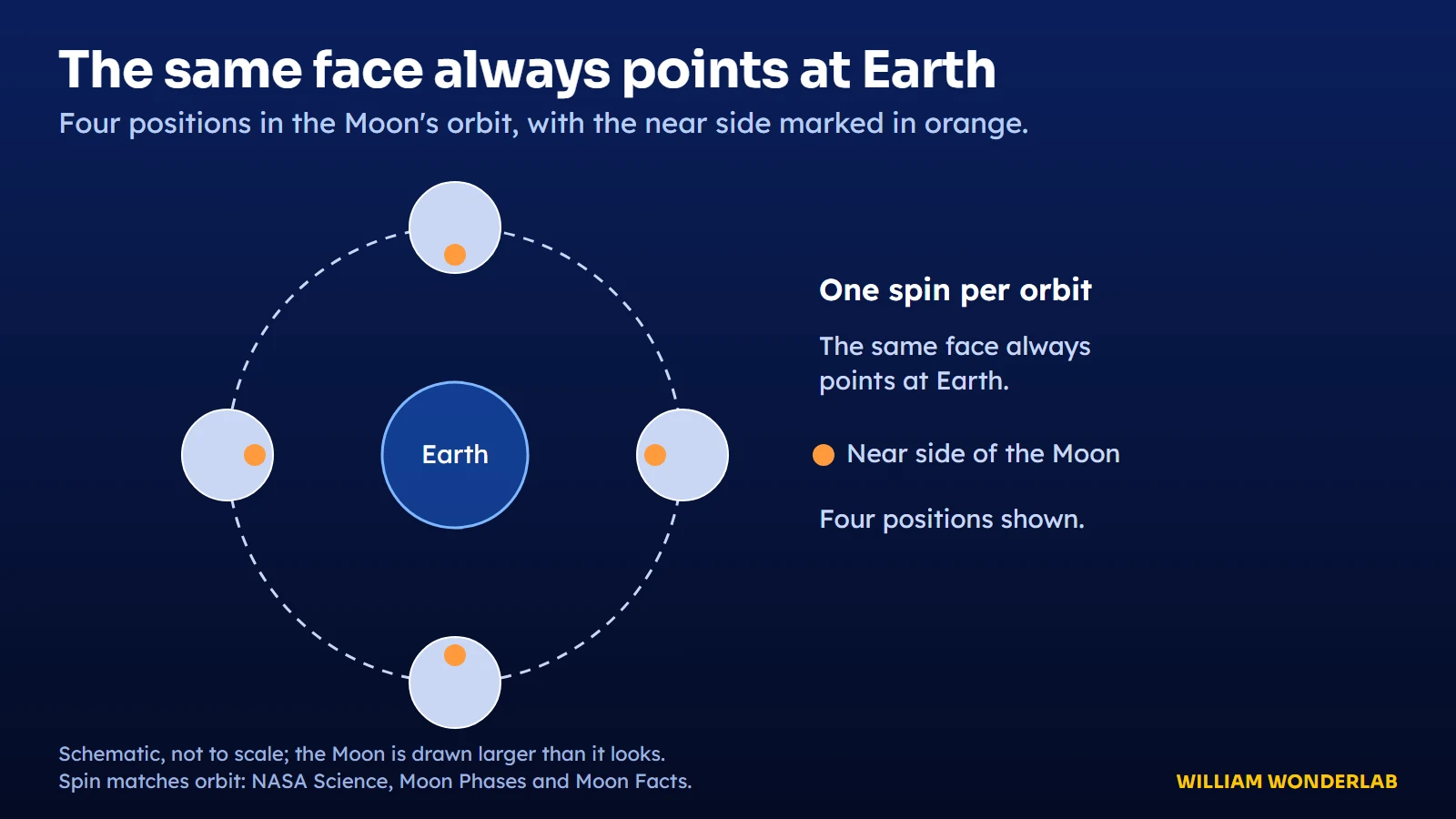
The Moon spins exactly once each time it orbits Earth, so the same face always points our way. Scientists call this tidal locking.

Every night the Moon rises, sets and changes shape, but the face we see looks much the same from one month to the next. Patterns of dark and light always sit in the same places. So why does the Moon keep one face turned towards us, while the other side stays hidden?
The short answer: The Moon spins on its axis exactly once each time it orbits Earth. Because the spin and the orbit match, the same side always faces us. This is called tidal locking, and Earth’s gravity is what caused it.[1][3]
The spin and the orbit match
NASA’s Moon Phases page says that “the Moon is tidally locked with Earth, which means that it spins on its axis exactly once each time it orbits our planet.”[1] NASA’s Moon Facts page puts it another way: “The Moon is rotating at the same rate that it revolves around Earth,” so “the same hemisphere faces Earth all the time.”[2]
A simple way to picture it is a set of two clocks running at the same speed. They stay in step. If one ran a little faster, the two would drift apart. The Moon’s spin and its trip round Earth stay in step in the same way.
How Earth’s gravity locked the Moon
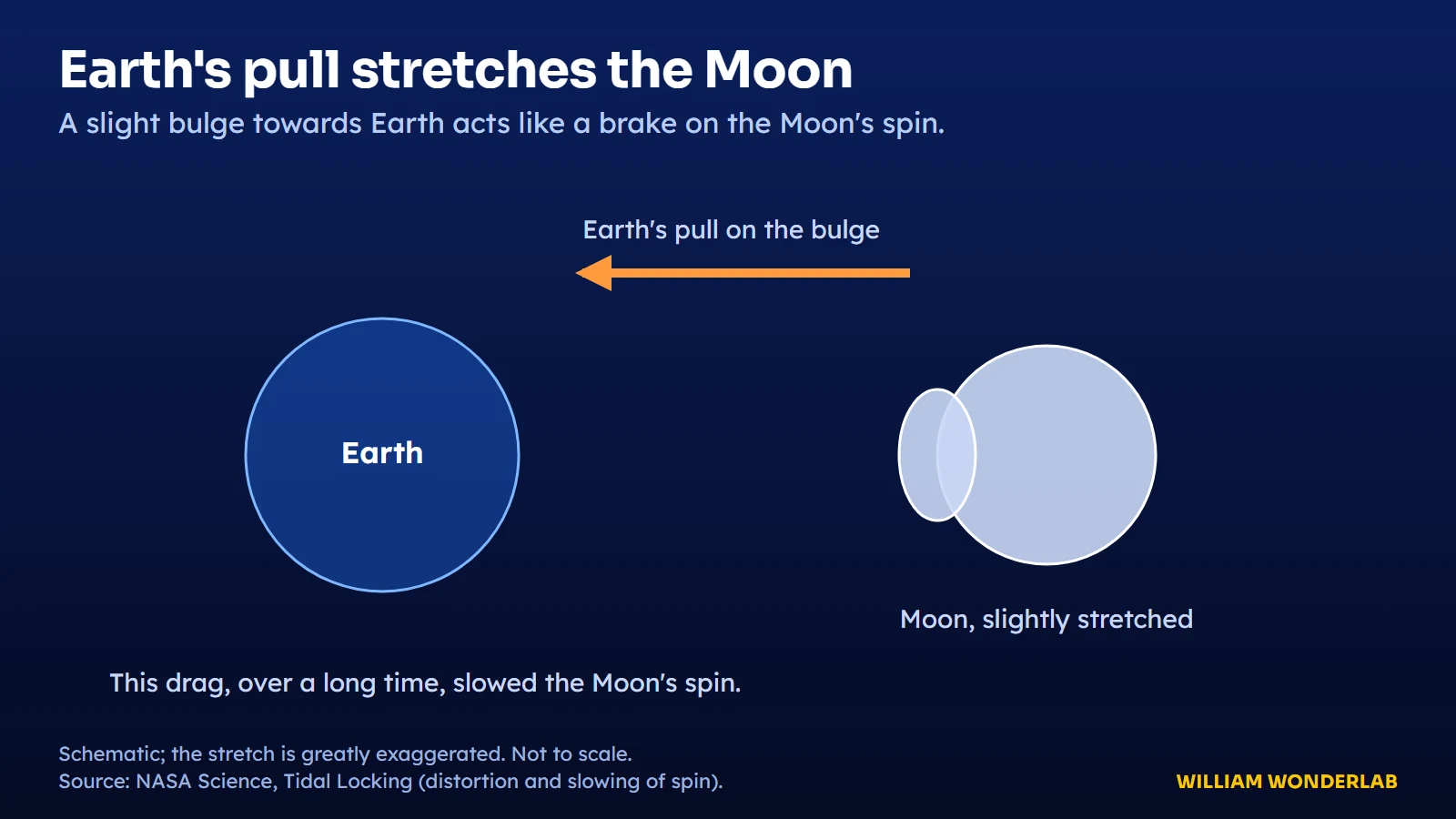
Earth’s gravity stretches the Moon very slightly, creating a bulge of rock that is pulled towards Earth. NASA’s Tidal Locking page explains that this distortion “would have been much more dramatic when the Moon was both closer to Earth and less solid.”[3] In other words, the effect was strongest in the Moon’s early history.
Over time, the bulge tugged on the Moon’s spin like a brake. NASA says that “the Moon’s rotation slowed until a single spin on its axis took the same amount of time as one trip around Earth.”[3] Once the two times matched, the bulge stopped sliding around, and the Moon kept the same face towards us.
Why we see slightly more than half
Although one side always faces Earth, we do not see exactly half of the Moon at all times. NASA’s Moon Viewing Tips describes a wobble called libration. Parts of the Moon near the edge of the disk “come into view at some times but not others.”[4]
Because of libration, observers can see a little more than half the Moon over time. NASA says that “experienced observers can take advantage of favorable librations to see about 59 percent of the lunar surface.”[4] The wobble does not change the fact that the Moon is locked, so the side we see stays much the same.
The far side is not dark
The side of the Moon we cannot see from Earth is often called the dark side. NASA’s StarChild page explains why the name is misleading. “The side of the Moon we do not see from Earth gets just as much sunlight on it as the side we do see.”[5] The page adds that “the only dark side of the Moon is the side that is pointed away from the Sun at any given time.”[5]
So the hidden side is not permanently dark. It is simply turned away from us. People first saw it when a Soviet spacecraft flew past in 1959, according to NASA.[2]
Try it: the chair walk
This is a proposed at-home activity that copies the Moon’s motion. Use an empty space in a room.
You need: a sturdy chair with no sharp edges, a clear floor with nothing to trip over, and a friend to sit on the chair.
- Put the chair in the middle of the space. Your friend sits on it, which stands in for Earth.
- Stand a few steps from the chair, facing it. You are the Moon.
- Walk slowly in a circle around the chair. As you move, turn your body once for each full lap, so that your face always points at the chair.
- Ask your friend what they can see of you. Then try walking a lap without turning, and compare.
What to expect: When you turn once per lap, your friend only sees your face. When you do not turn, your friend sees your back as well. The turning is the same kind of spin the Moon does.
Safety first: Do this with an adult or a friend nearby, and move slowly so you do not bump into the chair or the wall. Keep the floor clear of cords, toys and rugs. Stop and sit down if you feel dizzy. Never stand on the chair or use it as a step, and never use a chair with a broken or loose leg.
Go deeper: spin, orbit and a tidal clock
Two rates that agree
The Moon is a good example of a rule called tidal locking, where a body’s spin takes the same time as its orbit around a partner. The same gravity-driven process is the reason the Moon’s spin and orbit match, and it acts slowly over a long time.[3]
What a mismatch would do
Imagine a hypothetical Moon that spins a little faster than it orbits. Its face would slowly sweep past us, and we would see different parts of its surface over the months. Because the real Moon’s spin and orbit match, the sweep does not happen. What we actually notice is the small wobble of libration, not a sweep.
Frequently asked questions
Does the Moon spin at all?
Yes. It spins exactly once each time it orbits Earth. That matching spin is why the same face stays turned towards us.[1]
Is the far side of the Moon always dark?
No. The side we cannot see gets as much sunlight as the side we can see. Only the side pointing away from the Sun is dark at any given time.[5]
Has anyone seen the far side?
Yes. Humans first saw it when a Soviet spacecraft flew past in 1959.[2]
What causes tidal locking?
Earth’s gravity. It stretched the early Moon, and the resulting drag slowed its spin until the spin matched its orbit.[3]
Can we see the whole Moon from Earth?
Not at once. Libration lets observers see about 59 per cent of the surface over time.[4]
The big idea
The same face, because spin matches orbit. Earth’s gravity slowed the Moon’s spin until one turn matched one trip round Earth. The Moon still turns, but it keeps the same face towards us.
Related reading
More from William Wonderlab:
- Why Does the Moon Look Bigger Near the Horizon?
- Why Does the Moon Change Shape?
- What Causes a Solar Eclipse?
Explore more from scientists:
References
[1] NASA Science, “Moon Phases” (accessed 25 October 2026)
[2] NASA Science, “Moon Facts” (accessed 25 October 2026)
[3] NASA Science, “Tidal Locking” (accessed 25 October 2026)
[4] NASA Science, “Moon Viewing Tips” (accessed 25 October 2026)
[5] NASA StarChild, “The Dark Side of the Moon” (accessed 25 October 2026)
Keep exploring
Now try the science yourself
Reading is a great start. Experimenting is even better: these interactive models use the same science as this article.