How Does a Submarine Dive and Come Back Up?
A submarine dives by letting seawater into its ballast tanks and rises by blowing compressed air in to push the water out. The key is buoyancy.
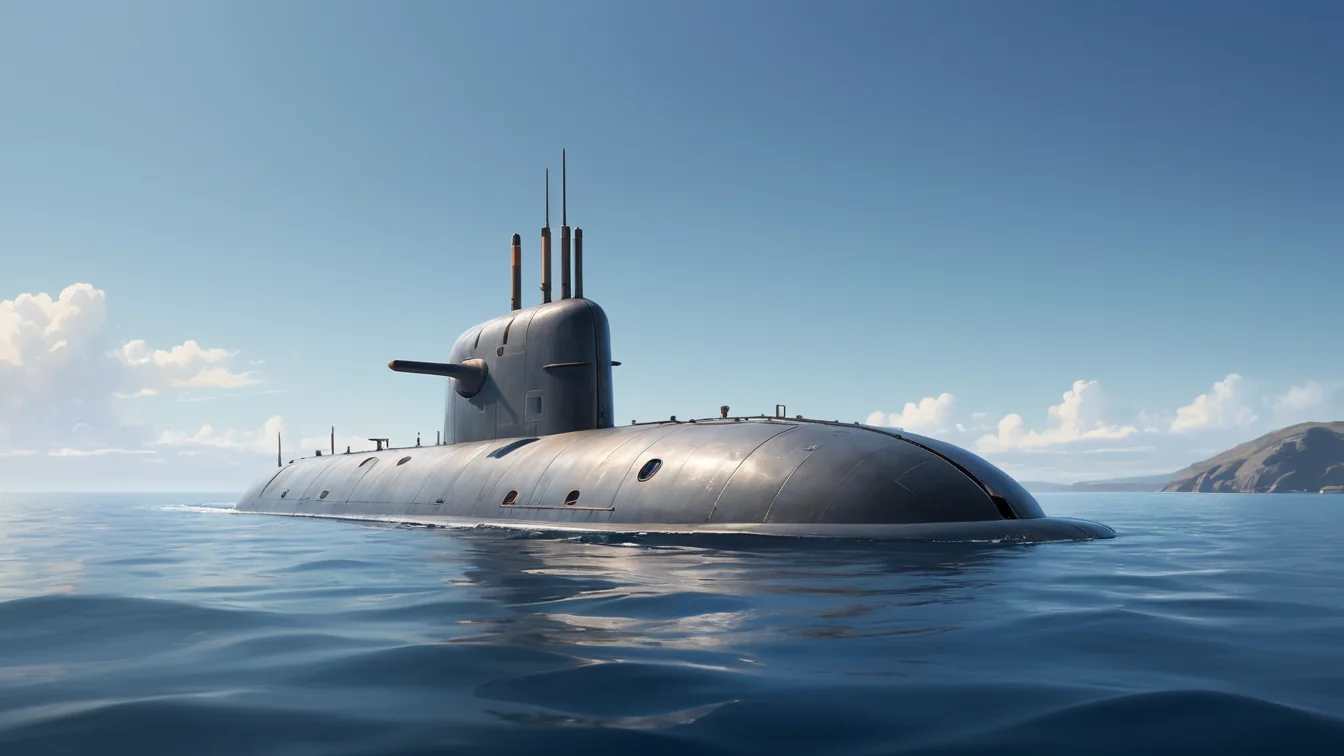
A large submarine can slide below the waves, sit quietly at depth and then rise back to the surface, all without an engine pushing it up. How does a heavy metal boat choose whether to sink or float?
The short answer: A submarine controls its buoyancy with ballast tanks. Letting seawater into the tanks makes the submarine heavier, so it sinks. Pushing compressed air into the tanks forces the water out, so the submarine becomes lighter and rises.[1][2]
Floating depends on weight and water pushed aside
Buoyancy is the upward push that a fluid gives to anything placed in it. The Greek thinker Archimedes described the idea long ago, and NASA’s buoyancy lesson states it this way: “the buoyant force on a submerged object is equal to the weight of the fluid that is displaced by the object.”[3]
Put simply, the water pushes up on an object with a force equal to the weight of the water the object moves out of the way. If the object weighs more than that water, it sinks. If it weighs less, it rises. HyperPhysics says that the result depends on “the comparison of that buoyant force with the weight of the object.”[4]
Ice works the same way. Ice is less dense than water, so it floats. You can read more in Why Does Ice Float?
Ballast tanks are the submarine’s water tanks
A submarine is built so that it can change its weight on purpose. Its ballast tanks are sealed spaces that can hold water or air. MIT’s ocean engineering notes say that ballast tanks “take in and expel seawater, changing a vessel’s buoyancy and thereby enabling it to vary its depth.”[1]
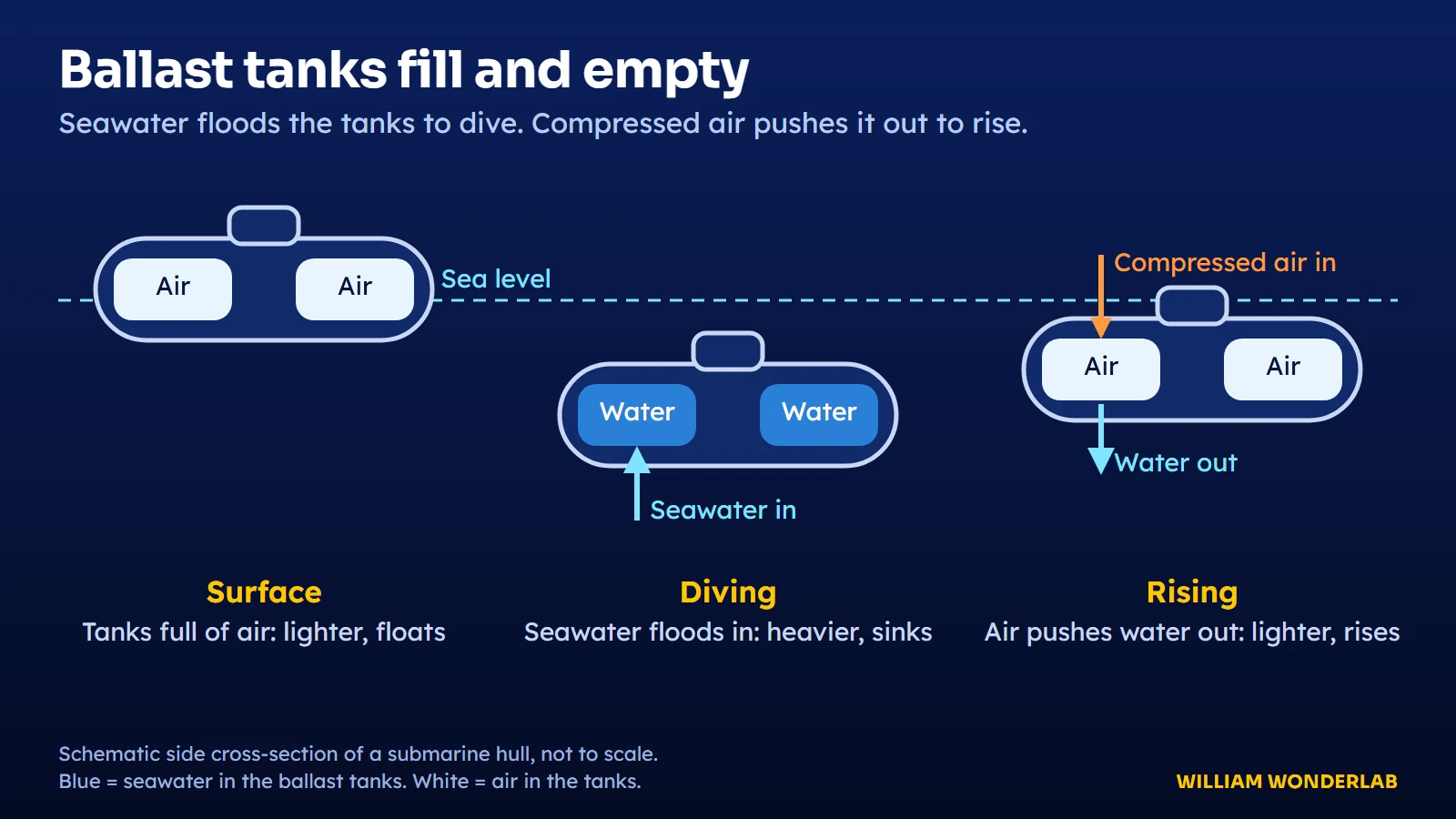
When the tanks are empty of water and full of air, the submarine is lighter, so it floats on the surface. When the tanks are full of water, the submarine is heavier, so it sinks.
Diving: let the water in
To dive, the crew opens valves that let seawater flow into the ballast tanks. The water adds weight to the submarine, so its total weight becomes more than the weight of the water it pushes aside. Gravity then pulls it down.
In a simple model, the submarine sinks as soon as its total weight is larger than the upward push of the water around it.
Surfacing: push the water out
To come back up, the submarine blows the water out of its ballast tanks. MIT’s notes describe the process: “To expel sea water, compressed air at high pressure is released into the tanks.”[1]
A second MIT page says that “Main way to empty variable ballast tanks of water is compressed air.”[2] Once the water is out, the tanks hold mostly air, and the submarine is light enough to rise.
Did you know? MIT’s course notes describe water ballast in shallow-water submersibles, which work at depths of less than about 2,000 feet.[2] The notes do not describe large submarines in detail.
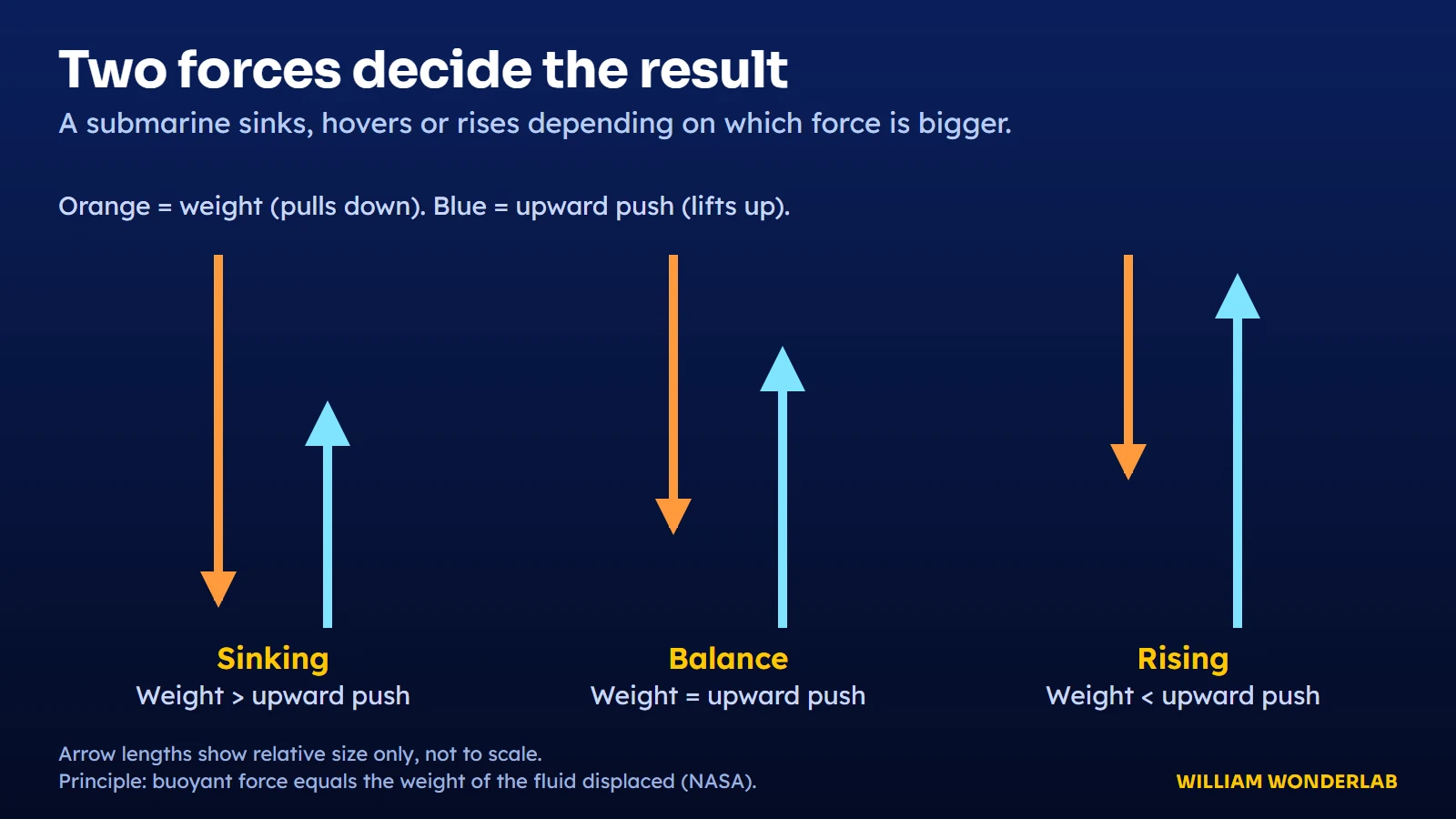
The diagram shows the two states. The weight and the upward push are equal at the balance point. A small change in the amount of water tips the balance one way or the other.
Staying at one depth
A submarine does not need to sink or rise to stay at a set depth. The MIT robotics notes say that the depth of a vessel changes when the amount of water in the ballast tanks changes, and that “dense objects sink in fluids with lower densities.”[1] In plain words, a heavy object sinks when it is denser than the water around it. The same principle means that a balance point can be found where the submarine neither rises nor sinks.
Try it: a sinking and rising dropper
This is a proposed at-home activity. It is a simplified model of ballast tanks, not a real submarine experiment.
You need: a clear plastic drink bottle filled with water and a sealed lid, a small plastic eye dropper or pipette, and an adult to help.
- Predict what the dropper will do when you squeeze the bottle.
- Fill the dropper partly with water, leaving a small bubble of air inside. Place it in the bottle so it floats near the top. Screw the lid on tightly.
- Squeeze the bottle gently and watch the dropper.
- Release the bottle and watch again. Write down what happened each time.
What to expect: Squeezing pushes water into the dropper and makes it heavier, so it should sink. Releasing lets the air push the water back out, so it should rise.
Safety first: Use a plastic bottle only. Do not use glass. Keep the lid on tight, and squeeze gently so the bottle does not crack. Keep the dropper and any small parts away from young children, because they can be a choking hazard. Never swallow or taste the water or the parts. Wipe up spills at once so no one slips. An adult should help.
Go deeper: density and buoyancy
Density in short
Density is the mass of a material in a given volume. A submarine sinks when its average density is greater than the water around it. It rises when its average density is less. Changing the amount of air or water in the tanks changes the average density.
Why this is a good example of engineering
The submarine changes its density without changing its shape. This is a clear example of how engineers can control an object’s weight and buoyancy on purpose.
Frequently asked questions
Why does a steel submarine float at all?
A submarine is shaped and built so that its overall average density can be lower than seawater when the tanks are full of air. The Archimedes principle explains the upward push.[3]
What are ballast tanks?
Ballast tanks are spaces inside the submarine that take in seawater or air. Changing the amount of water changes the submarine’s buoyancy.[1]
How does a submarine rise?
Compressed air is released into the tanks to push the water out. The submarine then becomes lighter and rises.[1][2]
Can a submarine just sit at one depth?
Yes. By adjusting the amount of water in its tanks, a submarine can reach a balance point at a chosen depth.[1]
Is the water in the tanks different from the sea?
MIT’s notes say that seawater taken into the tanks “is of the same density as the surrounding water.”[1] The change in weight comes from the amount of water, not from a change in what the water is.
The big idea
Heavier to sink, lighter to rise. A submarine uses seawater and compressed air in its ballast tanks to change its weight. That changes the balance between its weight and the upward push of the water.
Related reading
More from William Wonderlab:
Explore more from scientists:
- Ballast tanks and buoyancy (MIT, robotics course notes)
- The Archimedes principle (NASA Glenn Research Center)
- Buoyancy (HyperPhysics, Georgia State University)
References
[1] MIT, course notes (Robotics), “Ballast tanks” (accessed 25 October 2026)
[2] MIT, “Ballasting and Trim Systems” (course notes, pg. 279) (accessed 25 October 2026)
[3] NASA Glenn Research Center, “Buoyancy: Archimedes Principle” (accessed 25 October 2026)
[4] HyperPhysics, Georgia State University, “Buoyancy” (accessed 25 October 2026)